Every week for nearly two months, the same boy walked into Hancock Fabrics on Abercorn Street and did the exact same thing.
He didn’t browse.
He didn’t ask for help.
He walked straight to the third aisle, reached up to the middle shelf, and picked up a single spool of dusty-rose thread.
Then he just… held it.
—
My name is Loretta Mae Hutchins. I’ve been sewing since I was nine years old, and I’ve worked part-time at that fabric store since my husband Earl passed four years ago. I know every bolt of cloth, every button card, every customer who comes through that door.
But I could not figure out this boy.
He looked about sixteen, maybe seventeen. Always in the same gray hoodie, even in the Savannah heat. Polite — Lord, was he polite. If he bumped your cart, he’d apologize twice. But he never made eye contact for long, and he never once brought that spool to the register.
He’d hold it for a few minutes, run his thumb across the label, then set it back down.
Same shelf. Same spot. Like he was tucking it in.
—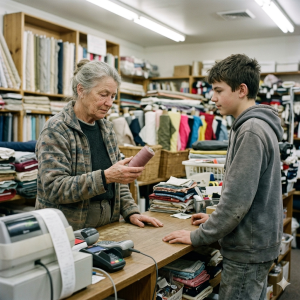
I started watching for him on Tuesdays.
I’ll admit, at first I thought maybe he was up to something. You watch enough people handle merchandise without buying, you get suspicious. But there was nothing sneaky about this child. He wasn’t hiding anything. If anything, he looked like he was the one trying not to be seen *feeling* something.
One Tuesday I drifted closer, pretending to restock the bias tape nearby.
That dusty-rose thread — it wasn’t even a popular color. We had twelve spools of it gathering a little dust on the shelf. It was a soft, warm pink. The color of the inside of a seashell. The kind of color a woman chooses when she’s making something tender.
He picked it up the same way every single time.
Both hands. Carefully. Like it was made of glass.
—
I don’t know exactly when it stopped feeling strange and started feeling sacred.
Maybe the fifth Tuesday. Maybe the sixth.
But I found myself looking forward to seeing him come through that door. Found myself relieved when he walked to that third aisle and the spool was still sitting right where he’d left it the week before.
I started making sure it was.
Once, another customer had moved it two shelves down. I put it back before he arrived.
I’m not sure I could explain why, even now.
—
Last Tuesday, I made a decision.
I got to the store early. I talked myself into it and then out of it and then back into it again while I restocked the zipper wall. By the time that gray hoodie came through the door, I had made up my mind.
I watched him do what he always did.
Both hands. Careful. That long quiet moment.
Then he set it back down, smoothed the label with his thumb, and turned to go.
I walked over, picked up the spool, and brought it to the register myself.
“I’d like to buy this,” I told Sandy, our cashier.
I was going to leave it at the courtesy desk with a little note. Nothing fancy. Just — *This is yours. No reason needed.*
But Sandy looked at the spool, and then she looked at me, and something crossed her face that I wasn’t expecting.
She didn’t scan it right away.
She glanced toward the door where the boy had just walked out, and then she leaned across the counter and lowered her voice.
“Loretta,” she said, “you know that spool’s been special-ordered for months.”
I told her I didn’t know that.
Sandy set it down gently between us, the same way *he* always did, and she said —
*”His mama put it on hold before she passed. He just comes in to make sure it’s still here.”*
The store went quiet around me.
Or maybe that was just me.
I stood there holding my purse, looking at that little spool of dusty-rose thread, and every single Tuesday I’d ever watched that boy suddenly looked completely different.
Every careful drive of his thumb across the label.
Every time he set it back in the exact same spot.
He wasn’t thinking about buying it.
He was visiting it.
—
I asked Sandy to tell me everything she knew, and she did, quietly, glancing at the door every so often like she was keeping watch.
The mother’s name was Delia. Sandy had known her — not well, but the way you know a regular. She’d come in a few times a year, always knew what she wanted, always had a project going. A woman who sewed the way some people pray. Steadily and with intention.
About eight months ago, Delia had come in and ordered that specific spool. Dusty rose, a particular brand, a particular weight. She’d paid for it in full and asked Sandy to hold it.
She said she was making a quilt.
She said it was for her son, for when he went off to college. She wanted him to have something she’d made with her own hands. Something warm.
Sandy said she seemed tired that day, but happy. The kind of happy that lives right alongside something hard.
She never came back to pick it up.
Sandy found out a few weeks later, the way you find out things in a place like Savannah — through a customer who knew a neighbor who knew the family. Delia had been sick for a while. Longer than most people knew. She passed in October.
The boy started coming in that November.
—
Sandy had never approached him. She didn’t know if he knew the spool was there by name, or if he’d somehow just found it — if maybe his mother had mentioned the store, the color, the project. She didn’t know what he knew or didn’t know, and she hadn’t wanted to cause him pain by bringing it up.
So she’d just let him come.
And she’d made sure, same as me, that the spool was always where he expected it.
We had both been keeping the same quiet vigil without knowing it.
I left the spool on the counter and I went out after him.
—
He was in the parking lot, cutting across toward the sidewalk on Abercorn, hands in the front pocket of that hoodie. The afternoon was thick and warm the way Savannah gets in September, the Spanish moss hanging perfectly still.
I’m sixty-three years old and I was not built for speed, but I called out, “Excuse me, honey,” and he stopped.
He turned around and looked at me, and up close — Lord, up close he was so young. He had his mother’s tired-happy look, I think, though I never met her. Or maybe that’s just what grief looks like on a young face. Like being older than you should be, and knowing it.
I didn’t have a speech prepared. I thought I did, but it left me completely.
I just said, “I work in the store. I’ve seen you come in on Tuesdays. I know about the spool your mama ordered.”
He went very still.
I kept going because stopping felt worse. “I know she put it on hold. I know what it was for.”
He looked down at his sneakers. He nodded once, barely.
“I just wanted you to know,” I said, “that we’ve been keeping it for you. We’re going to keep on keeping it for you. For as long as you need.”
He didn’t say anything for a moment. A car pulled out of the lot behind me and neither of us moved.
Then he said, real quiet, “She never told me she ordered it. I found the receipt in her sewing box after.” He paused. “I didn’t know if it would still be here.”
“It is,” I said. “It will be.”
He nodded again, and I could see him working to hold himself together, the way teenagers do, like composure is something you grip with both hands.
Then he said, “She used to let me pick the colors. When I was little. For whatever she was making.” He almost smiled. “I always picked pink. She said I had good taste.”
I had to press my lips together for a second.
“She sounds like she was a wonderful woman,” I said.
“She was.” He said it simply and completely, the way you say something that is just true and always will be.
—
We stood there another moment. Then I told him something I hadn’t planned on telling him.
I told him about Earl. About how after he passed I went back to work at the fabric store because I didn’t know what to do with my hands. How I’d needed somewhere to put them. How, four years later, I still sometimes run my fingers over a bolt of good cotton and feel steadied by it in a way I can’t fully explain.
He listened. He was a good listener, this boy.
I told him the spool would be at the register whenever he was ready. That there was no rush, no pressure, no expiration. That some things are worth holding onto until you’re ready to hold them differently.
He said, “Thank you, ma’am.”
I said, “You come back on Tuesday. You come back whenever you want.”
He said he would.
—
His name is Marcus. I know that now because he came back the very next Tuesday and introduced himself properly, the way a boy does when someone has been kind to him and he wants to honor it.
He stayed a little longer than usual. He walked the third aisle and he picked up the spool, same as always. Both hands. Careful.
But this time he brought it to the register.
He paid for it with money he’d clearly been saving — he counted it out in fives and ones and a handful of quarters, and he didn’t seem embarrassed about that, just deliberate. Like this moment deserved to be done right.
Sandy put it in a small paper bag and folded the top over twice, neat.
Marcus held the bag the same way he’d held the spool. Like it was made of glass. Like it was precious. Because it was.
Before he left, he turned around and said, “I’m going to finish it. The quilt.” He said it like a promise he was making to more than just us. “I looked up how online. It doesn’t look that hard.”
I told him it wasn’t hard at all.
I told him to come back if he got stuck.
—
He did come back. Three weeks later, on a Tuesday, with a question about how to do a proper seam on batting that thick, and I spent forty minutes with him at the cutting table going over it. He had his mother’s sewing box with him — a battered wooden thing with a little brass latch — and he’d already made a start. The squares were careful and a little uneven and completely beautiful.
That dusty-rose thread was threaded into her old needle, ready to go.
I think about Delia sometimes, a woman I never met. I think about her picking that color, paying for that spool, planning something warm for her son to carry with him when he left home. I think about how she did all of that while she was tired, while she was running out of time, while she was still trying to take care of him from whatever distance the future would demand.
Mothers do that. They tuck things in. They make sure what’s precious stays right where you can find it.
Marcus is going to have that quilt. It’s going to be a little uneven and it’s going to be all the right colors and it’s going to be the warmest thing he owns, I guarantee it.
And every stitch of it will be an act of love from someone who made sure it would be.
That’s all I wanted to say.
🌸