Every morning for six weeks, Loretta Mae Combs slid a plate of biscuits and gravy across the counter at Patsy’s Diner — and pretended it was an accident.
“Ordered too much again,” she’d say, patting her hips like they were evidence. “You’d be doing me a favor.”
The young man never said much. Just nodded. Pulled the plate close.
And then went right back to staring at that envelope.
—
Loretta had driven a school bus in Pikeville for thirty-one years. She knew kids. She knew the ones who were hungry but too proud to say so. She knew the ones who smiled so big you almost missed the hollowness behind their eyes.
This boy — he couldn’t have been more than twenty-five — had that look.
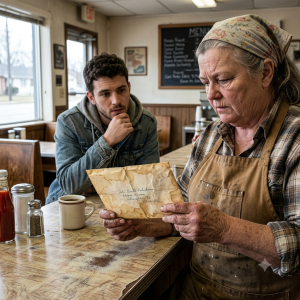
Every single day, he’d come in around 9 a.m., order a black coffee he nursed for three hours, and sit at the far end of the counter nearest the window. Always the same stool. Always the same posture — shoulders curved in, like he was trying to take up less space in the world.
And always, always, that envelope.
Small. Yellowed at the corners. Water-stained in a way that made Loretta think of rain, or maybe tears. He’d take it out of his inside jacket pocket, set it on the counter beside his mug, and smooth it flat with his thumb. Slow, careful strokes. Like he was ironing out something that couldn’t be fixed.
Then he’d tuck it back in. Stand. Leave.
He never opened it. Not once in six weeks.
—
Loretta started asking Patsy about him after the second week.
“Don’t know his name,” Patsy said, refilling the coffee machine. “Pays in cash. Tips a dollar whether he has food or not. Quiet as a Sunday morning.”
“Where do you think he’s from?”
Patsy shrugged. “Doesn’t have local plates. Car’s got Ohio tags, I think. But he’s got that Eastern Kentucky sound when he does talk.”
Loretta thought about that. A boy from somewhere close who’d driven himself far, then stopped here. At this counter. At this window.
Like he was waiting on something. Or someone.
Or maybe just gathering nerve.
—
She doubled her own lunch order starting week three.
Meat loaf on Mondays. Grilled cheese on Wednesdays. A slice of Patsy’s coconut cream pie on Fridays, because everybody deserves pie on a Friday.
“You don’t have to keep doing that,” he said one morning. First full sentence he’d ever spoken to her.
“Doing what?” Loretta said, all innocence.
He almost smiled. Almost.
She noticed his hands when he reached for the fork. Knuckles a little raw. Nails bitten short. The hands of someone who’d been living hard, or living out of a car, or both.
But he always had that envelope on him. Always.
And every day she watched him smooth it flat, and every day she wondered what was inside it that was so precious he couldn’t bring himself to read it — or so painful he couldn’t bring himself to throw it away.
—
By week six, Loretta had decided today was the day she’d ask his name.
She’d rehearsed it in her bathroom mirror that morning, which she was not embarrassed about at all.
She drove to Patsy’s. She hung up her cardigan on the hook by the door. She ordered her usual and his usual, and she walked that plate of eggs and toast right down to the end of the counter like she owned the whole state of Kentucky.
He looked up when she sat down across from him.
And Loretta, who had talked teenagers off ledges and talked parents through grief and driven her bus through ice storms without flinching, opened her mouth and said, “I don’t believe I’ve ever gotten your name.”
He looked at her for a long moment. Something moved across his face — some emotion she couldn’t quite name. Something between relief and grief, all tangled up together.
“It’s Daniel,” he said.
And then his phone buzzed, and he reached to check it — and in doing so, he knocked the envelope off the counter.
Loretta bent to pick it up before he could.
It was lighter than she expected. Just a single folded page inside, she could tell. The water stains were worse than she’d realized up close. And the handwriting on the front —
She felt the air leave her body.
She knew that handwriting.
She had watched it develop over twenty-three years, from a little girl learning to print her name in wobbly capital letters, to a woman who looped her L’s in a way that was hers and hers alone.
The name on the envelope wasn’t Daniel’s.
It was hers.
Loretta Mae Combs. Pikeville, Kentucky.
In her daughter’s handwriting.
Her daughter, who had been gone for three years.
She looked up at the boy across the counter — this quiet, hungry boy with the careful hands and the sad eyes — and he was already watching her.
Like he’d been waiting six weeks for exactly this moment.
—
For a long time, neither of them spoke.
Patsy was clattering something in the back kitchen. The bell above the door chimed twice as a couple of regulars came in for their morning coffee. The world went right on doing its ordinary things while Loretta sat there holding a piece of paper that had her dead daughter’s handwriting on the front of it, and she could not make her hands move.
“Her name was Cassie,” the boy said finally. Not a question.
Loretta’s throat closed up tight. “Cassandra Lynn,” she managed. “We called her Cassie from the day she came home from the hospital.”
He nodded like he already knew that too. Like he knew a great many things about a girl he’d never get to introduce to her mother in any normal way.
“She talked about you,” he said. “All the time. She’d say, ‘My mama drives the school bus and she knows every single kid in Pikeville by name.’ She said you used to save her a seat right behind you, even in high school, so you could hear her sing.”
Loretta pressed her lips together hard. That was true. Cassie had sung every morning of her life — in the car, in the shower, in the dairy aisle of the Kroger. She’d had a voice like something that didn’t belong in Pike County, something that belonged on a stage somewhere with good lighting.
“Where did you know her from?” Loretta asked.
Daniel wrapped both hands around his coffee mug. He looked down at it like the answer was in there somewhere.
“Cincinnati,” he said. “We both ended up there around the same time, I guess. I was working at a warehouse on River Road, and she was waitressing at this diner — not unlike this one, actually.” He glanced around Patsy’s with something soft in his eyes. “She used to say that diners were the most honest places on earth. That you could tell everything about a person by how they treated a waitress.”
Loretta almost laughed at that. Because that was Cassie, word for word.
“We were friends for about two years,” Daniel said. “Good friends. She let me crash on her couch when my apartment situation got bad. I helped her move twice. We used to watch old movies on Friday nights and she’d narrate the whole thing like a sportscaster.” He smiled at that — a real smile, quick and painful. “She was the funniest person I ever met.”
Loretta knew. Lord, she knew.
“She never told me she was sick,” he said. The smile faded. “I didn’t know until she was already — until it was near the end. She kept saying she was tired, just tired, and I believed her because we were both working too hard and not sleeping enough. By the time I figured it out, it had moved fast. Faster than anybody expected.”
Loretta had gotten the call on a Thursday morning in October. A number she didn’t recognize, a nurse’s voice, careful and practiced. Cassie had listed her as emergency contact even after three years of near-silence between them. Even after all that distance, all that stubborn quiet on both sides, she had still written her mother’s name down on that form.
Loretta had driven to Cincinnati in four hours flat. She’d made it in time to hold her daughter’s hand, but not in time for anything else. Not for the conversation she’d been rehearsing for three years. Not for the I’m sorrys that had piled up on both sides until they were too heavy to carry and too heavy to put down.
“She gave me that letter about a week before she passed,” Daniel said, nodding at the envelope still in Loretta’s hands. “She made me promise I’d get it to you. I said I would.” He looked out the window. The morning light was doing something pale and thin across the parking lot. “I meant to do it right away. I drove down here the week after the funeral. Got all the way to Pikeville, drove past your house twice, and then I just — couldn’t.”
Loretta thought about that. A boy sitting in his car outside her house. Maybe it had been raining. Maybe it had been one of those gray November days that settles into your bones.
“So you came here instead,” she said.
“I didn’t know where else to go.” He said it plainly, without apology or self-pity. “I kept thinking I’d know when the time was right. And then every day I’d come in here and lose my nerve.” He looked at her. “And then you started feeding me.”
Loretta laughed — actually laughed — even though her eyes were burning. “I didn’t know what else to do either.”
“She would’ve liked that,” Daniel said. “She really would’ve.”
They sat with that for a moment. Outside, a coal truck rumbled past on the main road.
“Can I ask you something?” Loretta said.
“Yes ma’am.”
“Why didn’t you just open it? Find out what was in it and figure out the best way to tell me?”
He shook his head right away, firm. “It wasn’t mine to open,” he said. “She wrote it for you. Every word of it was for you.” He paused. “Besides, I think she needed you to hold it first. She needed it to pass from her hands to yours without anybody in between knowing what it said. That’s just how she was.”
Loretta looked down at the envelope. Cassandra’s handwriting. Those looped L’s. Her name written in her daughter’s hand like a gift, or maybe like an apology, or maybe — maybe — like both things at once.
She took a slow breath.
And she opened it.
—
The paper inside was a single sheet, folded in thirds. College-ruled, torn from a spiral notebook. She recognized that too — Cassie had always been partial to spiral notebooks, had filled dozens of them over the years with songs and lists and thoughts and observations about the world that she didn’t share with just anyone.
The handwriting was shakier than she expected. Thinner. But still hers.
Loretta read it twice before she trusted herself to look up again. She won’t share every word of it here, and that is her right. Some things between a mother and daughter are nobody else’s business, and they belong exactly where they ended up — in Loretta’s hands, and in Loretta’s heart, and nowhere else.
But she will say this.
Cassie had been sorry. Not for leaving, not really — she and Loretta both knew that Cassie had needed to leave, needed to find out what kind of person she was away from the mountains and the expectations and the particular weight of being known your whole life. She wasn’t sorry for that.
She was sorry for the silence. For letting three years go by. For deciding it was easier not to call than to call and say all the hard true things.
She said Loretta had been the best mother she knew how to be, and that most of their fights had been about the same thing underneath — they were too alike. Too stubborn. Too convinced that love was supposed to look a certain way.
She said Cincinnati had taught her that love looks however it needs to look. She said Daniel bringing her soup when she had a cold was love. She said a woman named Mrs. Petrakis down the hall leaving a plate of spanakopita outside her door every Sunday was love. She said her mama sliding a plate of biscuits and gravy across a diner counter to a hungry stranger was probably love too, even if they’d never met.
Then she wrote: I know you, Mama. I know you’re already doing it, whatever you’re doing. I know you’re already taking care of somebody.
She said: Don’t stop.
She said: I’m sorry I wasted time being scared instead of just calling you up and telling you I loved you, which I did, which I do, which is a thing that doesn’t stop just because I’m not there to say it anymore.
And at the very end, in writing so light it was almost not there, she wrote: Tell Daniel I said he better eat something. He never eats enough.
—
Loretta folded the letter back along its original creases. Her hands were steady, which surprised her. She’d expected them to shake.
She looked at Daniel.
He was watching her with that careful, waiting look she’d seen on him for six weeks, the one she’d mistaken for sadness and now understood was something more complicated — a person carrying a responsibility he’d made a promise about, who wasn’t sure he’d done it right.
“She said to tell you to eat something,” Loretta said. “Her exact words.”
He made a sound that was not quite a laugh and not quite a cry but something that lived exactly between the two.
“That sounds right,” he said.
Loretta slid the plate of eggs and toast — which had been sitting there going cold this whole time — another inch in his direction.
He picked up his fork.
They sat there together in Patsy’s Diner in Pikeville, Kentucky, while the morning got itself sorted out around them, and they ate, and they talked, and Loretta asked him questions about her daughter’s life in Cincinnati — about the diner and the coworkers and the Mrs. Petrakis downstairs and the Friday night movies — and Daniel answered every single one of them. He didn’t rush. He didn’t look at his phone. He understood that this was the thing he had come here to do, and he was going to do it properly.
He told her about the time Cassie had argued with a street musician for forty-five minutes about the correct key for “Jolene” and been completely right about it. He told her about the time she’d found an injured pigeon outside the warehouse and nursed it back to health in a shoebox and named it Gerald. He told her about the way she’d taken her coffee — black with one sugar, which Loretta already knew — and the way she’d cried at every single movie regardless of whether it was sad, even the action ones, which drove Daniel absolutely crazy in the best possible way.
He gave Loretta her daughter back, piece by piece, across a diner counter on an ordinary Tuesday morning.
And when they had been there long enough that Patsy came over and refilled their coffees without being asked and squeezed Loretta’s shoulder and didn’t say a single word because Patsy had known Loretta for thirty years and understood exactly what silence was for — Loretta realized she felt something she hadn’t expected to feel today.
Not okay. She wasn’t okay. She probably wouldn’t be okay for a good while yet.
But not alone, either. Something had shifted. Some door had opened that she’d been standing on the wrong side of for three years.
Cassie had known her. Even at the end, she had known her. Had known exactly what Loretta needed and had found a way, in her own stubborn particular Cassie way, to get it to her.
—
Daniel left Pikeville two days later. Before he went, Loretta had him over to the house and cooked him a real dinner — pot roast, which Cassie had always asked for on her birthday, and which Loretta had not made since.
He ate two helpings without being asked.
He helped her wash the dishes after, which nobody had done in that kitchen since Cassie used to stand at the sink making up songs about whatever vegetables needed peeling.
Before he got in his car, Loretta made him take a Tupperware container of leftover pot roast and a separate one of biscuits, and she wrote her phone number on a piece of paper and folded it into his jacket pocket the same way he’d carried that envelope.
“You come back through here,” she told him.
He looked at her with those careful, careful eyes.
“Yes ma’am,” he said. “I will.”
He kept that promise too. He came back in the spring, and again at Thanksgiving, and the visit at Thanksgiving he brought a girl named Wren who had paint on her hands and laughed at all the right places in Loretta’s stories, and Loretta liked her immediately and told her so, which made Wren laugh again.
Loretta keeps the letter in her nightstand now. The envelope is in there too — water stains and all, Cassie’s handwriting on the front. Some nights she takes it out just to look at it. To see her daughter’s hand