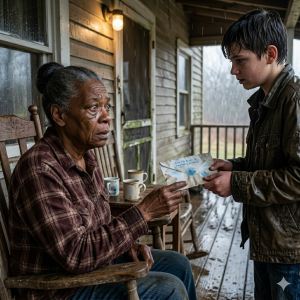
The boy was soaked clear through to his bones, standing at the end of her driveway like he wasn’t sure he was allowed to exist there.
Dolores Marsh had been a mail carrier for thirty-one years in Calloway County, Montana. She knew the look of someone who’d been walking too long in the wrong kind of weather.
“Porch is dry,” she called out. “Coffee’s hot.”
He hesitated — they always do at that age — then came up the three creaky steps like he was walking into a church he hadn’t earned the right to enter.
She handed him a towel and didn’t ask questions.
That was the Dolores way. You let people unfold at their own speed.
His name was Tyler. Seventeen. Passing through from Billings, he said, which was a four-hour drive and made no sense on foot, but she didn’t push. She just poured the coffee and watched the rain come down in sheets off the Rockies while he wrapped both hands around the mug like it was the first warm thing he’d touched in days.
That’s when she noticed it.
He reached into his jacket pocket — the inside one, close to his chest — and pulled out an envelope. Water-stained along the edges, creased soft from what looked like weeks of folding and unfolding. He looked at it for a long moment.
Then he put it back.
Dolores kept her eyes on the mountains.
Five minutes later, he did it again. Took it out. Looked at it. Put it back without opening it.
Sealed. Still sealed.
She recognized the behavior. Grief does that. Makes you carry something you can’t bring yourself to open and can’t bring yourself to throw away.
“You want more coffee?” she asked.
“Yes, ma’am. Thank you.”
The storm rolled in harder. The old weather vane on her barn — the one shaped like a rooster that Franklin had welded together the summer of 2019 — spun wildly in the gust. She watched it and felt the familiar hollow ache she’d learned to live alongside.
Three years now.
Three years since she’d stood in this same county funeral home and listened to Pastor Briggs say words she couldn’t hear over the sound of her own heartbeat.
Tyler pulled out the envelope a third time.
This time, he held it longer.
And Dolores — who prided herself on minding her own — found her eyes drifting to it the way they used to drift to strange postmarks on her route. Occupational habit. You notice handwriting. You notice the way certain people form their letters. The particular lean of someone’s cursive. The way some folks press too hard and others barely touch the page.
She noticed.
She told herself she was imagining it.
She looked away.
But when Tyler shifted in the wicker chair and the envelope caught the porch light just right, she looked again.
And the way that “D” was formed in the corner of the envelope — looped twice at the bottom, the way her third-grade teacher had called it “old country cursive” — she felt something cold move through her despite the warm coffee in her hands.
“That letter,” she said carefully. “Has it been with you long?”
Tyler looked down at it. “Awhile,” he said.
“You don’t have to tell me anything,” Dolores said. “But if there’s something weighing on you—”
“It’s addressed to someone.” He turned it over in his hands. “Someone I’ve been trying to find. I don’t even know if she still lives here. I just… I had to try.”
Dolores set down her mug.
“What’s the name?” she asked, though something in her chest had already begun to tighten.
He turned the envelope over and held it toward her — just enough for her to see the front.
Her own name looked back at her.
Dolores Marsh. Rural Route 9, Calloway County, Montana.
The world tilted slightly.
She reached out — not to take it, just to steady herself, just to make sure it was real — and her fingers brushed the return address in the upper left corner.
The handwriting there.
That handwriting.
She knew every loop, every pressed-in line, every place the pen had lifted and come back down. Thirty-four years of grocery lists and birthday cards and one love letter she still kept in her nightstand drawer.
She reached out and touched the return address, and the name printed there — the name she hadn’t spoken aloud since the funeral — stopped every thought in her head.
Franklin Marsh. 14 Copper Basin Road. Billings, MT.
Her husband’s name. Her husband’s handwriting. Her husband’s address — the address of the VA hospital where he’d spent his last eleven weeks.
She couldn’t breathe for a moment.
Tyler was watching her with those careful eyes, the kind of eyes a boy gets when he’s been watching adults fall apart long enough to know when it’s coming.
“He gave it to my grandfather,” Tyler said quietly. “My grandfather was his roommate. At the VA. Last fall.”
Dolores pressed her hand flat against her sternum. Old reflex. What the body does when it’s trying to hold itself together.
“Your grandfather,” she managed.
“Earl Poole. He passed in March.” Tyler turned the envelope over and over in his hands, the same motion as before, but different now. Not indecision. More like ceremony. “When we were going through his things, we found it in his Bible. There was a note with it, in Grandpa’s handwriting, that said: ‘This needs to reach her. Franklin asked me to make sure.'”
The rain came down so hard it turned the driveway white.
“He asked your grandfather to deliver it,” Dolores said.
“Yes, ma’am. Grandpa was supposed to get out before him. Before—” Tyler stopped. Started again. “But Grandpa’s health went faster than anyone expected. So he couldn’t. And then I guess he was afraid it would just disappear into a box somewhere, so he tucked it in his Bible. I think he meant for my mom to find it. But she’s not—” He cleared his throat. “She’s got a lot going on right now. So I found it first.”
Dolores understood then why the boy had been walking. Not recklessness. Purpose. He’d inherited someone else’s unfinished errand and had carried it on his back, the way decent people have always carried things for each other in this country, in the places where the distances between people are long and the weather doesn’t care about your timeline.
“You came from Billings,” she said. “By yourself.”
“Hitched most of the way. Walked the last eight miles when the last ride let me off at the county road.” He glanced down at his soaked boots, almost apologetic. “I knew the address. I just didn’t know if you’d be — if you still—”
“I’m still here,” Dolores said.
She took the envelope from him then. Not gently, not roughly. The way you take something that belongs to you. The paper was soft from all his weeks of handling it, and damp from the rain, and she held it in both hands and looked at her own name written in the hand that used to reach across the kitchen table to squeeze her fingers on Tuesday mornings for no reason at all.
She didn’t open it right away.
She sat with it for a minute the way you sit with the last bite of something you’ve been savoring. Not because you don’t want it. Because you want to be fully present when it happens.
Tyler looked out at the rain, giving her the courtesy of not watching.
Good kid, she thought. Whatever he’d been through to grow that kind of consideration, it had cost him something real.
She slid her finger under the flap.
The glue had softened from the damp, and it opened easily, like it had been waiting for exactly the right conditions.
One page, folded in thirds. The date at the top was from ten months before Franklin died — written, she realized, while he could still sit up on his own, while his hands still worked well enough to press hard on the page the way he always had, the letters firm and dark and unmistakably his.
She read it the first time fast, the way you do when you’re afraid of what it says.
Then she sat still for a moment.
Then she read it again, slowly.
He wrote about the rooster weather vane. That he hoped she hadn’t taken it down. That he’d been lying in that hospital bed some nights listening to the man in the next bed snore and thinking about the summer he’d welded that thing together, how he’d gotten the tail feathers wrong twice and she’d laughed and said it looked more like a turkey and he’d been offended for about ten minutes before he laughed too.
He wrote that he was sorry for the hard years. The specific ones. He named them, which is harder than a general apology and means more.
He wrote that the house on Rural Route 9 was the only place he’d ever felt like himself from the very first day, and that was because of her, not the house, and he needed her to understand that even if he’d been bad at showing it sometimes.
He wrote: “I know you’ll keep the coffee hot for people who need it. I know you’ll keep letting folks unfold at their own speed. I know this because I have watched you do it for thirty-four years and it is the finest thing I have ever seen a person do. Don’t let anyone tell you kindness is small. It is the biggest thing there is. It is the whole thing.”
He wrote at the end: “The rooster still points north when the storms come in from the northwest. You know I never could figure out how to fix that. Don’t bother trying. Let it be wrong. Some things are fine the way they are.”
Dolores folded the letter back along its creases.
She was crying, but not the way she’d cried at the funeral — that terrible, drowning kind of crying that doesn’t feel like grief so much as erasure. This was different. This was the kind that happens when something lost finds its way home.
She looked over at Tyler, who was still studying the rain with great intensity, pretending he hadn’t noticed.
“How long have you been carrying this?” she asked.
“About six weeks,” he said. “Since we found it.”
Six weeks. A seventeen-year-old boy, carrying a dead man’s letter to a widow he’d never met, hitchhiking across Montana in the rain because a great-grandfather’s Bible had contained someone else’s unfinished errand and he’d decided, for reasons Dolores suspected ran deeper than he’d said, that it needed finishing.
“Tyler,” she said. “Why did you decide to do this yourself? Why not mail it, or have your mother—”
He was quiet for a moment.
“My dad left last year,” he said finally. “Just kind of stopped being around. And I kept thinking about your husband, asking my grandfather to make sure you got it. Like, that was the last thing he was worried about. Making sure you knew something.” He picked at a loose thread on his jacket cuff. “I thought that was worth doing right. I thought someone should show up.”
Dolores nodded slowly.
She thought about Franklin in that hospital room, hurting, scared probably, using some of his last good energy to write this out and fold it in thirds and hand it to the man in the next bed. Trusting a stranger with his most important unfinished thing.
She thought about Earl Poole pressing it into his Bible, unwilling to let it disappear.
She thought about this boy standing in the rain at the end of her driveway, not sure if he was allowed to exist there.
A chain of ordinary people doing the decent thing, link by link, across months and miles.
“Come inside,” she said. “Out of this weather. You’ll stay for supper.”
“Ma’am, you don’t have to—”
“You walked eight miles in a Montana rainstorm to bring me a letter from my husband,” Dolores said, standing up from the wicker chair. “The least I owe you is pot roast.”
Something in the boy’s face changed then. The careful, watchful quality loosened just a little. He looked, for a moment, like what he was: a kid who was tired and wet and had done a hard thing and was ready to put the weight down.
“Yes, ma’am,” he said. “Thank you.”
Inside, she put the letter on the kitchen table while she cooked, where she could see it. Franklin’s handwriting in the warm kitchen light. She kept glancing at it the way you check on something you were afraid of losing.
The rooster weather vane was visible from the kitchen window. Still spinning wildly in the northwest wind, still pointing the wrong direction, just like always.
Let it be wrong, he’d written. Some things are fine the way they are.
Over supper, Tyler told her more about Earl Poole. The way he used to do crossword puzzles every morning. How he’d taught himself Spanish from a library book in his seventies just to have something to do. How he’d talked about Franklin — “Marsh,” he’d called him, the way men of that generation called each other by last names — with real warmth, the way you talk about someone who made the hard part of something easier.
“They were only roommates for about three months,” Tyler said. “But Grandpa talked about him like they’d been friends for years.”
“Franklin had that way,” Dolores said. “He could make three months feel like years.”
After supper she called Tyler’s mother, who was relieved in the way that mothers are relieved when something they’d been holding their breath about is finally resolved. They spoke for a few minutes, woman to woman, past the awkwardness of the circumstances. The mother’s voice was worn in the edges, like fabric that’s been washed too many times. Dolores recognized that, too.
Before Tyler left — his mother was driving up to collect him, a two-hour drive she’d started before the call was even finished — Dolores made him take the leftover pot roast wrapped in foil and a thermos of coffee for the road.
She also gave him something else.
She went to her nightstand and took out the love letter Franklin had written her thirty years ago, the one she’d kept all that time, and she brought it to the kitchen and set it beside his.
She didn’t give Tyler either of the letters. Those were hers.
But she let him see them side by side. The thirty-year-old letter and the ten-month-old letter, the same handwriting across three decades, the same person pressing his particular way onto the page.
“He never stopped,” she said. “Some people don’t.”
Tyler looked at the two letters on the table for a long moment.
“My dad used to write notes sometimes,” he said. “In lunches. Stupid stuff. Bad puns.”
“Keep those,” Dolores said. “Whatever you have. Even if it’s hard. Especially if it’s hard.”
He nodded, and she could see him filing that away somewhere important.
When his mother’s headlights finally swung into the driveway around nine o’clock, the rain had gentled to a steady quiet drizzle, the kind that doesn’t soak you so much as simply settle over everything. Dolores walked Tyler to the porch.
He paused at the top of the three creaky steps — the same place he’d hesitated coming up — and turned back.
“Mrs. Marsh,” he said. “I’m glad it was still the right address.”
“So am I,” she said. “You tell your grandfather thank you. Wherever he can hear it.”
Tyler nodded once, then jogged out to the idling car.
Dolores stood on the porch and watched the taillights disappear down Rural Route 9 and then she stood there a little longer, just listening to the rain on the barn roof and the quiet, steady turning of the weather vane.
She reached into her cardigan pocket, where she’d slipped the letter before coming out.
She didn’t take it out again. She didn’t need to. She’d read it twice already, and she had a good memory, and she’d be reading it again before she went to sleep.
She just held it there, through the fabric.
Some people don’t stop.
The rooster spun in the northwest wind, pointing the wrong direction, and she left it alone.