She walked into the room holding a secret that could burn the whole evening to the ground.
Nobody knew her face. That was the point.
Pepper Dault had spent fifteen years being nobody in Beaufort. The woman the Haddock family had quietly erased from every dock, every co-op, every handshake deal on the Carolina coast. The woman Earl Haddock had fired in front of thirty-two workers on a gray November morning, right there on the weathered planks of Haddock & Sons Pier Number Two.
She remembered every word he said.
*”You’ll never understand this water.”*
Then he’d taken her tide chart — her battered, salt-stained pocket tide chart from 1989, the one she’d carried since her first season working the shrimp boats at nineteen — and he’d torn it clean in half.
Slow. Deliberate. So everyone could see.
She’d picked up both pieces off the dock. Taped them together that night at her kitchen table. And she had carried that chart in her breast pocket every single day since.
—
The Beaufort Maritime Heritage Festival was the crown jewel of Earl Haddock’s social calendar. He’d helped found it. His family’s name was on the bronze plaque by the entrance. Every year, he sat at the head of the banquet table like a man who had never once questioned whether he deserved to be there.
This year, Pepper had been assigned the seat directly across from him.
She didn’t ask for it. She didn’t arrange it.
Some things, she’d come to believe, just find their own level. Like water.
—
The memoir had come out eight months ago.
*Forty Fathoms Down* — published under the pen name C.R. Dault — had sold one hundred and fourteen thousand copies in hardcover. It had spent eleven weeks on the regional bestseller lists. It had a long chapter, chapter seven, titled “The Tear,” that described in precise and patient detail how one family had systematically locked an entire generation of independent shrimpers out of their livelihoods through fake safety violations, rigged co-op votes, and a telephone tree of intimidation that reached from Beaufort all the way to Savannah.
Nobody in Beaufort knew who C.R. Dault was.
Nobody had connected the pen name to the quiet woman who’d moved back to town two years ago and started helping at the library on Thursdays.
The festival committee had invited C.R. Dault as their honored guest. They’d sent the invitation care of the publisher. They’d set a place card at the table.
*C.R. Dault.*
Pepper had arrived early and moved it herself.
She sat down across from the empty chair where Earl Haddock would soon settle his considerable presence. She set her cloth napkin in her lap. She reached into her breast pocket and touched the tide chart — soft now, almost velvety at the fold lines after fifteen years of handling — and she breathed.
—
Earl Haddock arrived at six-fifteen, pink-cheeked and laughing at his own joke before he’d fully cleared the doorway.
He sat down.
He looked at her the way powerful men look at women they don’t recognize. That flat, polite, uninterested glance.
Nothing.
Not a flicker.
Of course not. She’d been twenty-four the last time he’d seen her face. She’d been a girl in rubber boots on his dock. She was fifty-three years old now, in a cream linen jacket, with reading glasses on a chain and a glass of sweet tea in her hand.
She was nobody to him still.
She let him have that. For now.
—
Through the soup course, she kept her hands folded.
Through the salad, she watched him hold court with the two aldermen on his right, laughing that big rolling laugh, touching the younger man’s arm when he made a point.
Through the main course — she barely tasted it — she felt the tide chart against her ribs like a heartbeat.
Fold. Unfold.
Fold. Unfold.
Ten feet behind Earl Haddock’s left shoulder, in a polished glass display case near the podium, sat a hardcover copy of *Forty Fathoms Down* opened to the inside cover.
Where the publisher had chosen, at the author’s quiet request, to reproduce one full-page image.
A battered, salt-stained pocket tide chart from 1989. Taped down the middle. Every crease visible.
Earl Haddock had not yet turned around to look at the display case.
He would.
—
The emcee clinked his water glass and rose from his chair.
He welcomed everyone. He thanked the sponsors. He talked about the heritage of Lowcountry fishing for what felt like three full minutes while Pepper sat very still and breathed through her nose.
Then he cleared his throat.
Adjusted the microphone.
And said the words.
*”And now, we’d like to ask the author to come up and say a few words.”*
Every head in the room turned, slowly, looking for C.R. Dault.
Including his.
Earl Haddock turned to look.
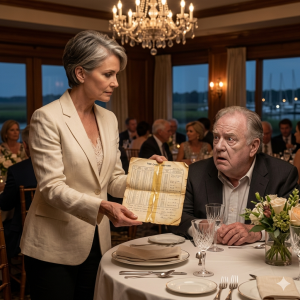
And Pepper Dault rose from the chair directly across from him, smoothed her cream linen jacket, and reached into her breast pocket.
The color left his face.
One shade at a time.
She unfolded the tide chart.
She held it the way you hold something that has earned the right to be held. Not dramatic. Not raised above her head like a torch. Just open, between her two hands, at chest height, so he could see the tape line running down the center. So he could see the handwriting in the margins — tide tables for the Lady’s Island shoals, current notations, her initials in the corner in blue ballpoint ink: P.M.D.
She watched his mouth work without producing sound.
Then she walked to the podium.
—
She set the chart face-up on the lectern’s edge where she could see it while she spoke.
She did not have notes. She had not written a speech. She had thought about this moment for fifteen years and she had decided, somewhere around year twelve, that when it came she would simply tell the truth in the same plain voice she’d used to write the book. No performance. No theater. The truth didn’t need costuming.
“My name,” she said into the microphone, “is Pepper Dault. Some of you know me from the library on Thursdays. Some of you knew my family from the water. And some of you —” she looked directly across the room to where Earl Haddock sat, still and pale as a man who has just watched thirty years of careful architecture begin to shift at its foundation, “— some of you knew me from Pier Number Two.”
The room was completely silent in the way that only rooms full of Southerners can be silent. Polite on the surface. Roiling underneath.
She talked for eleven minutes.
She did not talk about the book. She did not need to. Every person in that room had read chapter seven, or knew someone who had, or had heard it discussed in the particular low-voiced way that Beaufort discussed things that mattered. She did not rehearse the grievances or recite the evidence. That was already in print, already in eleven weeks of regional bestseller lists, already in the hands of a journalist from the Post and Courier who had been making calls for six weeks and whose story, Pepper happened to know, was scheduled to run the following Thursday.
Instead she talked about the water.
She talked about what it meant to learn the Carolina coast the way her father had taught her — by feel, by patience, by a kind of listening that had no name in English but that every waterman understood in their chest. She talked about the shrimp boats and the way the light came in low off Port Royal Sound on an October morning. She talked about the women who had worked those boats and those docks across a hundred and fifty years and whose names appeared on nothing, no plaques, no founding documents, no bronze at any entrance.
She talked about what it cost to be told you didn’t belong to the thing you had given your life to.
She talked about the tape.
“I taped this chart back together the night of November fourteenth, fifteen years ago,” she said. “I have carried it since then because I needed to remember that something torn can still be used. It’s not the same as whole. The tape shows. The crease is permanent.” She paused. “But it still tells you where the water is. It still tells you how to move through it without running aground.”
She picked it up off the lectern.
“I wrote this book because thirty-one other people deserved to have their story told, and most of them were too tired or too scared or too beaten-down to tell it themselves. I wrote it because silence is its own kind of tide, and it will carry you somewhere whether you intend to go there or not.”
She looked out at the room. Not at Earl. Just at the room. At the faces of people she’d grown up around, people she’d avoided for fifteen years, people who had known what happened and looked away, and people who genuinely hadn’t known and were only now beginning to understand the shape of what they’d been living inside.
“I came back to Beaufort,” she said, “because this is my water too.”
She folded the tide chart.
She put it back in her breast pocket.
She said thank you, and she stepped away from the microphone.
—
The applause started slowly. The way applause does when people are still deciding what they feel.
Then it wasn’t slow.
Pepper walked back to her seat. She picked up her sweet tea. She took a long sip and set it down and looked across the table.
Earl Haddock was still in his chair. He had not moved. His face had progressed through several colors and had settled on something that was not quite anger and not quite shame and was perhaps, for the first time in a long time, simply exposure. The particular discomfort of a man who has spent decades controlling the narrative discovering, all at once, that the narrative has been living a second life without him.
He met her eyes.
She did not look away. She did not smile. She did not perform anything at all.
After a long moment, he picked up his water glass and looked down at the tablecloth.
That was all.
It wasn’t a confession. It wasn’t a collapse. It wasn’t the dramatic reckoning she might have imagined at twenty-four, standing on the dock in the November wind, holding the two halves of her chart and trying to breathe.
But it was real. It was witnessed. And it would not un-happen.
—
Three people stopped her on the way to her car.
The first was a woman in her sixties, sturdy and sun-weathered, who grabbed both of Pepper’s hands and said, “My brother worked that pier. He never got another co-op berth after the trouble in 2004. I just want you to know he read your book twice.” She squeezed Pepper’s hands and walked away before either of them could cry.
The second was the younger alderman who’d been sitting on Earl’s right all evening, who shook her hand and looked at her steadily for a moment and said, “I’d like to have a conversation sometime. If you’re open to it.” Pepper said she was.
The third was the emcee, slightly flustered, who handed her a sealed card from the festival committee and said he was sorry the evening had been — and then stopped, because he couldn’t find the word he wanted, because there wasn’t one that covered it.
“It was fine,” Pepper told him, and meant it.
—
She drove home the long way. Down Carteret, then out along the water, windows down, the night air carrying that particular low-tide salt smell that she had grown up inside and that still, after everything, felt more like home than anywhere else on earth.
She parked outside her rented house. She sat in the car for a moment.
Then she reached into her breast pocket and took out the tide chart one more time.
She unfolded it in the dark. She couldn’t read it. Didn’t need to. She knew every marking by memory — every notation, every depth, every warning she’d penciled in at nineteen along the channels she’d learned to run before sunrise.
The tape had gone soft and slightly translucent with age. The fold line where Earl Haddock had torn it was barely a line anymore, just a difference in texture, something you’d only find if you knew to look.
She folded it back up.
She thought about her father, who had taught her to read tides before she could read a clock. She thought about the thirty-one names in the acknowledgments of *Forty Fathoms Down*, each one real, each one chosen carefully, each one belonging to a person who had stood on a dock or a boat or a co-op floor and been made smaller than they were.
She thought about chapter seven, and the journalist from the Post and Courier, and the conversation she’d agreed to have with the alderman, and the long, unromantic, particular work of actually changing things as opposed to merely surviving them.
She got out of the car.
The tide was coming in. She could hear it in the dark — that low, patient push of water finding its level, moving through the channels the way it had always moved, indifferent to names on bronze plaques, indifferent to who claimed to own the coast, returning and returning and returning regardless.
She went inside.
She had a library shift in the morning.