He wasn’t dead.
He had been three blocks away for six years.
And somewhere in that locked rolltop desk, he had kept every single letter I ever wrote him.
—
My name is Lily Tran, and I appraise estates for a living.
I walk into strangers’ homes after they’re gone and I put a number on what they left behind. Furniture. China sets. Old fishing rods. Jewelry boxes with the locks rusted shut. I’ve done it for eleven years, and I’m good at it because I don’t get attached.
That’s what I always told myself.
I don’t get attached.
When the attorney called me about a property on Avenue O in Galveston — a 1920s craftsman bungalow, contents unknown, owner recently deceased — I almost passed it to one of my associates. It was a Tuesday. I had three other jobs waiting.
But something made me say yes.
I still can’t explain it.
—
The house smelled like cedar and salt air and something else I couldn’t name.
Old books, maybe. Or the particular stillness of a place where someone lived alone for a very long time.
The attorney — a thin man named Mr. Holloway, gray suit, very polite — let me in and said he’d be back in an hour. Standard procedure. I had my clipboard. My camera. My whole professional life wrapped up in a Monday through Friday routine.
I started in the front room.
Nice pieces. A maritime map framed in walnut. A set of Longaberger baskets still in their wrapping. A rocking chair worn smooth on the right armrest, like whoever sat there always rested the same way.
I was making notes when I saw the rolltop desk in the back corner.
Locked.
That’s normal. People lock things. I photographed it and moved on.
But I kept coming back to it.
Three times I walked past it. Three times I stopped.
On the fourth pass, I noticed something on the floor underneath it, barely visible in the shadow.
A button.
Small. Round. The color of the inside of an oyster shell — that pale, soft shimmer of mother-of-pearl.
I picked it up.
My hands went cold.
—
I know this button.
I know it the way you know your own heartbeat.
It came from the dress I wore on September 14th, 2008.
The morning two men from the county knocked on our apartment door in Houston and told my mother and me that my father’s body had been recovered from the floodwaters after Hurricane Ike.
I was wearing a pale yellow dress with mother-of-pearl buttons down the front.
I lost three of them that day. Didn’t notice until that night when I was sitting on the bathroom floor, still in that dress, not able to make myself take it off.
I never threw the dress away.
I never found those buttons.
—
Mr. Holloway came back forty minutes later with a locksmith.
I don’t know what I said to make him call one. I don’t fully remember the conversation. I just know I was standing in front of that rolltop desk and I was not moving.
When the lock gave, the top rolled back smooth as water.
And there they were.
Bundled in rubber bands.
Stacked in order, oldest on the bottom.
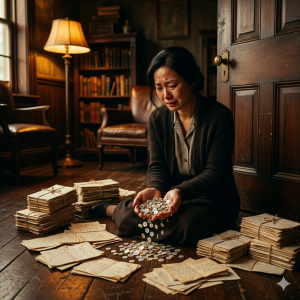
Eleven years of letters in my own handwriting — the ones I wrote to my father every single month after he died, because my grief counselor said it might help and it did help, so I kept going, kept writing, kept mailing them to an address that shouldn’t have existed.
Letters I sent to a PO box I found in his old wallet.
Letters I assumed went nowhere.
Every envelope had been opened.
Every envelope had been read.
And tucked inside each one — carefully, intentionally, like someone placing a small and sacred thing —
was a mother-of-pearl button.
Not the same one. Not one button passed from envelope to envelope.
A different button each time.
Eleven years. Dozens of letters.
Dozens of buttons.
All identical to the ones from my dress.
—
I was sitting on the floor of a dead man’s study with my hands shaking and eleven years of unanswered grief in my lap when Mr. Holloway cleared his throat.
“Miss Tran,” he said.
I looked up.
He wasn’t looking at the letters.
He was looking at the door behind me.
“The man who owned this house,” he said slowly, “he left everything to you.”
I couldn’t speak.
“He’s been watching you build your business from three blocks away for six years.”
The room was very quiet.
“And Miss Tran —”
He paused, and in that pause was every letter I had ever written, every button I had ever lost, every year I had spent grieving a man I thought the water had taken —
“He’s not dead.”
Mr. Holloway looked at the closed door to my left.
“He’s in the next room.”
—
I want to tell you that I stood up gracefully.
That I smoothed my clothes and took a breath and walked calmly through that door like a woman who had her life under control.
That is not what happened.
What happened is that my legs didn’t work right. I got halfway up from the floor and had to put one hand flat on the desk, on top of those bundled letters, just to stay vertical. Mr. Holloway made a small move toward me and I held up my other hand and shook my head.
I needed a second.
I needed about ten thousand seconds.
The door was a plain interior door, white paint, brass knob, the kind of door that is in every house in America. I had walked past it twice without giving it a thought. Now I stood in front of it and my whole body was asking me a question I didn’t know how to answer.
My father had been afraid of water his whole life.
That was the thing no one ever talked about after he died. The strange, bitter irony that the sea had taken a man who never trusted it. He grew up in Galveston. He knew what the Gulf could do. When we were small, he wouldn’t let me and my sister go past our knees at the beach. He watched us from a folding chair at the waterline with his arms crossed and his jaw tight until we came back to him.
And then Hurricane Ike filled the streets of Houston, and he was gone.
Except.
Except he wasn’t.
I turned the knob.
—
He was thinner than I remembered.
That was the first thing. He had always been a broad man, my father, thick through the shoulders from thirty years of loading cargo at the Port of Houston. The man in the wingback chair by the window was narrow. Careful. Like someone had taken the same bones and redrawn them with a lighter hand.
His hair was white.
All of it.
He had been fifty-one when I last saw him. He looked past seventy now.
His hands were on the armrests and he was gripping them the same way, I noticed, that the rocking chair in the front room had been worn down. Same right side. Same angle.
He had moved the chair from room to room and it was the same chair, the same worn groove, the same man.
For a long time neither of us said anything.
Outside, the Gulf wind was working at the window frames the way it always does in old Galveston houses. Little audible pressures. The house breathing.
“Bà nói tôi đã chết,” I finally said. Mom said you were dead.
My Vietnamese came out rough. I hadn’t spoken it in years, not really, not the way we used to speak it at home when it was just family, when it didn’t have to be performed for anyone.
He closed his eyes.
“Bà ấy tin như vậy,” he said. She believed it.
“Did she have a reason to?”
He opened his eyes and looked at me.
“They found a body,” he said, in English now, carefully. “In the water. It had my wallet. My ring.” He paused. “A man I knew. He had nowhere to go and no one to go to. I gave him those things before the storm.”
“Why.”
It wasn’t a question. Not really. It was the whole sentence. The whole eleven years of it.
He was quiet for a long moment.
“I owed people money,” he said. “Not regular money. Not the kind of debt you work off.” He looked at his hands. “I had made choices. Very bad choices. And the storm — when they said there was a body — I thought if I stayed dead, the men I owed would stop looking. And you and your mother and your sister would be safe.”
“We grieved you.”
“I know.”
“I wrote you letters for eleven years.”
His voice, when it came, was barely there. “I know.”
“And you just — you just sat here?”
“I read every one.” He said it like it was the only defense he had. Maybe it was. “Every single one. I watched you open your business. I had a friend who knew a friend — I followed everything. Your sister’s wedding. Your mother’s hip surgery. I was at the church for the wedding. In the back. I left before it ended.”
I thought about that for a second. My sister Mai’s wedding, four years ago, the little Vietnamese Catholic church on Seawall Boulevard, ninety people packed into a space meant for sixty.
He had been there.
I had probably walked within ten feet of him.
“The buttons,” I said.
His face changed. Something in it got both softer and harder at the same time, which I didn’t know a face could do.
“When I read your first letter — the one where you talked about the dress, about losing those buttons — I went and found the same kind. I don’t know why. I just needed to do something. Send something back.” He shook his head slightly. “I know it wasn’t enough. I know it wasn’t close to enough. But it was the only way I could — I needed you to know that someone was on the other end. That you weren’t just writing into nothing.”
“I thought I was writing into nothing.”
“I know.”
“For eleven years I thought I was writing to a dead man.”
“I know, Lily.”
The way he said my name.
That was what broke me.
—
I won’t try to make what happened next into something clean, because it wasn’t clean.
I cried in a way I haven’t cried since I was twenty-three years old, sitting on a bathroom floor in a yellow dress. He cried too. He’s a Vietnamese man of his generation and he cried without making a sound, tears just running down the sides of his face while he sat very still, which somehow made it worse.
I said things that I’m not going to repeat here because they weren’t for anyone but him.
He didn’t defend himself. He just let me say them.
When I finally ran out of words and was just standing there empty, he reached into the breast pocket of his shirt and held something out.
A button.
Mother-of-pearl. Pale and soft as the inside of a shell.
“I kept one,” he said. “I was going to put it with you, eventually. I had this idea that when I died — really died — Mr. Holloway would give it to you. So you’d know.”
I looked at it in his palm.
“Why did you decide to do this now?” I asked. “Why today?”
He was quiet for a moment.
“My heart,” he said simply. “The doctor says six months, maybe a year. I wasn’t going to die again without you knowing the truth.”
—
Here is what I know right now, two weeks out from that Tuesday in Galveston:
My father is alive. He is sick. He is living in a small apartment — he signed the bungalow to me as I now know — three blocks from where I am writing this, because I moved into the bungalow eight days ago. I’m not ready to be far from him. I don’t know if that’s healthy or not and I don’t particularly care.
My mother does not know yet. That conversation is coming and I am not going to pretend I’m not terrified of it.
My sister Mai knows. I called her the night of the Tuesday. She didn’t speak for a long time. Then she said, very quietly, “I always thought the casket was too light.” I didn’t know what to do with that. I still don’t.
The letters are in a box on my kitchen table. I haven’t moved them. I make coffee in the morning and I look at them and I think about the fact that every single time I licked a stamp and dropped an envelope in a mailbox, there was a man reading what I wrote. That a grieving daughter and a hiding father have been in quiet conversation for eleven years without either of us knowing it.
My grief counselor — a different one now, but good — says there is no roadmap for this. That I should let myself feel all of it in whatever order it comes.
So far the order has been: shock, fury, grief again (different kind), something that is not yet forgiveness but is standing in forgiveness’s general direction, and underneath all of it, stubborn and persistent and slightly embarrassing, an enormous relief.
He’s alive.
The water didn’t take him.
—
Yesterday I brought him lunch. A bánh mì from the place on 25th Street that I like. I made enough for two and I walked three blocks and I knocked on his door.
We sat at his kitchen table and ate sandwiches and he asked me about the bungalow and whether the water pressure in the upstairs bath was still giving trouble.
It is. He said there’s a valve behind the panel in the hall closet. He said he never got around to fixing it.
I told him I’d figure it out.
He nodded. He looked out the window.
After a while he said, “You’re good at your job.”
I asked him how he knew.
“I read about it,” he said. “There was a piece in the Galveston paper when you appraised the Moody estate. They quoted you. You said —” and here he paused and looked like he was being careful with the words, getting them right — “you said that every home is an autobiography. That objects tell the truth even when people can’t.”
I remembered saying that.
“I cut it out,” he said.
Of course he did.
Of course he has a folder somewhere, or a drawer, full of small evidence of a life he watched from the outside. Of course he kept the clippings and the letters and found the same buttons, the exact same buttons, because he needed to be, in whatever way he was allowed to be, still a father.
I ate my sandwich.
He ate his.
The Gulf wind worked at his windows the same way it works at mine, three blocks away, because it is the same wind and this is the same town and we are, despite everything, still here.
“The valve,” I said, when I was leaving. “In the hall closet.”
“Behind the lower panel,” he said. “You’ll need a flathead. Quarter-turn to the right.”
I said I’d let him know if I had trouble.
He said okay.
He stood in his doorway and watched me walk down the steps and I didn’t turn around but I knew he was watching, the same way I knew, somehow, on a Tuesday I almost didn’t take, that I was supposed to walk into that house on Avenue O and pick up a button from the floor and not let go.
I’m not going to pretend this story is finished.
It isn’t.
But I’m three blocks away now.
And so is he.
And for the first time in eleven years, the distance between us is one we can actually cross.