They called her “the lady with the clipboard.”
Not Dr. Patrice Wynn. Not “the hydrologist.” Not even “the retired Army Corps engineer with thirty-one years on major waterway systems.”
Just the lady with the clipboard.
She’d shown up at three county commissioner meetings in a row, same navy cardigan, same manila folder thick with calculations, same quiet voice asking for five minutes on the agenda. The third time, Commissioner Dale Hutchins leaned back in his chair, clicked his pen twice, and said, “Ma’am, I appreciate your concern. We’ve had professionals look at this.”
Patrice nodded once, picked up her folder, and drove home to her little white house on Sycamore Bend.
That night, she pulled the orange survey flag from behind her kitchen faucet and set it on the table in front of her.
She’d yanked it out of the levee bank herself, two years ago, the afternoon she first walked the grade and felt something wrong before she even ran the numbers. The flag was faded now — bleached from orange to the color of old Halloween candy — and one of the wire legs had a bend in it she’d never straightened.
She left it there on the table while she ate her soup.
She’d found the error on a Tuesday in October. Decimal point. One zero that shouldn’t exist. In the updated load-bearing calculation for Sector 7, the weakest stretch of the levee, the elbow where the river pushed hardest when it ran high.
She’d emailed the county engineer. No response.
She’d called the Army Corps district office in St. Louis. They’d thanked her and opened a “review file.”
She’d driven forty minutes to hand-deliver a twelve-page report to Hutchins’ office. His assistant had smiled and said, “I’ll make sure he gets this.”
That was fourteen months ago.
Patrice kept the orange flag behind the kitchen faucet. She told herself it was a reminder to stay patient.
It was also evidence.
She knew the type of flood that was coming — not if, when. The Missouri River doesn’t ask permission. She’d spent thirty-one years watching it breathe. She knew its moods the way you know a difficult family member: familiar, exhausting, and entirely capable of catastrophe.
When the National Weather Service issued the flash flood watch on a Thursday evening in late May, Patrice Wynn made herself a thermos of coffee and put the orange flag in her jacket pocket.
By midnight, the rain was something else entirely.
By 2 a.m., water was sheeting across County Road F and the emergency text alerts were pinging every phone in Benton Crossing.
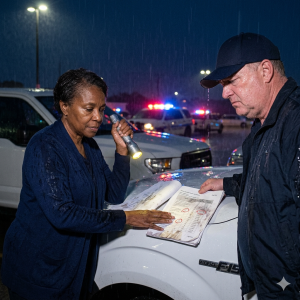
By 2:47 a.m., Patrice was standing in the parking lot of the levee authority maintenance shed, her folder sealed inside a gallon zip-lock bag, watching Commissioner Dale Hutchins’ white F-250 pull in fast with the headlights still on.
He got out of the truck looking like a man who hadn’t slept.
He looked at her standing there in the rain like she was the last person on earth he wanted to see.
“Dr. Wynn.” His voice was flat.
“Commissioner.” She walked to the hood of his truck.
He hadn’t called her Dr. Wynn before.
She noticed that.
She pulled the report from the zip-lock bag, spread it flat on the hood, and pressed her palm down against the rain to hold it still. She clicked on her flashlight. The beam hit page nine.
The number was still there.
The wrong number. The one with the extra zero that turned a reasonable safety margin into a fiction. The one in the column for maximum water load tolerance on Sector 7.
She’d circled it in red ink two years ago.
The circle hadn’t faded.
She looked up at Dale Hutchins. Rain was running off the brim of his cap. His jaw was tight. Behind them, she could hear radio chatter from the emergency vehicles beginning to stage on the access road.
In her jacket pocket, her fingers found the bent wire leg of the orange survey flag.
She looked back down at the number.
Then back up at him.
“That zero shouldn’t be there,” she said.
Her voice was completely calm.
“And you knew it.”
The radio behind them crackled.
Dale Hutchins did not move.
And somewhere out in the dark and the rain, a quarter mile east, the levee at Sector 7 made a sound that Patrice Wynn had only heard once before in her life —
A low, percussive groan, like a freight train applying its brakes a second too late. Not a crack. Not a crash. A groan. The sound of something enormous deciding.
She had heard it in 1993, standing on a Mississippi levee near Quincy when she was thirty-four years old and still had brown hair. That levee had gone six minutes after making that sound. Took out four thousand acres of bottomland and a grain elevator that had stood since 1941.
Six minutes.
She was already moving.
“Get on that radio,” she said to Hutchins, and her voice was not calm anymore, it was iron, it was thirty-one years of authority that no one in this county had ever bothered to respect, “and you tell them to pull every vehicle off the Sector 7 access road right now. Get the State Patrol blocking both ends of County Road F. Tell them you have imminent breach, Sector 7, and you need air assets for downstream evacuation of the Millhaven bottoms.”
Hutchins stood there for one full second looking at her.
One second.
She didn’t have time to be angry about it.
“NOW, Dale.”
Something in the way she said his first name broke him out of it. He grabbed his radio off his belt and started talking fast.
Patrice was already at her own car, pulling out the laminated sector map she had kept in her glove box for fourteen months. She had marked it herself with yellow highlighter: every farmhouse, every mobile home park, every low-lying road in the two-mile flood shadow below Sector 7. Thirty-one structures. Roughly eighty people if the seasonal occupancy held, more if families had doubled up for the holiday weekend.
She got back on her phone. She had a list. She’d made the list fourteen months ago, the same week she’d hand-delivered the report to Hutchins’ office. She had told herself she was being paranoid.
She had not thrown the list away.
She started at the top.
The Delvecchio farm was first. She’d met Gary Delvecchio once, at the second commissioner meeting. He’d nodded at her from the back row. He picked up on the second ring, half-asleep, and she told him in eight words: “Gary, the Sector 7 levee is going. Go now.” She heard him swear, heard bedsprings, heard him shout to someone in the back of the house.
She moved down the list.
Behind her, Hutchins was on the radio, and she could hear his voice had changed. The flatness was gone. He was talking fast and he was using the right words and she didn’t have time to feel anything about that either.
The second groan came at 2:54 a.m. Deeper than the first. Closer.
One of the state patrol deputies near the access road heard it from his cruiser and later told a reporter it sounded like God clearing his throat.
At 2:58 a.m., Sector 7 failed.
It failed at the precise point Patrice Wynn had marked with that orange survey flag on a warm Tuesday afternoon two autumns ago. The overburden calculation she’d flagged — the one corrupted by the transposed zero, which had inflated the rated water load tolerance by a full order of magnitude — had been the only thing standing between a known structural weakness and an honest reckoning with the river.
The river had been waiting patiently.
The breach opened forty feet wide in under ninety seconds and widened to nearly two hundred feet before the main surge pushed through. Water moved into the Millhaven bottoms at a speed that left no room for debate about whether anyone who’d stayed would have survived.
No one had stayed.
Patrice had reached every name on her list.
Not every call had gone smoothly. The Trotter family, six of them including a grandmother on oxygen, had needed the county sheriff’s deputy to go physically to the door, which Hutchins had dispatched at Patrice’s instruction at 2:51 a.m. The deputy got them out with four minutes to spare. The grandmother left her oxygen concentrator behind because there was no time. The Red Cross had a replacement unit to her by ten the next morning.
By 4 a.m., the bottoms were under six feet of water.
By 4 a.m., every person who had been in those thirty-one structures was accounted for, wet and frightened and in some cases furious, but breathing, standing on high ground, alive.
Patrice sat in her car in the maintenance shed parking lot and drank the last of her thermos coffee. It had gone cold two hours ago. She drank it anyway.
Someone knocked on her window.
It was Hutchins. He looked like he’d aged four years since he’d climbed out of his truck. His cap was soaked through and he was holding his radio in both hands like he didn’t know what to do with them.
She rolled the window down.
He didn’t say anything for a moment. Rain dripped off his nose.
“Eighty-three people,” she said, so he didn’t have to find the place to start. “That’s the rough count from the bottoms. Based on seasonal occupancy and what I knew about the Delvecchio and Trotter families having company this weekend.”
He nodded slowly.
“All out,” she said.
He nodded again.
She reached into her jacket pocket and took out the orange survey flag. The wire was still bent on one leg. The plastic was still the color of old Halloween candy. She held it out through the window and he took it without quite understanding why.
He looked at it in his hands.
“I pulled that out of the Sector 7 bank two years ago,” she said. “You’ll want to give it to whoever’s doing the incident documentation. Chain of custody starts tonight.”
His jaw worked.
“Dr. Wynn.” He stopped. Started again. “I’m not going to — I don’t have an excuse.”
“No,” she agreed. “You don’t.”
She said it without cruelty, because cruelty would have been a luxury she hadn’t earned and didn’t want. She said it the way you state a load calculation. As a fact. As something the numbers had already settled.
He stood there in the rain holding a bent orange flag.
She screwed the cap back on her thermos.
“There are going to be investigators here by morning,” she said. “State, probably federal. The Army Corps district office has had an open review file on this for fourteen months. I’d suggest you call your attorney before six a.m.”
He looked at her.
“That’s not a threat,” she said. “That’s just the timeline.”
She rolled up her window.
She sat there until he walked away. Then she sat a little longer, watching the rain on the windshield, listening to the radio chatter on the scanner she kept clipped to her visor. Rescue boats were staging for the bottoms. An aerial unit out of Jefferson City was inbound to assess the breach. The National Weather Service was updating the downstream warning.
The machine was working. Late, imperfect, grinding, but working.
She thought about the grandmother and her oxygen concentrator, sitting somewhere on the floor of a flooded farmhouse, and decided not to think about it again.
She drove home to her little white house on Sycamore Bend as the sky started going gray at the edges.
The kitchen faucet dripped once when she came in, the way it always did, as if it were acknowledging her. The spot where the orange flag had lived for fourteen months was just empty space behind the handle now. She noticed the emptiness the way you notice where a piece of furniture used to be.
She made fresh coffee. Real coffee, not thermos coffee.
She sat down at her kitchen table with her hands around the mug and let herself be still for the first time since Thursday evening.
Her phone started ringing at 6:15 a.m. She didn’t recognize the first number. Or the second. By the third she’d figured out it was press, and she let it go to voicemail and drank her coffee.
The fourth call was from a woman who introduced herself as the division chief of the Army Corps Midwest Region. She was calling from Washington. It was not yet seven in the morning.
Patrice listened. Then she said she’d be available for a call at nine. Then she hung up and poured herself a second cup.
At seven-thirty, her neighbor Bev from three houses down knocked on the door with a plate of biscuits because Bev had heard about the flood on the radio and that was the kind of person Bev was. Patrice let her in, and they sat at the kitchen table, and Bev didn’t ask a single question about the levee, just talked about her garden and the deer that kept getting at her hostas, and Patrice was more grateful for that than she could have said.
The investigation took eleven months.
The decimal error was traced to a data migration in 2019, when the county had transferred old engineering records to a new software system. The migration had introduced a formatting error. The county engineer had signed off on the updated calculations without running an independent verification. His office had assumed the software had handled the conversion correctly.
It had not.
Hutchins had not known about the error. That was the finding, and Patrice believed it, because when she’d said “and you knew it” in the rain at 2:47 a.m., she hadn’t been entirely sure of it — she had said it to see what his face did. What his face had done was the face of a man who’d dismissed someone, not the face of a man who’d concealed something. Those are different faces and she knew how to read both.
What he’d done was dismiss her. What he hadn’t done was lie.
The distinction mattered. In the end it mattered a great deal.
He resigned from the commission in February. He did it quietly, in a written statement that didn’t use the word sorry, which Patrice thought was probably his attorney’s advice. She didn’t hold it against him specifically. She held it against the kind of thinking that looks at a woman with a clipboard and sees a woman with a clipboard.
The county engineer’s license was suspended for eighteen months pending remediation requirements.
The Army Corps of Engineers issued a formal commendation to Dr. Patrice Wynn, retired, for her identification of the calculation error and her actions during the emergency response. There was a ceremony in St. Louis. She wore the navy cardigan. She didn’t say much in her remarks. She didn’t need to.
The levee at Sector 7 was rebuilt the following year, to the corrected specification, with an independent verification requirement written into the construction contract. Patrice was asked to consult on the review board. She said yes.
She drove out to the site in September, after the new work had been completed and the grade had settled and the engineers had signed off. She walked the bank on a cool morning with yellow leaves coming down from the cottonwoods. She walked slowly, the way she had that first afternoon two years earlier, when she’d felt something wrong before she even ran the numbers.
She walked the full length of Sector 7.
She pressed her boot into the bank at the point of the old breach. The fill was solid. The armoring was correct. The slope ratios were what they should have been all along.
She stood there for a while, looking at the river.
The Missouri was running low for September. It looked almost polite, brown and easy, sliding between its banks without any particular ambition. She knew better than to believe it. She’d spent thirty-one years knowing better.
She didn’t have an orange flag in her pocket this time.
She didn’t need one.
She drove home, made soup, and ate it at the kitchen table, and the kitchen faucet dripped once, and the house was quiet, and she was fine.