They took everything from Cecelia Hargrove — her title, her reputation, eighteen years of her life — and she let them.
That was the part nobody understood.
—
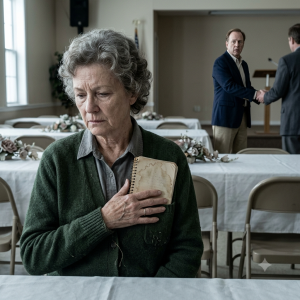
She didn’t fight back at the board meeting. Didn’t raise her voice when they read the “findings” aloud. Didn’t even flinch when her second cousin Dale stood up, adjusted his bolo tie, and shook hands with every man in that room like he’d just won the county fair.
She just reached into her cardigan pocket, touched something small and soft, and walked out.
—
Cecelia had chaired the Rotary Club’s Appalachian Folk Festival committee for eighteen years.
Eighteen years of hand-lettered programs. Of tracking down dulcimer players from three counties over. Of staying until midnight to count every dollar raised for the children’s literacy fund — and writing it all down, every single cent, in the little notebooks she kept.
Dale had been the one to suggest she “modernize the bookkeeping.”
She should’ve known then.
—
The notebook she carried now was different from the others.
Small. Spiral-bound. The cover was water-stained and soft with age, printed with a faded Dollywood logo — a souvenir, clearly, from a long-ago trip. She kept it tucked in the left breast pocket of her cardigan, the one with the loose button she’d been meaning to fix for years.
She never opened it in front of anyone.
People noticed. Her friend Patsy asked about it once, gently, over coffee. Cecelia just smiled and stirred her cup.
“It’s just something I need to remember,” she said.
—
For six months after she was removed as chairwoman, Cecelia Hargrove did something nobody expected.
She got quiet.
She stopped coming to the Thursday luncheons. Stopped returning calls from the women who’d whispered that poor thing behind their sweet teas. She let Dale Pickett smile and wave and settle into her old chair at the head of the committee table.
She let him get comfortable.
—
What she did instead — what she spent those six months doing — was drive.
Twice a month, she made the three-hour trip east toward the Tennessee border. She had pie at a little diner outside Elizabethton. She sat across from a woman named Rhonda.
Rhonda had been Dale Pickett’s first wife.
They’d been married eleven years, divorced for fourteen. She’d moved away after the split and hadn’t spoken his name in public since.
Dale had never once mentioned her to anyone in Clover Hill.
That was his first mistake.
His second was assuming a woman like Rhonda had nothing left to say.
—
By October, Cecelia knew things.
She didn’t talk about them. She just kept driving east, kept having pie with Rhonda, kept coming home and sitting in her kitchen with the Dollywood notebook open on the table — writing in it in her small, careful handwriting — and then tucking it back into her cardigan before she left the house.
She wore that cardigan to the banquet.
—
The Annual Awards Banquet of the Clover Hill Rotary Club was held the second Friday of November, same as always, in the fellowship hall of First Baptist.
Round tables with white cloths. Silk flower centerpieces. A podium up front with the good microphone, the one that didn’t squeal unless you tapped it wrong.
Dale Pickett accepted the Community Leadership Gavel in a navy blazer and a new bolo tie — turquoise this time, very handsome — and he shook hands and laughed and said all the right things about service and integrity and the spirit of this great community.
Cecelia sat at a table near the back.
She hadn’t been sure she was even coming. But she’d gotten a text three days ago — just a time and an address — from a number she’d saved in her phone simply as R.
She touched the pocket of her cardigan. The notebook was there. The loose button held.
She was ready.
—
Dale was wrapping up. Something about legacy. Something about the festival being in good hands.
The microphone squealed — just once, sharp and sudden — and the room went quiet the way rooms do when something is about to change.
And then, from the back of the fellowship hall, at a table near the door where nobody had thought to look —
A woman stood up.
Nobody recognized her. Not Patsy. Not the board members. Not the men who’d shaken Dale’s hand six months ago and taken his word as gospel.
She was calm. She was steady.
And she looked directly at Dale Pickett and called him by a name.
A name not one person in that room had ever heard before.
Dale’s face went the color of old chalk.
Cecelia’s hand rested, very gently, over her cardigan pocket.
She didn’t open the notebook.
She didn’t need to.
—
The name Rhonda used was Gerald.
Gerald Allen Pickett. The name on the original marriage certificate filed in Carter County, Tennessee, in 1998. Before the move. Before the reinvention. Before Dale became the kind of man Clover Hill trusted with its money and its festivals and its children’s literacy fund.
Rhonda said it quietly. She wasn’t performing. She wasn’t shaking.
She simply said, “My name is Rhonda Pickett. Most of you know this man as Dale. I knew him as Gerald. And I need to tell you what Gerald does when nobody’s watching.”
—
The fellowship hall had gone so still you could hear the ice settling in the tea pitchers.
Dale — Gerald — had stopped smiling. His hand was still wrapped around the Community Leadership Gavel, which suddenly looked ridiculous, a lacquered wooden thing he had no business holding.
He started to speak. Something about misunderstandings. Something about this being highly inappropriate.
Rhonda didn’t raise her voice. She just kept going.
She told them about the community theater group in Johnson City, the one Gerald had briefly “managed” before he left town. About the box office proceeds that never made it to the director. About the woman — a schoolteacher named Darlene — who’d been told the discrepancy was her own accounting error, and who’d lost her volunteer position over it.
She told them about the church fundraiser in 2004. A coat drive for families in Unicoi County. The donated goods that were sorted, catalogued, and then sold at a flea market two counties away, with the cash folded neatly into Gerald’s shirt pocket.
She told them about the eleven years she’d spent watching him do this — small, careful, always to organizations that ran on trust and handshakes rather than audits — and about how, when she’d finally confronted him, he’d had papers drawn up within a week that made her look unstable in the divorce proceedings.
She had documentation for all of it. Copies, not originals. The originals were already somewhere safe.
—
Dale set the gavel down on the podium.
It made a small, hollow sound.
—
Patsy, who was sitting three tables away from Cecelia, turned around slowly and looked at her oldest friend.
Cecelia was sitting with her hands folded on the tablecloth. Her expression was composed. She looked, Patsy would later say, like a woman who had finished a very long piece of work and was quietly satisfied with how it had turned out.
—
Here is what the Dollywood notebook actually contained.
Not evidence. Not accusations. Not anything a lawyer had told her to write down.
It contained dates.
Dates of every conversation she’d had with Rhonda over those six months. Dates of every piece of documentation Rhonda had shown her. Dates of the calls she’d made — on Rhonda’s behalf, with Rhonda’s blessing — to a woman named Darlene in Johnson City, who had spent fifteen years believing the theater’s losses were her fault.
Darlene was the one who’d contacted the Carter County records office.
Darlene was the one who’d found the original marriage certificate and the name Gerald Allen Pickett and the paper trail that connected Gerald to Dale the way a thread connects a needle to a hem — thin, but it holds.
Cecelia hadn’t orchestrated any of it. She’d just been the one willing to drive three hours, eat a piece of pie, and listen.
She was good at listening.
She’d had eighteen years of practice sitting across a table from people who underestimated her.
—
Dale left before dessert was served.
He walked out through the side door — the one by the coatroom — with his turquoise bolo tie slightly crooked and his gavel still sitting on the podium where he’d left it. His navy blazer disappeared into the parking lot, and the sound of a car engine starting came through the thin walls of the fellowship hall like a period at the end of a sentence.
Nobody tried to stop him.
Nobody called after him.
—
Three of the board members who’d voted to remove Cecelia from the committee came to her table before the evening was over.
They came separately, which she noticed. They didn’t coordinate. They each came on their own, holding their coffee cups, and they each said some version of the same thing — that they hadn’t known, that they were sorry, that they didn’t understand how this had happened.
Cecelia was gracious.
She had always been gracious. That wasn’t performance; it was just who she was.
She told them that what mattered now was the literacy fund, that the festival had a planning meeting in January, and that she’d be glad to help however she could going forward.
She did not offer to take her old position back. She didn’t need to.
By the following Tuesday, they would ask her themselves.
—
Rhonda drove back to Elizabethton that night.
Before she left, she stopped at Cecelia’s table. The two women looked at each other for a moment in the way that women look at each other when they have done something difficult together and come out the other side of it intact.
“Thank you for the pie,” Cecelia said.
Rhonda laughed — a short, real laugh, the kind that sounds like something loosening.
“Best coconut cream in three counties,” she said. “I’ll see you again sometime.”
She would. They’d have lunch twice a year for the rest of the decade — not to talk about Dale, or Gerald, or any of it, but because they had discovered they were the same kind of woman, and that kind of thing is worth holding onto.
—
In the parking lot afterward, Patsy caught up with Cecelia and linked arms with her the way they’d done since the seventh grade.
“That notebook,” Patsy said. “All this time I thought it was something mysterious.”
“It is,” Cecelia said. “It’s a record of every time I sat down and listened when I could have been making noise.”
They walked to their cars. The November air smelled like wood smoke and cold pavement. The fellowship hall lights were still on behind them, yellow and warm through the windows.
“You know,” Patsy said, “Dale — Gerald — whatever his name is. He picked the wrong woman to underestimate.”
Cecelia considered this.
“He picked the wrong county,” she said. “We all know each other’s business here eventually. He just forgot that cuts both ways.”
She unlocked her car. She set her purse on the passenger seat. And before she pulled the door shut, she reached into her cardigan pocket one last time — felt the soft, water-stained cover of the Dollywood notebook — and left it there.
She’d know when it was time to put it away.
That time was almost here.