My father left me nothing when he died.
Or at least, that’s what the paperwork said.
—
I grew up on 640 acres of high desert outside of Tucumcari, New Mexico. Red clay roads. Piñon trees that smelled like winter even in July. A cattle operation my daddy built from nothing, with his own two hands and a stubbornness that would’ve made a mule feel humble.
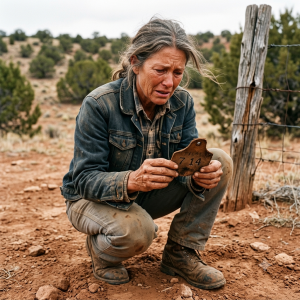
His name was Earl Vásquez. And he was the kind of man who still hand-stamped his own leather tags for the fence posts — an old surveyor’s habit from before he ranched full-time. Each one burned careful and exact, with the property mark and the date.
I used to find them as a little girl. Tucked onto boundary stakes around the edges of our land.
I thought they were the most beautiful things in the world.
—
Daddy died three years ago. Stroke. Gone before the ambulance cleared the county line.
And six weeks after the funeral, I found out I’d been removed from the deed.
Quietly. Completely.
Replaced by a half-brother named Garrett, who I had never once heard my father mention. A man with Daddy’s jaw and none of his manners, who showed up at the property with a lawyer and a smile that didn’t reach his eyes.
The ranch — my grandfather’s land, my childhood, every summer of my life — belonged to him now.
I didn’t fight it. I didn’t have the money, and honestly, I didn’t have the heart. Some losses just swallow you whole.
I moved to Clovis. Got a seasonal position with the county land office. Started driving out to survey parcels all across eastern New Mexico, just me and my truck and a kit full of equipment.
It was honest work. It kept me moving. And moving was the only thing keeping me from falling apart.
—
Last month, my supervisor handed me a new file.
I almost dropped my coffee.
The parcel address was our road. Our section number.
It was the ranch.
Garrett had filed for a boundary adjustment, and the county needed an independent survey. My supervisor didn’t know. How could he? My married name is different. Nobody connected it.
I almost asked to be reassigned.
Almost.
But something made me take the file. Something I still can’t fully explain.
—
The first day I drove out, I cried the whole way down the red clay road and didn’t let myself cry once I got there.
I walked the fence lines. I took my measurements. I did my job.
And then, on the northeast corner stake — the one that marks the edge of what used to be the family cemetery plot — I found something that stopped me cold.
A leather tag.
Hand-stamped. The old kind.
Daddy’s kind.
I told myself it was old. Leftover from years ago, just weathered and still hanging on. I photographed it and kept walking.
But the next day, on the western boundary, there was another one.
On a stake I had placed myself the afternoon before.
A stake that hadn’t had anything on it when I left.
I stood there in the morning quiet with the wind coming across the mesa, and I felt the hair rise on the back of my neck.
The leather was fresh. The stamping was crisp.
It was exactly the way Daddy made them.
—
I told myself there was an explanation. Garrett, maybe, trying to mess with me — somehow knowing who I was. Or an old ranch hand who remembered Earl’s methods.
I kept surveying. I kept finding them.
One on the south gate post. One tucked into the split-rail corner by the stock tank where I learned to swim.
Every single one in a spot that meant something to me personally.
Not the legal boundaries. Not the disputed lines Garrett cared about.
The places that were mine.
—
On the fourth day, I found one on the stake closest to the house.
The porch where Mama used to shell peas. The window of the room where I was born.
I picked it up.
Turned it over the way Daddy always did — because he said the back was where the real mark went, the one that mattered, the one just for family.
And I saw something burned into the leather in a hand I would know anywhere.
My name.
Not the married one.
My born name. His name for me.
And a date.
A date from six weeks after Earl Vásquez was supposed to have died.
I sat down in the red dirt right there in the middle of the field, and I couldn’t breathe, and I couldn’t speak, and every single thing I thought I knew about what happened to this land and to my father started to crack open like the desert after rain.
Because either someone was doing something very cruel.
Or my daddy had been alive.
And he had left me a message that only I would ever find.
—
I sat in that dirt for a long time.
The sun moved. A red-tailed hawk crossed the mesa from west to east. The cattle in Garrett’s far pasture made their slow, indifferent sounds.
And I held that little piece of leather in both hands like it was the most fragile thing on earth.
The date burned into the back was October 14th. Three years ago. I knew that date. I had been at a funeral on that date. I had stood at a grave at the Quay County cemetery on that date, in a black dress that was too tight in the shoulders because I’d bought it in a hurry, and I had thrown a handful of red dirt onto a casket.
Daddy had been cremated, they told me. The casket was just for the service. A formality.
I had not thought to question that at the time. I had been too broken to question anything.
I stood up. I brushed the dirt off my jeans. I walked back to my truck.
And I drove to the Tucumcari Public Library, because it had better internet than anywhere else in town and because I needed to sit somewhere with other people around me, somewhere public, somewhere that would keep me from doing something I couldn’t take back.
—
I want to be clear about something before I go further.
I am not a dramatic person. I am not someone who looks for signs or sees patterns where there aren’t any. I am a land surveyor. My entire profession is about precision and evidence and what can be proven on paper.
What I did next, I did carefully.
I started with the obituary.
Earl Vásquez, 67, of Tucumcari, New Mexico. Survived by his son, Garrett Vásquez. No mention of me. I had noticed that at the time, had let it land like a slap and then kept moving. But now I looked at who had submitted it.
Garrett had submitted it. Garrett, who I’d never heard of until six weeks after the funeral.
The funeral home was listed. A place in Tucumcari I didn’t recognize, smaller than the one our family had always used, out on the highway toward Amarillo. I wrote down the name.
Then I pulled up the Quay County property records. I knew how to do this — it was my job. I found the deed transfer. It had been filed October 2nd, twelve days before the date on that leather tag.
Twelve days before October 14th.
Which meant, if that date meant what I thought it meant — if Daddy had burned it in himself, alive — he had been alive when the deed was already gone.
He had known.
I sat with that for a long time.
Then I searched for Garrett Vásquez, and what I found made my stomach turn to cold water.
Garrett wasn’t from New Mexico. He was from Odessa, Texas. He had a real estate license he’d had for eleven years. He had been involved in three civil suits over property transactions, all settled quietly, none of them resulting in criminal charges. The kind of record that doesn’t look like much until you know what you’re looking at.
I knew what I was looking at.
—
I drove back out to the ranch the next morning.
I wasn’t on the survey clock. This was personal.
I parked at the gate and walked the whole property on foot, the way I had as a girl. I wasn’t looking for stakes this time. I was looking for my father.
Not his ghost. Not some impossible thing.
I was looking for what he had left me to find.
Because that’s what those tags were. I understood that now. They weren’t just comfort or proof of life. They were a map. They had always been a map. He had placed them at the spots that meant something to me specifically — the cemetery corner, the stock tank, the south gate, the house. Not randomly. Not decoratively.
He was pointing at something.
I just had to figure out what.
I walked to each spot in order. The cemetery corner. I got down on my knees and looked at the post, really looked at it. Nothing unusual. But when I pulled the stake and checked the ground beneath it the way you do when you’re verifying a corner monument — packed earth, a little loose, recently disturbed.
I used my flagging tool to dig down maybe four inches.
A tin box. The kind you’d put index cards in. Sealed with electrical tape around the lid.
My hands were shaking so badly I could barely get the tape off.
Inside, folded into a square and then folded again: a letter.
And clipped to the letter, a key.
—
I’m going to share parts of what that letter said, but not all of it, because some of it is still private, still just mine, and I need to keep something for myself after all of this.
What I can tell you is this.
My father did not die on September 28th three years ago.
He had a stroke — that part was real. Severe enough that he’d been transferred to a hospital in Albuquerque, away from anyone who knew him, and during that hospitalization Garrett had appeared. Daddy had known about Garrett. He was the son of a woman from Daddy’s life before my mother, a woman he’d had no contact with in forty years. Garrett had somehow found out Earl was sick, had come to the hospital, and had presented himself as next of kin.
Daddy was not fully coherent for almost three weeks after that stroke. He would learn later, once he recovered more of himself, what had been signed in his name during that time. What had been transferred. What had been filed.
He wrote in the letter: “I couldn’t prove what had been done to me. I couldn’t prove what had been done to you. And a man with a lawyer can move faster than a man learning to walk again.”
He had been living, for the past three years, with an old family friend outside of Anton Chico, a woman named Celestina who had known my grandfather. A woman so far off the grid she didn’t have a listed phone number, only a P.O. box in Mora County.
He had not contacted me directly because he was afraid Garrett would find out I was involved. He knew Garrett was watching for any challenge to the deed. He knew if Daddy surfaced, Garrett’s lawyers would tie it up in court for years, drain every resource either of them had. He had been waiting. Building something that couldn’t be torn apart in a courtroom.
And then the county assigned the survey to me.
He wrote: “I didn’t arrange that. I want you to know I didn’t arrange that. But when Celestina’s grandson told me a woman named Ramírez was assigned to survey the Vásquez parcel, I thought maybe your grandfather was still looking out for us both.”
He had come out at night. Three nights in a row.
Placed the tags.
Waited to see if I would understand.
—
The key in the tin box was for a safe deposit box at a bank in Santa Rosa.
In that safe deposit box — and this is the part that took my breath away, that takes my breath away still — was three years of work.
My father had spent three years building a case.
Medical records from the Albuquerque hospital, showing his condition during the period the deed was transferred. A signed statement from a nurse who had been present during one of Garrett’s visits, who had written down her concerns at the time and kept a copy. Bank records showing transfers Garrett had initiated from a joint account — an account Daddy hadn’t known was joint until the money was gone.
An affidavit from Celestina, notarized, documenting when my father had arrived at her home, his physical and mental state, and the timeline of his recovery.
And a second deed.
Handwritten, witnessed, and notarized — executed on October 14th, three years ago, the date on the leather tag.
A deed returning the 640 acres of the Vásquez family ranch to me.
His signature, witnessed by Celestina and her grandson. A notary stamp from a woman in Mora County.
It wasn’t filed. He hadn’t filed it. He’d been afraid to, afraid it would tip Garrett off before everything else was in order. But everything else was in order now. He’d been waiting for a way to get it to me that Garrett couldn’t intercept.
He had waited for me to come home.
—
I called an attorney from the parking lot of that bank in Santa Rosa. I sat in my truck with the safe deposit box on the passenger seat and I called a property law attorney in Albuquerque whose name I’d gotten from a colleague, and I told her the short version of the story, and she was quiet for a moment and then she said: “Can you come in tomorrow morning?”
I said yes.
Then I drove to Anton Chico.
—
I’m not going to describe that reunion in detail. Some things I’m keeping.
I’ll say this: he was thinner. He walked with a cane. His hair had gone fully white, which it wasn’t before. He cried when he saw me, and I cried, and we stood on Celestina’s porch in the November cold for a long time without saying anything at all.
He smelled like woodsmoke and leather and piñon trees, the same as he always had.
He said: “I’m sorry it took so long. I had to do it right. I had to make sure it would hold.”
I told him it was going to hold.
—
Here is where we are now.
The civil case is filed. The attorney — her name is Dolores Vigil and she is exactly the kind of woman you want on your side — called it one of the more clear-cut cases of elder financial exploitation she had seen, with documentation this thorough. Garrett’s lawyers have been quiet in a way she says usually means they’re calculating how to settle.
Daddy is in Tucumcari now. Renting a small house on the edge of town while everything moves through the legal process, which is slow and will continue to be slow. But he’s here. He goes to mass at the same church he has attended since he was seven years old. He had coffee last week with three men he has known for fifty years, men who thought he was dead, and I imagine that conversation was something to witness.
Garrett has not been back to the ranch since the case was filed. Celestina’s grandson, who is young and observant, says the cattle have been sold off already, which the attorneys say is relevant. You can’t sell off assets you might have to return without consequence. Dolores Vigil does not seem like a woman who forgets things like that.
The ranch sits empty right now, waiting. The red clay roads and the piñon trees and the old split-rail corner by the stock tank where I learned to swim.
I drive out there sometimes, in the evenings, just to the gate. I don’t go in. It’s not mine yet in the eyes of the law, and I’m not going to give anyone a reason to complicate that.
But it’s mine.
I know it’s mine because my daddy told me so in a language he invented for me before I was old enough to read. In burned leather and old stakes and the specific geography of everything he knew I loved.
—
People have asked me how I feel about the three years. About the grief I carried for someone who was alive. About missing his presence through all the ordinary days, the things I didn’t get to tell him, the ways I changed that he didn’t get to see.
I don’t have a clean answer for that. I don’t think there is one.
What I know is this: he didn’t choose to disappear. He chose to fight in the only way he thought would work, slow and careful and documented, against a man who had moved fast and dirty and had a head start. He spent three years building something that couldn’t be undone in a courtroom.
He spent three years waiting for a chance to give it back to me.
I think about the night he came out to that ranch with his leather and his stamp and his cane, in the dark, working by feel and memory on ground he’d walked ten thousand times. Placing each tag at each spot as carefully as he’d placed every fence post he ever drove.
Not screaming into the void.
Not giving up.
Just doing what he’d always done. Marking what was his. Marking what was mine. Trusting I would know the difference.
He always said the back was where the real mark went. The one that mattered. The one just for family.
He was right.
He was always right about that.