By the time Marcus Whitfield stepped through the revolving doors of the Aldridge Grand Hotel, he was running on the kind of exhaustion that left a man moving carefully, not because he had energy to spare, but because one wrong motion might break the last fragile thing he was carrying.
That fragile thing was his daughter.
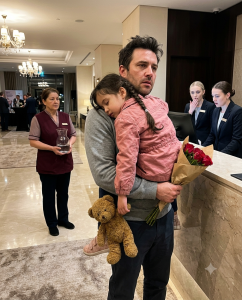
Sophie slept against his chest, one small arm wrapped loosely around a threadbare teddy bear, her cheek pressed into the collar of his jacket. She was six years old, warm and limp with trust, the kind of trust children give without hesitation when they believe their parent can still hold back the world.
Marcus held her like he was trying to keep that belief alive.
In his other hand, he carried a bouquet of red roses he’d bought at the airport during a rushed layover. The flowers had suffered for it. A few outer petals were bent. The stems were pinched too low where his grip had tightened during the delay, the landing, the taxi ride, and the long walk through the polished entrance of a hotel he knew better than almost anyone alive.
The Aldridge Grand wasn’t just another place to sleep.
It was one of his.
The seventh property in the chain he had built over eleven relentless years, one deal, one risk, one sleepless quarter at a time. Marcus knew the lobby’s lighting design because he had approved it. He knew the marble had been imported after six weeks of arguments over cost. He knew the scent diffused through the air near the elevators because Elena had once laughed and said, “If you’re going to build expensive hotels, at least make them smell like peace.”
That memory hit him hard as soon as he walked inside.
Tomorrow would mark three years since Elena died.
Every year since, no matter what else was falling apart, Marcus and Sophie had observed the same ritual. Roses. A vase. A framed photograph on the table at home. Sophie always chose the vase as if the decision mattered enormously. Marcus always trimmed the stems. Together they stood before Elena’s picture and let silence do what words never could.
This year, a delayed flight and a last-minute meeting had stolen home from them. Marcus had hated that. Sophie had asked twice whether Mommy would “mind” if the flowers were somewhere else this year. Marcus had told her no. Love didn’t live in addresses.
Still, he had promised there would be roses.
That promise was why he was holding them now.
He crossed the lobby without drawing attention to himself. He could have called ahead. He could have had the general manager waiting at the entrance. He could have used the ownership status attached to his name and asked for the presidential suite, a driver, and a private dining room.
He didn’t do any of that because, every few months, Marcus liked to arrive unannounced. No entourage. No warning. No title. It was the only way to see a hotel honestly.
A property always behaved differently when it thought no one important was watching.
At the front desk, two women stood beneath the soft downlights.
The first, Clare, was immaculate in every visible way: navy blazer, gold nameplate, hair drawn into a neat low bun. The second, Ranatada, leaned slightly beside her in a cream blazer, one manicured hand near her phone, her expression cool enough to make a person feel like they were interrupting a better evening.
They both looked up at Marcus.
He recognized the look instantly.
Assessment. Categorization. Decision.
A wrinkled jacket. Airport fatigue. Old leather bag. Unshaven face. Sleeping child. Cheap-looking flowers in a crushed fist.
Not worth much.
“Good evening,” Marcus said softly, careful not to disturb Sophie. “I have a reservation under Whitfield.”
Clare typed, but without urgency. Her fingers moved just enough to suggest effort. After a moment, she looked at the screen, then at him.
“I’m not seeing anything under that name.”
“It may have been booked through corporate,” Marcus said. “Would you mind checking again?”
A tiny breath escaped her nose. Not quite a sigh. Something more polished than that, but with the same message.
“Sir, even if there was a reservation issue, we’re fully booked. There’s a corporate event upstairs. We don’t have anything available.”
Marcus shifted Sophie gently. She murmured against his chest, clutching the teddy bear, then settled again.
“I understand,” he replied. “But we’ve had a long day. My daughter needs a bed. Please check one more time.”
Ranatada looked up then, but not at his face. At the roses. The jacket. The bag. Then Sophie.
“At times like this,” she said smoothly, “calling ahead is usually the best approach. Unexpected problems aren’t always the hotel’s fault.”
The words were clean. Elegant. Almost soft.
That made them crueler.
Marcus felt something inside him go very still.
He had spent years training managers across his properties with the same principle repeated until it became culture: tired guests are not problems. They are people. Especially the ones arriving late, grieving, carrying children, trying not to unravel in public.
Apparently, culture had not reached this desk.
“May I speak to the manager?” he asked.
Clare smiled in a way that contained no warmth at all.
“He’s tied up with the event. I can’t pull him away over a room that doesn’t exist.”
Marcus looked down at Sophie.
Three years since Elena’s death, and he still had nights when grief hit not as tears, but as humiliation. The kind that made ordinary setbacks feel personal. The kind that turned a missing room into proof that the world had no patience left for tired people keeping promises to the dead.
He was about to reach for his phone when a side door near the concierge station opened.
A housekeeping attendant stepped out, guiding a cart stacked with folded sheets and fresh towels. Her burgundy vest was pressed but modest. Her name tag read Dolores.
She was perhaps in her early fifties, with silver threaded through dark hair and eyes that noticed more than decor. She took in the scene in a single sweep: the sleeping child, the flowers, the posture at the desk, the tension no one had yet named.
Then she parked the cart and approached.
“Excuse me, sir,” she said softly. “Is everything all right?”
Marcus looked at her.
In a lobby full of polished surfaces, she was the first thing that felt genuinely human.
“I have a reservation,” he said. “They can’t find it.”
Dolores turned toward Clare. “Did you check the corporate block?”
Clare’s expression tightened. “I checked the system.”
“That isn’t what I asked,” Dolores replied, still calm. “Did you check the corporate block? Executive reservations can sit in the secondary tab.”
Ranatada crossed her arms. “Dolores, this is reception.”
“And he’s still a guest,” Dolores said.
The silence that followed changed the room.
Clare turned back to the monitor. This time there was irritation in her movements. Click. Pause. Another click.
Then her face altered.
“It’s here,” she said, too quietly at first. She cleared her throat. “Whitfield. Ninth-floor suite. Executive category.”
Marcus didn’t answer.
Dolores’s attention shifted to the bouquet.
“They’re bruised,” she said gently. “Are they for someone special?”
Marcus lowered his gaze to the red petals.
“For my wife,” he said. “Tomorrow makes three years since she passed.”
The words seemed to settle differently in the air than everything else had.
Dolores looked at Sophie, sleeping through all of it.
“Then those flowers shouldn’t arrive in your room like that,” she said. “Please wait here. I’ll bring you a vase.”
She took the bouquet from him with both hands.
It was such a small act. But it was the first moment of care he had been shown all night, and Marcus felt it with almost painful force.
As Dolores stepped away, Clare stared harder at the reservation record.
Then she saw what she had missed.
Not just the room class. Not just the corporate code.
The ownership profile attached to the booking.
Marcus Whitfield. Registered owner, Aldridge Hotel Group.
The color drained from her face.
Ranatada leaned in. Her posture changed at once.
“Mr. Whitfield…” Clare said, barely above a whisper.
Marcus lifted his eyes.
He watched the fear move through them both. The instant recalculation. The brutal speed of respect arriving only after status had.
Ranatada’s tone changed first. “Sir, if we had realized—”
“That’s the problem,” Marcus said.
He didn’t raise his voice. He didn’t need to.
Across the lobby, the ballroom doors opened and released a spill of music and laughter from the corporate event upstairs. A few guests looked over. Someone from the event paused near the bar, sensing tension and not understanding it.
Marcus turned back to the desk. “I’d like to speak to the general manager. Now.”
This time, no one said he was unavailable.
Clare reached for the desk phone with unsteady hands, but she didn’t get far. The event doors opened again, and Daniel Reeves, the hotel’s general manager, stepped into the lobby mid-conversation with two regional executives.
Daniel was smiling until he saw Marcus.
Then the smile vanished.
The executives beside him noticed the change and fell silent.
“Mr. Whitfield,” Daniel said at once, hurrying forward.
Marcus glanced at Sophie. “Lower your voice.”
Daniel obeyed immediately. That alone told the entire desk more than any title could have.
By then Dolores had returned with a glass vase, clean and filled, holding it with careful dignity. She stopped a few feet away when she sensed the shift in the room.
And suddenly the whole scene stood exposed in one image Daniel could not defend: the owner of the hotel, carrying a sleeping child and roses for his dead wife, had been treated as a nuisance while the only person who offered him compassion was a housekeeper.
Daniel looked to the screen. Then to Clare. Then to Ranatada.
“What happened?” he asked quietly.
Clare began speaking too fast. “It was in a secondary tab, and I—”
Ranatada cut in. “There was confusion with the reservation display—”
Daniel leaned across the desk and pulled up the audit trail himself. His jaw tightened.
The booking had been there. Visible. Properly coded. Time-stamped. Unmistakable to anyone who had looked carefully enough to want to help.
Not a system failure, then.
A choice.
Marcus watched Daniel come to the same conclusion.
“My daughter needed a pillow,” Marcus said. “Your staff gave her judgment.”
The words landed harder than anger would have.
Daniel swallowed. “Mr. Whitfield, perhaps we should continue this in my office.”
Marcus glanced toward the ballroom, where more event guests were beginning to spill into the lobby between speeches. Executives. Department heads. Sponsors. People who had spent the evening praising the Aldridge brand.
“No,” Marcus said. “We’ll do it here.”
Daniel’s expression changed. He understood instantly. This was no longer about protecting embarrassment. This was about confronting a culture failure where that culture had failed.
The regional executives stepped back, saying nothing. Around them, conversations quieted. Clare’s composure cracked. Ranatada stood unnaturally still.
Marcus turned first to Dolores.
“Thank you,” he said.
She handed him the vase, her voice low and steady. “Your wife deserved better than crushed flowers.”
The line nearly undid him.
He set the vase carefully on the desk beside the monitor and adjusted Sophie against his shoulder. She stirred, blinking awake at last. Her eyes were hazy with sleep.
“Daddy?” she whispered.
“I’m here,” he said.
She looked around the bright lobby, then at the roses now standing properly in water. “You fixed them.”
Marcus swallowed. “Someone kind helped us.”
Sophie turned her sleepy gaze toward Dolores and offered the small, solemn smile only children can give. Dolores smiled back.
That was when Marcus made his decision.
He faced Daniel. “Effective immediately, Clare and Ranatada are suspended pending termination review for refusal of service, discriminatory conduct, and violation of guest care policy.”
Clare made a shocked sound. “Mr. Whitfield, please—”
He didn’t look at her.
Daniel nodded once, already knowing there was no path back. “Understood.”
Marcus continued. “You’re suspended as well, Daniel.”
The manager stared at him. “Sir?”
“You were unavailable at the front desk during a full lobby arrival window because you chose to prioritize optics upstairs. I built this company on the belief that service starts where inconvenience begins. You allowed that principle to disappear.” Marcus paused. “If housekeeping understands our values better than management, management has already failed.”
Daniel’s face lost all color.
One of the regional executives stepped forward as if to intervene, then thought better of it.
Around the lobby, no one pretended not to be listening anymore.
Marcus turned to the executive. “I want HR on-site first thing in the morning. Full review of guest complaints from the last twelve months. Audit all check-in denials, upgrades, and compensation reports. I want to know how many tired people were treated the way my daughter was tonight.”
The executive nodded immediately.
Then Marcus looked to Dolores.
She seemed almost ready to step back, as if this had gone far beyond anything she wanted to stand inside.
“How long have you worked here?” Marcus asked.
“Twelve years, sir.”
“And how long have you been quietly fixing what other departments miss?”
Dolores hesitated. “Long enough.”
A few people in the lobby laughed softly under their breath. Not because it was funny, but because it was true.
Marcus gave the smallest nod. “As of tomorrow, you’ll move into guest relations management on an interim basis while corporate completes formal review.”
Her eyes widened. “Sir, I’ve never—”
“You saw a child before you saw a problem,” Marcus said. “That’s harder to teach than software.”
For the first time that night, the lobby felt different. Not softer. Not lighter. But cleaner somehow, as if something false had been stripped away.
Sophie rested her head back on Marcus’s shoulder. “Can we go to the room now?” she mumbled.
Marcus smiled for the first time since entering the hotel.
“Yes,” he said. “We can.”
Dolores took the bag from his shoulder before he could protest. One of the bell staff, who had watched the whole scene in horrified silence, hurried to help with the rest. No one needed instructions anymore.
As Marcus turned toward the elevators, Daniel spoke once more, his voice low with the weight of consequences.
“Mr. Whitfield… I’m sorry.”
Marcus stopped but did not turn around immediately.
When he finally did, his face held no triumph. Only fatigue. And something sadder.
“I know,” he said. “That’s what makes it expensive.”
He rode upstairs with Sophie half asleep against him, the roses upright in their vase, and Dolores beside him carrying the bag as if it were the most natural thing in the world.
In the suite, Sophie insisted on helping place the flowers near the window first, before pajamas, before brushing teeth, before anything else. Marcus found a small side table and set Elena’s roses there while city lights flickered beyond the glass.
Sophie stood on tiptoe and touched one petal.
“Mommy would like these,” she whispered.
Marcus knelt beside her. “She would.”
That night, after Sophie fell asleep across the wide hotel bed with her teddy tucked under her chin, Marcus sat alone near the vase and looked at the roses for a long time.
He thought about Elena, who had always been able to tell within thirty seconds whether a person was kind or merely polished. He thought about how easily power could disguise rot, and how often true grace wore no title at all.
In the morning, the formal process began. Complaints were uncovered. Patterns emerged. Other staff came forward. By the end of the week, Clare and Ranatada were gone. Daniel resigned before the board could finalize his removal. Dolores accepted the interim role only after making Marcus promise she could still tell people the truth when they were wrong.
He promised.
Months later, guest satisfaction at the Aldridge Grand had risen sharply. Staff turnover dropped. Reviews mentioned warmth, care, dignity, and one manager by name who always noticed when a child was tired or a traveler looked close to tears.
Marcus kept one of those reviews.
Not because it praised the hotel.
Because it reminded him how close he had come to forgetting that the soul of a place is never measured by marble, event revenue, or chandelier light. It’s measured by what happens when someone weary walks through the door carrying more than they can comfortably hold.
And sometimes the biggest red flag isn’t open cruelty at all.
It’s how quickly respect appears the moment a name becomes important.