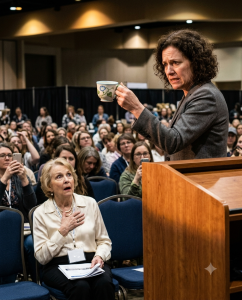
She was halfway through the walk from backstage to the podium when she saw the name tag.
Vendor Applicant.
At first, it barely registered. The ballroom lights were hot and white, the applause was swelling, and the convention coordinator was still whispering reminders near her elbow about timing, sponsors, and where to stand for the photographers. Carla Jean Hobbs had delivered talks before. She had stood on stages in New York, Atlanta, and Chicago. She had spoken to culinary schools, gallery patrons, and artisan groups who treated her like proof that handcrafted work could still matter in a world that wanted everything faster and cheaper.
But this was different.
This was Pigeon Forge.
The same fairground. The same county. The same heavy mountain air pressing against the walls. Thirty-three years had passed, and she had returned not as the twenty-four-year-old girl who once taped her own handwritten price cards to a folding table, but as the keynote speaker of the largest artisan convention in the country.
Then she saw the woman in the front row.
Cream blouse. Pearls. Back still straight despite the years. A convention packet in her lap and a rectangular tag clipped neatly to her collar.
Margaret Hollowell.
Carla Jean’s hand moved to her jacket pocket on instinct. Her fingers closed around the small curved shape she had carried into more rooms than anyone knew.
Still there.
Still whole.
The coordinator was introducing her now, listing awards, exhibitions, and honors she still didn’t quite know how to hear without flinching. Two-time James Beard honoree for craft excellence. Ceramicist. Studio founder. Mentor. Collector favorite.
None of that was what she felt in that moment.
What she felt was August heat. Asphalt glare. Newspaper tearing in shaking hands. The sound of a box striking pavement.
By the time she reached the podium, she knew exactly what she was going to do.
She set her notes down. Then, beside them, she placed the tiny teacup.
The gesture was so small most people wouldn’t have thought much of it. But people always noticed unusual objects on stages. Heads tilted. A few audience members leaned sideways to get a better look. The cup was delicate enough to seem almost lost against the polished wood, a pale little thing with a hand-painted morning glory curling around the handle.
Carla Jean looked up and found Margaret already staring at it.
Good, she thought.
Let her remember.
The applause died away. The room settled.
“Before I begin,” Carla Jean said, her voice even, “I’d like to return something that was never really yours to take.”
A tremor moved through the front rows. Not loud, not visible from the back, but enough. Enough for Carla Jean to know that people sensed they had been dropped into the middle of something real.
She lifted the teacup into the light.
Margaret’s face drained of color so quickly it looked almost unnatural.
And just like that, thirty-three years fell away.
In 1991, Carla Jean Hobbs was still balancing trays at Cracker Barrel and throwing clay in a borrowed studio after hours. She lived in a narrow apartment in Maryville where the kitchen window stuck in humid weather and the plumbing rattled every time the upstairs neighbor showered. She did not have backup savings, family connections, or a trust fund quietly smoothing out the rough edges of life. What she had was an old coffee tin full of tips and a certainty she couldn’t fully explain to anyone: when her hands touched clay, she felt less lost.
The craft fair in Pigeon Forge had seemed like a beginning.
She had spent eleven months saving for it. Eleven months of double shifts, aching arches, grease burns, and saying no to every unnecessary expense. At night she attended pottery class, then stayed late cleaning tools in exchange for extra wheel time. Her wrists throbbed. Her nails were permanently lined with clay. But she kept going.
The morning of the fair, she arrived before sunrise and laid out forty-seven pieces on a blue gingham tablecloth her grandmother had sewn years earlier. She arranged mugs by glaze tone, stacked bowls by size, placed the canister set in the center where it could catch the light. The teacup she could not bring herself to price.
It was small, elegant, and quietly perfect.
For the first time in her short pottery life, she had made something that felt complete without apology.
So she kept it in her apron pocket.
By ten o’clock, she had sold six pieces. A few more people lingered nearby, and she had begun to allow herself dangerous thoughts. Maybe she had underpriced the mugs. Maybe galleries wouldn’t laugh her out of the room forever. Maybe this could become something.
Then Margaret Hollowell stepped into the booth.
Margaret had always dressed as though she expected to be observed. Even in summer heat, she looked crisp and expensive. Carla Jean knew her from two years of strained holidays, clipped lunches, and the never-spoken-but-always-felt knowledge that Daniel Hollowell’s mother disapproved of her.
Daniel, Margaret believed, was meant for polished women from polished families. He was not supposed to fall in love with a waitress who wanted to make pottery.
Margaret inspected every piece in silence.
Then she bought all of them.
For a few stunned minutes, Carla Jean thought she had been wrong all along. Thought perhaps Margaret was making some awkward peace offering. Thought perhaps this rigid woman had seen the work and, despite herself, recognized its worth.
That hopeful little fantasy lasted until the parking lot.
The first box hit the pavement with a sound Carla Jean would later hear in dreams.
The second followed.
Then the third.
Mugs split into jagged halves. Bowls burst into fragments. The beautiful persimmon canisters shattered so completely they looked like they had never existed as anything but ruin. People stopped to watch. Some winced. Nobody intervened quickly enough.
Margaret stood there, elegant and merciless.
“I want you to understand,” she said, “that charity work is the only reason anyone would own something so crude. I’m doing you a kindness by making sure no one else has to pretend.”
Then she turned and left.
Carla Jean remembered little about the drive home except the heat and the numbness. She remembered placing the teacup on her windowsill and staring at it. Remembered the tears finally coming in a violent rush. Remembered the strange stillness afterward.
Then she washed her face.
If she had quit that day, everyone would have understood. Maybe even admired the practicality of it. She could have married someone else, stayed in restaurants, told the story later as one of those youthful humiliations that teach you realism.
Instead, she made herself a promise.
No one would ever be able to dismiss her work like that again.
The years that followed were unglamorous in ways success stories rarely describe honestly. Grants were denied. Gallery submissions were ignored. Kilns malfunctioned. She lost money on events. She carried boxes in rain, set up booths with the flu, and sold enough work some weekends to fill her gas tank and not much more.
But she improved.
Every rejection sharpened her discipline. Every failed glaze test taught her something. Every small sale gave her one more reason not to stop.
And always, the teacup stayed near her.
Not on display. Not as some theatrical symbol. It was private. Proof more than inspiration. A reminder that not everything from that day had been destroyed.
In 1998, she opened a studio in Knoxville, tiny and underfunded but hers. In 2007, four galleries took her work. A food stylist used one of her bowls in a national magazine spread, and suddenly inquiries multiplied. Chefs began commissioning tableware. Collectors started calling. Her prices rose because demand did. The work deepened, too. What people responded to wasn’t trendiness. It was emotional precision. Her glazes held softness without sentimentality. Her forms felt handmade without being rustic for effect. They had authority.
Years later, when journalists asked about her artistic voice, Carla Jean usually smiled and said she had learned early not to waste time trying to imitate what impressed cruel people.
But there was one part of the story she almost never told.
In 2001, she attended a gallery opening in Chattanooga and saw Daniel Hollowell for the first time in nearly a decade.
He looked older than he should have. Not in face, exactly, but in posture. Like life had worn him in places she couldn’t immediately see. They spoke politely at first. Then less politely. Then honestly.
He apologized for not defending her better when they were young.
He admitted he had come to her apartment the night before the fair in 1991, hoping to convince her not to set up. He had been afraid. Margaret had discovered that he had quietly used money from the family business to help Carla Jean pay the vendor fee, believing in her when no one else with power seemed to. Margaret was furious. Furious not only about the money, but about what it represented: investment, belief, legitimacy.
“She knew you were talented,” Daniel told her that night in Chattanooga. “That was the problem. If you had actually been harmless, she would’ve ignored you.”
Carla Jean never forgot those words.
Years later, after Daniel died unexpectedly following a brief illness, a letter arrived in Carla Jean’s mailbox. His handwriting. Several pages. In it, he said things he had not managed to say well in person. He took responsibility for his cowardice. He described the argument with his mother before the fair, her insistence that she would put an end to “the fantasy.” He confessed that the cash Margaret used to buy Carla Jean’s work had been withdrawn from the same account he had tapped to help her in the first place.
And on the last page, he included one final detail.
After smashing the pottery, Margaret had ordered him to collect every broken piece before anyone could salvage them.
“She couldn’t stand the idea that even in fragments, someone might see beauty,” he wrote.
That line stayed with Carla Jean.
Now, standing on stage in Pigeon Forge, she looked at Margaret and understood that the years had not erased anything. Time had changed the setting, the clothing, the status, the audience. It had not changed the truth.
Margaret was trying to re-enter the artisan world as a vendor.
Carla Jean was the woman opening the convention.
How strange life could be.
She did not raise her voice. She didn’t need to.
“In 2001,” she said into the microphone, “I learned that what happened in this building decades ago was not just cruelty. It was fear.”
The room was utterly still.
Margaret rose halfway from her seat. “This is inappropriate,” she said, and the old steel was there, thinner now but recognizable.
Carla Jean nodded. “Public humiliation usually is.”
A murmur ran through the crowd.
Carla Jean held up the teacup. “This survived because you didn’t know it existed. For years, I carried it with me as proof that destruction isn’t always complete, no matter how badly someone wants it to be.”
Margaret’s mouth tightened. “You don’t get to rewrite history.”
“No,” Carla Jean said softly. “But I do get to stop protecting yours.”
She reached down and lifted a folded envelope from beneath her notes.
The convention director, seated near the stage, looked startled. Several people in the audience had their phones up now, though none of that mattered to Carla Jean anymore. She wasn’t performing. She was finishing something.
“This is a letter from your son,” she said. “He wrote it six months before he died.”
Margaret went completely still.
Carla Jean did not read the whole letter. She didn’t need to. She read the lines that mattered. About the vendor fee. About the threat. About the order to collect the broken pieces so no one would take them home. About the shame Daniel had lived with for years because he had let his mother define power as humiliation.
When she finished, the silence in the ballroom felt heavier than any applause she had ever heard.
Margaret stood fully now. For one second Carla Jean thought she might march onto the stage. Instead, she only said, “He was emotional. He exaggerated.”
Then, from the side aisle, a new voice cut through the room.
“He did not.”
Everyone turned.
A woman Carla Jean recognized only after a beat was standing there with a lanyard around her neck and a vendor folder tucked under one arm. Elise Martin. Forty years ago, she had been a teenager helping her parents run a glassware booth at that same fairground. Carla Jean remembered her vaguely because Elise had been one of the people who saw the shattered pottery in the parking lot.
Elise stepped forward. “I watched you do it,” she said to Margaret. “And I watched your son cry while he picked up the pieces you told him to gather. My mother kept two shards after he missed them, because she said one day that girl might need proof nobody imagined it.”
The room broke open.
Whispers. Sharp breaths. Chairs shifting.
Elise reached into her folder and drew out a small padded envelope. Inside were two curved fragments of persimmon-orange ceramic.
Carla Jean stared at them, stunned. She had spent years believing all of that work was gone forever.
Elise looked at her gently. “I’ve carried these to three conventions hoping I’d run into you.”
Carla Jean accepted the fragments with careful hands. They were warm from the room, imperfect, and unmistakably hers.
The convention board chair rose from her seat in the front section. “Mrs. Hollowell,” she said in a measured voice, “I think it would be best if you stepped out with us.”
Margaret looked around the room, perhaps expecting sympathy, or at least hesitation. She found neither. Only faces closed against her. Faces of artisans who knew exactly what it meant to pour labor, hope, and selfhood into fragile things.
For the first time Carla Jean had ever seen, Margaret Hollowell looked small.
She left without another word.
The ballroom doors closed behind her.
Nobody clapped. It wasn’t that kind of moment.
Carla Jean stood there with the teacup in one hand and the old shards in the other, feeling something inside her shift loose at last. Not triumph. Not revenge. Something quieter. Something like the end of carrying a weight so long you had forgotten your body had adjusted around it.
She looked out at the audience.
“When people talk about resilience,” she said, “they often make it sound noble and graceful. Most of the time it isn’t. Most of the time it’s humiliating and stubborn and fueled by the refusal to let another person define what your work is worth.”
This time, when the applause came, it came slowly and then all at once.
After the keynote, the board formally denied Margaret’s vendor application. Several attendees approached Carla Jean in tears. Others brought their own stories: teachers who mocked them, parents who sabotaged them, spouses who sneered at their ambitions until success made those same ambitions look respectable.
Elise stayed until the room had mostly cleared.
Over coffee in a side lounge, the two women talked. Elise told her mother’s version of the story, how she had wrapped the ceramic shards in tissue and tucked them into a kitchen drawer because she couldn’t stand the ugliness of what she had witnessed. Years later, after her mother died, Elise found them again with a note: In case the artist ever needs to know someone saw.
Carla Jean laughed then, though it came with tears. “I thought all that survived was the teacup.”
Elise smiled. “Apparently not.”
A month later, Carla Jean returned to her studio in Knoxville and did something she had not expected to do. She took the two persimmon shards and built a small shadow box around them with the teacup mounted beside them. She did not place it in the gallery area where customers could ask about it. She hung it in the workroom near her wheel, where only people close to the making would see.
Below it, on a narrow strip of paper, she wrote four words:
Still here. Still mine.
She never heard from Margaret again. Daniel’s letter was placed in archival sleeves and tucked into a drawer with other documents Carla Jean considered too important to leave loose in the world. The convention video circulated quietly in artisan circles for months, less as scandal than as cautionary tale. New makers mentioned it in workshops. Older ones nodded with painful recognition.
What endured, in the end, was not Margaret’s cruelty.
It was the work.
The teacup. The shards. The life built afterward.
And sometimes, late in the studio after everyone else had gone home, Carla Jean would glance at that shadow box and think about the difference between breaking a thing and ending it. Some people never learn there is a difference. Some people spend their whole lives mistaking force for power.
She had been a girl in an apron pocketing the best thing she had ever made because she wasn’t ready to let it go.
She had become a woman who finally understood that maybe the teacup had never only been about survival. Maybe it had also been about witness. About carrying forward one small, undeniable piece of truth until the day the room was finally ready to see it.
And if there was any aftershock left, it lived in the question that followed her long after the convention was over:
What destroys a person more completely — being humiliated in public, or spending decades becoming the kind of person who needed to do the humiliating?