“The cleaning lady’s daughter corrected the millionaire sheikh’s translator… and a lie hidden for eight years came crashing into the light.”
By the time anyone understood what was happening, the room was already too quiet.
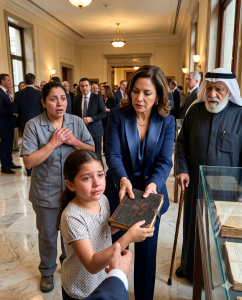
The marble-floored hall of Centro Cultural Los Pinos had been designed to impress people. It had high arched ceilings, polished stone columns, controlled lighting, and a kind of elegant hush that made every heel-click and whispered conversation sound important. That morning, it was hosting a high-profile cultural summit between Mexican officials, museum experts, private donors, and a distinguished delegation from the Arab world.
Everything about the event had been planned to appear seamless. The right flowers. The right table settings. The right sequence of speeches. Even the coffee was curated: spiced Arabic coffee for the guests of honor, traditional Mexican coffee for local dignitaries. Every name card stood exactly where it belonged.
Only two people in the hall had not been assigned a place.
Mariana López and her daughter Valeria.
Mariana had arrived at five in the morning through the service entrance, as she always did. By seven, she had cleaned two exhibition rooms, the staircase, the lower corridor, and half the main hall. Her back ached. Her hands burned from bleach and soap. The cuffs of her gray uniform were still damp from the mop bucket. But she moved with the same practiced silence she always used inside wealthy institutions: work, disappear, do not interrupt.
For years, that had been her survival.
She was a widow in everything but paperwork. Her husband had left when Valeria was still a baby. Rent was late more often than not. School supplies were bought one notebook at a time. Illness was a luxury they could not afford. And despite all that, Mariana kept moving, because stopping was not an option.
Valeria came with her during school breaks or on days when no one else could watch her. The girl was only ten, but she had already learned how to sit still in adult spaces without calling attention to herself. She chose corners. She spoke softly. She made herself small.
But she noticed everything.
That morning, as Mariana cleaned, Valeria sat near a column with an old notebook in her lap. It had once belonged to her grandfather, Hassán Salgado, and she treated it like treasure. The pages were filled with Arabic phrases, grammar notes, rough translations, diagrams of old scripts, diplomatic terminology, and odd personal reminders squeezed into margins. Some pages were stained, others brittle, but Valeria had read them so often she knew whole sections by heart.
Her grandfather had died when she was too young to remember his voice clearly. What remained were fragments: the smell of cardamom in his coat, the way he insisted words mattered, the boxes of books he left behind, and Mariana’s silence whenever his work came up.
Officially, Hassán had been a former interpreter. That was all Valeria had been told.
Unofficially, the family history around him felt unfinished.
Mariana’s older sister, Teresa López, worked in administration at the same cultural center. She wore pressed blouses, kept her hair perfect, and carried herself with the confidence of someone who understood how institutions functioned and how people could be sorted within them. Teresa knew everyone worth knowing in the building. She smiled at directors, flattered donors, anticipated protocol.
And she never acknowledged Mariana as her sister.
At work, Mariana was just the cleaner.
Teresa had built a life that depended on separation. She would greet her politely when no one was around, sometimes even slip Valeria a pastry or an old pen from reception. But in public, especially around executives and guests, she acted as though Mariana and Valeria were minor inconveniences she happened to tolerate.
“Tell your daughter to sit somewhere she won’t be in the way,” Teresa murmured that morning without losing her smile. “Important people are coming.”
Mariana lowered her eyes and said nothing. Conflict cost too much.
Valeria hugged the notebook tighter.
Then the timing of the event began to unravel.
The official translator assigned to greet the Arab delegation had been delayed at the airport. At first, the center’s director insisted it would be fine. Then he checked his phone again. Then again. A bead of sweat formed at his temple.
When the delegation entered earlier than expected, everyone straightened at once.
Sheikh Karim Al-Faruq led the group with a quiet authority that did not need performance. He was a man in his late sixties, perhaps older, with a white beard trimmed close, intelligent dark eyes, and a cane of polished dark wood. He funded restorations, archives, and cross-cultural projects across several countries. His presence alone had elevated the event.
Beside him walked an elderly spokesman with a scholar’s bearing and a voice like dry paper. The moment he began speaking, the room’s confidence evaporated.
His Arabic was not the modern formal version many institutions prepared for. It was layered, old, regionally textured, and threaded with classical references. The few people who recognized words could not follow the structure. The director froze. A university specialist cleared his throat and failed to respond. Another official gave the strained smile of a man hoping politeness might disguise ignorance.
The spokesman paused, then repeated himself more slowly.
The silence became humiliating.
It might have stayed that way if Valeria had not stood up.
Mariana saw her daughter move and nearly called out—but too late.
Valeria stepped just far enough into the open to be seen. Her voice, when it came, was calm.
“He says he appreciates the welcome,” she translated, “but before signing anything, he needs to know whether the manuscript on display was identified correctly.”
For a second, nobody reacted. The sentence was too precise. Too fluent. Too impossible coming from a ten-year-old standing in secondhand shoes.
Then heads turned all at once.
Teresa laughed first, a brittle sound. “You? What would you know?”
But the spokesman’s expression sharpened. He addressed Valeria again, this time using more difficult vocabulary, almost testing her.
She listened carefully.
“He says the text is not a commercial contract,” Valeria replied. “It’s a pledge of protection between allies. If it was translated as a trade agreement, that’s wrong.”
A scholar near the display case blanched. He flipped open the exhibition guide and found the printed label describing the manuscript. Trade covenant. Commercial record. Negotiation text. Every word now looked suspect.
The center’s director turned white.
Sheikh Karim studied the little girl with sudden intensity. “Where did you learn that, child?”
Valeria looked toward her mother before answering. “From my grandfather.”
The old spokesman inhaled sharply.
Something passed between him and the sheikh—some private recognition too quick for the room to understand.
Teresa’s composure snapped.
She strode across the floor, seized the notebook from Valeria’s hands, and hissed through clenched teeth, “This doesn’t belong to you.”
Valeria stiffened but did not cry.
Mariana lifted her head.
Then Teresa said the sentence that changed everything.
“If you keep talking, everyone here is going to find out who your grandfather really was.”
The room seemed to harden around those words.
Because they implied not just a family argument, but concealment.
The director frowned. “What is that supposed to mean?”
Teresa did not answer. Her mouth tightened. For the first time that morning, she looked frightened.
Mariana stared at her sister in disbelief. “Give her the notebook.”
“You don’t know what’s in it,” Teresa shot back.
Mariana’s expression changed. “No. You do.”
The elderly spokesman spoke softly to Valeria. She listened, then translated in a trembling voice.
“He wants to know why my grandfather’s name was erased from the restoration file eight years ago… and who replaced it with Teresa López’s signature.”
No one moved.
The accusation hit with the force of something half-known, long-buried, and suddenly undeniable.
Teresa lost all color.
Eight years earlier, the center had received a private archive connected to a rare manuscript collection. That much several people in the room knew. The restoration project had elevated careers. Academic credit had been assigned. Donor relationships had formed around it. Reports had been signed. Catalog entries had been published.
But now the implication was devastating: the wrong person may have been credited for identifying and securing one of the archive’s most important texts.
The sheikh tapped his cane once against the marble.
The sound cracked through the hall.
At that exact moment, a folded letter slid from the bent notebook and landed near Mariana’s shoe. An old official seal glinted on the outside.
Mariana bent to pick it up—and her breath caught.
The handwriting was her father’s.
She had not seen it in years, but she knew it instantly. The slant. The compressed loops. The urgency in the pressure of the ink. Memory moved through her like cold water.
“Don’t read that,” Teresa said.
It was the worst thing she could have said.
Two members of the delegation stepped closer—not threateningly, but with unmistakable purpose. The old spokesman spoke in a low voice to the sheikh, who did not take his eyes off Teresa.
Mariana unfolded the letter.
The first line made her knees weaken.
Do not trust Teresa with the archive.
For a second she could not breathe.
Eight years collapsed into one brutal instant.
Hassán had died shortly after a dispute over a sealed packet of historical documents that had passed through his hands during a temporary consultation for the center. He had come home exhausted, agitated, and more silent than usual. When Mariana asked what was wrong, he only said there were people who loved prestige more than truth. A week later, he was dead of what everyone called a sudden medical collapse. No investigation. No questions. No one from the center attended the funeral except Teresa—and even then she stayed only a few minutes.
Now Mariana’s eyes raced down the page.
The letter was unfinished, written in obvious haste. Hassán described concerns over altered records, missing pages, and pressure to sign a summary that changed the legal meaning of an old custody agreement tied to the manuscript collection. He named Teresa directly. He wrote that she had been approached by senior staff who wanted the archive processed quietly and credit assigned “where it would be institutionally useful.” He warned that the original file contained not only translation notes but ownership records and hereditary declarations linked to a family line thought to be lost.
Valeria looked up at her mother. “What does it say?”
Mariana could barely speak. “Your grandfather knew.”
Teresa shook her head wildly. “You don’t understand. It wasn’t like that.”
Now the director found his voice. “Explain.”
Teresa turned toward him with desperate speed. “I did what I was told. The file was a mess. Hassán was already sick. They said he hadn’t finished the work. They said the donors needed a clean record or the whole agreement would collapse.”
“Who said that?” the director demanded.
Teresa looked around, suddenly aware that the room had become a trap.
The old spokesman spoke again, his tone sharpened by age and authority. Valeria translated, slower this time because she was visibly shaken.
“He says the missing pages did not contain financial records. They contained the original custody agreement… and the real heir’s name.”
The room erupted—not loudly, but in a rush of overlapping whispers, sharp intakes of breath, and horrified glances.
A real heir.
That changed everything.
This was no longer only about academic theft or bureaucratic fraud. It involved legal succession, cultural custody, and the possibility that a living claimant had been erased in order to redirect control.
Teresa took a step back. “I never took the pages.”
“Then who did?” Mariana asked.
Teresa looked at her sister—and in that look was shame, resentment, and a fear so old it had calcified into cruelty.
“You think I had power?” Teresa said. “I was a clerk. They used me because I was invisible enough to blame and ambitious enough to manipulate.”
“Who?” the sheikh asked directly in Spanish that was careful but clear.
Teresa’s lips trembled. She looked toward a senior academic standing near the display case.
The man stiffened instantly. “This is absurd.”
But Mariana was no longer watching him. She had turned back to the letter.
Halfway down the page, another line hit her even harder.
If anything happens to me, the proof is with Samir Al-Faruq.
The sheikh went still.
A murmur moved through his delegation.
Valeria looked from the letter to the sheikh. “Al-Faruq?”
Karim closed his eyes for a moment. When he opened them, grief had replaced confusion.
“Samir was my brother,” he said quietly.
The elderly spokesman bowed his head.
Everything in the room rearranged itself around that revelation.
Years ago, Samir Al-Faruq had apparently worked with Hassán on identifying and protecting the archive. If both men had believed the documents contained a hereditary declaration, then someone had powerful reasons to interrupt the chain of custody and rewrite the record before the truth surfaced.
“Where is the rest of the file?” Sheikh Karim asked.
No one answered.
Then Valeria, still staring at the notebook now lying partly open in Teresa’s weakened hands, noticed something. Several pages at the back were thicker than the others. The spine had been repaired badly once, with glue that no longer held cleanly.
“That part is different,” she said.
She stepped forward before anyone could stop her and carefully lifted the back cover. A hidden seam split open.
Inside was a narrow packet wrapped in oil paper.
The entire hall seemed to inhale at once.
Teresa covered her face with one hand.
Mariana unfolded the packet with terrifying care. Inside were three items: two missing manuscript pages, a copy of the original custody agreement bearing Hassán’s annotations, and a photograph.
The photograph was old but clear.
It showed Hassán standing beside a younger Samir Al-Faruq in front of the same cultural center years earlier. Between them stood a woman holding a baby wrapped in a pale blanket. On the back, in Hassán’s writing, were the words: For the child named in the agreement.
Mariana’s hands began to shake again.
Valeria stared at the image. “That baby…?”
The old spokesman asked for the paper packet. Sheikh Karim examined the agreement, then the photograph, then the handwritten annotation in the margin naming the beneficiary of protective custody over a branch archive and associated family recognition rights.
He looked up slowly.
“Translate this exactly,” he told Valeria.
She read his Arabic back into Spanish for the room.
“The child identified in this agreement was to be protected until legal recognition could be established. Her lineage was verified through Hassán Salgado’s maternal line and entrusted under witness by Samir Al-Faruq.”
Valeria frowned. “Which child?”
Karim’s eyes moved to Mariana.
Then to Valeria.
The answer hit Mariana first. She sank into the nearest chair as if her bones had vanished.
Her father had never been guarding a stranger’s legacy.
He had been guarding theirs.
Hassán’s Arab ancestry had not been a distant family curiosity. It connected directly to the archive’s custodial line. Somewhere in the chaos of deaths, sealed documents, and institutional theft, Mariana’s branch of the family had been identified as lawful heirs to a protected collection and to recognition rights tied to it. Teresa had known enough to understand the value, but not enough to control it completely. So she had done the next best thing: helped erase the people most entitled to it.
The senior academic near the display case tried to leave.
Two members of the delegation blocked his path.
The director turned on him. “Did you know?”
The man sputtered denials that collapsed under the first question.
Then the second.
Then the third.
Records had been edited. Signatures reassigned. Internal reports adjusted to move credit and control away from Hassán. Teresa had signed revised intake documents because she was told it was procedural. Later, when she realized there was more at stake, she kept quiet. Promotions followed. Access followed. Shame followed. By then she was trapped.
“You let us scrub floors while you wore stolen respect,” Mariana said, voice breaking.
Teresa burst into tears. “I thought if I stayed useful, they’d protect me.”
“Did they?” Mariana asked.
Teresa could not answer.
The rest came apart quickly after that. The director ordered the archive room sealed. The delegation demanded an immediate review of all restoration records connected to the collection. The senior academic was escorted out under protest. Teresa surrendered the notebook without another word.
But the most important moment happened in the middle of the wreckage, when Sheikh Karim approached Valeria.
He knelt despite his age and his cane.
“You heard what everyone else missed,” he said. “Your grandfather would have been proud.”
Valeria looked at the notebook, then at her mother. “Why didn’t anyone tell us?”
Mariana wiped at her eyes. “Maybe because some truths are dangerous when poor people carry them.”
Karim heard that.
His expression hardened—not at them, but at the system that had made that sentence feel ordinary.
In the weeks that followed, the scandal spread far beyond the center. Independent investigators reviewed the archive. Legal counsel verified the altered filings. The cultural ministry opened a formal inquiry. Media outlets reported irregularities in manuscript attribution and donor records. Teresa lost her position. The academic who had overseen the altered restoration paperwork was removed pending criminal investigation.
And the Salgado name, buried for eight years under institutional silence, returned to the official record.
Mariana did not become rich overnight. Real life did not transform that neatly. There were lawyers, hearings, documents, and months of uncertainty. But one thing changed immediately: she no longer entered Los Pinos through the service door as though she were invisible.
She entered through the front.
Valeria, meanwhile, became impossible to ignore. Scholars wanted to know how a child had learned to hear nuance in a dialect professionals failed to recognize. The answer was simple and painful at once: she had inherited attention from a man the world had dismissed too easily, and she had practiced in the corners where no one bothered to imagine genius could grow.
One afternoon, long after the scandal broke, Mariana sat with Teresa in a quiet government office while both waited to sign separate statements. Teresa looked smaller without her polished armor.
“I was ashamed of us,” Teresa said at last. “Then I was ashamed of what I’d done. And after a while I couldn’t tell which shame was running my life.”
Mariana looked at her for a long time.
“You didn’t just hide us,” she said. “You helped them bury him.”
Teresa nodded, crying silently.
There was no easy forgiveness. No dramatic embrace. Some damage settles too deep for that. But Mariana did not walk away in hatred either. She simply stood, signed her papers, and carried the truth out with her.
That mattered more.
Months later, a corrected exhibition opened in a smaller but more honest room at the center. Hassán Salgado’s name appeared on the wall as lead interpreter and primary identification consultant. Beside it was a note acknowledging the recovery of missing custody materials and the role played by his granddaughter in restoring the historical record.
Valeria stood before the display in a clean dress and held her mother’s hand.
The same marble floors gleamed beneath them, but the room felt different now. Not grander. Just less false.
Sheikh Karim attended the reopening quietly. Before leaving, he handed Valeria a new notebook bound in dark leather.
“For your own work,” he said.
Valeria smiled but kept her grandfather’s old one tucked safely against her side.
Because some things did not need replacing.
As they walked out, Mariana glanced back once at Hassán’s name on the wall. Eight years of lies had nearly erased him. In the end, it was not a powerful official, a famous scholar, or a wealthy donor who brought the truth back.
It was a little girl no one thought worth listening to.
And maybe that was the part that stayed with everyone who heard the story afterward. Not just the fraud. Not just the stolen credit. Not even the inheritance hidden inside old pages.
It was the warning underneath all of it.
How often do people miss the truth because they have already decided who matters?
How many lies survive only because the right person is wearing a uniform no one respects?
And if Teresa had not panicked, if that letter had not fallen, if Valeria had stayed quiet like the room expected her to—how much longer would the wrong names have remained on the wall?