The first thing people remembered later was not the quilts.
It was Ruthanne Pickett’s face.
Not because she had cried. Not because she had shouted. Not because she had pointed across the ballroom and demanded justice in a voice built for spectacle.
They remembered her because she looked calm.
Calm in a room where calm no longer made sense.
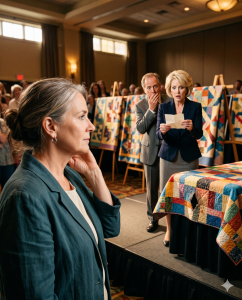
The ballroom at the Handmade & Heritage Vendor Showcase in Nashville had been arranged to flatter success. Warm amber lighting. Crisp white tablecloths. Easels draped in soft uplighting. Little placards placed neatly beside each quilt as if order itself could make a story true. At the front of the room, forty-seven quilts from the Compass Rose Medallion line hung in a graceful arc behind the stage, their precise geometry glowing beneath the lights.
The display was meant to look like arrival.
Instead, by the time Ruthanne walked in through the rear doors, it looked like evidence.
Fourteen months earlier, when Dale Whitfield stole her business out from under her, she had done the one thing he least expected.
She had said almost nothing.
To anyone who didn’t know her, that silence might have looked like weakness. To anyone who understood quilting, it should have looked like discipline. Ruthanne had spent her life learning not to yank at a seam just because she was angry. If something mattered, you opened it carefully, examined the stitching, and let the structure tell you what had happened.
That habit had started in a farmhouse kitchen near Clarksville, Tennessee, where her grandmother taught her to sew.
The Singer machine had been old even then, black body dull with use, gold lettering worn thin by years of hands and dust cloths. Her grandmother never rushed. She pinned carefully. Pressed every seam. Measured twice, then checked again with her fingertips as if fabric could confess under enough patience.
When Ruthanne was nine years old and eager to get to the pretty part—the colors, the patterns, the top layer that people admired—her grandmother would stop her with one sentence.
“A quilt is a record.”
Ruthanne had heard it so many times it became part of how she saw the world.
A record of time.
A record of labor.
A record of choices.
A record of who did the work, who cut corners, who paid attention, who cared.
If a seam wandered, the record showed it. If the piecing was clean, the record showed that too. It was impossible, her grandmother insisted, to hide yourself entirely inside something you made by hand. Eventually, the truth rose through.
Ruthanne carried that belief into adulthood, into marriage and grief and the ordinary disappointments life hands out without asking permission. And eventually she carried it into business.
By the time she was forty-nine, she and Dale Whitfield had built Pickett & Whitfield Handmade into something sturdy enough to feel like a future. They were not rich. They were not famous. But they were real. They had repeat customers, wholesale accounts, a loyal following at regional craft fairs, and a reputation for quality that had taken years to build and only a few bad choices to destroy.
They worked differently from the beginning.
Ruthanne was the maker. The designer. The one who stayed up late redrawing border proportions and rejecting almost-right versions that nobody else would have noticed were wrong. Dale was easier in a room. Better at greetings, pitches, polished talk, and making people feel like they had found exactly what they had been looking for. That division of labor worked until it didn’t. Until the person who sold the work began acting like selling mattered more than making. Until credit became negotiable. Until access became power.
The Compass Rose Medallion pattern had started on three Saturdays in Ruthanne’s kitchen in Murfreesboro.
Coffee rings marked the sketch paper. Fabric swatches spread over the table. She adjusted the center medallion again and again until it held the eye without swallowing the rest of the design. The balance had to be exact. Directional enough to feel symbolic, soft enough to remain heirloom. It was not a pattern that arrived in one burst of inspiration. It was built. Earned. Refined.
Dale had opinions, of course. He often did. Slightly bigger corners. A different palette for mass appeal. But the pattern itself, the architecture of it, belonged to Ruthanne. He knew that. She knew that. Anyone who had watched the two of them work for more than five minutes knew that.
Which is why the licensing call hit with such surgical force.
It came on a Tuesday morning in March. Ruthanne was sitting on the edge of her bed when her phone rang. A cheerful woman from a national craft chain’s licensing department introduced herself and asked to verify “Mr. Whitfield’s banking information for the royalty disbursement.”
At first Ruthanne assumed she had misheard. Then she assumed there had been an administrative mistake.
By the time the caller repeated the line name—Compass Rose Medallion—Ruthanne felt something inside her go very still.
She said, “Of course. One moment.”
Then she laid the phone down on the nightstand and stared ahead while her pulse beat hard in her throat.
Royalty disbursement.
Not proposal. Not interest. Not preliminary discussion.
Completed deal.
Her deal. Her pattern. His bank account.
The meeting that followed took place in a bland conference room that might have hosted any minor professional cruelty in America. Filtered coffee. A speakerphone in the center of the table. A legal pad no one wrote on. Dale’s attorney had everything prepared. Trademark documents. Licensing agreement. Separation terms. A severance check. The language was polished enough to disguise intention beneath procedure. There was talk of efficiency. Of strategic consolidation. Of practical realities. Of how difficult it would be to untangle matters now that filings were complete.
Dale did not quite meet her eyes.
That, more than anything, told Ruthanne the full shape of it.
He expected outrage. He expected pleading. He expected her to argue from morality in a room built to reward paperwork.
Instead, she read every page with a steadiness that unsettled even the lawyer. She noticed what had been filed, what had been omitted, how dates had been arranged, and where assumptions had been converted into claims. She understood quickly that there would be no immediate victory available to her in that room. The trail had been prepared too neatly.
So she signed.
It shocked them.
The lawyer’s shoulders loosened. Dale let out a breath so small he likely thought no one could hear it. Ruthanne took the severance check, placed it in her purse, thanked them for their time, and left.
She did not cry until she reached the parking garage.
Even then, she cried only for a few minutes.
Not because it hurt less than expected.
Because part of her had already moved to a colder, clearer thought.
She had been uneasy for weeks before the call. Dale had become guarded in ways that did not fit his usual self-satisfaction. He was vague about shipping updates. Defensive over paperwork she once saw freely. The explanations were plausible, but his timing had changed, and timing, in Ruthanne’s experience, mattered as much as words.
Three weeks before the meeting, while that unease still had no name, she had finished the final round of sample quilts for the corporate pitch package. Forty-seven quilts in all, each one carefully pieced, quilted, bound, rolled, boxed, and sent to headquarters.
And in each of those forty-seven quilts, hidden in the batting along a seam no casual handler would inspect, she had sewn a small muslin pocket.
She did it alone.
At night.
After the house was quiet.
The work was slow because it had to be. The pockets had to disappear into the quilt structure. They could not distort the surface or alter the drape. No puckering. No visible bulk. Nothing that would invite attention too soon. Her grandmother had taught her to hide repairs that way, and later to leave notes for family inside heirloom pieces when history mattered more than presentation.
Ruthanne called it her insurance stitch.
The contents of the pockets were not identical. That was the elegant part.
Some held handwritten notes with dates and design stages.
Some held copies of receipts, sketches, and supply records.
One contained a note identifying the meeting when Dale first brought a mockup to buyers as if it were his concept.
Another referenced an email thread by date and subject line.
One listed the names of people present when Ruthanne was asked to remove her initials from the sample labels “for consistency.”
And one—only one—held the document Dale had once told her nobody would ever believe she still had.
She never told anyone what she had done, not even after the theft became undeniable. People imagine revenge as hot. Ruthanne’s was cold in the best sense of the word: preserved, measured, waiting for the exact conditions under which truth could do the most work.
The months after the separation passed quietly enough to fool outsiders.
She took private commissions. A quilt made from a late husband’s shirts for a widow who wanted to keep touching his sleeves. A baptism gift. A graduation piece in school colors for a girl headed out of state and terrified to leave home. Ruthanne cooked, visited her sister in Franklin, slept more deeply than she had in years, and let the world mistake her patience for surrender.
Every so often, someone would mention seeing Dale online, or hearing that the licensing deal was moving forward, or that a major launch was planned. Ruthanne would nod, ask whether they wanted more tea, and say very little.
She was waiting for scale.
A theft is one thing in private. It becomes something else when dressed up for applause.
The invitation to the Handmade & Heritage Vendor Showcase arrived in a crisp envelope several weeks before the event. It listed Dale Whitfield as featured partner and named the Compass Rose Medallion line as a highlighted offering. Ruthanne stared at the card for a long time before setting it aside. Whether the mailing was accidental or pointed hardly mattered. The effect was the same. Someone expected her to witness the public coronation of the work stolen from her.
She chose not to sit in the ballroom and watch strangers clap for it.
On the evening of the event, she drove toward Nashville anyway. Not to attend. Not exactly. She parked at a Cracker Barrel off I-40, ordered a sweet tea to go, and sat in her car with the radio low. The parking lot lights painted a pale glaze across her windshield. Interstate traffic hummed in the distance. In the cup holder, the ice shifted as it melted.
She had a phone in her hand and the kind of stillness that only comes when waiting has turned into readiness.
The message arrived a little after Gretchen Mauer, the regional buyer from Chicago, was scheduled to begin presenting.
It came from a number Ruthanne had been hoping to see for fourteen months.
It said only: It’s time. Open the one on the end.
Who sent it mattered less than what it meant. Someone inside the venue had followed a trail. Someone had either been tipped off or had grown suspicious enough to inspect the construction. Someone had opened the end quilt and found the pocket.
Ruthanne read the text twice. Then she set down the tea.
Inside the ballroom, Gretchen Mauer had been midway through her polished remarks. She was good at these events—graceful, composed, corporate without seeming stiff. She spoke about heritage, craftsmanship, scalability, storytelling, authenticity. The words sounded expensive under soft lights.
A woman Ruthanne had never met approached the stage and leaned close to Gretchen’s ear.
The whisper lasted only a few seconds.
Yet everyone nearby saw the result.
Gretchen’s face changed with stunning speed. Color drained from it. Her posture tightened. She looked over her shoulder toward the end quilt, then back at the woman, then again at the display as if forty-seven decorative samples had abruptly become forty-seven active problems.
By the time Ruthanne entered through the rear doors, a low current of confusion had already started moving through the room.
The stage smile was gone.
One quilt had been taken down and laid flat across a draped table. A woman in black event gloves was opening a seam under Gretchen’s direction while a man with a venue badge and two buyers stood close enough to observe. Dale hovered nearby, speaking in the particular rushed tone guilty people use when they are trying to outrun facts.
“Old construction notes,” he said too loudly.
“Nothing unusual. Makers do things like this.”
Ruthanne stopped near the back and watched.
The glove-wearing woman reached into the opened seam and withdrew a folded muslin packet.
Gretchen took it and unfolded the note inside.
Silence spread in visible ripples. The kind people do not notice they are obeying until the room is already still.
Gretchen read once.
Then again.
Then she looked at Dale—not the way a colleague looks at a colleague, but the way a buyer looks at inventory that has just become contaminated.
That first pocket contained design dates and a handwritten notation identifying the original draft of Compass Rose Medallion as “completed at kitchen table, Murfreesboro, third Saturday revision finished 4:15 p.m.” It was signed in Ruthanne’s unmistakable hand. Not proof by itself, perhaps. But not harmless either.
Dale tried to dismiss it as sentimental notation.
Then a second quilt came down.
Then a third.
That was when the structure of Ruthanne’s insurance stitch revealed itself. Each pocket carried a different piece of the story. Dates. Process notes. Material receipts. Revisions. References to meetings. Instructions Dale had given. Requests he had made. The pockets did not merely assert authorship. Together they mapped conduct.
Gretchen ordered the rest of the display removed from the easels.
No one in the room was smiling anymore.
The audience, which minutes earlier had been a crowd of potential buyers and admirers, now behaved like accidental witnesses. Some stood. Others pulled out phones. A few exchanged the tense glances people share when they understand they are present for the collapse of a narrative still trying to hold its shape.
Ruthanne saw Dale’s confidence break by degrees.
First came annoyance, as if this were a nuisance.
Then contempt, as if he could belittle the problem into shrinking.
Then calculation.
And finally fear.
Because one pocket referenced another. One note corroborated the date on another note. A receipt aligned with a revision timeline. A label change matched a meeting. What looked at first like the eccentric habits of a maker became, in accumulation, a record.
A quilt is a record.
Her grandmother had been right.
Gretchen asked for all the packets collected in order. The man with the badge made a call. Someone from the craft chain’s legal department was patched in on speaker. Dale protested, then demanded privacy, then insisted Ruthanne was unstable. The accusation landed badly in a room that now held multiple hand-sewn exhibits contradicting him.
Then the center quilt was lowered.
Ruthanne knew exactly which one it was.
The room gathered around that table the way people gather around a bedside or a verdict. The seam was opened more carefully this time. The muslin packet removed more gently. Whatever instinct for caution had been missing from the launch was fully present now.
Gretchen unfolded the contents.
Her mouth parted before she could stop it.
The document inside was a copy of an early submission sheet and attached notation showing the pattern originally logged under Ruthanne’s name, with alterations later requested before presentation. Tucked behind it was a signed handwritten note naming who had instructed her to remove identifying initials from sample labels prior to shipment. There was no melodrama in the language. That was what made it devastating. It read like a maker’s record kept by someone who assumed accuracy would matter someday.
Because accuracy always matters eventually.
Dale said, “That proves nothing.”
No one answered him.
A lawyer on speaker asked for photographs of every packet. Gretchen requested a secure room. The buyers stepped back from the display as if distance itself might keep them clean. Someone from the venue closed the ballroom doors.
Only then did Ruthanne move farther in.
Heads turned as her name spread quietly from one side of the room to the other. She did not hurry. She did not posture. She simply walked forward until she stood where Gretchen could see her clearly.
For a few seconds, neither woman spoke.
Then Gretchen said, very carefully, “Mrs. Pickett, were these placed by you?”
Ruthanne looked at the opened quilt, at the muslin pocket lying beside it, at the years of work now surfaced through a seam.
“Yes,” she said.
“Why didn’t you say anything sooner?”
Ruthanne could have answered a dozen ways. She could have said because no one with power was listening. Because accusation without structure sounds emotional, and structure is what institutions trust. Because Dale had counted on the familiar math of charm plus paperwork minus proof. Because women in craft businesses are expected to absorb betrayal neatly and privately.
What she said instead was, “I knew the quilts would.”
It was not a dramatic line. It was simple, almost plain. Yet people remembered it later because it explained everything.
The chain suspended the launch that night.
By the following week, the licensing agreement was under formal review. By the week after that, Dale’s public statements had become increasingly frantic and contradictory. He claimed collaboration, then sole authorship, then misunderstandings over business structure. Each version arrived too late and matched too little. The craft chain distanced itself. Vendors withdrew. The story moved through industry circles with the speed reserved for scandal backed by documentation.
Legal proceedings followed. Some parts settled quietly, others less so. Ruthanne regained control over her design rights. The public record did not erase what had happened, but it prevented Dale from continuing to profit from it as if it were his clean success story. Gretchen Mauer, to her credit, acknowledged from the outset that the company should have looked harder before elevating one narrative over another. That admission did not fix the damage, but it changed the tone of what came next.
People urged Ruthanne to celebrate more loudly than she did.
She did not.
Vindication, she discovered, did not feel like triumph so much as oxygen. A release of pressure. The return of ordinary breath. She went back to work. She finished commissions. She spoke to a few reporters, declined many others, and refused every invitation to turn the whole thing into a performance about resilience.
But in the months after the Nashville showcase, she received letters.
From women pushed out of family businesses.
From artists whose names vanished from collaborative work.
From makers told that if they could not prove authorship in ways designed by other people, then perhaps they had not truly owned what they created at all.
Those letters mattered to her more than the coverage.
One afternoon, her sister found her in the kitchen reading one of them and asked whether the whole ordeal had changed how she felt about quilting.
Ruthanne thought for a moment before answering.
“No,” she said. “It changed how I feel about people who think handmade means helpless.”
Later that year, she taught a small workshop on record-keeping for textile artists. Not legal strategy. Not revenge. Just documentation. Dates, sketches, labels, process notes, archived drafts. Ordinary proof. The room was full. At the end, a young woman lingered to ask whether keeping such careful records meant Ruthanne expected betrayal.
Ruthanne smiled a little.
“It means I expect truth to need help getting introduced.”
That line circulated too.
But the line that stayed with people longest was still the oldest one, the one inherited in a farmhouse kitchen from a woman who understood labor, memory, and the stubborn morality of well-made things.
A quilt is a record.
And if there was an aftershock to everything that happened in Nashville, it lived there.
Because Dale had not only stolen a pattern. He had mistaken softness for absence of structure. He had looked at fabric, history, and a woman who worked with her hands and assumed the record could be rearranged by whoever held the paperwork.
He was wrong.
The most unsettling part, depending on where you stood, was that Ruthanne never needed a dramatic trap. She did not manufacture a scandal. She did not forge outrage into theater. She simply embedded truth where truth belonged: inside the work itself.
In the end, that was either the most graceful thing about her or the most terrifying.
Maybe both.
Because anyone can lie in a meeting.
Anyone can smile at a podium.
Anyone can stand under lights and call theft a partnership if the room wants an easy story badly enough.
But the real red flag had been there long before Nashville, long before the launch, long before the first pocket was opened.
It was the moment Dale believed the maker would not think ahead.
It was the moment he decided the woman who stitched the work would somehow fail to understand the value of hidden structure.
And maybe that is why so many people who heard the story kept asking the same question afterward.
Not whether Ruthanne should have forgiven him.
Not whether the company should have noticed sooner.
But how anyone who had spent twelve years beside a woman like Ruthanne Pickett could have looked at those steady hands, that patient silence, that old discipline shaped in a farmhouse kitchen, and still convinced himself she would leave no record behind.