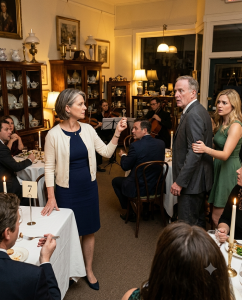
She walked into his grand reopening party like she belonged there.
In a way, she did.
Marlene Fitch arrived ten minutes after the first round of champagne had been poured and five minutes before the string quartet began. She gave the hostess a quiet smile, confirmed the reservation under her sister’s married name, and let herself be led to table seven near the back of the room. It was the kind of seat most people would have considered unlucky at an event like this. Too far from the speeches. Too far from the center of attention. Too easy to overlook.
Marlene preferred it that way.
From table seven, she could see the entire room: the front display windows glowing under new signage, the polished cases, the rented floral arrangements, the tiny gold place cards, the bar on the right, the side entrance on the left, and the man at the center of it all—her ex-husband Gary—moving from guest to guest with the inflated confidence of someone who believed the night proved he had won.
He looked prosperous in a navy blazer and open collar. His hand never strayed far from the back of Renee, the young woman beside him. Renee wore a pale dress and a practiced smile. She nodded when people complimented the “beautiful new direction” of the shop. She laughed a second too late when Gary joked. She looked exactly like what she was: a woman standing inside a story someone else had written for her.
Marlene lifted her champagne flute and took a small sip.
Two years earlier, seeing Gary play host inside that building would have destroyed her. Tonight, it steadied her.
Because the more comfortable he looked, the harder he was about to fall.
To understand why, you had to go back to the first version of the store, long before the repainting, the new name, and the grand reopening banners. Back when the floors creaked louder, the sign over the door was hand-painted, and the inventory was built one Saturday at a time.
Marlene and Gary had created the shop together over thirty years of marriage. It began with estate sales and folding tables and the simple discovery that they were good at different parts of the same dream. Marlene had the eye. Gary had the salesmanship. She could spot value under dust and damage. He could talk a hesitant customer into buying a refinished writing desk by making them imagine it in their foyer.
They traveled rural Mississippi in a pickup truck with coffee in a thermos and old blankets in the back for fragile finds. They bought hand-stitched quilts, walnut chests, oil lamps, side tables, silver sets, campaign trunks, and local pottery from families clearing attics and porches and barns. Marlene refinished what could be saved, catalogued what mattered, and built displays that made people slow down. Gary kept the books and worked the floor.
By the time the shop was thriving in downtown Tupelo, customers saw it as one seamless business. They called it Gary and Marlene’s place. They trusted the taste. They trusted the stories. They trusted that if Marlene said a piece was worth buying, it was.
That trust had value. So did her labor. So did the reputation she spent decades building.
Gary, of course, had a different memory of those years. As the marriage soured, his language changed. He began speaking of the store as if he had built it and Marlene had simply been around while it happened. He referred to suppliers as his contacts, sales as his deals, customers as his regulars. It would have been laughable if it hadn’t been so strategic.
Their divorce was ugly in the quiet way long marriages often are. Not dramatic at first. Just cold. Rooms closed off. Meals eaten separately. Bitter comments disguised as observations. Then came the younger woman—Renee—and suddenly Gary had both an audience and a reason to rush.
Marlene knew he was capable of selfishness. She did not yet know how far ahead he had planned it.
A week before the divorce was finalized, the papers arrived. Marlene stood in a parking lot and read that the business had been transferred into Renee’s name. The wording was slick. The timing was precise. The implication was devastating. Gary had not only cut Marlene out. He had tried to make it look official before she could challenge it.
She went home, made coffee, and sat in her kitchen until dark.
Then she opened the drawer beside the fridge and took out a small brass key.
The key belonged to a safe deposit box at First National Bank of Tupelo. Years earlier, when the business was formally incorporated, Marlene had insisted on real legal structure. Gary had mocked her caution, but she had followed through anyway. The attorney drafted articles and operating documents that made both spouses joint legal owners, and because Marlene had contributed both capital and the underlying inventory relationships that sustained the shop, she required one specific clause.
No transfer of ownership could be valid without her signed, notarized consent.
Gary signed the papers without reading them carefully. That was his habit. Marlene read everything.
And she kept the originals secure.
That brass key sat in her hand while coffee cooled beside her. At first it represented proof. By midnight, it represented something else.
Patience.
Marlene did not storm into court the next day. She did not call Gary in tears. She did not give him the gift of immediate battle, where loudness and improvisation had always served him well.
She waited.
Over the next two years, she visited the shop again and again under different styling and careful discretion. A different hairstyle. Contacts instead of glasses. Cash instead of cards. Thursdays instead of weekends. She bought small items and made forgettable conversation. The college-aged clerk came to know her as a pleasant woman with a fondness for odd little antiques.
From those visits, Marlene learned everything she needed.
Gary and Renee had renamed the shop and repainted the interior. They were trying to move it slightly upscale while still trading on the reputation Marlene had helped build. The back room had been expanded. The bookkeeping had grown loose. Gary was leveraging the business for visibility and credit. Most important of all, neither he nor Renee had ever checked the foundational documents. They were operating on assumption, not authority.
That error was so deeply Gary that Marlene almost admired it.
When she learned they were planning a grand reopening gala that fall, with catered food and invited guests and speeches, she knew exactly what she would do. Public truth had a force private arguments never did. Gary could lie to a lawyer. He could gaslight an ex-wife. He could rewrite history for a girlfriend. But it was harder to stand in a room full of supporters and still pretend when documents were about to speak.
So Marlene hired counsel quietly. She retrieved certified copies from the bank. Her attorney reviewed the transfer filing, the incorporation agreement, and the timeline. The conclusion was devastatingly simple: the transfer to Renee had been invalid from the beginning because Gary had no authority to convey full ownership without Marlene’s consent. Worse, if Gary had represented otherwise in financing, vendor agreements, or tax matters, the fallout could spread well beyond a property dispute.
The attorney filed an emergency petition the afternoon of the gala to freeze sale, liquidation, or collateralization of shop assets pending judicial review.
Then he agreed to meet Marlene at the event and remain unobtrusive until she gave the signal.
By the time speeches began that Friday night, every piece was in place.
Marlene wore her best navy dress and cream cardigan. She applauded at the right moments. She watched Gary perform gratitude before donors, patrons, and local business owners who had no idea they were attending the beginning of his collapse.
When he thanked Renee for “helping bring this vision to life,” Marlene nearly smiled. Vision had never been Gary’s problem. Vision without honesty was.
At last he stepped to the front of the room for the final toast, flushed with praise and full of himself.
Marlene set down her champagne flute.
She stood.
“I’m so sorry to interrupt,” she said.
The trained classroom voice cut through the room with effortless command. Conversations stopped. Silverware paused. The quartet faltered.
“My name is Marlene Fitch. Most of you may not know me. But I am the legal co-owner of this shop. And I have been for thirty years.”
The silence that followed was pure, stunned disbelief.
Gary stared at her. It took him a second to recognize her—long enough for the guests to look between them and sense the shape of something terrible. Renee clutched his arm. One man near the front turned fully around in his chair. Someone near the bar whispered, “Oh my God.”
Then Marlene reached into her cardigan pocket and drew out the small brass key.
She laid it on the tablecloth.
Gary saw it and lost every bit of color in his face.
The key itself meant nothing to anyone else. To Gary, it meant the safe deposit box. The original documents. The clause he had never remembered because he had never respected the possibility that Marlene might one day need protection from him.
“Gary,” Marlene said, still calm, “would you like me to explain what this key opens?”
He swallowed visibly. “Marlene, this isn’t the time.”
“No,” she replied. “You should have thought of that before you turned theft into a party.”
Whispers rippled through the room.
Renee looked at Gary. “What is she talking about?”
He didn’t answer.
Marlene did. She explained in clear terms that the original incorporation documents named her a permanent joint owner and required her notarized signature for any valid transfer of ownership. She stated, without raising her voice, that no such signature had ever been given.
Then she looked toward the bar.
Her attorney stepped forward at exactly the right moment, carrying a folder.
Gary actually swayed.
“What folder is that?” Renee asked, her voice trembling now.
“That,” Marlene said, “is a certified copy of the incorporation agreement, the transfer filing your name appears on, and the emergency petition filed this afternoon to freeze the business assets until the court reviews ownership.”
The room erupted.
Not loudly at first. More like a wall cracking under pressure. Shocked murmurs. Chairs shifting. Questions beginning to overlap. One guest stepped away from Gary as if legal trouble might be contagious.
Renee let go of his arm.
“You told me it was clean,” she whispered.
Gary reached for her. “Renee, listen to me—”
She backed away. “What did you sign in my name?”
That question changed everything.
Marlene had come to expose the theft of the shop. She had not been certain, until that moment, how much Renee knew. The look on the younger woman’s face answered it. Fear, not guilt. Shock, not performance.
The attorney opened the folder and addressed Gary by full name. He informed him that effective immediately, he was on notice of the petition and any attempt to move assets, misrepresent ownership, or obstruct access to records would be documented for the court.
Then he added one more sentence that drained the last bit of confidence from Gary’s posture.
Their preliminary review suggested additional filings had been made using Renee as nominal owner while omitting Marlene’s legal interest. Depending on the surrounding representations, that could carry civil and possibly criminal consequences.
The room went dead quiet again.
Renee stared at Gary as if seeing him for the first time.
“You said she walked away,” she said.
Marlene answered before he could. “I didn’t walk away. He tried to erase me.”
Renee turned back to Gary. “Did you use my name because you knew you couldn’t do it with yours?”
Gary finally did what men like him often do when charm fails: he got angry. He accused Marlene of embarrassing him, ruining the business, being vindictive, showing up only to destroy what he had rebuilt. It might even have worked on some people if not for the documents in the attorney’s hand and the plain fact that innocent men rarely panic at the sight of certified copies.
Marlene let him talk.
Then she told the room exactly what she had contributed to the business over thirty years. The sourcing, the restoration, the customer base, the structure, the legal protections he had ignored. She did not dramatize. She did not shout. She simply made herself impossible to erase.
When she finished, several guests were no longer looking at Gary with sympathy. They were looking at him with recognition.
One older dealer near the front finally said what many were thinking. “So this whole thing was built on a transfer that wasn’t valid?”
“Yes,” Marlene’s attorney said.
The dealer sat back hard in his chair.
Gary’s collapse from host to liability happened with astonishing speed. People who had been laughing with him an hour earlier were suddenly checking watches, collecting handbags, murmuring apologies, slipping toward the door. A supplier quietly asked the attorney for his card. A local investor left without speaking to Gary at all.
Renee stood motionless until the room had thinned by half.
Then she removed the ring Gary had given her for “their next chapter”—not an engagement ring exactly, but close enough to promise—and set it beside an untouched champagne glass.
“I didn’t know,” she said to Marlene.
Marlene believed her.
“I know,” she replied.
That was the moment Gary looked truly afraid—not when Marlene stood up, not when the attorney appeared, but when he realized he had lost his last witness.
Within weeks, the court ordered a full accounting. The invalid transfer unraveled. Financial records were subpoenaed. Several vendors confirmed they had been given misleading information about ownership. The shop was temporarily closed pending review.
Gary tried, briefly, to negotiate. He suggested quiet settlement. He floated buyouts. He framed the whole thing as a misunderstanding between former spouses. But once paperwork begins to tell the truth, performance has limited value.
The final resolution was neither glamorous nor kind. The court affirmed Marlene’s ownership interest and voided the transfer to Renee. The parties eventually reached a structured settlement under which Gary surrendered operational control and his remaining interest was diluted against liabilities he had created. Renee was cleared of intentional wrongdoing after it became obvious she had signed documents based on false representations.
As for the shop, Marlene took it back.
Not the exact version Gary had staged under warm lights and borrowed prestige. That illusion was too expensive to maintain and too tainted to keep. She restored the original name. She sold off some of the inflated inventory Gary had brought in to impress the wrong people. She repainted the walls in a color that actually suited old wood. She reopened quietly, without a gala, six months later.
Customers returned.
Some came because they had heard the story. More came because they remembered what the store had once been under Marlene’s hand. The displays regained their texture. The place felt honest again. There was less noise, less ego, more care. People lingered. They trusted it.
One Thursday afternoon, months after the reopening, Renee came by with a small package. Inside was a brass-framed receipt holder Marlene had once used near the register and thought lost.
“I found it in a box of Gary’s things,” Renee said. “I thought it belonged here.”
Marlene thanked her and offered coffee. They talked for half an hour—not as friends exactly, but as two women who had survived the same man in different ways. Renee admitted she had ignored certain signs because she wanted to believe him. Marlene admitted that sometimes experience doesn’t protect you from betrayal; it only teaches you what to do after.
When Renee left, Marlene placed the old receipt holder back by the register.
That evening, as she locked up, she paused with her hand on the door and looked at the shop around her. The light was soft. The floorboards creaked. The glass reflected shelves she had arranged herself. For the first time in years, the place felt like hers again not just on paper, but in the air.
The small brass key still lived in her cardigan pocket more often than necessary.
Not because she needed the reminder.
Because some victories are too hard-won to ever feel ordinary.
And if there was an aftershock to everything that happened, it was this: the biggest red flag had never been Gary’s affair, or his arrogance, or even the stolen paperwork. It was how certain he had been that Marlene would stay quiet. That after thirty years of her labor, he could remove her from the story and she would accept it.
He was wrong.
The truth was, Marlene had spent a lifetime teaching children how to show their work.
In the end, she simply did the same for him.