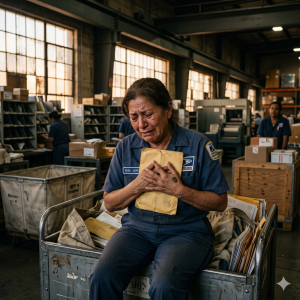
She found a letter addressed to herself in a pile of mail that had been sitting in a government warehouse for 34 years.
And the moment she saw it, her knees gave out.
—
Diane Reyes had spent 31 years delivering other people’s lives to their doorsteps.
Bills. Birthday cards. Packages wrapped in brown paper that smelled like someone’s grandmother’s house. She’d seen it all.
But she had never — not once — seen her own name in that dead letter office.
Until today.
Her last day.
—
It was a Tuesday in October, the kind of morning Albuquerque does better than anywhere else — that high desert light coming through the warehouse windows like something holy. Diane was supposed to be cleaning out her locker, signing forms, eating the sheet cake somebody had already set out in the break room.
Instead, she was elbow-deep in a bin of unclaimed mail from the early 1990s.
It was habit. Thirty-one years of habit.
She almost missed it.
The envelope was yellowed, soft at the corners, the ink on the address faded to the color of old tea. But the name was unmistakable.
*Diane Marie Reyes.*
Her maiden name.
An address she hadn’t lived at since she was twenty-three years old.
—
She stood there a long time before she turned it over.
And that’s when she saw it.
Pressed beside the return address — small, deliberate, unmistakable — was an ink thumbprint.
Not a smudge. Not an accident.
A *print.* Intentional. Like a signature.
Diane’s free hand moved without her permission. Pulled back her left sleeve. Stared at the small tattoo she’d worn on her wrist for thirty-two years — the one she’d gotten six months after the hospital, after the doctor had sat down across from her with that practiced, terrible face and told her the baby hadn’t made it.
The baby she never got to hold.
The baby she’d asked to see, and been told — gently, firmly — that it would be better if she didn’t.
She had gotten the thumbprint tattoo so she would always carry *something.*
Even if it was only imaginary. Even if it was only hers.
The print on the envelope was the same size.
The same shape.
*Identical.*
—
Diane sat down on a mail bin.
She sat there for a long time.
Around her, the warehouse hummed with the ordinary sounds of a Tuesday — carts rolling, someone laughing by the loading dock, the ancient fluorescent lights doing what they always did.
None of it felt real.
She turned the envelope over again. The return address listed a name she didn’t recognize — a woman named Carol Fitch, with a street address in Santa Fe.
*Carol Fitch.*
Diane rolled the name around in her mind like a stone. She had never known anyone named Carol Fitch. Not in Santa Fe. Not anywhere.
A stranger’s name.
But something about the handwriting made her chest lock up.
She looked closer.
The loops on the D. The way the R leaned slightly to the left. The little tail on the lowercase *e* that curled back on itself like it was trying to come home.
Diane had stared at that handwriting her whole life.
On birthday cards.
On grocery lists left on the refrigerator.
On the letter her mother had written her when Diane was in the hospital, twenty-three years old and alone and absolutely shattered, telling her that sometimes God’s plan was not our plan, and that the grief would pass.
*The grief would pass.*
Her mother had been dead for eleven years.
Her mother, who had been in that hospital room with her.
Her mother, who had spoken to the doctors while Diane was sedated.
Her mother, whose handwriting was *all over this envelope* — an envelope sent from a woman named Carol Fitch, from an address in Santa Fe, thirty-four years ago.
With a thumbprint beside the return address.
The same thumbprint Diane had tattooed on her own wrist to remember a child she was told had never drawn a single breath.
—
Diane’s hands were shaking now.
She didn’t open it yet.
She couldn’t.
Because if she was right about what she was holding —
If the handwriting was what she *knew* it was —
Then her mother hadn’t just been in that hospital room to comfort her.
Her mother had made a decision.
*Without her.*
The sheet cake was still sitting in the break room.
Her retirement party was waiting.
Thirty-one years of service, and the only delivery that had ever mattered had been sitting in a bin, three feet from her desk, for longer than some of her coworkers had been alive.
She pressed the envelope against her chest.
And finally — slowly — she slid her finger under the seal.
—
The paper inside was folded in thirds, the way you fold a letter when you mean it to be read by one person and no one else.
It was two pages.
Her mother’s handwriting.
Every line of it.
—
*Diane,*
*By the time you read this, I will have had to make peace with what I’ve done. I hope I have. I hope you can.*
*The baby lived.*
*She was breathing when they brought her out. She was small — too small, the doctors said — but she was breathing and she had your same dark hair and she made a sound, just once, just a small sound, and I heard it and I knew.*
*I knew what I was going to do before I even knew I was deciding it.*
*You were twenty-three years old. You were alone. The father was gone. You had nothing — no money, no place to live that was really yours, no one but me, and I was sixty-one years old with a bad heart and doctor’s appointments every other Tuesday. I looked at that baby and I looked at what your life was in that moment and I made a choice that was not mine to make.*
*I am sorry for that. I have been sorry for it every day.*
*I told the doctor you couldn’t handle seeing her. He was a kind man. He didn’t ask questions. In 1989, they didn’t ask the questions they ask now.*
*There was a woman — Carol Fitch — who worked at the hospital in records. I had known her from church for twenty years. She had a sister in Santa Fe who had been trying to adopt for a long time. Her sister and her husband were good people, Diane. I want you to know that. I looked them in the eye and I believed it.*
*The baby went to Santa Fe.*
*Her name — the name Carol’s sister gave her — is Patricia.*
*She would be thirty-three years old now, if you are reading this when I’m sending it.*
*I wrote down everything I knew. Carol’s address is on this envelope. She will know how to reach her sister. She agreed to be the one who kept the thread, in case you ever came looking.*
*I am sending this to your apartment because I cannot say these words to your face. I am a coward in this and I know it. But I could not leave this world — and my heart is not good, Diane, and I know I may not have as many years as I’d like — without giving you the thread to pull if you wanted it.*
*If you don’t want it, you can burn this letter and I will understand from wherever I am.*
*But if you do —*
*Carol Fitch. Santa Fe.*
*She has a thumbprint too. I pressed the baby’s thumb to this envelope before Carol took her. So you would know. So there would be proof that was just between you and her, something no one could fake or argue with.*
*I love you more than I have ever known how to say. I love you in ways that made me do something unforgivable. I know that is not an excuse.*
*I only want you to have the thread.*
*— Mom*
—
Diane did not cry right away.
She read the letter twice. Then a third time. Then she sat with it in her lap and looked up at the fluorescent lights and breathed the way you breathe when your body is trying to decide whether you’re going to pass out.
She did not pass out.
She folded the letter back along its original creases. Tucked it into the envelope. Held the envelope with both hands like it was something that might dissolve.
Someone from the front office poked their head into the warehouse. “Diane? We’re waiting on you — the cake’s gonna get stiff.”
“Two minutes,” she said.
Her voice came out completely normal. She was surprised by that.
—
She did not tell anyone that day.
She ate the sheet cake. She smiled in the photographs. She accepted a crystal clock she would never display and a card signed by forty-three people, some of whose names she barely knew. She hugged Marlene from sorting, who cried, and she told Marlene it was fine, it was time, she was ready.
She drove home.
She sat at her kitchen table until it was dark.
—
Carol Fitch was still listed.
That was the first thing Diane checked, the next morning, after a night in which she slept maybe two hours. She found a listing in Santa Fe — same street address, thirty-four years later.
She stared at the phone number for a long time.
Then she dialed before she could talk herself out of it.
It rang four times.
A woman answered. Older. A little out of breath, like she’d come in from outside.
“Is this Carol Fitch?” Diane said.
A pause. Long enough that Diane’s heart moved up into her throat.
“Who’s calling, please?”
“My name is Diane Reyes. I was Diane Marie Reyes, in 1989. I worked at the post office in Albuquerque for thirty-one years.” She stopped. Steadied herself. “I think you knew my mother. Elena Reyes. From Our Lady of Guadalupe in Albuquerque.”
The silence that followed was the longest of Diane’s life.
Then Carol Fitch said, very quietly: “I wondered if this call would ever come.”
—
Carol was eighty-one years old and still sharp as a tack, and she talked for a long time.
She confirmed everything the letter said. She had kept the thread, the way she’d promised Elena she would. Her sister — her name was Barbara, Barbara and Tom Aldridge — had raised Patricia in Santa Fe, and they had told Patricia, when she was old enough, that she was adopted. They had been open about it. They had told her almost everything they knew, which wasn’t much, but they had not hidden it from her.
“Does she know about me?” Diane asked.
“She knows she has a biological mother somewhere,” Carol said. “She’s asked, over the years. Barbara and Tom — Tom passed in 2014 — they didn’t have the contact information. I was the one who had it. I told Barbara, if Patricia ever really wanted to look, to have her call me.”
Diane closed her eyes. “Has she called?”
Another pause.
“She called,” Carol said, “about eight months ago.”
—
Carol gave her a phone number.
A cell phone number, with a Santa Fe area code.
Diane wrote it down on the back of an envelope — not the letter, not the original, she could not use that — just an ordinary envelope from the stack beside the telephone.
She wrote the number down.
And then she put the pen down and sat with it for five days.
She told her daughter, Rosario, on the third day. Rosario was thirty now and the one person in the world Diane trusted with anything that mattered. She sat her down at the same kitchen table and showed her the letter and watched her daughter’s face move through shock and grief and something close to fury and then, finally, land on something gentler.
“Mama,” Rosario said.
“I know.”
“You have to call.”
“I know.”
“She’s already looking. Carol said she called eight months ago. She’s already trying to find you.”
Diane looked at the number on the envelope. “What if she’s angry?”
Rosario reached across the table and put her hand over her mother’s. “What if she’s not?”
—
She called on a Sunday morning.
It rang twice.
“Hello?”
The voice was younger than Diane’s. Clear. A little careful, the way people sound when they don’t recognize the number but they’ve answered anyway because some instinct told them to.
Diane had practiced what she was going to say. She had written it down and rehearsed it in the bathroom mirror for two days.
Every word of it left her the moment she heard that voice.
“My name is Diane Reyes,” she said. “I live in Albuquerque. I — I’m not sure how to say this. I think I may be —” She stopped. Started again. “I had a daughter, in October of 1989, at Presbyterian Hospital. I was told she didn’t survive. I found out recently that — that maybe that wasn’t true. And I was given this number.”
The silence on the other end of the line was complete.
Then Diane heard something that broke her open entirely.
Not words.
Just a sharp, sudden intake of breath — the sound of someone who had been waiting for a long, long time and had just heard a door open.
“October 14th?” the young woman said. Her voice had changed. It had gone soft and stunned, the way voices go when the world reorganizes itself around a single sentence.
Diane pressed her hand over her mouth.
“October 14th,” she managed.
A sound on the other end of the line that might have been a laugh and might have been a sob and was probably both at once.
“My birthday is October 14th,” the woman said. “My name is Patricia. I’ve been looking for you for eight months. I’ve been looking for you for —” Her voice broke. She recovered. “I have so many questions.”
“So do I,” Diane said.
“I don’t even know where to start.”
“Me either.”
A pause that was not awkward. A pause that was two people standing at the edge of something enormous, catching their breath before they stepped in.
“Are you in Albuquerque?” Patricia asked.
“Yes.”
“I’m in Santa Fe.”
“I know.”
“That’s only an hour,” Patricia said. “That’s only — Diane, that’s only an hour away. I’ve been an hour away this whole time.”
Diane was crying now, quietly, one hand still pressed over her mouth so the girl wouldn’t hear how completely she had come undone.
An hour.
Thirty-four years, and the whole time, an hour.
—
They met eleven days later, at a diner exactly halfway between Albuquerque and Santa Fe — a place in Bernalillo with good green chile and windows that looked out at the Sandia Mountains.
Diane got there early.
She sat in a corner booth and watched the door and told herself she was calm.
She was not calm.
When Patricia walked in, Diane knew her immediately.
Not because she looked the way Diane had imagined — she had tried hard not to imagine, had tried to hold that space open and empty so she couldn’t be disappointed.
She knew her because of the way she moved. The slight hesitation at the threshold, scanning the room. The dark hair. The way her eyes, when they found Diane’s, went very still for a moment before everything else in her face caught up.
Patricia Aldridge was thirty-three years old, a nurse practitioner in Santa Fe, divorced, with a seven-year-old son named Marcus who had, according to the photograph she showed Diane within the first ten minutes, his great-grandmother Elena’s ears.
Diane laughed at that through tears and couldn’t stop laughing for almost a minute.
“I’m sorry,” she kept saying. “I’m sorry, I’m not — this is —”
“I know,” Patricia said. She was crying too. “I know.”
They sat in that booth for four hours.
They ordered coffee and then food and then more coffee. They talked about the hard things carefully and then less carefully. Patricia said she wasn’t angry — not at Diane. She had processed something close to anger, she said, at a grandmother she would never get to meet, who had made an impossible choice with the best and the worst intentions, and she had made a kind of peace with it. Grief, she said, was something she understood. She was a nurse. She had sat with people in the middle of things she couldn’t fix and learned that sitting was sometimes enough.
“I want to understand her,” Patricia said. “Your mother. I don’t want to only be angry at her.”
“She wasn’t a cruel person,” Diane said. “She was a frightened person. There’s a difference.”
“There is,” Patricia said. “Yeah.”
Diane told her about the tattoo. She pulled back her sleeve and showed her the small thumbprint on the inside of her wrist, faded now with age but still there, still deliberate.
Patricia stared at it for a long time.
Then she pulled back her own sleeve.
On the inside of her left wrist was a small scar — a burn from a cooking accident when she was nine, she explained, that she’d always worn like a mark she couldn’t explain, that had