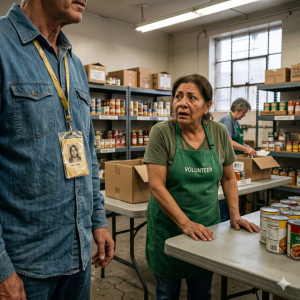
Every Saturday morning, Ruth Hadley puts on her green volunteer apron and drives the same twelve minutes to Northside Community Pantry in Duluth.
She’s done it for nine years.
She knows the regulars. She knows who needs the gluten-free items, who has a new baby at home, who’s too proud to make eye contact and needs her to just quietly slide things across the table without ceremony.
Ruth spent 38 years as a school librarian at Jefferson Elementary. She knows how to read people without making them feel read.
So when the tall, quiet man came in that February morning — the one who always stood at the back of the line, shoulders curved inward like he was trying to take up less space in the world — she noticed him the way she noticed all of them.
Carefully. Gently. Without staring.
He never said much. Just nodded. Just took his standard bag and left.
But that morning, Ruth had packed a second bag. Peanut butter, canned soup, a box of oatmeal, some of the good coffee she’d brought from home. Nothing fancy. Just enough to say someone sees you.
She waited until the line thinned.
Then she walked around the table and held the extra bag out to him.
“I had a little extra today,” she said, which was the kindest lie she knew how to tell.
He looked up for the first time.
And that’s when she saw it.
Hanging around his neck on a cracked plastic lanyard — the kind you’d find in any school supply closet — was a laminated card. Worn at the edges. Creased down the middle. The lamination peeling just enough to curl at one corner.
A hall pass.
She would know that format anywhere.
She’d made hundreds of them herself over the years, feeding them through the school’s laminator one by one, writing each child’s name in her careful teacher’s-aide print before the principal switched to printed cards in the early nineties.
Jefferson Elementary. The logo still faintly visible beneath years of handling.
Ruth’s hand didn’t shake. She was a librarian. She had spent decades maintaining composure in front of small humans who needed her to be steady.
But something moved through her chest like a door swinging open in a cold house.
She made herself smile. She made herself say, “You have a good week, now.” She made herself walk back behind the table.
But her eyes didn’t leave that lanyard.
He tucked the second bag under his arm and turned toward the door. The hall pass caught the fluorescent light for just a moment. Enough for her to see it clearly.
The name on it.
She had kept her composure through thirty-eight years of scraped knees and lost mittens and kids who cried in the stacks because home was hard and the library was the only quiet place they had.
She had held it together the morning the police came to Jefferson Elementary.
The morning a third-grade boy didn’t come to school and his teacher noticed and the principal’s voice on the intercom sounded strange and then stranger still and then everything went quiet in a way that school hallways are not supposed to go quiet.
She had held it together then too.
She thought about that boy more than she would ever admit to anyone. The way he used to sit at the beanbag in the corner of the library, holding a book with both hands like it might float away. The way he’d ask her if he could stay just a little longer, even after the bell. The way she had always said yes.
She had said yes that last morning too.
He’d stayed until she had to turn off the lights.
And then he had walked out the door.
And that was the last time anyone at Jefferson Elementary saw him.
Thirty-one years ago.
She had never stopped wondering.
Had never stopped hoping.
And now her hands were trembling — just slightly, just barely — because the name printed on that faded hall pass, still legible under the crease, was not a stranger’s name.
It was his name.
The boy who disappeared.
He was still wearing it.
She stood behind that table for a long moment after the door swung shut behind him, and she did the thing she had trained herself to do in thirty-eight years of school libraries: she breathed. She put both palms flat on the table. She breathed again.
The other volunteers moved around her without noticing. Carol from the Methodist church was restocking the pasta shelf. Young Dominic from UMD was checking bags at the end of the line. Nobody saw Ruth Hadley standing perfectly still in the middle of a February morning with her whole world rearranged.
His name was Danny Kowalczyk.
She had written that name on a hall pass herself. She could still feel the pen in her hand, the deliberate way she formed the K, the way she always dotted her lowercase i’s just a hair above center because her third-grade teacher had told her it looked neater that way and she’d never broken the habit.
Daniel James Kowalczyk. Danny. Third grade, Mrs. Petricka’s class. He’d come to her library like it was a place he’d been searching for his whole short life and finally found.
He disappeared on a Tuesday in March of 1993. His mother, a woman Ruth had seen only twice at school events — thin, distracted, smelling of something Ruth had learned to recognize but not name — had not reported him missing for four days. The police were patient about that in their public statements. Ruth had never been able to be as patient about it privately.
The case had run in the Duluth News Tribune for two weeks. Then it moved to the back pages. Then it became the kind of thing people mentioned in a certain tone of voice, the tone that meant: we think we know what happened, and the knowing is too heavy to carry in full sentences.
Ruth had written his name on the National Center for Missing and Exploited Children’s website comment form three separate times over the years, just to feel like she was doing something. She didn’t know if anyone had ever read those comments. She suspected they hadn’t.
And now he was here.
He was alive.
She pulled off her apron and told Carol she’d be right back and walked out the front door into the February cold without her coat.
He was in the parking lot. He hadn’t gotten far. He was standing at the rear corner of a blue Ford pickup that had seen better decades, loading the bags into the bed of the truck with the slow, deliberate movements of someone who has learned not to rush anything. Ruth had a sudden, certain feeling that he had learned a great deal the hard way.
“Excuse me,” she said.
He turned. Up close, in the flat winter light, she could see it — not the third-grade boy exactly, because thirty-one years is a long time and life had written things across his face that no child should have to carry — but the shape of him. The jaw. The particular way his eyes moved when he looked at her, careful and assessing and a little bit sorry, as if he was already apologizing for existing in her vicinity.
She had seen that look on him in the library too. Every single time she’d said yes, he could stay.
“I’m sorry to stop you,” she said. “My name is Ruth Hadley. I was the librarian at Jefferson Elementary.”
She watched his face.
He went very still the way a person goes still when something they have buried shifts suddenly beneath the ground.
“I need to ask you something,” she said. “And you don’t have to answer. You can get in that truck right now and drive away and I will never say a word about this to anyone, and I will still be here next Saturday with a standard bag and whatever good coffee I’ve got. That does not change. That will never change.”
She stopped. She was aware of the cold now, the kind of Duluth February cold that comes off the lake and finds the gap between your collar and your jaw.
“But if you are who I think you are,” she said, “I’ve been wondering about you for thirty-one years. And I just needed you to know that.”
He looked at her for a long time.
A semi moved through the intersection at the end of the block. Somewhere in the building behind them, Carol was probably stacking pasta and not noticing that Ruth had been gone three minutes already.
The man reached up with one hand and touched the lanyard. Not self-consciously, the way you’d touch something you’d forgotten you were wearing. Deliberately. The way you’d touch something you’d kept on purpose.
“She gave it to me,” he said. His voice was low and a little rough, the voice of someone who didn’t use it often. “Before I left. She said — ” He stopped. Started again. “She said if I ever got lost I should show someone this and they’d know where I belonged.”
Ruth felt the cold go out of her completely.
She had not said those words to him. She was almost certain she had never said those exact words to any child.
But she understood then who had.
Danny’s teacher, Mrs. Petricka, had retired in 2001 and moved to Tucson to be near her daughter. Ruth had her address somewhere, on a Christmas card list she’d kept since Reagan was president.
“She was right,” Ruth said. “She was absolutely right.”
She saw his jaw tighten and then release. The way a person looks when they’ve been holding a door shut for a very long time and someone has just told them it’s all right to open it a crack.
“I don’t really remember much about back then,” he said. “Some of it. The library. The beanbag.”
“You liked the dinosaur books,” Ruth said. “And anything with dogs. You cried at Where the Red Fern Grows and you were furious at yourself for it.”
Something that was not quite a smile moved across his face. It was rusty. Like it didn’t get much use. But it was there.
He told her a little. Not everything — she didn’t expect everything, not then, maybe not ever — but a little. His mother had moved them to a cousin’s house in Wisconsin that March, fast and without telling the school, the way she moved whenever things got complicated. The cousin’s house had led to another house and then another state, the geography of a hard childhood measured not in years but in addresses. He’d aged out of the foster system in Minnesota at eighteen after his mother’s rights were finally terminated, which was three years after it should have been, in Ruth’s private opinion. He’d worked construction, then warehousing. He’d been in Duluth four years. He didn’t explain why he’d come back and she didn’t ask.
He’d kept the hall pass because it was the only thing he’d had in his pocket the day they left. He hadn’t known, at eight years old, that he was leaving for good.
Ruth listened to all of it standing in a February parking lot without her coat, and she did not cry, because he wasn’t crying and she understood instinctively that this was not a conversation that could afford tears right now. There would be time for that later, privately, in the car on the way home.
“Are you housed?” she asked him, because she was a practical woman.
“Yeah,” he said. “I’ve got a room over on 4th. It’s fine.”
“Do you have people?”
He thought about that for a moment. “Not really.”
Ruth nodded once. She reached into the pocket of her volunteer apron — the one she was still wearing, she realized — and found the small notepad she kept there for logging inventory. She tore off a page and wrote her name and phone number in her careful, slightly above-center-dotted handwriting.
“I make dinner on Sundays,” she said. “Nothing fancy. Usually soup in February. You’re welcome any Sunday you want to come, and equally welcome not to, and there will be no questions you don’t want to answer.”
He took the paper. He looked at it for a moment.
“Mrs. Hadley,” he said.
“Ruth,” she said.
“Ruth.” He folded the paper once and put it in the front pocket of his jacket. “She said — Mrs. Petricka — she said you were the best thing about that school.”
Ruth stood with that for a second.
“She was the best thing about that school,” Ruth said. “I was just the person who kept the lights on a little longer.”
He nodded. Got in the truck. She stood in the parking lot and watched the blue Ford pull out onto the street and disappear around the corner, and then she stood there a moment longer, just breathing the cold air off Lake Superior, which in February smells like iron and distance and the particular clarity of a world that hasn’t warmed up yet.
Then she went back inside and put her apron straight and finished her shift.
Danny Kowalczyk showed up the following Sunday at 5:15 in the evening with a gas station pie — the kind with the lattice top, still in the plastic clamshell — because, he said, he hadn’t been sure if she meant it about the soup and he didn’t want to come empty-handed.
She set two places at the kitchen table.
He stayed until well after eight. They talked about the library, about Mrs. Petricka, about the particular quality of winter light in Duluth. He ate two bowls of soup and half the pie. He helped her wash the dishes without being asked, the way someone does when they’ve learned that helping with dishes is how you earn your right to stay.
Before he left, he paused at the door the same way he used to pause at the library door — just for a beat, just long enough to make sure she saw him going, the same small boy checking that someone knew where he was.
“Same time next week?” he said.
“Same time next week,” she said.
He smiled then. Not the rusty one from the parking lot. A different one. Easier. Like something coming back after a long winter.
She watched his taillights back out of the driveway and then stood in her kitchen for a moment, one hand still on the door.
Thirty-one years of wondering.
And here was the answer, eating gas station pie at her kitchen table.
Not every lost thing comes back the way you imagined. Sometimes it comes back quieter, more careful, carrying thirty-one years of weather on its face.
But it comes back.
That’s the part she hadn’t let herself fully believe. Not until now.
She went to the window and watched the blue truck’s taillights disappear down the street, and she thought about a boy in a beanbag chair holding a book with both hands like it might float away, and she thought about how some rooms, once you find them, you spend your whole life finding your way back to.
She put on the kettle.
She had a card to write to a woman in Tucson.