Twenty years ago, Carmen Vega laughed at Gloria Reyes in a way Gloria never forgot.
It wasn’t just loud. It was deliberate. The kind of laugh designed to do more than embarrass. It was meant to place someone beneath you in front of witnesses. It was meant to turn a room into a stage and another woman into a warning.
Gloria was twenty-six years old that day, standing in the original Vestidos Vega shop on Culebra Road with grief still fresh on her skin. Her mother had just been buried. She still felt hollowed out, as if every sound around her arrived from far away. In her hand was the last thing her mother had made for her, a white cotton handkerchief with blue forget-me-nots stitched around the border in tiny, careful loops.
Her mother had been a seamstress all her life. She measured hems by eye. She could rescue a bodice that other women would have thrown away. She had taught Gloria how to hold fabric like it mattered and how to read a pattern the way other people read a prayer. That handkerchief was simple, but it held her mother’s patience, skill, and tenderness in every stitch.
Carmen looked at it with contempt.
“Run my shop?” she had said, staring at Gloria from head to toe. “Mija, you are too common for this.”
Then she had taken the handkerchief right out of Gloria’s trembling hands, lifted it toward the fluorescent light, and called it peasant work.
Pretty little peasant work from a pretty little peasant girl.
The women in the shop had gone quiet. Nobody stepped in. Nobody told Carmen she had gone too far. Nobody handed Gloria the dignity Carmen had just tried to strip from her.
Carmen dropped the handkerchief on the cutting table.
Gloria picked it up, folded it, tucked it into her sleeve, and walked out.
She did not cry until she got to her car. Even then she cried silently, gripping the steering wheel until the leather creaked under her fingers. That day she learned something useful about humiliation. When it came from people with money, status, and a polished smile, it was often mistaken for authority.
At the time, Gloria was still married to Carmen’s son, Rodrigo Vega. Back then she had believed marriage would make her part of the family in some meaningful way. It didn’t. Rodrigo had the kind of weakness that looked harmless until life demanded courage. He avoided conflict. He softened everything with excuses. He was always planning to stand up to his mother tomorrow.
Tomorrow never came.
Gloria stayed longer than she should have because that is what many women do when they are taught to be patient with disrespect. She told herself Rodrigo loved her, and in his way he did. But love that never stands beside you in the room where you are being humiliated starts to rot.
By the time the divorce was final, she no longer argued with him. She simply signed the papers, removed Vega from her name, and went back to Reyes-Montoya, the name she chose for herself after her mother and grandmother. That week she also took the handkerchief out of the drawer where she had hidden it and pressed it into her sleeve before leaving the house.
It became a ritual after that.
She carried it to every frightening new beginning.
She had almost no money when she started over. What she had was skill, stubbornness, and a folding card table she set up at Traders Village on weekends. She sold simple alterations at first, then custom quinceañera bodices, then last-minute bridal fixes for women desperate enough to trust a stranger with a wedding hem two days before the ceremony.
She took every job seriously. A rushed zipper replacement. A christening gown restoration. A prom dress rescue after another tailor ruined the fit. Women came once, then returned with sisters, cousins, daughters, friends. Gloria listened. She remembered preferences. She treated poor customers the same way she treated wealthy ones. She knew what it felt like to be looked over, and she built her reputation by making women feel seen.
There were bad months. There were terrifying months. Once she had to choose between buying more lace yardage or paying her electric bill on time. Another time she sat in a bank parking lot for ten full minutes before going in to ask for a business loan because she was sure they would laugh at her the way Carmen had laughed.
They didn’t.
The banker asked hard questions. Gloria answered every one. She had records, sketches, orders, and a business plan written in a composition notebook with tabs sticking out from the pages. She walked out with a modest loan and cried in her car again, but this time from relief.
She opened a small commercial space years later. Then a larger one. She hired one assistant, then three, then a patternmaker, then a floor manager. Her work moved beyond local orders into boutique wholesale. A shop in Houston placed a trial order. Another in Austin followed. Then a second Houston boutique called after seeing one of her custom gown lines online.
At forty-six, Gloria Reyes-Montoya owned a bridal and formalwear company with twelve employees and a waiting list long enough to prove she had outgrown every insult ever thrown at her. She still worked longer hours than she admitted to anyone. She still checked stitches herself before major deliveries. She still carried her mother’s handkerchief inside her left sleeve when something important was about to happen.
That is why, on the morning she drove back to Culebra Road, the cloth was already there before she even fully realized she had tucked it in.
Vestidos Vega had fallen hard.
The franchise expansion that once made Carmen brag at luncheons and ribbon cuttings had soured. The corporate partner withdrew. Inventory aged on the racks. Trends shifted. Debt followed. Three locations closed in eighteen months. The flagship store on Culebra Road was the last one standing, and even it wore failure openly. Peeling paint above the door. Faded displays. Dresses in the window that looked years too old. A crooked handwritten sign taped to the inside glass: UNDER NEW MANAGEMENT COMING SOON.
The broker handling the sale was Dennis Holt, a neatly dressed man from Dallas who had seen enough distressed retail deals to know when family history sat hidden beneath the paperwork. He called Gloria after being referred through a supplier who knew she was looking to expand into San Antonio proper. Dennis was careful during the first conversation. He discussed numbers, lease terms, brand rights, inventory liabilities.
Then, in a lower tone, he added, “The current owner has requested a discreet process.”
Gloria almost laughed at that. Carmen had always loved the word discreet when what she meant was ashamed.
Dennis told her he had one serious buyer in the running. He did not reveal that the serious buyer was her, not to Carmen, not until the final meeting.
Gloria agreed.
She didn’t tell her staff where she was going that morning, only that she had an acquisition meeting. She drove herself in a white Tahoe and parked two blocks away. Old habits die hard, especially around places once connected to pain. She sat for a moment before getting out, fingertips brushing the folded square inside her sleeve.
Then she walked to the back entrance and entered the building where Carmen Vega had once tried to reduce her to nothing.
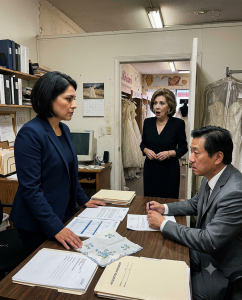
The back office had barely changed.
Same cramped dimensions. Same file cabinets. Same desk placement. Different dust. Different desperation.
Dennis greeted her with professional warmth and laid the acquisition folder in front of her. She read through it methodically while waiting. He made small remarks about timing, market conditions, the landlord’s patience thinning. Gloria nodded but did not overtalk. She knew exactly where she was and exactly why her pulse had not settled since she entered.
When the front door opened, she felt it before she heard it. A subtle tightening in her chest. Then the unmistakable click of Carmen’s heels on tile.
Some sounds travel through years intact.
Carmen entered the office looking immaculate. Her clothes were tailored, her hair carefully styled, her makeup expensive and restrained. Time had not made her soft. It had only thinned the distance between her control and her panic. You could see it around the eyes if you looked long enough.
At first she didn’t look at Gloria at all.
She looked at Dennis.
“Is the buyer here?” she asked.
Dennis folded his hands. “Yes, ma’am. She’s been here awhile.”
Carmen turned.
Gloria looked up.
The silence was immediate and physical, like another person had entered the room and shut the door behind it.
For a fraction of a second Carmen didn’t fully process what she was seeing. Recognition traveled across her face in stages. Surprise. Denial. Calculation. Then something sharper underneath it all: fear.
Dennis, sensing the danger of silence, began reciting the terms of the sale. Purchase price. Remaining obligations. Naming rights. Licensing transfer. Lease assumption. Inventory disposition. He slid pages. Pointed to sections. Spoke in the neutral language of commerce because neutral language was the only thing standing between that room and emotional combustion.
Gloria listened. She read. She did not rush.
Carmen remained standing near the door, as though sitting might make her position feel weaker.
When Gloria finished the last page, she closed the folder gently. Then she slipped two fingers into her sleeve and drew out the handkerchief.
White cotton.
Blue forget-me-nots.
She laid it on top of the paperwork.
Carmen went pale.
It was the kind of pallor that starts beneath the skin, the body answering before the mind can rearrange the face. Her eyes locked on the little square of cloth. Gloria knew, in that instant, that Carmen remembered everything. Not generally. Not vaguely. Specifically. The insult. The room. The timing. The cruelty.
Her mouth opened.
Nothing came out.
Then, in a voice so unlike the woman Gloria remembered that it almost felt unreal, Carmen asked, “You kept it?”
Gloria’s fingertips rested on the cloth.
“All these years,” she said.
It was not a dramatic answer. That made it worse.
Carmen stared at her a moment longer and something in her posture shifted. Not into humility. Carmen Vega was not built for humility. But some of the old certainty drained away. She seemed to understand that this was not a simple matter of an ex-daughter-in-law purchasing a failing store. This was a witness returning to the scene with proof.
“You said my mother’s work was peasant work,” Gloria said quietly. “You said I was too common to run your shop.”
Carmen swallowed. “This is a business meeting.”
“No,” Gloria said. “It started as one.”
Dennis went completely still.
Gloria’s voice never rose. It didn’t need to. Calm is often more devastating than fury when the other person knows they deserve both.
“My mother taught me to sew when we had almost nothing,” Gloria said. “She stitched by window light when the electricity got cut off. She stitched through migraines and swollen fingers and exhaustion. She stitched because rent was due and because women still needed dresses finished even when life wasn’t fair.”
Carmen’s expression tightened.
“And the week I buried her,” Gloria continued, “you looked at the last thing she made me and laughed.”
Carmen looked at the handkerchief again.
That glance told Gloria more than an apology could have. Carmen remembered all of it. She had simply never expected to be made to sit inside the memory.
“If this is about humiliating me,” Carmen said carefully, “then say so.”
Gloria shook her head once.
“Humiliation is cheap,” she replied. “You taught me that.”
Dennis lowered his eyes to the papers.
Gloria slid the acquisition folder slightly forward. “I can buy this store. I can keep the name or bury it. I can renovate every inch of this building and rebuild the business in a year. I can do all of that.”
Carmen did not answer.
“But before I sign anything,” Gloria said, “there is something I need from you.”
Carmen held her gaze. Gloria could see pride and dread fighting inside her.
Then Carmen did something surprising. She reached for her purse with a hand that trembled.
She took out a small bundle wrapped in yellowed tissue paper.
For the first time, Dennis looked openly confused.
Carmen set the bundle on the desk but kept one hand over it, as if she still wasn’t sure whether revealing it would destroy her last defense or preserve it. When she spoke, her voice had roughened.
“I told myself your mother owed me,” she said. “For table space. For fabric. For training. I told myself I had improved what she brought in.”
Gloria’s chest tightened.
Slowly, Carmen peeled back the tissue paper.
Inside was a folded packet of old pattern pieces, aged and fragile, marked along several corners with tiny blue stitch tabs meant to keep paper sections aligned. Gloria knew those little blue stitches instantly. Her mother used thread like other women used labels. It was her way of keeping order in a crowded workroom where everyone else’s hands were always moving.
Gloria stared.
Her mother’s original dress patterns.
Not copies.
Not reproductions.
The originals.
“I used them,” Carmen said.
No one in the room moved.
“My best-selling line in 2005,” Carmen continued, each word seeming to cost her. “The fitted waists. The drape that everyone said made the silhouette look more expensive. The shoulder balance. Your mother solved those cuts first. I changed details, enough to call them mine. But the line was built from her work.”
The room tilted for Gloria.
She had spent twenty years believing Carmen mocked her mother because she truly looked down on her skill. But the truth was uglier than contempt. Carmen had recognized value immediately. She had insulted it, then stolen it.
The handkerchief suddenly meant more than remembered cruelty. It meant evidence of motive. Carmen had laughed not because Gloria’s mother’s work was worthless, but because degrading the woman who made it made the theft easier to live with.
“You stole from her,” Gloria said.
Carmen closed her eyes briefly. “Yes.”
The word landed like a dropped stone.
Dennis inhaled sharply, now fully aware he had wandered into something no broker’s contract could contain.
Gloria reached for the pattern packet but paused before touching it. She thought of her mother bent over a table, sharpening chalk with a kitchen knife. She thought of how often women like her mother solved difficult design problems only for someone richer to claim refinement had magically appeared in their own hands. She thought of every customer who had praised a Vestidos Vega silhouette without knowing where it came from.
“When?” Gloria asked.
“Before she died,” Carmen whispered. “A few months before. She brought the patterns in hoping I’d consider a new line. I said they were too provincial for the front floor. Then I kept them.”
Gloria looked at her, stunned by how plain the admission was once it finally came out.
“Did my mother know?”
Carmen hesitated.
That hesitation was its own cruelty.
“I think she suspected,” Carmen said. “But she never confronted me. Not directly.”
Of course she hadn’t, Gloria thought. Her mother had been practical. She would have measured the cost of confrontation against the need to keep working, keep paying bills, keep surviving. Women like Carmen counted on that. They knew exactly how much silence poverty could buy.
A hard anger rose in Gloria then, cleaner than the old humiliation had ever been.
She picked up the pattern packet and unfolded the top page carefully. Her mother’s handwriting was there in faded pencil, marking grain lines and seam allowances. At the edge of one piece was a tiny notation in Spanish only Gloria fully understood because her mother had abbreviated in her own odd way, half practical shorthand, half private habit.
Gloria’s throat tightened.
Dennis murmured, almost to himself, “This changes things.”
He was thinking like a broker, like a man who understood liabilities. Gloria barely heard him.
Carmen, however, wasn’t finished.
“There’s more,” she said, and for the first time there was unmistakable panic in her voice. “Rodrigo never knew about the patterns. Not then. But he did know something else. Something after the divorce.”
Gloria looked up sharply.
Carmen’s eyes were wet now, though she seemed furious at her own tears. “When the corporate deal started failing, your old records came up in a valuation discussion. One of the consultants compared historical construction details from your current designs to archived Vestidos Vega samples. Rodrigo recognized the similarity.”
Gloria stared at her.
“He found internal sketches. Copies I’d kept. Enough to realize where the line began.” Carmen’s mouth tightened. “He knew your mother had been the origin of those designs.”
A chill moved through Gloria. “And he said nothing.”
“He said plenty to me,” Carmen replied bitterly. “Not to you.”
Of course he hadn’t. Rodrigo had always chosen the path that protected him from discomfort. Even after the marriage, even after the years, he had still found a way to keep the truth at arm’s length if speaking it required courage.
“What did he do?” Gloria asked.
Carmen looked at the desk before answering. “He used the information.”
Those four words changed the air again.
“To do what?”
Carmen swallowed. “To secure leverage during the franchise restructuring. There was talk of liquidating certain legacy design archives for cash flow. He argued against it publicly. Privately, he started keeping copies. He said if the business ever went under, he wanted insurance.”
Gloria felt a slow, rising horror.
“Insurance against what?”
“Against being left with nothing,” Carmen said. “Against me. Against the lenders. Against anyone.”
The shape of it became visible now. Rodrigo had discovered that one of the most profitable old Vestidos Vega lines was rooted in stolen work by Gloria’s mother, and instead of telling Gloria, returning the evidence, or exposing the theft, he had stored it away as leverage.
“What exactly does he have?” Gloria asked.
Carmen did not answer immediately.
That answer was in itself a warning.
“Carmen.”
“Copies of the original patterns,” she said. “Annotated redesigns. Internal dates. Sales reports. He also has a draft licensing memo that was never executed. And…” She stopped.
“And what?”
“A letter,” Carmen said softly. “From your mother.”
Everything inside Gloria went still.
“A letter?” she repeated.
Carmen nodded.
“She wrote to me after she saw the first dresses in the window. She didn’t accuse me in public. She wrote privately. She said she recognized the cuts. She asked me to do right by the work, if not for her, then for you.”
Gloria could barely breathe. “Where is it?”
Carmen’s eyes dropped. “Rodrigo took it from the file cabinet three years ago.”
The betrayal of that landed differently from the old ones. It was not the familiar betrayal of neglect or spinelessness. It was active. Deliberate. Rodrigo had found proof that Gloria’s mother had been robbed and had withheld it while Gloria built her own business from scratch, never knowing the full truth of what had been taken from her family.
“Why?” Gloria asked, and this time the question was not really aimed at Carmen.
“Because he thought one day you might be forced to negotiate for it,” Carmen said.
Gloria let out a harsh breath that was almost a laugh and almost a sob. Of course. Rodrigo had learned from the family business after all. Not the craftsmanship. Not the work ethic. The leverage.
Dennis shifted carefully. “Ms. Reyes-Montoya, given what has just been disclosed, I should advise that any signing today be postponed pending legal review.”
She nodded once without taking her eyes off Carmen.
The sale papers no longer mattered in the same way. The store still mattered. The building still mattered. But the deeper story had climbed out from under the floorboards. This was no longer about whether Gloria wanted Carmen’s storefront. It was about her mother’s legacy, stolen and buried under profit margins, and an ex-husband who had quietly sat on the evidence.
Carmen looked older now than she had when she entered. Not because of wrinkles or posture, but because secrets age a face the second they stop being hidden.
“I am not asking for forgiveness,” she said.
Gloria almost answered, but stopped. Forgiveness was nowhere near the room.
Instead she folded the handkerchief carefully and placed it over the pattern packet, protecting old paper with old love. Her mother’s stitches lay on top of her mother’s designs, the way they should have from the start.
Then Gloria rose from her chair.
Carmen instinctively straightened, as if expecting judgment to come in a formal sentence. Dennis stood too, uncertain whether this was the end of the meeting or the beginning of a lawsuit.
Gloria gathered the folder, the packet, and the handkerchief into her arms.
“The store can wait,” she said.
Carmen’s face flickered.
Gloria looked directly at her. “The truth waited long enough.”
She turned toward the door.
Behind her, Carmen said her name once, softly. Gloria paused but did not face her.
“I did admire your mother,” Carmen said. “That was part of the ugliness. I admired her enough to steal from her and despise her for making something I couldn’t.”
Gloria closed her eyes for a single second.
There it was. The small rotten core inside so much cruelty: envy dressed as superiority.
She did not answer. Nothing worthy of her mother could be built from that confession.
Outside, the store looked different than it had when she entered. Still fading. Still wounded. But now she understood more clearly what had lived inside its walls all these years. Not just vanity. Not just decline. Theft. Fear. Silence.
She stepped into the afternoon light and stood on the sidewalk with the packet held firmly against her side. Her phone was already in her hand before she reached the car.
Rodrigo answered on the fourth ring, sounding distracted until he heard her voice.
“Gloria?”
“I just left your mother’s store,” she said.
The silence on his end told her enough.
“You knew,” she said.
He tried to deflect first. Then to soften. Then to explain. He said it was complicated. He said he meant to tell her when the timing was right. He said he didn’t know what good it would do to reopen old wounds unless it helped her somehow.
That was Rodrigo all the way through. Even now he framed truth as a tool to be released only when useful to him.
Gloria let him talk until he reached the part where he insisted he had protected the documents from being destroyed.
Then she cut him off.
“You protected your leverage,” she said. “Not my mother.”
He had no answer to that.
By the time she hung up, the last illusion she had ever carried about him was gone.
The legal fight that followed was not simple, but it was effective. Gloria hired an attorney specializing in intellectual property and commercial fraud. The pattern papers, the surviving archived samples, the internal redesign notes, and eventually the letter from her mother created a chain no one could plausibly explain away. Rodrigo surrendered the documents before formal discovery finished, no doubt hoping cooperation might reduce his exposure. Carmen settled before trial, perhaps because age had finally taught her that some public fights cannot be survived with posture alone.
The settlement terms were private, but the outcomes were not difficult to read.
Gloria acquired the Culebra Road store under a new name.
Not Vestidos Vega.
Not anything carrying borrowed prestige.
She renamed it Flores de Olvido Bridal House, a private nod to the blue forget-me-nots on the handkerchief that had outlasted an empire.
Inside the renovated showroom, one framed display hangs in a quiet hallway outside the design room. It contains a copy of her mother’s original pattern notation beside a small photograph of her hands at work, taken years before on a cheap disposable camera. There is no grand speech attached to it. No manufactured brand mythology. Just a discreet plaque that reads: For the women whose work was called ordinary until someone else profited from it.
Customers stop there sometimes. Many wipe at their eyes before moving on.
Gloria expanded carefully after that. Not out of vengeance. Out of clarity. She built apprenticeship opportunities into the business for young seamstresses who had talent but no connections. She instituted design credit standards inside her company so no assistant, cutter, or patternmaker could disappear into someone else’s signature line without recognition. She made sure the hands doing the work had names attached to that work.
People in the industry called her strict.
She considered that a compliment.
As for Carmen, she retreated from public business life. Whether she felt regret, embarrassment, relief, or some mix of all three, Gloria couldn’t say. They never became close. There was no sentimental reconciliation. Some wounds don’t want that. Some truths do not restore a relationship; they simply restore the record.
Rodrigo tried twice, over the following year, to arrange a conversation that sounded suspiciously like he wanted absolution without consequence. Gloria declined both times. She had spent too much of her life understanding men who refused to understand themselves.
On the anniversary of her mother’s death, Gloria sometimes takes the original handkerchief out and smooths it flat with two fingers. The cloth is more fragile now. The stitches have loosened in one corner. Time always leaves its evidence. But the blue flowers still hold.
She thinks, on those evenings, about the strange shape justice can take. It does not always arrive as punishment. Sometimes it arrives as recovery. A name returned. A design reclaimed. A lie finally forced to stand in daylight.
And sometimes it arrives when the woman once called common walks back into the room carrying the very proof they tried to degrade, only to discover that what was mocked was never small at all.
Maybe that is the part that lingers longest.
Not that Carmen lost.
Not even that Gloria won.
But that for years the most valuable thing in the story was dismissed because it came from the wrong hands, the wrong neighborhood, the wrong kind of woman.
How many times does that happen before anyone notices? How many gifted women are told their work is too plain, too provincial, too ordinary, only to watch somebody wealthier rename it brilliance?
Gloria knows the answer now.
Too many.
Which is exactly why she never lets anyone in her workroom use the word common again.