Claire almost canceled the date twice, and later she would wonder whether instinct had tried to save her from the entire night.
The first time had been ordinary enough. Her babysitter texted an hour before dinner to say she had a fever and couldn’t come. Claire stood in her kitchen reading the message while reheated pasta steamed on the stove and Rosie sat at the counter drawing a dragon with six wings and a human smile.
The second time hit harder.
Rosie slipped off her chair, walked over, wrapped both arms around Claire’s waist, and pressed her cheek to Claire’s side.
“Do I have to like him?” she asked.
Claire looked down at her daughter’s brown hair, at the part that never stayed straight, at the spot behind her left ear where a pale scar curved like a half-moon if the hair shifted the right way.
“No,” Claire said after a moment. “You don’t have to like anybody.”
Rosie nodded as if this confirmed something important, then went back to her dragon.
That should have been the end of it.
Claire was not hungry for romance. She was not standing dramatically on the edge of a new chapter. She was a thirty-six-year-old litigation attorney who worked too much, slept too little, and spoke fluent disappointment. She had a nine-year-old daughter, a carefully managed divorce, a mortgage that made her jaw clench every month, and a private history of fear she didn’t discuss with anyone unless a form required it.
Her friends called Adrian “safe” with the enthusiasm of people who did not understand how insulting the word could be.
“He’s stable.”
“He’s kind.”
“He’s normal.”
As if Claire should be thrilled by the possibility of a man who did not immediately set off alarms.
But the babysitter was sick. Rosie was already dressed. Claire was too tired to invent another excuse and too proud to admit she’d been relieved to have one.
So she did the practical thing, which was also the foolish thing.
She brought Rosie.
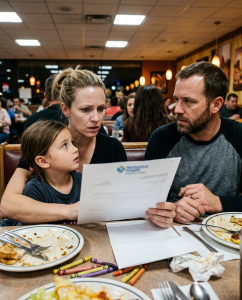
The restaurant was crowded, loud, and bright in the slightly unforgiving way family Italian places always were. Claire chose it because it felt public, harmless, impossible to romanticize. A first date should be easy to leave.
Adrian was already there when they arrived, standing beside the booth. He looked exactly like his photos and somehow less self-conscious than most men did in person. Early forties. Navy button-down. Wedding ring gone, tan line faded. He had the composed face of someone who had spent years learning not to overreact in front of children.
He smiled at Claire first.
Then he lowered himself slightly so he was closer to Rosie’s eye level without making a performance of it.
“Hi,” he said. “Your mom told me you draw dragons.”
Rosie studied him. “Some of them.”
“The important ones?”
Rosie gave a grave nod. “Yes.”
Adrian nodded back. “Makes sense.”
That alone made Claire suspicious. Most adults tried too hard with Rosie. They wanted instant approval, which Rosie always recognized and resented. Adrian seemed content to leave a little distance.
They sat.
Claire expected strain. She expected the evening to collapse under the obvious mismatch between a first date and a child with glitter on her sleeve. Instead, Adrian adjusted with surprising ease. When Rosie asked for extra napkins, he slid them over. When she dropped her fork, he caught the server’s eye before Claire could apologize. When she folded one leg under herself and used the kids’ menu as a drawing pad, he treated it as weather—present, unremarkable, not offensive.
It disarmed Claire against her will.
They talked about jobs first. Adrian worked in compliance for a medical technology company, which sounded dry enough to be believable. Claire admitted she was a litigator and watched him decide whether to be intimidated. To his credit, he only laughed and said, “So I should choose my words carefully.”
“You should choose the truthful ones,” she replied.
“That sounds more dangerous.”
Rosie interrupted to announce that Pluto should still count as a planet because demoting it was “mean.”
Adrian took this seriously enough to earn a full explanation.
He had a son in middle school. His divorce had been final three years earlier. Shared custody. He spoke of co-parenting without poison, which Claire found both reassuring and suspicious. Nobody decent advertised bitterness on a first date, after all.
Still, something about him felt tired in a familiar way. Not sloppy. Not broken. Simply worn thin around the edges, the way Claire felt when she was honest with herself.
For a little while, she relaxed.
Then Rosie dropped a crayon.
It bounced off the booth and rolled beneath the table. Adrian bent to get it before Claire could move. He came back up, held out the crayon, and Rosie reached for it while tucking her hair behind one ear.
Claire saw Adrian stop.
Not dramatically. Nothing obvious enough to name.
But his eyes fixed behind Rosie’s ear on the pale scar there, and all the color seemed to leave his expression.
Claire felt every muscle in her body tighten.
That scar belonged to the worst year of her life.
When Rosie was four, what had first sounded like a manageable congenital abnormality turned into complications. Then procedures. Then overnight monitoring. Then the kind of medical language that empties a parent from the inside. Claire remembered sleepless hospital nights under too-cold blankets, the smell of sanitizer, the mechanical chirping of monitors, and the way every doctor seemed calm in a language designed not to panic the adults.
She remembered being told Rosie needed surgery.
She remembered signing forms she could not read through tears.
She remembered a surgeon later telling her, with grave kindness, that the outcome had depended on a decision made in the final thirty seconds.
That phrase had lodged in Claire’s mind for years. A decision made in the final thirty seconds. She had repeated it to herself as proof that miracles still existed in sterile rooms.
Most people never noticed the scar unless Rosie pulled her hair back.
Adrian noticed.
And not the way strangers noticed.
The way one professional recognizes another’s signature.
“You okay?” Claire asked.
He looked up too quickly. “What hospital did she have that done at?”
Claire’s spine went rigid. “Why?”
His expression altered immediately, as though he heard himself and understood what he had just done.
“I’m sorry,” he said. “That was too direct.”
“Yes,” Claire said. “It was.”
Rosie glanced between them. “Did I do something?”
“No, sweetheart,” Claire said at once.
Adrian sat back, but he didn’t recover. Something had opened in his face that would not close again.
After a moment, he asked, quieter, “Children’s Memorial?”
Claire did not answer, which was answer enough.
He drew in one breath, shallow and controlled. “Then I know the surgeon.”
Claire pushed halfway out of the booth before she realized she was standing.
“How?”
He looked at the table, then back at her.
“Because I sued him.”
The words landed with physical force.
Rosie’s crayon slipped from her hand and rolled across the tabletop. Claire stared at Adrian as if he’d started speaking a language she was supposed to know but didn’t.
“What are you talking about?”
He lowered his voice. “My wife died during a procedure at that hospital.”
Everything around Claire seemed to go loud and far away at the same time.
Rosie sensed it instantly and climbed into Claire’s lap without a word. Claire held her with one arm while the other gripped the table edge.
Adrian did not reach toward them. He did not ask for sympathy or soften the facts.
“It wasn’t the same surgery,” he said. “But it was the same surgical team.”
Claire’s mind split in ugly directions.
Had he known who she was before tonight?
Had he agreed to this date because of Rosie?
Had her friends somehow set her up with a man carrying pieces of the same hospital in his past?
“What exactly are you saying?” she asked.
He put a hand inside his coat.
Rosie clutched Claire’s neck.
“Don’t,” Claire said sharply.
He stopped at once and slowly withdrew a folded set of papers, placing them on the table within her reach, not forcing them into her hand.
“Because if I’m right,” he said quietly, “your daughter’s surgery wasn’t the miracle you think it was.”
Claire looked at the first page.
Hospital logo.
Case heading.
Legal language.
Wrongful death claim.
Her throat tightened.
She unfolded the documents carefully, as if rough handling might change what they said. Adrian remained still across from her, his eyes not on the paper but on Rosie, then away again, as if he hated the fact that a child sat at the center of this.
The first page was dense. Dates. Procedural notes. Names of physicians and departments. The phrases “failure to disclose” and “intraoperative deviation” leapt out like burns.
Then one line caught and held.
Emergency graft material obtained from pediatric donor case transferred intraoperatively under exceptional authorization.
Claire blinked.
Read it again.
Pediatric donor case.
Transferred intraoperatively.
Her hand started to shake.
“No,” she said, though she did not know whom she was arguing with.
Adrian’s voice stayed low. “I didn’t know the donor case was your daughter until I saw the scar.”
Claire looked up slowly. “Donor?”
He hesitated.
That hesitation changed everything. It meant the truth was worse than the sentence on the page.
“My wife was in surgery that same evening,” he said. “The case notes in discovery showed that a critical graft match, along with the specialist who could place it, was reassigned under emergency authorization. The records on the pediatric side were sealed. The adult file only referenced a case number.”
Claire could barely hear him over the noise in her own head.
Years ago, doctors had told her Rosie had been saved by quick thinking, precision, courage. Claire had accepted that story because she needed to. Because the alternative was unthinkable.
Rosie looked up at her. “Mom?”
Claire kissed the top of her head automatically.
Adrian continued, each word precise. “I’m not saying they shouldn’t have saved your daughter. I’m saying they made a decision between two patients, and neither family was told enough to understand what they were trading.”
The server appeared at the table just then with breadsticks and saw all three faces.
“Everything okay here?”
“Yes,” Claire said, too quickly.
The woman retreated.
Claire looked back down at the paperwork. On the second page someone had underlined a notation in blue ink.
Resource redirected by attending after consult from family advocate.
“Family advocate,” Claire read aloud.
Adrian’s jaw tightened. “That was me.”
She looked up.
He held her gaze. “I was there. My wife had signed an updated consent that afternoon. We were told the team was handling complications. I was the one pushing for answers. Pushing for them to move faster. Pushing for someone senior to make a call.” He swallowed. “I thought I was helping her. I didn’t know my pressure would be attached to another case.”
Claire felt cold all over.
In her memory, that night at the hospital was a blur of running shoes, clipped voices, and one nurse who would not meet her eyes. She remembered being told there was a last-minute opportunity, a possible intervention, a narrow opening. She remembered consenting to anything, everything. She remembered praying to a God she had ignored for years.
Had someone else been losing their wife down the hall while her daughter was being prepared?
She kept reading.
Another note. Another time stamp. Another signature she half recognized from Rosie’s records. Then a room number and a phrase that made her lungs lock.
Prognosis differential favored adult patient absent pediatric reassignment.
Claire stopped.
The attending had believed Adrian’s wife had the better chance.
And they had still reassigned the material.
Rosie shifted in Claire’s lap, uncomfortable now with the tension she couldn’t decode.
“Can we go home?” she whispered.
“In a minute,” Claire said, but she barely heard herself.
Adrian leaned forward for the first time. “There’s more.”
Claire laughed once, a brittle sound with no humor in it. “Of course there is.”
He winced but continued. “The surgeon’s deposition changed twice. The hospital settled quietly. Sealed portions stayed sealed. But I never stopped reading. I never stopped looking at the timeline. Then your friend showed me your photo.” He shut his eyes briefly. “I almost canceled.”
Claire stared at him. “You knew before tonight?”
“I knew there was a chance,” he said. “I didn’t know until I saw the scar.”
Claire should have stood up. She should have walked out, taken Rosie, and burned the papers later in the sink.
Instead she asked, “Why come at all?”
He took a long breath. “Because after years of wanting someone from that other case to be a monster, I needed to know whether you were real.”
The answer was so unexpected it stunned her into silence.
Rosie tugged at Claire’s sleeve. “Mom?”
Claire stroked her daughter’s hair and finally stood. “We’re leaving.”
Adrian stood too, but kept his distance. “Take the papers.”
Claire did.
Outside, the night air felt harsh and clean. Rosie held Claire’s hand all the way to the car.
In the backseat, Rosie buckled herself and asked, “Is that man bad?”
Claire closed the driver’s door and sat without starting the engine.
“No,” she said after a long time. “I think something bad happened to him.”
“And to me?”
Claire looked at her in the rearview mirror. At the scar hidden again by hair. At the child who had survived without knowing what survival had cost.
“I don’t know yet,” Claire said.
That night, after Rosie was asleep, Claire spread the documents across her dining table and pulled out the box where she kept every medical record she had promised herself she’d never reread. Operative reports. Billing summaries. Discharge instructions. Notes she had scribbled in parking garages while crying so hard she could barely hold the pen.
At 1:14 a.m., she found a name in Rosie’s chart that matched the attending physician from Adrian’s lawsuit.
At 2:03 a.m., she found an amended operative note that had been filed forty-eight hours after surgery.
At 2:17 a.m., she found the lie.
The original note described an unsuccessful first approach and urgent reassessment. The amended note replaced that with a cleaner sequence, one that made the final intervention look planned rather than redirected. A page was missing between two timestamps. Not accidentally missing. Removed.
Claire sat very still.
By morning, she had emailed an old law school friend who specialized in medical records compliance. By noon, she had requested certified copies from the hospital. By evening, Adrian had sent over the unsealed deposition transcripts from his case, every page labeled and indexed.
They did not become allies gracefully.
At first, every phone call sounded like an accusation.
Claire hated what Adrian’s documents implied.
Adrian hated what Claire’s daughter represented.
Neither of them knew how to look at the other without seeing a hallway where one family’s terror ran parallel to another’s.
But facts have their own momentum.
The certified records confirmed the timeline discrepancy.
A nurse’s handwritten note, overlooked for years, described an emergency consult between departments after “pediatric viability reassessed.” Another internal memo mentioned reputational exposure if “cross-case reallocation” became public. The surgeon’s deposition included one chilling sentence he had tried to soften later:
We had one resource, two crashing trajectories, and a window measured in moments.
Claire read that line six times.
One resource. Two patients. A window measured in moments.
The final piece arrived from an unexpected source: a retired anesthesiologist who had been subpoenaed in Adrian’s case and, after the settlement, moved out of state. He agreed to speak only after Claire contacted him herself, lawyer to reluctant witness.
“What they told you wasn’t technically false,” he said over the phone. “A decision was made in the last thirty seconds. What they didn’t tell you was that it wasn’t just about your daughter’s body. It was triage.”
Claire sat at her desk gripping the phone so tightly her fingers hurt. “Did they choose her because she was a child?”
A pause.
“Partly,” he said. “Partly because her projected recovery after reassignment improved once the graft became available. Partly because another surgeon argued hard for her. Partly because everyone in that room knew if a child died and an adult died, the public story would not land the same way.”
Claire closed her eyes.
“And Adrian’s wife?”
“She might still have died,” he said. “No honest person can promise otherwise. But her odds were better before the reassignment. That much is true.”
When Claire told Adrian, he didn’t speak for several seconds.
Then he said, very quietly, “So I wasn’t crazy.”
“No,” Claire replied. “You were just never told the whole truth.”
The hospital tried to stonewall when Claire moved toward legal action. So did the surgeon. But the combination of preserved records, amended notes, deposition contradictions, and an adult wrongful death suit already in existence made the strategy fragile. They could survive one grieving widower. They were less prepared for a litigator mother whose child had survived under false pretenses.
The case did not go to trial.
Hospitals rarely let certain truths reach a jury if money can bury them first.
There was a settlement offer, then another. Claire rejected both until the terms included a formal acknowledgment of nondisclosure in cross-case emergency reassignment, a review of pediatric consent language, and the release of several sealed findings from the original investigation.
It still wasn’t justice.
It was paperwork around a wound.
But it was truth, or enough of it to damage the lie.
Months later, Claire met Adrian in a park instead of a restaurant.
Rosie was with her, chasing pigeons with the solemn focus of a child on a mission. Adrian’s son sat on a bench nearby pretending not to watch.
Neither adult mentioned the date that had started it all.
They talked about the settlement. About how little it changed and how much it cost. About how strange it was to build a friendship on a catastrophe neither of them had chosen.
At one point Rosie ran back, hair flying, and asked Adrian if he knew how to draw dragon wings “that don’t look dumb.”
He took the sketchpad she offered and said, “I can try.”
Claire watched him, the careful way he handled the pencil, the way Rosie leaned in without fear.
For the first time, the scar behind her daughter’s ear did not look like a secret. It looked like a mark left by a history no one could untangle cleanly.
Adrian handed the sketchpad back. Rosie approved the wings.
Then she ran off again.
Claire sat down beside him on the bench.
“Do you hate me less now?” she asked, because honesty had become the only language that still worked between them.
He looked out across the park. “I never hated you.”
“My daughter?”
His face tightened. “I tried to. For a while. It was easier than hating a system with no face.”
Claire nodded. It was the most painful answer he could have given, which was exactly why she believed it.
After a moment, he said, “And you?”
Claire thought about the years she had spent calling Rosie’s survival a miracle. About the gratitude that had once felt pure. About the nausea of learning that someone else’s loss had been folded into her relief and hidden from her.
“I don’t know who to forgive,” she said.
“That probably means they don’t deserve it yet.”
She laughed once, softly.
The wind lifted a strand of Rosie’s hair and exposed the scar for just a second before it disappeared again.
A curved pale line.
A mark of survival.
A mark of selection.
Claire would always be grateful her daughter lived. Nothing could change that. Nothing should. But gratitude, she had learned, could exist beside horror. Love could stand next to guilt. And the ugliest truths were not always about villains choosing evil. Sometimes they were about professionals deciding whose future carried more acceptable consequences.
Rosie came running back, breathless, demanding snacks.
Claire stood.
Adrian stood too.
For a second they faced each other in that uneasy territory where grief, anger, and reluctant tenderness had all taken turns living.
No miracle had happened in the final thirty seconds of Rosie’s surgery.
A choice had.
And years later, after every document had been opened and every careful lie dragged into daylight, the hardest question still wasn’t whether the doctors had been honest.
It was whether, in that room, with two lives collapsing and one impossible resource between them, anyone would have made a different decision at all.