For seven mornings in a row, Dolores Martinez watched the same woman sit on the same bench in the same thin cardigan under a sun that had no mercy.
By the third day, Dolores had stopped pretending she was only noticing by accident.
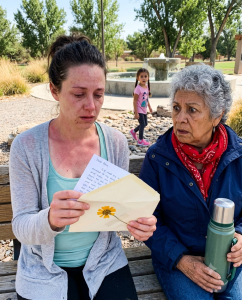
There were some people who seemed built for Albuquerque and some who arrived looking like the desert had taken offense at them. This woman was in the second category. Her shoulders had gone from pale to angry pink in two days. The bridge of her nose was peeling by the fourth. Her hair was always loosely tied back as if she’d put it up without looking in a mirror, and every morning she held the same cream-colored envelope in both hands.
That envelope became impossible to ignore.
It was thick and soft at the edges, not crisp the way fresh paper should be. It had been carried, turned over, and touched so often that even from another bench, Dolores could tell it had a history. There was no stamp, no mailing label, no neat little window. On the front was only a pressed desert marigold taped carefully to the center. The flower looked brittle enough to disintegrate if anyone breathed too hard.
The woman never opened it.
Dolores was sixty-nine years old and had spent thirty-one of those years as a telephone operator. Back when people still called operators in moments that mattered—bad connections, wrong numbers, emergencies, news too big or too painful to say cleanly—she had learned something about silence. Silence had texture. Fear sounded different from grief. Shame sounded different from guilt. Waiting sounded different from all of them.
This woman was deep inside waiting.
Dolores told herself to leave it alone. She was old enough to know that curiosity could dress itself up as concern. She had no business turning strangers into stories.
But on the fifth morning she brought a second cup with her thermos.
She did not offer it. Not yet. She sat by the fountain, poured coffee from Earl’s old green Stanley, and watched pigeons peck at the path while the woman on the bench stared ahead with the envelope in her lap.
On the sixth morning, she did the same.
On the seventh, everything changed.
A little girl came tearing across the grass with pink sneakers flashing and braids flying behind her. She ran as if she had escaped something or feared she might lose something if she wasn’t quick enough. When she reached the bench, she threw herself straight at the woman and wrapped both arms around her neck.
The woman caught her instantly, clutching her with a ferocity that told Dolores two things at once: first, that the child belonged to her; and second, that something had frightened them both long before they got to this park.
The envelope slid from the woman’s lap and landed on the bench.
Dolores didn’t think about it after that. She simply stood, took the thermos, and crossed the path.
“I’ve got more coffee than I need this morning,” she said when she reached them. “And I’m a good sitter, if that’s worth anything.”
The woman looked up, tired in a way that had nothing to do with missed sleep. There was a pause long enough for Dolores to consider retreating. Then the woman moved over and made room.
That was how Dolores met Renata.
The child was Maya.
They stayed in Renata’s sister’s apartment two blocks away, having arrived from Oregon a little over a week earlier. “Somewhere green,” Renata said with a faint smile, as if she no longer trusted specific places to stay ordinary. Dolores learned those things slowly, between sips of coffee and long shared silences. The child’s tears dried. Maya slid down from her mother’s lap and went to gather pebbles near the fountain. The mockingbird overhead cycled through half the neighborhood’s soundscape. Nothing looked remarkable.
Still, Renata kept one hand on the envelope almost constantly.
That detail would stay with Dolores later: not just possession, but vigilance.
Then the wind came off the Sandias, sudden and hard. The envelope lifted, spun once, and slipped in Renata’s grasp before she caught it. The flap shifted.
On the inside of that flap was a return address written in blue ink.
Dolores saw it by accident. Renata saw her see it.
And then Renata said the sentence that split the morning open.
“That’s my daughter’s handwriting.”
Dolores looked at Maya by the fountain. The girl couldn’t have been older than seven.
She looked back at Renata and found no sign of a joke, no embarrassment, no wish to be dramatic. What she saw instead was a woman too exhausted to protect her secrets any longer.
“What do you mean?” Dolores asked gently.
Renata’s eyes dropped to the envelope again. “I mean,” she said, “that I found this before Maya was born.”
At first Dolores thought she had misheard. Her hearing wasn’t what it had been. “Before?”
Renata nodded once.
And because the truth had apparently reached the point where it wanted out, she began.
When she was seven months pregnant, she started sleepwalking.
At least that was what everyone called it. Renata herself preferred the word waking-dreaming, because what frightened her most wasn’t that she ended up in strange places. It was that some part of her seemed awake before the rest of her got there. She would come to standing in the kitchen with every cabinet open. She would wake up on the hallway floor beside neatly stacked diapers she didn’t remember buying yet. Once she found the nursery closet organized by size and color when she knew she had left everything in shopping bags the night before.
Her husband, Daniel, thought stress. Their doctor blamed hormones and broken sleep. Her sister called it nesting with extra flair. Renata wanted badly to believe them, because the alternative had no shape she could live with.
Then one rainy morning in Portland, she opened the nursery closet and found a cream-colored envelope on the top shelf.
It was sealed.
A pressed marigold was taped to the front.
There was no name. No postage. Nothing on the outside to suggest how it had arrived or who had placed it there. For a moment she actually wondered if Daniel was planning some sentimental surprise and had done it badly.
But when she called him from the kitchen, confused and already annoyed, he swore he had never seen it.
“You probably put it there and forgot,” he said.
She almost accepted that explanation. She was tired enough to accept anything. Then she turned the envelope over and saw handwriting on the inside flap.
Not hers. Not Daniel’s.
A return address.
Bench 12, Tiguex Park, Albuquerque, New Mexico.
They had no plans to move to Albuquerque. No family there yet, no vacation there, no reason even to discuss it. Renata had never heard of Tiguex Park. And still the envelope sat in her hands like a private instruction she didn’t understand.
She did not open it.
That part, she admitted to Dolores, made no sense even to her. Fear should have made her open it immediately. Curiosity should have won. But the moment she touched the seal, she felt something so cold and final pass through her that she shoved the envelope into a drawer instead.
Two months later, Maya was born.
The sleepwalking stopped.
Life became the sort of exhausted blur that erases the edges of strange things. Feedings, doctor visits, laundry, fever scares, first smiles, rent increases, arguments over who was more tired, the constant ache of loving someone so small you could hardly bear the responsibility of it. The envelope moved with them from drawer to drawer, then into a keepsake box, then into the back of a closet. Renata would go months without looking at it.
Until Maya began to write.
“She was five when I noticed it,” Renata told Dolores. “Just ordinary practice pages at first. Her teacher sent home sheets of capital letters. And the second I saw the way she curved her M’s, I felt sick.”
Dolores said nothing. She only listened.
“It was the slant,” Renata went on. “And the tails on the y’s. The way she pressed harder on the downstrokes. Children aren’t supposed to have handwriting that specific yet, but she did. I pulled the envelope out and compared them side by side after she went to bed.” Renata looked up, eyes raw in the bright air. “It matched.”
Dolores followed her gaze to Maya, who was placing pebbles one by one on the fountain’s rim. She looked exactly like a child should look. Sun-warmed, intent, full of little private thoughts.
“What did your husband say?” Dolores asked.
Renata gave a joyless smile. “That I was frightening myself. That a lot of children copy what they see. That brains love patterns and panic loves coincidence.”
He had been right about one thing: Renata was frightened. So frightened she had almost thrown the envelope away more than once.
Then came the drawing.
A week before the trip, Maya came home from school with a crayon picture folded in her backpack. Children draw impossible things all the time—purple cats, houses floating over rainbows, entire families with six fingers. Renata nearly tossed it onto the kitchen counter without looking closely. But the fountain caught her eye first. Then the line of cottonwoods. Then the cracked tile at the base.
At the top, in careful first-grade lettering, Maya had written: The park where you need to go.
Renata asked her where she had seen it.
Maya shrugged and said, “It’s where the flower goes.”
That night Renata pulled out the envelope again. The marigold was still taped to the front. Its papery petals matched the yellow crayon flower in Maya’s drawing.
Three days later, Maya woke crying from a dream and told her mother, “The bench is lonely if you don’t come.”
That was when Renata called her sister in Albuquerque.
Her sister, Elena, had lived there nearly twenty years. When Renata described the drawing and hesitantly asked whether there was a park with a fountain and cottonwoods that looked like that, Elena went quiet and said, “There’s one near my place.”
“Does it have numbered benches?”
“Yes.”
Renata booked the flight the same night.
She brought the envelope with her but could not open it. Something about the address on the flap felt like a rule. Come here first. Sit here first. Wait here first. It made no rational sense, and yet every morning for a week she found herself on the same bench, envelope in hand, while Maya alternated between playing nearby and clinging to her as if she sensed the tension humming under her mother’s skin.
“I thought maybe I was losing my mind,” Renata admitted. “Or maybe I had already lost it, and everyone was being kind.”
Dolores understood more than Renata realized. She understood what it meant to fear your own mind. Earl, in his last year, had sometimes reached for people who weren’t in the room. He had once asked her whether the little boy under the sink had been fed. You could love reality and still feel it slipping at the edges.
But Dolores also understood the seriousness in Renata’s voice. This was no performance.
“What made Maya cry this morning?” she asked.
Renata looked over at her daughter, and the answer softened her face. “I left the apartment without her. My sister was still sleeping, and I thought I’d be back before Maya woke up. She ran all the way here when she realized.”
As if on cue, Maya turned toward them. She had a pebble in her palm and a wet strand of hair sticking to her temple. She smiled at her mother.
Then her gaze dropped to the envelope.
Everything in her expression changed.
The smile remained, but it grew distant somehow, older, as though another thought had stepped behind it and was looking out through her.
“You’re supposed to open it today, Mama,” she said.
Dolores’s fingers tightened around her thermos.
“Not tomorrow,” Maya added calmly. “Today. Before the lady in the red scarf gets here.”
Dolores was wearing a red scarf.
Renata made a small sound in the back of her throat, not quite fear and not quite disbelief. It was the sound of a person hearing the final click of a lock she had been brushing against for years.
Her hands shook so hard she could barely break the seal. Dolores, though she almost never touched strangers anymore, reached out and steadied the bottom edge for her.
Inside was a folded letter and one photograph.
The photograph came out first.
It showed Maya at what looked like twelve or thirteen, standing in front of the same fountain. Her braids were gone; her hair was loose and shoulder-length. But the face was unmistakable. Same eyes. Same chin. Same slight inward turn of the left foot. She was smiling into the camera with a sadness no child that age should have carried.
On the back, in the same blue handwriting, were seven words:
If you’re reading this, it worked.
Renata stopped breathing for a moment.
Dolores reached for the bench with one hand.
Maya, the small Maya, had wandered closer, peering curiously. “That’s me,” she said, sounding pleased. “But bigger.”
Renata unfolded the letter.
The handwriting matched the flap. It matched the practice pages Maya had made in kindergarten. It matched the shape of her name on lunchbox notes. Only steadier. Older.
Mom,
If you opened this, then you finally came to Albuquerque like I asked. I know you didn’t want to. I know you were scared of the letter. You were supposed to be.
I’m writing this from Bench 12 because Nana Elena says time is only a road if you insist on walking one direction. She also says you won’t believe any of that until after Thursday, so I’ll say the important part first.
Please don’t let Dad drive us on the canyon road the night of my twelfth birthday.
He’ll say he’s fine. He won’t be. He’ll be angry and trying not to show it, and he’ll miss the curve because he turns around when you call his name. I die. You don’t. You survive long enough to keep thinking you should have grabbed the wheel.
When Renata got that far, the page slipped in her hands.
Dolores thought she might faint.
Maya, the little Maya standing beside them now, frowned because adults were suddenly behaving badly for no visible reason.
Renata forced herself to continue, voice breaking over every other word.
If you changed anything, if I’m younger than twelve while you read this, then it means the door worked sooner than Nana thought. I don’t understand all of it either. I just know grief opened it, and this park is where it stays thin.
You’re here because Elena is not just your sister.
She’s the woman who found you.
Renata stared at the page.
Dolores looked at her sharply.
Renata’s lips moved before sound came. “Found me?”
She kept reading.
You were taken when you were three. Not by strangers exactly. By the man you knew as Dad and the woman you knew as Grandma Ruth, after your mother got sick and the family started breaking apart. Elena was sixteen. She never stopped looking, but by the time she tracked you down, too much had already been buried. She stayed close anyway. She became “your friend from church” first, then “your cousin,” and by the time the truth could have come out, everybody was terrified of destroying you.
Nana Elena keeps all the papers in the cedar chest under her bed. Hospital bracelet. newspaper clipping. custody petition that was never finished. She says she was waiting for the right time. There isn’t one.
If I died, you were going to spend the rest of your life not knowing who stole you and who saved you.
I didn’t want that to be the story that survived us.
By then Renata was crying openly, the kind of crying that seems to pull years out of a body. Dolores moved closer without thinking and put a hand on her shoulder.
“It can’t be true,” Renata whispered.
Yet even as she said it, memory was already rearranging itself. Elena’s strange protectiveness. The too-intense look in her eyes when Maya was born. The old photo albums with missing years. The way questions about Renata’s earliest childhood always dissolved into confusion or deflection.
Maya tugged at her mother’s sleeve. “Mama?”
Renata folded herself around her daughter instinctively, one arm still holding the letter.
There was more.
The last part was practical in a way that made it somehow worse.
Call Elena before sunset and ask for the cedar chest key. Don’t accuse her first. She’ll panic and lie. Ask for the green recipe tin on top of the fridge. The key is taped underneath.
Then call the state police cold case office in Bernalillo County. The detective’s name is Sosa. He believes her now.
And Mom—this part matters most—leave Dad before my twelfth birthday, not after. He never hit you hard enough to call it that, and I know that makes it confusing. But anger doesn’t become safer because it wears a wedding ring.
I loved him. I know you did too.
That still isn’t enough.
Love,
Maya
P.S. You keep the marigold in the blue dictionary when I’m gone. Since I’m not gone, plant it.
When Renata finished, the park returned in pieces: the splash of the fountain, a dog barking beyond the fence, a child laughing somewhere too far away to matter. Ordinary sound rushing back around extraordinary ruin.
Dolores sat very still. She had spent her life believing that most mysteries were just information delayed. This was more than that. And yet the letter in Renata’s hands was real. The photograph was real. The details were specific in the way invented things rarely are.
“What did Elena know?” Dolores asked quietly.
Renata wiped at her face with shaking fingers. “Enough, apparently.”
She stood so fast the bench creaked. Maya immediately reached for her hand. Renata grabbed the thermos cup before it could spill, set it aside blindly, and looked at Dolores like a woman seeing a witness she had not expected but now desperately needed.
“Will you come with me?” she asked.
Dolores did not hesitate.
Elena lived in a low stucco building two blocks from the park. She opened the door in slippers, looking annoyed for exactly two seconds before she saw Renata’s face and went white.
“You opened it,” Elena said.
Renata held up the letter.
Elena pressed one hand over her mouth.
Everything after that happened very quickly. The green recipe tin. The key taped underneath. The cedar chest under the bed. The smell of old wood and lavender sachets when the lid lifted.
Inside were documents wrapped in a dish towel: a faded hospital bracelet with Renata’s birth name, Marina Lucero; a newspaper clipping about a custody dispute after the death of her mother; a police report; letters Elena had written to agencies that never called back; and a photograph of a three-year-old Renata standing beside a woman whose face was unmistakably hers.
Elena sat on the floor and told the truth in pieces.
Their mother had died young. Their grandfather had spiraled. A relative by marriage—Ruth, the woman Renata grew up calling Grandma—had taken advantage of the chaos. She and her son, the man Renata grew up calling Dad, had moved away with the child under the pretense of temporary care. By the time Elena, still a teenager, understood what was happening, the paper trail was mud. She found Renata years later but was talked out of going public by adults who insisted another rupture would destroy the child.
“I thought staying near you was better than losing you again,” Elena said through tears. “Then time kept passing. Then every year it got harder to say. I told myself I was waiting until you were stable, until you were happy, until there was a right moment. There never was.”
Renata was too stunned even to shout. The rage would come later. For the moment she looked emptied out.
Then she asked the question that mattered now.
“Daniel,” she said. “The road. The birthday.”
Elena closed her eyes. “He scares you.”
It was not an answer and somehow answered everything.
By evening they had spoken with Detective Sosa, who remembered Elena’s letters and took renewed interest once he heard about the documents. By nightfall Renata had booked a flight home for the next morning. By the end of the week she had left Daniel.
That part was ugly, as endings often are when they have to tear through denial first. Daniel cried, pleaded, called the letter insane, accused Elena of poisoning her against him. But when Renata stopped arguing and simply watched him, she saw what she had refused to name for years: the volatility, the intimidation, the way every room adjusted itself around his moods.
There was no canyon road on Maya’s twelfth birthday.
There was no crash.
There was only a rented cabin near a lake in Oregon, a chocolate cake with lopsided frosting, Elena flying in with too many gifts, and Maya laughing when the candles nearly went out in the wind. Renata cried in the bathroom that night, not from sadness exactly but from the unbearable pressure of a future that had apparently changed and stayed open.
Months later, after legal consultations and old records and more truth than any family should have to excavate, Renata finally understood the full shape of her own childhood. Some wounds sharpen when named. Others loosen. This one did both.
As for the letter, no one ever found a satisfying explanation for how it existed.
Elena had theories she spoke only half-seriously, usually after wine: that grief bends time, that certain places remember us in more directions than one, that love becomes practical when it has to. Dolores, for her part, decided she did not need the machinery of it. She had held the paper in her own hands. She had seen the photograph. She had watched a woman save her daughter because a mystery asked her to listen.
That was enough.
The next spring, Dolores met Renata and Maya again at the same park.
This time Renata wore a sunhat. Maya had a juice box and grass stains on both knees. They looked lighter, not unscarred but less hunted. In a small paper bag, Renata carried a marigold plant.
Together they tucked it into the dirt beside Bench 12.
Maya patted the soil firmly and looked up at her mother. “Do you think she’ll like it?”
Renata brushed a hand over her daughter’s hair. “I think she already does.”
Dolores watched them and felt the old ache of living long enough to know that truth rarely arrives clean. It comes late. It comes crooked. Sometimes it comes in a voice you have not heard yet, warning you about the life you still have time to change.
She still wasn’t sure what unsettled her most: that the letter had known the future, or that the future had only needed one frightened mother to believe it.
Maybe the biggest red flag had been Daniel. Maybe it had been the silence around Renata’s past. Maybe it was the way families can spend years calling something love while it quietly rearranges itself into fear.
Or maybe the strangest part was simpler than all of that.
A child, somewhere ahead on the road, had loved her mother enough to reach back through the dark and place a letter in her hands before the worst thing could happen.
And this time, her mother finally opened it.