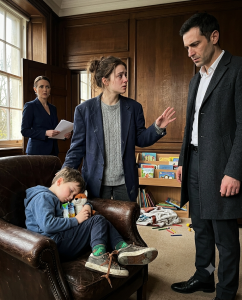
Nora brought her six-year-old son to a job interview in a wrinkled sweater, and before the man across from her looked at a single line on her résumé, he looked down at her child’s shoes.
One lace was broken.
The other had been tied and retied so many times it no longer looked like a lace at all, just a tired knot doing its best.
That was the moment everything changed.
At 8:15 on a gray Tuesday morning, the lobby of Mercer & Vale looked like a place built to reject women like Nora before they even spoke. Glass walls glowed with reflected city light. Elevators opened and closed in silent silver flashes. Women in tailored coats moved through the space with expensive coffee in one hand and phones in the other. Men in dark suits carried leather briefcases and wore the calm expressions of people who had never had to calculate whether a tank of gas was worth skipping dinner.
Nora adjusted her son higher on her hip and tried not to let her panic show.
Eli was half-asleep, warm and limp against her shoulder. His hair stuck up in the back where he had fallen asleep in the bus ride across town. One small hand was curled into the collar of her blazer. The blazer itself was from a thrift store. The sweater underneath had come out of the dryer wrinkled because the laundromat near her apartment had broken machines and she had not had the extra three dollars to run another cycle.
She had powdered over the dark circles under her eyes in the bathroom of a gas station before dawn.
It had not worked.
At twenty-nine, Nora had become an expert in functional humiliation. Smiling through collection calls. Stretching groceries. Making rent late enough to be ashamed but not late enough to be evicted. Telling her son they were “being careful” with money when what she really meant was that the checking account balance had dropped low enough to make her lightheaded.
That morning she had exactly eighty-three dollars and some change left.
Her after-school provider had canceled at 6:40 a.m. with an apology and a stomach bug. The neighbor downstairs, who sometimes watched Eli in emergencies, was nowhere to be found. Her ex-husband had let the phone ring four times, then sent it straight to voicemail. By the third unanswered call, Nora had stopped leaving messages. She knew the sound of indifference too well to beg into it.
This interview was the final round for an operations manager role that could change everything. Better pay. Benefits. Regular hours. Health insurance that didn’t disappear the second a single bill got missed. It was not just a job. It was rent. Groceries. Stability. Breathing room.
And she had come carrying her child into the lobby like proof of every bias she knew they already held about women like her.
The receptionist looked up, smiled automatically, then let the smile cool when she saw Eli.
“Can I help you?”
“I’m Nora Bennett. I’m here for my eight-fifteen with Mr. Mercer.”
The receptionist’s fingers paused on the keyboard. Her eyes flicked over Nora’s face, the child on her hip, the folder under her arm.
“With Mr. Mercer?” she repeated.
“Yes.”
A small silence.
Then that careful expression, the one polished professionals use when they are trying to sound decent while distancing themselves from your problem.
“I’m sorry,” the woman said, lowering her voice. “This is a final-round interview.”
“I know.”
“We really weren’t expecting…” The receptionist glanced at Eli. “A child.”
Nora shifted her weight, hating the heat rising in her face. “I understand. I had childcare fall through this morning. I tried to find—”
The receptionist gave a tight sympathetic nod that wasn’t sympathetic at all. “Mr. Mercer is extremely busy.”
Nora almost laughed at that. Of course he was. Men like Daniel Mercer were always extremely busy in ways the rest of the world was expected to respect.
“I understand,” she said again.
Eli stirred against her shoulder, then settled. He was too tired to complain, too used to being moved from one plan to another. That hurt in a way Nora could never explain. He was six, and already he had developed the instinct to shrink himself when adults got tense.
He was apologetic by nature now.
Nora hated that she knew exactly where he had learned it.
She tightened her grip on the folder and made a decision in a fraction of a second. She would leave. Better to leave with a little dignity than stand here while strangers silently confirmed every ugly assumption: unreliable, messy, distracted, burdened.
She had just turned half an inch toward the door when a male voice cut cleanly across the lobby.
“What’s his name?”
She looked up.
The man standing near the elevator didn’t need an introduction. She had seen his headshot on the company website and in a business journal article clipped in the public library. Daniel Mercer. Founder and CEO of Mercer & Vale. Thirty-six, if the article had been right. Known for discipline, precision, impossible standards, and a leadership style people described as brilliant if they liked him and brutal if they had worked beneath him too long.
He wore a dark coat over a white shirt with no tie. His expression was unreadable, not warm exactly, but controlled in a way that made most people instinctively straighten up around him. The receptionist did.
Nora opened her mouth to answer, but Eli got there first.
“Eli,” he mumbled without lifting his head.
Daniel’s attention shifted completely.
He walked toward them, not fast, not slow. Stopped close enough to see Eli clearly. Then he crouched to meet the little boy’s eyes and said, in a tone so solemn it was almost absurd, “Those dinosaur socks are doing all the heavy lifting here.”
Eli blinked, then looked down. Bright green T-rexes peeked from above the tops of his worn shoes.
A tiny smile tugged at his mouth.
It was the first time Nora had seen him smile that morning.
Daniel noticed. Something in his face softened so briefly she might have imagined it.
“Come with me,” he said, rising.
The receptionist looked startled. “Mr. Mercer, your board call begins in seven minutes.”
“It can begin without me.”
He turned and walked toward a hallway branching off from the main office floor. Nora hesitated for only a moment before following. She could feel eyes on her from every direction. Curiosity. Judgment. Office gossip being born in real time.
Daniel opened the door to a smaller private office and stepped aside for her to enter.
It was warmer than the lobby. Not physically warmer, though maybe that too. The light was softer. There was an old leather chair near the window and a narrow couch along one wall. But what stopped Nora were the details that made no sense in a room belonging to a man like Daniel Mercer.
A low bookshelf filled with children’s books. Not decorative ones. Actual books, some bent at the corners from use. A cup of crayons beside a stack of printer paper. Two folded blankets in a basket. A plush fox with one ear slightly flattened.
Daniel followed her gaze.
“My daughter used to come here after school,” he said.
Used to.
The word hung there with a weight that changed the air.
Before Nora could decide whether to speak, Daniel crossed to a cabinet, opened a drawer, and pulled out a juice box and granola bar. He handed them to Eli without ceremony.
“You can sit there,” he said, gesturing to the leather chair.
Eli slid down from Nora’s hip and climbed into it, moving with the sleepy seriousness of a child doing his best to behave correctly in an adult room.
“Thank you,” he said.
Daniel gave one small nod, as if gratitude from children was a matter to be accepted respectfully.
Nora felt her throat tighten. “You really don’t have to do that.”
“I know.”
That answer hit her harder than any display of pity could have. He wasn’t performing kindness for effect. He was simply doing it.
Or maybe not kindness, she realized.
Recognition.
Daniel studied her for a moment. “You came anyway.”
“I almost didn’t.”
“But you did.”
Nora let out a breath that wavered. “I need this job.”
Something unreadable moved through his expression. He looked at Eli opening the granola bar with both hands, then back to Nora.
“What happened to his shoelace?”
She glanced at Eli’s shoe, suddenly embarrassed by a detail she had tried not to think about all morning. “It snapped last week.”
“And you tied it.”
“Yes.”
Daniel’s jaw tightened once. Not in judgment. Not in disgust. More like a reaction to a private memory.
Then he said, “I’m going to ask you something. I need an honest answer.”
She nodded.
“If I hire you, are you going to spend every day worried that one emergency with your son will make this company decide you’re unprofessional?”
Nora stared at him.
The question landed so precisely it knocked all the prepared interview language right out of her. This was not where the conversation was supposed to go. He was supposed to ask about workflow systems, team conflict, deadlines, software, leadership philosophy. Not this. Not the exact fear she had dragged in with her from the bus stop.
“Yes,” she said quietly.
Daniel nodded once. “Good.”
She frowned. “Good?”
“Then at least we’d both be telling the truth.”
“What does that mean?”
Before he could answer, the office door opened without warning.
A woman in a navy suit stepped in, stopped when she saw Eli in the chair, and looked at Daniel with open disbelief.
“You can’t be serious.”
Daniel exhaled through his nose. “Not now, Claire.”
Claire ignored him. She was in her forties, polished and sharp-faced, with the exhausted elegance of someone who had been carrying too much for too long and had learned to do it in heels. Her gaze swept over Nora in one cutting glance before landing back on Daniel.
“You refused to bend policy for me when Ava was in the hospital,” she said. “But for her? Suddenly the rules don’t matter?”
Nora went still.
Daniel’s voice dropped. “This isn’t the time.”
Claire laughed once, short and bitter. “That’s convenient.”
Eli had gone quiet in the chair, his eyes moving between the adults. Nora immediately moved toward him, but Daniel lifted a hand very slightly, as if asking her to wait.
Claire pointed at the bookshelf. “Tell her. Tell her why all this is still in here. Tell her why one little boy with broken laces suddenly has your full attention.”
Nora looked from Claire to Daniel.
Daniel did not answer.
That silence said more than any denial could have. This was not a workplace disagreement. This was a wound.
“I should go,” Nora murmured, horrified at being in the middle of something she did not understand.
“No,” Daniel said, without taking his eyes off Claire.
Claire folded her arms. “Go ahead,” she said. “Tell her what happened the last time a child needed you and work came first.”
The room went airless.
Daniel stood very still for several seconds. Then he looked over at Eli. The little boy’s shoes were planted awkwardly against the edge of the leather chair, the broken lace visible from across the room. Those shoes. That knot. That quiet effort to hold something together a little longer than it was built to last.
When Daniel finally spoke, his voice had changed.
“My daughter was eight.”
Claire turned away toward the window, pressing her lips together.
Daniel moved to the bookshelf and rested a hand on the plush fox. “Her name was Sophie.”
The name made the room feel smaller.
“She spent a lot of afternoons here while I worked late,” he said. “She liked to sit on that rug and line up markers by color. She hated math, loved thunderstorms, and once told me my office smelled like stressed-out coffee.”
For the first time, the faintest ghost of a smile touched his mouth. It vanished almost instantly.
“She got sick,” he said. “Very sick.”
Nora lowered herself into the chair opposite Eli without meaning to. She was no longer in an interview. She was inside something else entirely.
“Claire was my chief of staff then,” Daniel continued. “The best one I’ve ever had. Her daughter, Ava, was in and out of the hospital the same year Sophie was getting treatments. Claire asked for flexibility. Time. Space. She asked me not to make her choose.”
Claire’s voice was flat. “You said leadership required sacrifice.”
Daniel didn’t contradict her.
He kept his eyes on the fox. “I told myself structure mattered. That if I bent the rules for one person, the whole system would slide. I called it fairness.”
“You called it professionalism,” Claire said. “You dressed cruelty up in clean language and called it discipline.”
Daniel accepted that too.
“The day Sophie took a bad turn,” he said, “Claire asked to leave because Ava had spiked a fever and the doctors were worried. I was preparing for a board vote. Biggest quarter of my career. Biggest deal of my life. I told her to stay until the meeting ended.”
Claire shut her eyes.
“She did,” Daniel said. “Because I was her boss.”
Nora looked at Claire and saw it then—not just anger, but old obedience turned into rage. The kind born when someone forces your loyalty to become a weapon against you.
“My phone rang during the presentation,” Daniel said.
His words were calm, but the calm had the brittle quality of glass under pressure.
“I silenced it. Then it rang again. And again. I remember feeling annoyed.” He swallowed. “That’s the part I hate most. Not just that I missed it. That for a few seconds, I was irritated that someone wanted me while I was busy pretending anything in that room mattered.”
No one moved.
“When I called back,” he said, “the nurse told me Sophie had been asking for me for forty-two minutes.”
Nora closed her eyes.
Daniel’s hand tightened around the stuffed fox. “Then she stopped asking.”
Claire turned from the window, tears bright in her eyes now. “And I left that building one hour later to get to Ava. I made it in time. You didn’t.”
The truth sat between them like wreckage.
Daniel looked down. “No.”
Eli, sensing something he could not fully understand, slipped off the chair and padded to Nora’s side. She drew him close, one arm around his shoulders. He leaned into her without taking his eyes off Daniel.
Claire laughed, but there was no humor in it. “After that, you got colder. Stricter. Like if you punished every parent in this company for being human, somehow you could avoid admitting what actually broke you.”
Daniel’s silence confirmed it.
For the first time, Nora saw the logic of the man the industry admired. Not brilliance. Grief turned into architecture. He had built policies out of guilt. Built a company where no one was allowed to need anything because he could not bear what happened when he did.
Claire looked at Nora then, and her expression changed. Not warm, but less sharp. “Do you know what women say about working here?” she asked.
Nora said nothing.
“They say if your kid gets sick twice in one month, you start updating your résumé.”
Daniel flinched.
Claire saw it. “Good,” she said. “You should.”
Nora should have stayed quiet. This was not her place. But something about the sight of Eli’s head tucked against her side, something about the memory of all those ignored calls and all those apologies for existing, made silence feel impossible.
“You asked me if I’d be afraid,” she said to Daniel. “The answer is yes. Not because I don’t work hard. Because every place says they support parents until parenting becomes visible.”
Daniel looked at her, fully looked at her this time.
“And when it becomes visible,” Nora continued, “it becomes the reason they stop seeing everything else.”
The room was still for a beat too long.
Then Daniel crossed to his desk, picked up Nora’s résumé at last, and read the first page in silence.
Claire watched him closely.
Nora had almost forgotten this was the purpose of the morning at all. The paper in his hands contained twelve years of jobs, gaps she had tried to explain elegantly, a degree she finished at night, promotions earned in places that underpaid her because they knew she was too tired to negotiate. It was the cleaned-up version of a life that never looked clean while she was living it.
Daniel flipped the page. “You reorganized dispatch systems for a regional supplier with no added headcount?”
“Yes.”
“And cut late deliveries by eighteen percent.”
“Nineteen by the end of quarter two.”
He looked up. Something different now. Not sympathy. Respect.
“Your references say you stabilized three teams after a merger.”
“They were already doing the hard part,” Nora said. “I just got people talking to each other again.”
Claire’s eyebrows lifted slightly.
Daniel set the résumé down. “Why this company?”
Nora almost laughed at the sudden return to interview logic, but the question was real and deserved a real answer.
“Because I’m good at building order where people only see chaos,” she said. “Because operations is really about pressure—where it builds, where it leaks, who carries too much of it, and what breaks first. And because from the outside this place looks efficient, but most efficient systems are hiding pain somewhere.”
Claire let out a quiet breath that sounded almost like surprise.
Daniel held Nora’s gaze. “And where do you think ours is hiding it?”
She could have lied. This was the point where sensible candidates praise the company and say all the right things. Instead she looked at the bookshelf, then at Eli, then back at Daniel.
“In your policies,” she said. “In whatever this office used to mean. And in the fact that your employees have learned not to bring you the truth until it becomes a crisis.”
Claire’s mouth twitched. Not a smile, but close.
Daniel was silent long enough that Nora wondered if she had just ended the interview for good.
Then he asked, “What would you change first?”
Nora answered immediately, because she had been living the answer for years.
“Emergency flexibility without punishment. Manager training that doesn’t treat caregiving like a character flaw. Measured performance by output, not by whose life is neatest at 8 a.m. And no parent should have to beg in whispers for the right to show up as a whole person.”
Daniel looked at Claire. “How many people have we lost in the last three years after repeated attendance write-ups connected to family care?”
Claire stared at him. “You know I know that number.”
“Say it.”
“Seventeen,” she said.
The room went quiet again.
Seventeen.
Not one tragic misunderstanding. Not one exception. A pattern.
Daniel sat down slowly, like the number had weight.
“Draft the new policy,” he said.
Claire blinked. “Today?”
“Now.”
She studied him, clearly testing whether this was guilt talking, or optics, or one emotional morning that would evaporate by lunch.
“You’re serious,” she said.
“Yes.”
“Board approval?”
“I’ll take it to them myself.”
Claire looked at Nora, then at Eli, then back at Daniel. Some of the steel in her expression eased, though the hurt remained.
“This won’t fix what happened,” she said.
“I know.”
“It won’t make you less late.”
“I know.”
Claire swallowed. “And it doesn’t mean I forgive you.”
Daniel’s answer came without hesitation. “I’m not asking you to.”
Something in her face finally unclenched. Not peace. Just truth accepted for what it was.
Daniel turned back to Nora. “I asked for honesty. You gave it.” He tapped the résumé. “You also happen to be the strongest candidate by a wide margin.”
Nora stared at him. “What?”
“I had already read your file,” he said. “Twice.”
Her pulse jumped. “Then why—”
“Because qualifications are easy to list on paper,” he said. “Character is harder.”
Claire made a dry sound. “That’s rich.”
Daniel accepted that too. “Probably.”
Then he looked at Nora and said, “If I offer you this job, I’m not offering charity. I’m hiring the person in front of me who showed up under impossible circumstances anyway, told the truth when lying would have been safer, and understands this company’s blind spot faster than most executives in this building.”
Nora could not speak for a second. Her eyes burned.
Beside her, Eli whispered, “Mom?”
She looked down. “Yeah, baby?”
“Are we in trouble?”
The question cut straight through her.
Daniel answered before she could. “No,” he said gently. “You’re not in trouble.”
Eli studied him with solemn six-year-old caution. “Okay.”
Daniel reached into his desk drawer again and pulled out a small sealed packet. New shoelaces. Black, simple, nothing remarkable. Except maybe that he had them at all.
He set them on the desk.
Nora looked at them, then at him.
“Sophie hated when my laces dragged,” he said. “Said it made people look unfinished.”
Nora’s throat closed.
Daniel slid the packet across the desk toward Eli. “These are yours, if you want them.”
Eli looked at Nora for permission. She nodded.
He took the packet carefully, like it was worth more than it cost.
“Thank you,” he said.
Daniel gave that same respectful nod he had given before. “You’re welcome.”
Claire watched the exchange in silence. Then she picked up Nora’s résumé from the desk, glanced through it once more, and said, “For what it’s worth, I would’ve called you back too.”
Nora let out a shaky laugh she hadn’t meant to make.
For the first time that morning, the room felt like somewhere breathing was allowed.
Daniel stood. “HR can draft the offer today. Flexible start date. And until the new policy is formalized, any childcare emergency gets handled by me directly.”
Claire arched a brow. “You’re volunteering for the chaos?”
“No,” Daniel said. “I’m taking responsibility for the system that created it.”
That landed in the room with quiet force.
Nora rose slowly, still not sure if any of this was real. “Why did you notice the shoelace?” she asked before she could stop herself.
Daniel looked at Eli’s shoes one more time.
“Because there was a year when every pair my daughter owned looked exactly like that,” he said. “Not because we couldn’t afford new ones. Because she loved the old pair and kept tying them together after they broke.” His voice softened. “I used to think I’d replace them next weekend. Then next weekend turned into later.”
No one said anything.
The entire polished building outside that office seemed absurd suddenly. The glass. The schedules. The polished confidence. All of it so fragile against one simple fact: later was never promised to anyone.
Nora took Eli’s hand. He held the packet of laces in the other.
At the door, she paused and looked back.
Claire had moved toward the bookshelf, running one finger along the spines as if remembering every year that had passed since she last let herself look closely at it. Daniel stood by the window, shoulders squared but older somehow, like truth had stripped ten pounds of armor off him in ten minutes.
Nora left the office not feeling rescued.
That was the strangest part.
She felt seen.
And there was a difference.
By noon she had a written offer in her inbox. By three, an all-staff meeting had been called. By the end of the week, Mercer & Vale announced emergency caregiver flexibility, revised attendance policies, and direct manager accountability for accommodation requests. Some people called it overdue. Others called it radical. A few whispered that Daniel Mercer had finally gone soft.
Claire shut that down in one sentence.
“No,” she told one senior director in the hallway. “He finally stopped confusing punishment with strength.”
Nora started two weeks later.
The first month was hard. New systems always were. She learned the rhythms of the office, the silent politics, the pressure points. Daniel kept his distance in the way wounded people do, but he never once broke his word. When Eli had a school closure and Nora had to join a budget call from her kitchen table with crayons scattered in the background, nobody treated it like a moral failure. When another employee left early for a pediatric neurologist appointment, Claire personally covered the meeting and dared anyone to complain.
Slowly, the place changed.
Not perfectly. Never all at once. But visibly.
Months later, Nora passed Daniel’s office one evening and found him alone, kneeling beside the low bookshelf with a cardboard box. He was sorting the children’s books.
She hesitated in the doorway. “Packing them away?”
He looked up. “Actually, no.” A faint, tired smile touched his face. “Refreshing them.”
He held up a new stack still wrapped in paper. Dinosaurs. Space. Adventure stories.
“For the employee lounge?” Nora asked.
“For wherever they’re needed,” he said.
She nodded.
On the shelf, the stuffed fox still sat in the corner with one flattened ear.
Daniel noticed her looking at it. “That stays.”
“Good,” Nora said.
He studied her for a second. “How are the shoelaces?”
She smiled despite herself. “Still holding.”
He gave one small nod, and for a moment that was enough.
Years later, Nora would still remember that morning in pieces sharper than photographs: the cold lobby, the receptionist’s careful humiliation, the green dinosaur socks, Claire’s anger, Daniel’s silence before the truth. But what stayed with her most was not the job offer or even the policy changes that followed.
It was the instant she realized that the people who look hardest are sometimes the ones already broken in the exact place they punish others for exposing.
Who was right that morning? Claire, for refusing to let grief excuse cruelty. Daniel, for finally facing what he had built out of guilt. Nora, for bringing her whole impossible life into a room that was never designed to hold it.
Maybe all three.
But the biggest red flag had never been the broken shoelace or the wrinkled sweater or even the child at a final interview.
It was a company so polished that the truth only became visible when someone walked in unable to hide it.