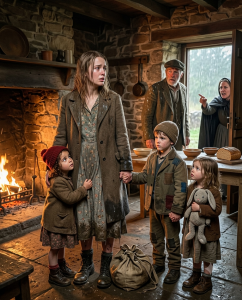
They cast her out for being poor, and no one in town wanted her. Then three motherless children called her Mom.
By the time Esperanza reached the road above the village, the rain had soaked through her dress, her shawl, and the little cloth sack that held everything she owned. One seam had split open, and the few things inside had begun to spill out with every step—a comb with two missing teeth, a change of clothes, a wooden rosary, and a heel of stale bread already turning to paste from the water.
She did not stop to fix it.
She did not stop because stopping would mean feeling the full weight of what had just happened, and if she let herself feel it all at once, she feared she might lie down in the mud and never get up again.
An hour earlier, she had still been in the courtyard of the Valdés estate, where she had worked for seven months without complaint. She had cooked, washed, carried water, scrubbed floors, mended shirts, and woken before dawn every day to do labor no one noticed unless it was missing. Then, with almost theatrical cruelty, the mistress of the house had thrown her belongings out into the rain and accused her of stealing a pair of earrings.
No proof. No witness. No search.
Only accusation.
“Get out,” the woman had said, clutching her shawl tightly around herself. “Before I tell everyone what you are.”
Esperanza had looked at the earrings once before in passing. That had been enough. In homes like that, a poor woman’s glance could be turned into guilt before sunset.
Three laborers had looked away. Two neighboring women had stood beneath the overhang, close enough to intervene, close enough to ask a question, but neither of them said a word.
Esperanza had learned long ago that silence could be as violent as a slap.
At twenty-four, she was already carrying a lifetime of rejections. She had been orphaned young and shuffled from house to house like something useful but not cherished. In one home, the wife claimed Esperanza’s eyes made her husband too attentive. In another, missing coins somehow appeared in the story the same week they decided they no longer needed an extra pair of hands. In a third house, the family’s son began speaking too kindly to her, and his mother solved the problem the fastest way she knew how: by blackening Esperanza’s name before affection could become scandal.
Men had done no better.
One suitor changed his mind the moment he learned there was no dowry, no plot of land, no goat, no trunk of embroidered linens. Another had let her stand in her best dress outside the church door while his family convinced him that a bride without relatives brought misfortune into future generations. She had watched the bells ring without her, then walked home with her shoes in her hands because her feet hurt less than her pride.
After that, the village gave her labels in place of kindness.
The found one.
The homeless one.
The one nobody wanted.
She survived by pretending not to hear them. But every insult stayed.
So when she climbed the road out of town that evening, wet and hungry and shaking, she did not think of tomorrow. Tomorrow was for people with doors to close, beds to return to, names that bought them patience. She had none of those.
The sky was turning the color of bruised metal when she heard the crying.
It stopped her cold.
This was not the angry crying of children denied a toy or scolded for mud on the floor. It was raw and frightened, the sound of small people abandoned by time. There was hunger in it. Panic. The kind of helpless desperation that comes when crying has become work.
Esperanza turned toward the sound and saw a stone house set back from the path. The stable beside it stood quiet. The front door hung half open. No smoke rose from the chimney.
Every hard lesson in her life told her to keep walking.
Instead, she stepped closer.
Inside the house, the air was cold and stale. On one side of the room, a hearth sat dead and full of gray ash. Near it stood a boy of about eight, straight-backed in the way children stand when they are trying to imitate the adults they miss. He held a black pot in both hands like a problem he did not know how to solve.
A little girl around five sat on a stool, hugging a rag doll so tightly one of its cloth arms had twisted backward. On the floor, a smaller child—no more than three—cried with her entire body, her cheeks streaked with dirt and tears.
Esperanza forgot her own misery for a moment.
“Where is your mother?” she asked softly.
The boy lowered his eyes. “She died when Rosa was born.”
The girl with the doll looked away as if that sentence had already been used too many times in the house.
“Our father went to the fields,” the boy added. “He said he’d be back before dark.”
The little one, Rosa, looked up with swollen eyes and whispered, “Hungry.”
Something in Esperanza gave way.
She set down her torn sack, rolled up her sleeves, and began.
There were dried beans in a jar, maize in a sack, a little lard, some salt. Enough to make food if one knew how to stretch things. She crouched by the dead hearth and blew on the buried embers until a faint red glow answered. A few bits of kindling, some careful coaxing, and soon the fire took hold.
The room changed almost at once.
Warmth touched the walls. A little sound returned. She put water on to boil, sorted the beans, scraped the table clean, and rinsed the little one’s face with warm water and the edge of her own apron. She gave the five-year-old corn to shell and asked the boy where the bowls were kept, not because she truly needed help but because children carried pain better when given a task.
The boy said his name was Martín. The girl with the doll was Lucía. The little one was Rosa.
“Do you know how to cook?” Martín asked after watching her for several minutes.
“I know how to keep people from going hungry,” Esperanza said.
He considered this answer with the seriousness of a much older person and nodded once.
By the time the beans were simmering and the maize was ready, the smell in the kitchen felt almost miraculous. Not rich, not grand, but deeply human. Food. Fire. Care.
The children sat at the table without being told. Esperanza served them first.
They ate quickly at the start, shoulders tense, eyes lowered, as if expecting the meal to be taken back. Then, little by little, something softened. Lucía licked the spoon. Rosa climbed into Esperanza’s lap halfway through and stayed there. Martín, even while trying to act like a man of the house, let relief show in the way his hands stopped trembling.
When the bowls were empty, Rosa tugged gently at Esperanza’s apron and asked, “Are you going to leave?”
The words hit with such force that Esperanza had to look away.
Before she could answer, the front door flew open.
A tall man stepped inside carrying the weather with him. His clothes were soaked through, his face lined with exhaustion, his hands rough from fieldwork. But what struck her first were his eyes. Not cruel. Not soft either. Alert, guarded, and carrying the permanent fatigue of grief that had had years to settle in.
He took one look at the stranger in his kitchen and went rigid.
“Who are you?” he asked. “And what are you doing with my children?”
Esperanza rose immediately, moving Rosa gently from her lap. “I heard them crying. I made them food. I was just leaving.”
The man—Tomás, she would soon learn—did not answer right away. His gaze moved over the room like someone trying to reconcile what he expected with what he saw. The clean table. The lit hearth. The children fed. Rosa clinging to the hem of a stranger’s skirt as though it were an anchor.
Then a voice cut through the doorway.
“Tomás! Don’t let that woman stay in your house!”
Esperanza closed her eyes for a fraction of a second. She knew that voice. One of the women from near the estate. The kind who fed on scandal because it made their own emptiness taste less bitter.
The woman appeared in the doorway, rain dripping from her shawl, eyes already bright with the thrill of public judgment.
“She was thrown out for stealing,” she announced. “Everybody knows it.”
The old shame came over Esperanza so fast it nearly bent her in half. Not because the lie was new. Because it was not. Because it was exactly the kind of lie that always found easy shelter in poor people’s lives.
Tomás looked from the woman to Esperanza.
Rosa solved the silence first. She wrapped both arms around Esperanza’s legs and shouted, “No! She’s good!”
The neighbor laughed. “Children don’t know what people are.”
Martín set his jaw. “She fed us,” he said.
Lucía whispered, “And she washed Rosa.”
Tomás remained still, but something sharpened in his expression. “I asked what happened here,” he said to the neighbor, “not what the town says.”
The woman bristled. “You’re going to trust a stranger?”
“Decent people,” Tomás replied, “do not stand outside gossiping while children cry from hunger.”
The rebuke landed hard.
Esperanza should have felt grateful, but she did not yet trust mercy. Mercy had betrayed her before. It often appeared only long enough to make the next cruelty sting worse.
She bent to untangle Rosa’s arms. “It’s all right,” she murmured. “I’ll go.”
Rosa burst into tears.
Lucía’s eyes filled instantly.
Martín, who seemed determined to age five years every minute, looked at his father and asked in a trembling voice, “Does she have to leave too?”
Too.
Tomás closed his eyes.
When he opened them again, the whole room seemed to understand that the child had named something larger than the moment. This house had already lost one woman. It had lost warmth, rhythm, softness, ordinary order. The kind of absence that keeps settling long after the funeral ends.
“My wife died three years ago,” Tomás said at last, his voice rough. “Since then, people have offered sympathy. Advice. Sometimes charity. But no one came in and simply did what my children needed.” He looked at Esperanza. “You did.”
The neighbor seized the opening. “Or she did it because she wants a roof.”
That struck nearer the bone than anything else.
Because yes, Esperanza wanted a roof. She wanted dry blankets, hot food, a door that shut, a place where she did not have to leave by dawn to avoid becoming a burden. But wanting safety had become, in the world she inhabited, a moral flaw whenever the wrong woman wanted it.
Tomás saw the pain in her face.
“What is your name?” he asked.
“Esperanza.”
Rosa repeated it carefully, then leaned against her and said with perfect certainty, “Don’t go, Mama.”
Everything stopped.
The neighbor gasped as if the child had committed sacrilege.
Lucía stared.
Martín looked down quickly, but not before Esperanza saw that his face had changed too—not in shock, exactly, but in the sudden dangerous hope children learn not to show unless they cannot help themselves.
Esperanza felt tears burn hot behind her eyes. She had been called many things, and not one of them had ever sounded like belonging.
“Can she stay until morning?” Lucía whispered.
Tomás looked at each of his children in turn. There was caution in him, and grief, and the crushing awareness that every choice a parent makes can wound or save in ways no one fully understands at the time.
The neighbor folded her arms, waiting.
So did Esperanza, though every part of her wanted to flee before the answer came.
Then Tomás said, “Did you steal from that house?”
It hurt, but she lifted her chin.
“No. But my word has never been enough for anyone.”
Martín walked to the table, picked up the spoon she had used to serve them, and laid it down with solemn care. “She could have taken our food and gone,” he said. “She didn’t.”
Tomás turned to the neighbor. “If you have proof, bring it. If not, leave.”
The woman stared at him, furious. “By tomorrow everyone will know what kind of woman you let into your house.”
Tomás opened the door wider. “Then tomorrow they can choke on it.”
She left, but not quietly. Her last look promised trouble.
When the door closed, the house seemed to exhale.
Tomás pulled out a fourth chair at the table. “Sit,” he said.
Esperanza did not move. “I can sleep in the stable.”
“You can sleep under a roof,” he replied.
So she sat.
That first night, she expected to be sent away at dawn. Instead she woke to Rosa asleep against her side on the blanket she had been given near the hearth, Lucía curled close by, and Tomás already outside chopping wood before sunrise. Martín was awake too, pretending not to watch her as she lit the fire.
“Do you know how to make tortillas?” he asked.
“Yes.”
He nodded as if this confirmed some private hope.
One morning became three. Three became a week.
Tomás did not ask her to stay in so many words. He simply made space for her in the ordinary life of the house. He repaired the loose hinge near where she slept. He left extra water by the basin. When he sold two sacks of grain in town, he returned with cloth for dresses for the girls and sturdy shoes that, without comment, happened to be her size.
The children attached themselves to her with frightening speed.
Rosa followed her everywhere and said Mama as though the word had always belonged there. Lucía began bringing her the doll for repairs and asking if braids could be made tighter, prettier, more like the ones “real mothers” did. Martín resisted longest, but even he started waiting for her opinion before making important declarations about chickens, weather, or fence posts.
The village noticed.
Of course it did.
At first the comments came as mutters. Then they grew bold. Some said Tomás had lost his mind. Others said Esperanza had trapped him. The old accusation returned, joined now by uglier suggestions: that she had used the children, used pity, used loneliness.
Tomás ignored them until he could not.
One Sunday after mass, an older man from the village pulled him aside in full view of everyone and asked whether he truly intended to marry “that kind of woman.” The phrase spread in the air like rot.
Tomás answered loudly enough for those nearby to hear. “What kind? The kind who feeds children? The kind who works before dawn? The kind who stayed when everyone else preferred opinions over help?”
The man colored and walked away. But the damage of gossip is not that it wins arguments. It is that it keeps returning.
Esperanza tried to protect the household from it by asking to leave.
It happened late one evening after the children were asleep. She stood by the dying fire and said quietly, “I should go before the town ruins you too.”
Tomás looked up from mending a harness. “The town has had years to ruin me. It failed.”
“This is different.”
“Yes,” he said. “It is.”
The simplicity of the answer unsettled her more than anger would have.
He set the harness aside. “Do you think I let you stay because I was desperate?”
She said nothing.
“I let you stay because my children laughed again,” he continued. “Because this house no longer feels like a grave with furniture. Because when Rosa wakes from nightmares, she calls for you. Because Lucía smiles at her reflection after you braid her hair. Because Martín stopped pretending not to be a child the day you arrived.”
Esperanza stared into the fire so he would not see how badly she was shaking.
“And because of me?” she asked before she could stop herself.
Tomás stood. “Especially because of me.”
Months passed before he asked her to marry him.
Not in public. Not with witnesses. Not with grand declarations. He asked in the kitchen at dawn while bread dough rested beneath a cloth and the children still slept. He placed a simple ring on the table between them and said, “You can say no. But if you stay in this house, I want it to be as someone no one gets to insult again.”
She cried then—not prettily, not delicately, but with the stunned grief of someone finally offered the thing she had stopped believing existed.
When they married, the village came mostly to watch, not to bless. Yet they came. Curiosity draws a crowd faster than love ever does. Esperanza walked into the church not abandoned, not waiting, not ashamed. Rosa scattered flower petals with disastrous enthusiasm. Lucía carried the veil edge as if guarding treasure. Martín stood beside Tomás in a shirt too big for him, trying and failing to hide his smile.
No bells ever sounded sweeter.
The true ending came a year later, when the mistress from the estate was accused by her own niece of stealing jewelry and hiding it to blame a servant she wanted gone. Under pressure, another woman admitted she had heard the niece boast about it months earlier. Suddenly the village remembered how quickly false accusations could be made when a poor woman was convenient to blame.
Several people suggested the old mistress ought to apologize.
She never did.
But by then, apology had lost its importance.
Esperanza no longer measured herself by the mouths that had shamed her. She had children who reached for her when sick, who ran to her with scraped knees, who fought over who would sit closest to her at supper. She had a husband who never once asked her to bow her head to keep peace with people who had never protected her. She had a home where her name was not spoken like a warning.
Years later, when strangers asked how many children she had, she answered, “Three,” without hesitation.
No one corrected her.
Because motherhood had not arrived through blood. It had arrived through hunger, fire, washed faces, night fears, and the decision to stay when leaving would have been easier.
And perhaps that was what unsettled the village most in the end.
Not that Tomás married the woman they had rejected.
Not that the children loved her.
But that the one they had called unwanted became, in the house that mattered most, utterly necessary.
Some still insisted she had been lucky.
Maybe she had.
But luck had very little to do with the moment three grieving children looked at a stranger and recognized safety before the rest of the world recognized her worth.
That is what lingers in the story long after the gossip dies: how often people mistake poverty for danger, loneliness for shame, and a woman without family for a woman without value.
The village had seen a burden.
Three children saw a mother.
And maybe that is the clearest judgment of all.