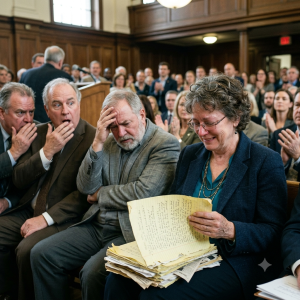
The day Marlene Kowalski walked out of that conference room, she had grease on her hands and tears on her face.
She also had the yellow legal pad tucked under her arm.
She never let go of it.
—
You need to understand something about the Kowalski brothers first.
Gary. Dennis. Ray.
Three big men who had spent thirty years running Kowalski Hardware & Supply like it was their personal kingdom — because, honestly, it was. Their father built it. Their father left it to all four of them equally, including their brother Tom’s share, which passed to his wife Marlene when Tom died of a heart attack on a Tuesday morning in March.
That was eighteen months ago.
At the funeral, while Marlene stood at the graveside holding that beat-up yellow legal pad to her chest — she’d grabbed it off Tom’s workbench on her way out the door, some instinct she couldn’t explain — Gary leaned over to Dennis and said, loud enough for three people to hear, *”She’s going to show up with her little doodle book and think she runs the place now.”*
Dennis laughed.
Ray had the decency to look at his shoes.
—
The first meeting was two weeks after the burial.
Marlene came in with her legal pad. She sat down. She asked to see the books.
Gary explained, very patiently, the way you explain things to someone you’ve already decided isn’t worth explaining things to, that she didn’t *really* understand the business side of things. That Tom had always handled the “vision” while the brothers handled the actual work.
“Marlene,” he said, “you’re a wonderful woman. But do you even know what a socket wrench is?”
She wrote something on the legal pad.
She didn’t answer the question.
—
By month three, they had lawyers involved.
By month five, Marlene had accepted a buyout that everyone in town assumed meant she’d been pushed out.
She signed the papers on a Friday afternoon.
She drove home, sat at Tom’s old drafting table, opened the yellow legal pad to page one, and got back to work.
—
Here’s what nobody knew about Marlene Kowalski.
Tom had taught her everything. Not because she asked him to — because she *wanted* to. For twenty-six years, she’d sat at that drafting table beside him while he sketched out project plans and material estimates and load calculations. She’d been the one who caught the accounting errors. She’d been the one who knew which suppliers were reliable and which ones would leave you short on a Friday.
The legal pad?
Tom had given it to her the first year they were married. *”Every good builder keeps a running record,”* he told her. *”Materials, costs, contacts, lessons learned. You never throw it away. You just keep adding pages.”*
Twenty-six years of pages.
The brothers called it a doodle book.
—
Marlene incorporated Kowalski Precision Build, LLC on a Monday morning in October.
She spent eleven months working quietly. Picking up small jobs. Earning her contractor’s license. Rebuilding the supplier relationships Tom had built, because those suppliers remembered Tom — and when Marlene called, they remembered her too.
Then Millhaven announced the Riverside Commercial Development Project.
Forty-two million dollars. The biggest construction contract this town had seen in twenty years. Open bid, public decision, city council chambers.
Gary submitted a bid. Dennis submitted a bid. They decided not to merge their proposals because each one was convinced his was better.
Marlene sat at Tom’s drafting table with the yellow legal pad and spent six weeks on her numbers.
She was meticulous.
She was precise.
She was, as it turned out, very good at this.
—
The council chambers were packed on a Thursday evening.
Marlene sat in the third row, the legal pad in her lap, her thumb running along the worn corner the way it always did when she was nervous.
Gary was in the front row. Dennis beside him. Ray on the end, looking at his shoes again.
Council Chair Deborah Pruitt sat at the center of the dais, the sealed envelopes arranged in front of her. She had been doing this job for sixteen years. She was not a woman who showed surprise easily.
She opened the first envelope. Read the number. Wrote it on the board.
Then the second.
Then the third.
She paused at the fourth envelope longer than she’d paused at the others.
She smoothed the paper flat on the table in front of her.
She looked up once — just once — at the three men sitting in the front row.
“The winning bid,” Deborah Pruitt said, her voice carrying to every corner of that room, “submitted under Kowalski Precision Build, LLC, comes in four hundred thousand dollars under the next closest estimate.”
She paused.
“And gentlemen — I believe you know the owner.”
That’s when Gary Kowalski’s coffee cup hit the floor.
Marlene didn’t look at him.
She looked down at the yellow legal pad in her lap.
And she smiled.
—
The room took about four seconds to process what had just happened.
Then it erupted.
Not in chaos, exactly. In that particular small-town way where everyone is talking at once but you can still hear individual voices. Someone behind Marlene said *”Is that Tom’s wife?”* Someone else said *”She did it herself.”* A woman near the back started clapping, the kind of slow, deliberate clapping that makes other people join in, and some of them did.
Gary Kowalski was on his feet. His face had gone a very particular shade that his blood pressure doctor had warned him about specifically.
“There has to be a mistake,” he said, to no one and everyone. “There has to be an error in the numbers. Deborah, that’s not — you can’t just —”
“Gary.” Deborah Pruitt had a way of saying a person’s name that ended conversations. She’d refined it over sixteen years. “The bids were submitted sealed, reviewed by the city auditor’s office, and verified this afternoon. There is no error.”
He sat back down.
Dennis stared straight ahead at the board like if he looked at it long enough the numbers would rearrange themselves into something he could live with.
Ray turned around in his seat and looked at Marlene.
She met his eyes.
He nodded. Just once. Small enough that his brothers didn’t see it.
She nodded back.
—
She’d beaten them by four hundred thousand dollars.
Here’s how.
Gary’s bid was built on relationships with mid-tier regional suppliers he’d been using for fifteen years — suppliers who had gotten comfortable and were no longer offering competitive pricing because nobody had made them compete. Dennis had padded his contingency numbers so aggressively that he’d effectively bid for a project and a half. Both of them had estimated labor costs using the same crew structures they’d always used, with the same inefficiencies they’d always tolerated.
Marlene had spent twenty-six years watching Tom identify exactly those kinds of problems and quietly correct them.
She’d gone back to four of the old suppliers in Tom’s legal pad. Suppliers the brothers had dropped after disagreements that Tom always said were handled wrong. She called them personally. She told them who she was. She told them what she was building.
Two of them cut her materials cost by eleven percent just to be in business with a Kowalski again, and to have a chance to remind Gary specifically what his stubbornness had cost him.
She’d also redesigned the phasing sequence for the project. The original city timeline had three stages running sequentially, which was how everyone else bid it. Marlene had been at that drafting table six weeks and she could see that two of the stages had independent foundation work that could run parallel if you managed the crew scheduling correctly. Parallel staging shaved forty-two days off the build timeline. Forty-two days of reduced equipment rental costs. Forty-two days of overhead she wasn’t paying.
She wrote the math out on the legal pad.
It was right there on page forty-seven.
—
After the meeting, people came up to her in the parking lot. Her neighbor Connie, who had brought her casseroles in the weeks after Tom died. A man named Dave Parrish who’d worked for Tom years ago on a warehouse project and still talked about it as the best job he ever had.
“You hiring?” Dave asked.
She was.
She already had a list.
It was on page fifty-one of the legal pad.
—
Gary called her cell phone the next morning at seven forty-five.
She let it go to voicemail.
He called again at eight ten.
She let that one go too.
He left a message the second time. She listened to it while she stood at the drafting table with her coffee. He used words like *”family business”* and *”what Tom would have wanted”* and *”we can still work something out here, Marlene.”*
She set the phone face-down on the table.
She thought about Tom on a Tuesday morning in March, and all the Tuesdays before that, and twenty-six years of pages.
Then she picked up the phone and called Dave Parrish back.
—
She broke ground on the Riverside project eleven weeks later.
It was a cool October morning, a little overcast, the river just visible through the bare trees at the edge of the site. Marlene stood there in her steel-toed boots and her canvas jacket with Kowalski Precision Build embroidered on the chest in blue thread, and she watched the first crew arrive.
She had the legal pad in a leather portfolio now. Tom’s daughter had given her the portfolio for her birthday that summer. *”For the job you’re going to win, Mom,”* she’d written on the card. She’d said it before the bid was even submitted, because she knew her mother, and she knew what that legal pad contained.
Marlene opened to a fresh page.
At the top she wrote the date and the words *Day One.*
Then she started her running record.
Materials. Crew. Weather. Contacts. Lessons already learned and lessons still coming.
She’d finish it in fourteen months, three weeks ahead of schedule, under budget, with zero significant safety incidents — a record the city would note specifically in their final project evaluation.
But that was still ahead of her.
Right now it was October, and the ground was cold, and the crew was arriving, and somewhere across town Gary Kowalski was sitting in a conference room with his brothers trying to figure out how they had lost a forty-two million dollar contract to a woman they called a doodler.
Marlene didn’t think about that.
She thought about Tom, and the first year of their marriage, and a yellow legal pad, and everything he’d told her about what it means to build something right.
*You never throw it away. You just keep adding pages.*
She turned her face toward the river, and she got to work.