She didn’t confront him. She didn’t cry. She didn’t tell a single soul what he’d done.
She just started volunteering at the library.
—
My name is Norma Fitch. I’m 71 years old. I drive a 2009 Buick, I still use a paper grocery list, and eighteen months ago I watched my son-in-law accept a plaque for “community leadership” while I sat in the third row knowing exactly what he’d stolen.
From a dead man’s name.
My husband Gerald passed four years ago this November. Pancreatic cancer. Eleven weeks from diagnosis to gone. He was a high school history teacher for 34 years, and the one thing he asked me — the very last thing, when he could barely get the words out — was to make sure the scholarship kept going.
We’d built it together. The Gerald R. Fitch Memorial Scholarship. Twelve hundred dollars a year to a kid in our county who wanted to go to college and just needed someone to believe in them first.
It wasn’t a fortune. It was Gerald.
So when the fund started running dry and my son-in-law Derek said it was “just the market” and “inflation” and “you know how these accounts work, Norma” — I nodded. I brought him coffee. I let him think I believed him.
I did not believe him.
—
I found the index card by accident.
I was cleaning out Gerald’s old rolodex — the man kept everything on paper, bless him — and tucked between the F’s and G’s was a small card in his handwriting. Just a name, a date, and seven words I didn’t understand yet.
I put it in my cardigan pocket.
I’ve worn a cardigan every day since.
My daughter Linda has asked me twice what’s on that card. My neighbor Patsy, who notices everything, asked me once. I just smile and touch the edge of it through the fabric and change the subject.
Some things you keep close until the moment is exactly right.
—
The library job was my idea.
Derek ran three “consulting” LLCs, the kind with websites but no real addresses. He kept his records the way men like him always do — scattered just enough to look complicated, but never quite hidden from someone patient enough to look.
I am very patient.
For eighteen months, I showed up every Tuesday and Thursday in my tan cardigan and my orthopedic Skechers, and I scanned documents. Permits. Business filings. Articles of incorporation. Financial disclosures that had been submitted to the county and then, apparently, forgotten.
The young librarian, Jade, taught me the scanning system in about forty minutes. I brought her oatmeal cookies every week. She started saving the interesting files for me.
I never told her why.
I built a folder on my laptop I labeled “Gerald’s Garden” because Derek sometimes used my computer and he would never open something that boring.
Slowly, patiently, the picture came together.
The scholarship money hadn’t gone to the market.
It had gone to a boutique on Ridgeline Avenue called Soleil & Grace — a darling little shop with turquoise walls and a hand-lettered sign and a woman named Camille who Derek had been seeing for two years.
He’d used Gerald’s scholarship fund to set her up in business.
My husband’s memory. Twelve hundred dollars at a time. To buy another woman her dream.
—
I did not cry when I figured it out.
I made a cup of Sleepytime tea and I sat at the kitchen table and I touched the index card in my pocket.
Then I started making calls.
—
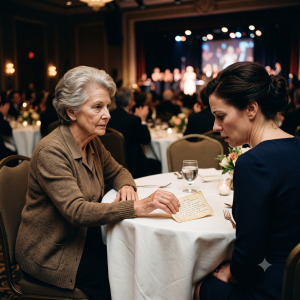
The Chamber of Commerce Businessman of the Year dinner was Derek’s idea, of course. He’d lobbied for the nomination himself. The venue was the Hargrove Ballroom — white tablecloths, centerpieces with real flowers, two hundred people in their Friday best.
Linda looked beautiful in her navy wrap dress. She reached over and squeezed my hand when we sat down.
I had the index card in my left cardigan pocket.
I’d added to it.
The evening moved through salads and speeches and polite applause. I ate my chicken. I smiled at the people who stopped by our table. I touched my pocket exactly once, just to make sure.
Derek was relaxed. He was always relaxed in rooms full of people who admired him.
That was the last thing he would feel relaxed about for a long time.
The Chamber president stepped to the microphone. He cleared his throat. He said Derek’s name.
The room applauded.
Derek stood, adjusting his jacket, already reaching for the smile he kept ready for moments like this.
And I — quietly, slowly, the way I do everything now — reached into my pocket, set the index card on the white tablecloth, and slid it face-up toward the one seat at the table that mattered most.
Linda hadn’t looked down yet.
The president was still talking.
Derek was still smiling.
And then Linda looked down.
The ballroom was silent except for applause.
And then it wasn’t.
—
I should tell you what was on that card.
Gerald’s handwriting on the front — the original part, the part I found in the rolodex. He’d written a name I recognized as one of his former students, a date from about six years before he died, and seven words: “He’ll know what to do with this someday.”
On the back, in my own handwriting, I had written the name of an attorney. A CPA. And a single account number that matched the one on the deed of Soleil & Grace, Ridgeline Avenue.
That was all. It fit on an index card.
Linda is a smart woman. She has her father’s eyes and, as it turned out, her father’s patience.
She read both sides in about four seconds.
Then she set the card down very carefully, the way you set something down when your hands have started to shake and you don’t want anyone to see.
She looked at me.
I looked at her.
Derek was shaking the Chamber president’s hand.
Linda stood up.
Now, I want to be clear: my daughter did not make a scene. She did not shout. She did not throw a glass of water or flip the white tablecloth or do any of the things that, I will admit, I had imagined once or twice during the previous eighteen months.
She simply walked to the podium.
She touched the Chamber president’s arm and said something quiet in his ear. He looked confused. Then he looked at her face and stepped aside.
Linda took the microphone.
Two hundred people in the Hargrove Ballroom stopped cutting their chicken.
Derek froze with the plaque in both hands.
My daughter said, in the clearest voice I have ever heard come out of a human being: “Before this award is given, I need to share something with this community. Because this community deserves to know.”
—
She spoke for four minutes.
I timed it later, watching the video that three different people posted before the evening was over.
She didn’t read from anything. She didn’t stumble. She laid out what Derek had done — the scholarship fund, the transfers, the boutique on Ridgeline — in the same plain, sequential way her father used to explain the causes of the Civil War to teenagers who thought history was boring. She made it impossible not to follow. She made it impossible not to understand.
Derek said her name once. Just “Linda.” The way a man says a name when he’s trying to remind a woman that he has power over her.
She didn’t look at him.
The Chamber president, to his credit, took the plaque back. He didn’t ask questions. He just reached out his hand and Derek, still not fully understanding what was happening to him, placed it there like a man in a dream.
Then Linda said one more thing.
She said: “My father was a teacher. He spent his whole career believing that the right twelve hundred dollars at the right moment could change a young person’s life. I’d like to ask anyone in this room who agrees with him to see me in the lobby afterward.”
Then she put down the microphone, walked back to our table, and sat down next to me.
She took my hand.
We didn’t say a word to each other.
We didn’t need to.
—
Thirty-one people came to the lobby.
Thirty-one people from this community — teachers, business owners, a retired judge, a woman who told Linda she’d received a scholarship herself, twenty-two years ago, from a teacher she’d never forgotten — came and stood with my daughter and wrote checks and handed over business cards and made promises.
By the end of that night, the Gerald R. Fitch Memorial Scholarship had more money in it than it had ever held in its entire existence.
I stood to the side and watched it happen and thought about Gerald. How he would have been mortified to be the center of any of this. How he would have said “now, Norma” in that mild way of his. How he would have found someone in the corner of the lobby who looked uncertain and gone to talk to that person instead of any of the rest of it.
I miss him every single day.
But I kept my promise to him. I want him to know that. Wherever he is, I want him to know.
—
Derek left the ballroom through a side door. I didn’t see him go.
The legal process is ongoing and I’ve been advised not to say too much. What I can say is that the attorney whose name was on the back of that index card — a woman named Patricia Osei, whom Jade the librarian had recommended, because Jade, it turned out, knew exactly what I’d been doing for eighteen months and never breathed a word — has been thorough, and relentless, and wonderful.
Linda filed for divorce eleven days after the dinner. She’s staying with me for now. She sleeps in her old room, the one that still has the faded curtains with the little yellow flowers that she picked out herself when she was nine.
In the mornings I make coffee and she makes toast and we sit at the kitchen table where I once sat alone with my Sleepytime tea and the thing I had figured out and the name of an attorney.
It’s better now, those mornings. It’s better with someone in the chair across from me.
—
The first scholarship went out last month under the restored fund.
A girl named Destiny, seventeen, first in her family to go to college, heading to study nursing. She wrote us a thank-you note by hand on yellow stationery.
I put it in the rolodex, between the F’s and G’s, right where Gerald would have kept it.
—
I still wear the cardigan.
The index card is gone now — it’s in a file at Patricia Osei’s office, doing the work it was always meant to do.
But I keep my hand in that pocket sometimes, out of habit. Out of something that isn’t quite grief and isn’t quite comfort but is somewhere in between, which is where most of the true things in a life seem to live.
Gerald was a high school history teacher for 34 years. He believed, genuinely believed, that the past was never just the past — that it kept moving forward through the people who remembered it honestly.
I think he was right.
I think he usually was.