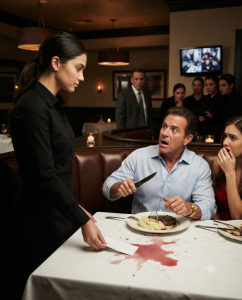
They made the new waitress pay for a customer’s meal because the man claimed she had insulted him.
That was how the night began.
By the end of it, half the restaurant was standing still, the manager looked like the floor had vanished beneath him, and the customer who had spent months humiliating young servers for sport was staring at a monitor that had just undone him in less than ten seconds.
Her name was Kelsey, and when she first started at the steakhouse, nobody expected her to be the one to break anything open.
She had been there two weeks.
Long enough to memorize table numbers, the order the cooks liked tickets stacked, and which soda fountain button stuck if you pressed it too hard. Long enough to know where the extra napkins were kept and which section got bad tips on Sundays. Long enough to understand that the restaurant ran on unwritten rules, and the biggest one was this: some customers mattered more than the people serving them.
Kelsey learned that on her first Friday.
The steakhouse tried hard to look polished. The lights were low and flattering. The booths were deep brown leather. The servers wore black button-downs and aprons ironed flat at the start of every shift. There was a wall of wine bottles near the entrance and framed photos of local athletes and city officials near the bar. The food was good, but the atmosphere did most of the work. It was a place where people came to look successful.
Kelsey did not look like she belonged in that world.
She was quiet, plain, and so careful in her movements that she seemed to apologize for taking up space. She wore minimal makeup, tied her hair back with the same black scrunchie every shift, and said “absolutely” even when people spoke to her like she was stupid. Her nervousness was visible enough that rude customers picked up on it instantly. They snapped their fingers, cut her off mid-sentence, or made her repeat herself just to watch her blush.
She needed the job too badly to push back.
Her rent had just gone up. Her old job at a coffee shop had disappeared when the place cut staff. She had been living in a tiny apartment with thin walls and overdue bills spread across the kitchen counter. So she showed up early, worked hard, and kept her head down.
The other servers liked her almost immediately, mostly because she didn’t pretend to know more than she did. Marissa taught her how to carry three plates without looking terrified. Tiana showed her which regulars tipped well and which ones wasted an hour of her time for four dollars. Luis, the dishwasher, slid her extra bread when she missed break and joked that surviving the dinner rush meant she was officially family.
But even in her first week, Kelsey noticed there was one guest who changed the mood of the whole floor.
He always sat in the corner booth.
He always dressed expensively without trying too hard. Crisp shirt, polished shoes, gold watch, easy confidence. The kind of man who looked at the room as if someone should be thanking him for entering it. He spoke in a smooth, controlled voice that grew sharp only when he wanted attention. And somehow, everyone gave it to him.
The hosts straightened when he arrived. The bartenders lowered their voices when he passed. Dale, the manager, reacted to him with a nervous respect that bordered on obedience.
Kelsey once asked why.
Marissa had been refilling sugars when she murmured, “Don’t ask too many questions.”
That answer only made Kelsey more curious.
The man never came alone. Every visit, there was a different woman. Sometimes younger, dressed carefully and smiling too hard. Sometimes older and elegant, leaning in across the table as though she was the one being chosen. He ordered like he was putting on a performance. The most expensive steak. The best wine. Add-ons, sides, dessert, after-dinner drinks. Enough food to make the table look lavish.
Then, near the end of the meal, something went wrong.
The first time Kelsey saw it happen, she was running food to a nearby table. The server assigned to him that night was Tiana. She had seemed tense from the beginning, and Kelsey didn’t understand why until the man suddenly raised his voice loud enough to turn heads.
There was a problem with the wine, he said. Then a problem with the service. Then somehow a problem with his meal.
By the time Dale appeared, the complaint had transformed into a whole story about ruined hospitality and disrespect. The woman at the booth looked embarrassed. Tiana looked trapped. Dale apologized repeatedly, comped the bill, and later that night Tiana came out of the office with red eyes and a face gone stiff from trying not to cry.
Kelsey found her by the back door.
“What happened?” she asked.
Tiana laughed once, bitter and exhausted. “Apparently, I cost the restaurant too much money.”
“What does that mean?”
“It means Dale took it out of my tips.”
Kelsey had stared at her. “He can do that?”
Tiana shrugged in the way people do when unfair things have become too familiar to fight. “He does.”
After that, Kelsey started paying attention.
The pattern repeated. Different woman. Same booth. Same expensive order. Same explosion at the end. Sometimes it was a hair in the food. Sometimes a wrong side dish. Sometimes an accusation that the waitress had been rude, inattentive, dismissive. Every time, Dale sided with him before hearing the full story. Every time, the bill vanished. Every time, the server lost tips.
And every time, the man wore the same expression when it was over.
Pleasure.
Not relief.
Not annoyance.
Pleasure.
That was what made Kelsey uneasy.
One night, after another server named Brooke emerged from Dale’s office looking like she might be sick, Kelsey asked Marissa how long it had been happening.
Marissa dried a glass without looking up. “Too long.”
“Why doesn’t anyone report him?”
“To who?”
“The owner.”
Marissa gave her a flat look. “You think Dale wants the owner hearing that he let a regular humiliate half his staff?”
That answer sat with Kelsey all night.
She began keeping notes in the little pad she carried in her apron. At first it was just because she didn’t trust her memory after long shifts. Date. Booth. Which server had the table. What the complaint was. Whether the meal was comped. Whether Dale called the server into the office afterward. But soon the list started looking less like observations and more like evidence.
Five names in two weeks.
Possibly more before Kelsey was hired.
She didn’t tell anyone she was writing it down. She barely understood why she was doing it, only that something in her refused to let the pattern keep passing as bad luck.
Then came the Friday night that finally put her in his path.
The dining room was packed from the start. A private party had booked half the back section, a birthday table near the windows was already ordering rounds of cocktails, and the kitchen printer sounded like it was screaming. Dale was pacing like a man trying to outrun his own panic.
Then the front door opened, and the corner-booth regular walked in with a woman in a fitted red dress and heels that clicked against the wood floor.
Dale saw him instantly.
“Kelsey,” he said, handing her the table assignment. “Twelve.”
She looked down.
Corner booth.
“No,” Marissa whispered from beside the server station.
Dale ignored her.
Kelsey took the menus and crossed the room.
The man looked her over once when she arrived, and in that glance she felt something cold settle into place. He recognized nerves when he saw them. He probably looked for them. He smiled like he had already decided how the evening would end.
The woman with him was young, maybe not much older than Kelsey, with glossy hair and the strained excitement of someone hoping this dinner meant something. The man ordered for both of them in a tone that was more performance than courtesy. Porterhouse. Lobster tail. Truffle mashed potatoes. Creamed spinach. A reserve cabernet. Dessert later. Maybe whiskey after that.
He corrected Kelsey’s pronunciation of the wine just to make her say it again.
He sent her back for extra napkins he had not requested.
When she returned with the bottle, he asked if she’d ever opened wine before in a voice that made his date laugh awkwardly.
Kelsey apologized each time, but inside she was counting.
Watching.
Waiting.
Before the rush had peaked, she had already made one move.
She found Luis near the dish pit where a wall monitor showed several security feeds from around the restaurant.
“Can you turn one of those toward the floor camera?” she asked.
He blinked. “Why?”
“Because I think tonight he’s going to do it again.”
Luis wiped his hands on a towel and looked at her more carefully. Then he nodded and adjusted the monitor angle slightly so the dining room feed was easier to see from the service hallway.
That was all.
A tiny change.
But it would matter.
The meal unfolded exactly as Kelsey expected. The man was charming when she approached with food, dismissive when she asked if they needed anything else, mildly insulting whenever he had an audience. His date seemed increasingly uneasy, though she kept smiling through it.
After the entrées, she excused herself to the restroom.
Kelsey was passing with a tray when she saw his expression change the instant the woman was out of sight.
He looked around.
Not casually. Deliberately.
Then he reached below the table.
When his hand came back up, there was a shard of glass between his fingers.
Kelsey slowed, hidden partly by a neighboring booth.
He dropped the shard into his mashed potatoes.
Then he lifted the wineglass and poured a measured line of red wine across the white tablecloth, letting some spill onto his own cuff.
He stared at the mess for one second.
Then he smiled.
The same smile Kelsey had seen from across the room when other girls were blamed.
In that moment, all her suspicion hardened into certainty.
The woman returned. He waited less than ten seconds before exploding.
“What the hell is this?”
Nearby conversations collapsed instantly. Heads turned. Forks froze midair.
He shoved his plate away and pointed. “There’s glass in my food.”
The woman gasped convincingly because she was genuinely shocked.
Dale appeared almost before Kelsey reached the table. “Sir—”
“And your waitress has had an attitude all night,” the man snapped. “Now there’s wine all over the table, broken glass in my dinner, and this evening is ruined.”
Kelsey opened her mouth to speak.
Dale cut her off with one look.
He inspected the plate just enough to make a show of it, then ushered Kelsey to his office without asking a single real question.
She stood in front of his desk while he printed the refund slip.
He wasn’t embarrassed. He wasn’t concerned. He was angry in the efficient, annoyed way of a man who believed the problem was whatever inconvenienced him most.
“Do you understand who that is?” he demanded.
“No,” Kelsey answered honestly.
Dale slammed the pen down. “Exactly. So don’t make my job harder. He says you insulted him, ruined service, and cost us a paying customer.”
“I didn’t do any of that.”
He acted as though the truth were irrelevant. “This comes out of your tips. Then you go apologize.”
Kelsey stared at the slip.
Her tips.
Hours of smiling, carrying trays, swallowing humiliation, all being stripped away because a man enjoyed power and a manager preferred obedience to honesty.
Something in her settled.
She took the slip without arguing and walked out.
The dining room quieted as she approached the booth again. People were pretending not to watch, but they were watching. The man had resumed cutting his steak, calm now, almost bored, like this was the final act of a routine he had performed too many times to worry about.
Dale hovered a few paces behind her.
Kelsey stopped beside the table.
The man did not look up. “Well?”
Her voice was low and steady.
“I’m sorry you thought no one would check the cameras.”
His knife stopped.
The woman in red looked between them. “What?”
For the first time that night, the man’s face lost its smug ease. He glanced toward the service hallway, and when he did, he saw staff gathered near the monitor.
Luis.
Marissa.
Tiana.
Dale turned too, and the color drained from his face so quickly it looked painful.
Kelsey set the refund slip on the table.
“For two weeks, I’ve watched you come in here with different women, order the most expensive things on the menu, then create a scene so the bill disappears,” she said. “Every time, one of the young servers pays for it.”
“That’s insane,” he snapped.
“The camera shows you dropping glass into your own plate.”
His jaw tightened.
“It shows you pouring wine onto the table.”
The woman beside him pushed back slightly from the booth.
“And it shows you smiling right after.”
The room had changed now. It was no longer just awkward attention. It was collective realization. Murmurs spread from table to table. A man near the bar stood to get a clearer view. Someone whispered, “Play it.”
Luis did.
The monitor was not huge, but it didn’t need to be. The overhead footage was clear enough to erase every lie in seconds.
There he was, reaching below the table.
There he was, dropping the shard.
There he was, pouring the wine himself.
There he was, checking the room before beginning his performance.
And there, plain as daylight, was the smile.
The woman in red looked at him like she’d been slapped. “You did that?”
He stood. “Sit down.”
She recoiled instead.
Dale didn’t move.
Kelsey watched him realizing the real danger now. The scam was ugly, but the bigger problem was that it had happened before. More than once. Often enough that staff had stories, and those stories all led back to him.
Kelsey pulled the small notepad from her apron.
“I wrote down every time you came in,” she said.
Dale looked at her sharply.
She opened to the pages she had filled over the past two weeks. Dates. Table numbers. Server names. Complaints. Comped checks. Estimated tips lost. There were five names on the page in careful handwriting.
Marissa.
Tiana.
Brooke.
Elena.
Jess.
The woman in red stared. “You made waitresses pay for your dates?”
The man’s composure cracked. “This is a misunderstanding.”
“No,” Kelsey said. “This is a pattern.”
One by one, staff drifted closer. A bartender. Two hosts. One of the line cooks wiping his hands on a towel. Not because anyone invited them, but because once a truth begins opening in public, people who have swallowed pieces of it for too long start moving toward it on instinct.
Kelsey didn’t raise her voice. She didn’t need to.
“You didn’t just steal meals,” she said, looking at the man. Then she shifted her gaze to Dale. “You stole from the servers.”
That was the line that hit hardest.
Because it named the thing everyone had been dancing around.
The owner chose that exact moment to walk in from the front.
He had come back unexpectedly after a supplier dinner, still in his overcoat, already frowning at the unusual silence in a restaurant that should have been buzzing. He took in the standing crowd, the monitor, the corner booth, and Dale’s face.
“What exactly is going on here?”
No one answered immediately.
Then Kelsey stepped forward and handed him the notepad.
“What’s on the monitor is one part,” she said. “What’s in there is the rest.”
The owner read only half a page before his expression changed.
“Office,” he said to Dale and the customer.
The man tried charm first. “I’m sure this can be resolved privately.”
The owner didn’t even look at him. “Now.”
The woman in red grabbed her purse and left without another word.
In the office, with the door open just enough for staff nearby to hear raised voices, the story collapsed quickly. Dale tried saying he had been protecting an important customer. Then he tried claiming the deductions weren’t really deductions, just “adjustments” to server payouts. Then he tried pretending he hadn’t realized how many times it had happened.
The footage ended that.
So did Kelsey’s notes.
So did the fact that Marissa, Tiana, and Brooke were suddenly willing to speak once they realized they weren’t alone.
The customer kept insisting it was a misunderstanding until the owner informed him security footage could be turned over to police if necessary. That was the first moment he looked afraid instead of angry.
By closing time, he was banned from the restaurant.
By the next afternoon, Dale was gone.
The owner spent two days reviewing payroll records. It was worse than anyone thought. Some deductions had been hidden by reducing tip-out reports. Others had been disguised as comp-related adjustments. Whether Dale had originally done it to please the customer or because the arrangement started benefiting him too was never fully clear. But he had known. That much was undeniable.
Every server Kelsey had listed was paid back.
Some got more after earlier records were checked.
Tiana cried when the owner handed her the envelope. Marissa laughed in disbelief and said she had imagined that money gone forever. Luis hugged Kelsey so hard she nearly dropped the stack of clean menus she was carrying.
The owner asked Kelsey why she hadn’t come to him sooner.
She answered honestly.
“Because I didn’t know if anyone would believe me until I could prove it.”
That sat with him for a moment longer than she expected.
A week later, a new manager was brought in. Policies changed. No server could have tips docked for a guest complaint. Any comp over a certain amount required written review. And the security monitor that once sat half-forgotten in the service hallway suddenly mattered a lot more.
The restaurant felt different after that.
Lighter, somehow.
Not perfect. Restaurants never are. The rush was still chaotic. Customers were still rude. Feet still ached by the end of a double shift. But there was a change in the air, the kind that happens when people realize silence is not the same thing as safety.
Kelsey stayed.
Not because she had fallen in love with the job, but because leaving right after would have felt like handing the story back to everyone who thought quiet girls were easy to break.
She wasn’t loud after that. She didn’t become a different person overnight. She still spoke softly. Still tied her hair back. Still preferred staying out of the spotlight.
But nobody mistook her for weak again.
Months later, new hires would hear the story in fragments.
About the regular in the corner booth.
About the manager who always sided with him.
About the waitress who said almost nothing until the exact right moment.
The details changed depending on who told it. Some said she trapped him. Some said she exposed him. Some said she saved half the staff from quitting.
Kelsey never corrected any version.
She just worked her shift.
But sometimes, when the restaurant was full and a customer got too comfortable talking down to a server, someone would glance toward the old corner booth and remember how fast power can change hands when the person everyone underestimates decides to pay attention.
And that was the part that lingered.
Not just that the man was caught.
Not just that Dale lost his job.
It was the uglier, harder question left behind after the truth came out.
How many people had watched pieces of it happen and convinced themselves it wasn’t their place to interfere? How many humiliations had been dismissed because the victim was young, nervous, replaceable? How much cruelty survives not because it is hidden well, but because it wears a nice watch, speaks confidently, and counts on everyone else wanting the evening to stay comfortable?
Kelsey had not been the strongest person in the room that night.
She had been the one who finally stopped looking away.
And for a lot of people, that was the most unsettling part of all.
Because once you know exactly what the red flags looked like—the rehearsed outrage, the instant blame, the manager’s panic, the pattern no one wanted to name—you also have to ask yourself what you would have done if you had seen it sooner.
And whether you would have spoken up before the quietest person there was forced to do it for everyone.