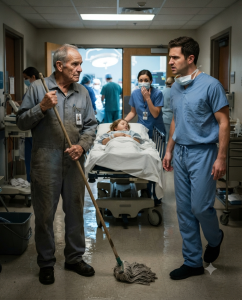
The young doctor told the old janitor to stop standing outside the operating room.
It was the kind of sentence nobody would remember on an ordinary day. Sharp, impatient, dismissive. One more command thrown into the noise of a busy hospital. But nothing about that afternoon stayed ordinary for long, and by the end of it, the people who heard those words would remember them with a different kind of discomfort.
Because the old janitor should never have been the only person in that hallway who knew a child was in danger.
Mr. Wallace had worked at St. Andrew’s Memorial Hospital for thirty-one years. He had arrived before dawn for so long that the building almost seemed to wake up with him. He knew which doors stuck when winter air hit the hinges. He knew the radiators in the north wing knocked twice before they warmed up. He knew exactly how much bleach to pour into a bucket by sight alone and which floor wax left the surgical corridor looking bright without making it slippery.
But the hospital had taught him more than maintenance.
It had taught him people.
He knew which nurses checked on patients even after their shifts ended and which ones rushed because they were exhausted, not because they didn’t care. He knew which doctors thanked housekeeping by name and which ones walked past staff as if they were pieces of equipment. He knew where families waited when they got bad news, where teenagers hid when they were scared, and where older men stood when they were trying not to cry in front of their wives.
Hospitals revealed people in fragments. Mr. Wallace had spent three decades quietly gathering them.
That was why he noticed things others missed.
To the newer staff, though, he was just an old man with a mop bucket. Helpful. Harmless. Background.
A figure in gray who polished the floors after the important work was done.
The afternoon of the bus crash started like many tense hospital afternoons did: too much happening at once and not enough warning. Rain had made the roads slick. A school bus had swerved trying to avoid a truck that jackknifed near an intersection less than ten minutes away. Several children came in with bruises and broken bones. One arrived in worse shape.
Mr. Wallace was mopping the corridor near Operating Room 3 when he heard the ambulance doors slam outside. The sound traveled through the emergency wing like a starter pistol. Suddenly the hallway was full of motion. A paramedic called for trauma support. A nurse pushed through double doors with a crash cart. Two orderlies ran past carrying fresh linens. Somewhere behind them, a woman cried out in a voice so raw it made everyone nearby move faster.
When they rolled the boy past him, Mr. Wallace only meant to get out of the way.
Then he saw the child’s face.
He stopped.
The boy looked smaller than he should have on that hospital bed. His hair was damp with sweat and rain. One side of his forehead was bruised. A clear oxygen mask covered part of his face, but it didn’t hide him enough. There was something familiar there—a line in the chin, the shape of his eyes, the way his lashes rested against pale skin.
For a second, Mr. Wallace couldn’t place him.
Then memory clicked into place.
Christmas. Bright lobby lights. A tin of sugar cookies wrapped with red ribbon. A woman laughing apologetically because her grandson had taken two snickerdoodles before they reached the nurses’ station. The boy had been younger then, shy at first, clutching her coat sleeve. Another child in the lobby had offered him a balloon from a holiday display.
Within minutes, chaos.
His lips swelled. His breathing changed. His grandmother nearly dropped the cookie tin trying to flag someone down. Staff rushed in. The balloon was taken away. The grandmother repeated through tears that he had a severe latex allergy. Not a mild sensitivity. Severe.
Mr. Wallace remembered because fear made certain details permanent.
He had helped clean the spilled cookies after they took the boy for treatment. Later, when everything settled, the grandmother had thanked him for helping and said, “You’d be surprised how many people think balloons are harmless.”
He hadn’t forgotten that either.
Now, standing in the corridor, he looked instinctively at the child’s wrist.
No bracelet.
He frowned and stepped closer.
The team was already moving quickly. A young attending surgeon was scrubbing in, issuing instructions with the clipped confidence of someone trained to dominate panic. He looked capable, maybe brilliant. But he also looked like a man with no room left in his mind for interruption.
Mr. Wallace glanced at the tray being prepared.
Latex gloves.
A knot formed in his stomach.
“He can’t have latex gloves,” Mr. Wallace said.
The surgeon didn’t look at him right away. “Sir, please step back.”
“The boy has a latex allergy.”
The doctor turned then, irritated at being challenged in the middle of an emergency. He saw an old janitor in the doorway and reacted exactly the way pride usually reacts when it thinks rank is being questioned.
“We are in the middle of surgery prep,” he snapped. “Get out of the way.”
A nurse nearby hesitated, eyes flicking from the doctor to Mr. Wallace and back. The room kept moving around them. Machines beeped. Packages tore open. Someone called out blood pressure numbers. It would have been very easy, at that moment, for Mr. Wallace to retreat.
That was what people like him were expected to do.
But he didn’t.
He had seen too much in that building to confuse a title with infallibility.
“Check the allergy bracelet,” he said.
Something in his tone made the nearest nurse look down.
She reached for the boy’s wrist.
Then his other wrist.
Her face changed.
“There isn’t one,” she said.
The room went still in that strange, brief way a room full of trained professionals can go still without physically stopping. Hands hovered. Eyes narrowed. The doctor moved to the bed and checked himself, as if the bracelet might appear if he looked hard enough.
Nothing.
He grabbed the transfer paperwork. Incomplete. Rushed. Vital signs, mechanism of injury, probable internal bleeding. No allergy warning visible where it should have been.
“Was family contacted?” he asked sharply.
“Grandmother is listed,” another nurse said. “No answer from the mother yet.”
“Call the grandmother,” Mr. Wallace said.
This time the doctor looked at him differently—not with respect yet, but no longer with automatic dismissal. Doubt had entered the room, and once doubt arrives in medicine, hierarchy matters less than certainty.
The nurse dialed.
Speaker on.
The phone rang twice before an older woman answered, breathless and frightened. She had already heard there had been a crash. She was on her way. She kept asking if her grandson was breathing.
The nurse interrupted as gently as she could. “Ma’am, does your grandson have any allergies we need to know about?”
The answer came instantly, with no hesitation at all.
“Yes. Severe latex allergy. Severe. He wears a bracelet. He always wears a bracelet.”
The nurse closed her eyes.
The doctor’s jaw tightened.
Mr. Wallace said nothing.
The grandmother kept talking, voice shaking harder now. “Please tell me you saw it. Please tell me you checked.”
No one answered that question directly.
They didn’t have to.
The room exploded into a different kind of motion. Boxes of gloves were pulled aside. A cart was checked for latex components. Equipment was swapped. The anesthesiologist asked for confirmation on every material that might come into contact with the child. The nurse who had made the call repeated, “Latex-free only,” as if saying it enough times could erase the fact that they had almost proceeded without knowing.
The young doctor moved fastest of all.
Shock had stripped the impatience from him. What remained was focus sharpened by the cold realization of what had almost happened under his watch.
Within minutes the setup was corrected, and the surgery began.
Mr. Wallace stepped back into the hallway.
He watched the doors close and heard the latch click into place.
Then the corridor was quiet.
He stood there for another second, feeling the tremor in his own hands. He hated how long that phone had rung. He hated how close it had come. But fear was a luxury in a hospital. There was always another room to clean, another family about to pace a corridor, another mess somebody would notice only when it wasn’t handled.
So he picked up his mop and went back to work.
A resident passed him twenty minutes later and did a small double take. Another nurse slowed as if she wanted to say something, then didn’t. News traveled strangely in hospitals. Not in full stories. In flashes.
Missing bracelet.
Severe allergy.
Janitor remembered.
Close call.
Child still in surgery.
By the time the operation ended, half the floor had heard some version of it.
The boy survived.
He needed monitoring. He had fractures and internal injuries that would take time to heal. But he survived the surgery, and just as importantly, he survived it without exposure to the one thing that could have turned crisis into catastrophe.
When the surgeon stepped out, his face showed the kind of controlled exhaustion that follows both effort and reckoning. He gave the update to the waiting staff first. Stable. Recovering. Good response. Relief moved through the hallway in visible waves.
Then he noticed Mr. Wallace polishing the same strip of floor near the wall.
For a moment, the doctor stood there watching him. The old man’s motions were steady, almost meditative. Dip. Wring. Push. Pull. The tile shone in long clean strokes.
The doctor walked over.
“I owe you an apology,” he said.
Mr. Wallace kept working another second before looking up. The doctor’s voice had changed. Gone was the clipped authority from earlier. He sounded shaken now, and a little ashamed.
“I’m sorry,” he said again. “I should have listened.”
Mr. Wallace dipped the mop back into the bucket.
The fluorescent lights shimmered across the water, then across the wet floor beneath them.
“People think cleaning means I don’t see things,” he said. “But clean floors reflect everything.”
The words landed harder than the doctor expected.
Because Mr. Wallace wasn’t only talking about what he had seen in the boy’s chartless wrist or remembered from a Christmas long ago. He was talking about the hospital itself. Its rhythms. Its blind spots. The way some people became invisible because they wore the wrong uniform. The way confidence could turn into carelessness when no one challenged it.
The doctor looked down at the floor, seeing his own reflection stare back at him in warped silver.
Before he could answer, a voice came from the waiting area.
“Wallace?”
The grandmother had arrived.
Her coat was half-buttoned, hair windblown, face pale from the drive and from whatever terror had accompanied it. She looked older than Mr. Wallace remembered, but panic could age anyone in an hour. When she saw him, she hurried forward and grabbed his hands.
“They told me,” she whispered, already crying. “They said you remembered. You remembered him.”
Mr. Wallace gave a small nod. “I remembered.”
She pressed his hands harder. “I always tell everyone. Every school form, every doctor, every dentist, every camp, every babysitter. I always say it twice.”
“I know,” he said.
The young doctor stood a few feet away, hearing every word.
The grandmother turned toward him then, her expression not angry at first, but stunned. The kind of stunned that comes before anger when the truth is too frightening to process immediately.
“If he hadn’t recognized my grandson,” she said, “would anyone have checked before touching him?”
The question opened in the hallway like a wound.
No one answered.
A nurse nearby looked down. Another shifted her weight. The doctor tried to speak, but truth has its own timing, and there was no sentence he could form that would undo the silence.
Finally he said, “We should have caught it. We didn’t. He did.”
The honesty in that answer made several people look up.
The grandmother closed her eyes briefly, then nodded once. Not in forgiveness. Not yet. More like someone marking a fact she would revisit later.
“He saved my grandson,” she said.
This time she looked directly at Mr. Wallace, and her voice broke for real. “Thank you.”
He seemed almost uncomfortable with the gratitude. “I just remembered what you told me.”
“No,” she said softly. “You remembered because you listened.”
That sentence stayed in the hallway long after she was taken to see her grandson in recovery.
Later that evening, the chief nursing officer requested the incident report. Then the surgery department head asked questions about transfer protocols, missing allergy identifiers, and emergency verification steps. Quiet review became formal review. Formal review became a full discussion at the next patient safety meeting.
More than one person expected the conversation to focus only on the missing bracelet.
It didn’t.
It also focused on why a staff member’s warning had been dismissed because of his role.
That part made some people far more uncomfortable.
The young doctor, whose name was Daniel Reed, spoke during the review. He did not hide behind the pace of the emergency or the incomplete transfer forms, though both had contributed. He admitted that when Mr. Wallace first spoke, he assumed the interruption was uninformed and inconvenient. He had not asked one simple question: How do you know that?
It sounded painfully obvious after the fact.
That was what made it so serious.
The hospital added new verification language to emergency intake procedures when identification markers were missing. They also instituted a broader training session that included a message many people had apparently needed to hear: patient safety information could come from anyone, and every concern had to be evaluated before it was dismissed.
Some staff rolled their eyes at that privately.
Most didn’t after hearing the full story.
As for Dr. Reed, he changed in smaller ways first.
He started learning names.
Housekeeping, transport, dietary, security. The people he had once passed without really seeing. He began thanking them when they pointed out spills, family distress, missing belongings, unusual behavior in waiting rooms, or anything else that might affect care. At first the gratitude looked awkward on him. Then it began to look natural.
A month later, he found Mr. Wallace buffing the surgical wing after visiting hours.
“I’ve been meaning to tell you,” Dr. Reed said, “I keep hearing your line in my head.”
Mr. Wallace gave him a sidelong look. “About reflection?”
Dr. Reed nodded. “About what I wasn’t seeing.”
Mr. Wallace pushed the buffer forward. “Seeing is easy. Respect is harder.”
Dr. Reed accepted that without argument.
The boy recovered slowly. His name was Eli. He returned to the hospital weeks later for a follow-up visit, walking carefully but under his own power. His grandmother brought cookies again, though this time she came straight to housekeeping first. Eli handed Mr. Wallace a drawing folded in half.
Inside was a picture done in crayon. A shiny hospital floor. A bed with wheels. A man with a mop standing like a guard in front of big double doors. At the top, in crooked handwriting probably guided by an adult but still unmistakably a child’s, were the words: Thank you for seeing me.
Mr. Wallace folded the paper very carefully and slipped it into his locker.
He didn’t say much.
He never did.
But when he returned to the corridor that evening, he spent a long moment looking at the floor after he finished it. The light from above stretched smooth and silver across the tile. Reflections of nurses, doctors, patients, and families passed through it in ripples.
Everyone moved quickly in hospitals. Everyone thought their own urgency mattered most.
Maybe that was true.
But that day had proved something else just as clearly: the most dangerous mistakes were not always caused by ignorance. Sometimes they were caused by deciding too quickly who was worth listening to.
A missing bracelet almost cost a child his life.
An old janitor’s memory saved it.
And for all the policy changes and safety meetings that followed, that was the part people kept repeating long after the paperwork was filed. Not because it was dramatic, though it was. Not because it was humbling, though it should have been.
They repeated it because it forced an uncomfortable question into the open.
In a place built to save lives, how many truths had been standing quietly in the room all along, waiting for someone important enough to be heard?
Some people in that hospital said Dr. Reed was lucky the lesson came before tragedy.
Others said luck had nothing to do with it.
Mr. Wallace might have called it attention. Or maybe respect. Maybe both.
Either way, every time the floors shone after that, more people noticed what they reflected.
And not all of them liked what they saw.