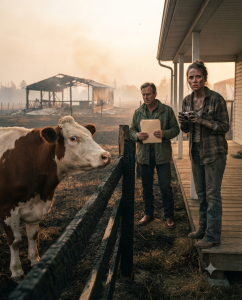
The old cow refused to leave the burned pasture.
At first, Anna thought it was grief.
Every morning just after sunrise, Bessie would shuffle to the blackened fence line, stop in the exact same place, and low toward the ashes until Anna came out onto the porch. It was not the impatient sound of an animal asking for feed. It was slower than that, rougher, almost mournful. The first few times, Anna stood there in her robe and boots, arms wrapped around herself against the morning chill, and listened with tears burning behind her eyes. The farm had not known silence in all the years she’d lived there. There had always been gates clanging, engines rattling, her father whistling as he crossed the yard. Now his voice was gone, and the land itself seemed stunned by the loss.
Then the fire came and made everything worse.
Two weeks after her father died of a sudden stroke, flames tore through the east side of the farm. The old feed shed went first. By the time anyone saw the smoke, the wind had already pushed the fire into the pasture and along part of the barn wall. The volunteer fire crew saved the house and most of the livestock, but not before half the property was left scorched and smoking. Even after the blaze was out, the place looked injured. Fence posts leaned black and cracked. Melted roofing lay in twisted sheets. Dirt that had once smelled like hay and rain now reeked of smoke and chemicals.
Anna still had not found a rhythm for her grief. Losing her father had split time in two. There was the world before the phone call from the hospital, and the world after. In the after, people spoke softly around her. They brought casseroles she could not taste. They said her father had loved this land, and she should hold on to that thought. Then, almost immediately, practical matters rose like floodwater around her—legal documents, funeral bills, repairs, insurance. She barely kept up.
Wade, her stepbrother, seemed to have no trouble at all.
He had always been smooth where Anna was direct, polished where she was plainspoken. Their father had married Wade’s mother when they were teenagers, and though the marriage had lasted until her death, the family had never fully blended. Wade moved away young, came back only when it suited him, and somehow still managed to speak with authority about the farm as though he had been the one living its daily reality.
After the fire, he arrived with sympathy in his voice and urgency in his eyes.
“It’s too much now,” he told Anna three days after the flames were out. They stood in the kitchen while the smell of smoke drifted in through the screen door. “Dad’s gone. Half the place is destroyed. You can’t rebuild this alone.”
Anna held a mug of coffee gone cold. “I didn’t say I was rebuilding anything today.”
“I’m trying to help you think clearly.”
He slid a folder across the table. Inside were preliminary sale estimates, contact information for a private buyer, and a checklist of forms. Anna stared at him.
“You already have a buyer?”
“I made some calls.”
“That fast?”
He lifted one shoulder. “People hear a property like this might go on the market, they move quickly.”
That was what unsettled her. Not just his efficiency, but the timing. Their father had not been gone a month. The ashes in the pasture were still warm in places. Yet Wade spoke about selling as if the decision had already been made and Anna was the only person who had not caught up.
He had explanations ready for everything. The farm was too expensive to restore. The insurance process would drag. The area was changing. Developers were already circling. They could get out now, take the money, and escape before more bad luck hit.
Bad luck.
He used that phrase often, and each time Anna disliked it more.
Her father had hated talk like that. He believed in causes, not curses. If a roof leaked, you found the weak seam. If a calf got sick, you looked for infection. If a storm flattened a fence, you rebuilt it stronger. He did not dramatize hardship. He worked through it.
The more Wade talked, the more Anna found herself resisting. But grief made resistance slippery. She doubted herself constantly. Maybe he was right. Maybe she was clinging to a place she could not manage alone. Maybe the farm had died with her father and she was the only one too sentimental to admit it.
Then there was Bessie.
The old cow had belonged to her father longer than almost anything else on the property. Bessie was twelve, broad-faced, white-starred, and steady in the way only older animals can be. Her father used to joke that Bessie knew everyone’s business and approved of very little. After his death, she had stood near the pasture gate for two days as though waiting for him. Then the fire changed her behavior in a way Anna could not explain.
No matter where Anna moved her, Bessie drifted back to the burned field.
She ignored fresh grazing to stand at the fence line and stare into the ruins. She lowed until Anna came outside, then watched the far corner near the feed shed with unnerving focus. Wade laughed when he saw it.
“Smoke in her brain,” he said. “That old thing’s confused.”
Anna wanted to accept that. But the animal did not seem confused. She seemed deliberate.
One evening, as the sun slid low and painted the ash in copper light, Anna carried a bucket toward the trough and saw Bessie break from her usual spot. The cow stepped through a gap in the damaged fence and moved into the ruined pasture. Anna swore softly and followed, afraid she would cut herself on debris.
The air there still had a bitter edge. Burned grass crumbled under her boots. Ahead, the feed shed crouched in wreckage—a collapsed frame, scorched boards, twisted hinges, half-melted tools. Bessie approached the remains of the floor and stopped. She lowered her head, sniffed, then pawed once at the ground.
Anna frowned. “What is it, girl?”
Bessie stepped aside.
Near the edge of the rubble, where ash had mixed with rain and hardened into a crust, something metallic reflected the last of the daylight. Anna knelt. At first she thought it was a bent piece of roofing. But when she brushed more dirt away, a shape appeared that made her pulse jump: a recessed metal handle.
Her father’s safe.
He had kept it hidden beneath the feed shed floor for years. She had seen him open it only a handful of times, always after making sure no one was around. The safe held papers too important to lose and too personal to trust elsewhere. Deeds. Insurance policies. Spare copies of contracts. Things that tied the history of the farm to the people who had built it.
Anna had completely forgotten about it in the chaos after the fire.
Now she dug like someone desperate to wake from a dream. Ash packed into the creases of her hands. The soil around the safe had partially fused from the heat, but the box itself was intact. When she finally dragged it free, she sat back on her heels, breathing hard, soot streaking her forearms.
The latch resisted, then gave.
Inside were sealed plastic envelopes, slightly warped at the edges but protected. Land records. Insurance documents. The original survey maps. A stack of receipts clipped together. Beneath them lay a small camera with a cracked lens and a dead-looking screen.
Anna froze.
She recognized it too. Her father used motion-activated cameras around the outbuildings when coyotes came near or when equipment had gone missing from neighboring farms. After the fire, Wade had said everything in and around the shed was a total loss, including any cameras.
Yet here one was, safe from the flames because it had not been left outside.
She carried the safe into the house after dark and set everything on the kitchen table. The room felt too quiet. Every noise she made sounded enormous—the scrape of a chair leg, the click of the lamp, the shaky exhale she did not realize she’d been holding. She plugged the camera into a charger. Nothing. So she opened the casing and removed the memory card instead.
Her laptop took an agonizing few seconds to read it.
When the file directory appeared, she almost cried with relief.
There were several older clips, ordinary and boring: raccoons nosing around feed bins, her father checking a latch, a stray dog cutting across the yard. Then she saw the timestamp from the night before the fire.
Her finger hovered over the trackpad.
The video opened to a grainy nighttime view of the feed shed exterior. Moonlight silvered the ground. The frame held still for several seconds. Then movement crossed the left side.
A man entered view wearing a work jacket and cap. He turned just enough for the porch light in the distance to catch his face.
Wade.
He carried a red gas can.
Anna’s breath disappeared.
On-screen, Wade glanced over one shoulder before slipping into the shed. He remained inside less than a minute. When he came back out, the can hung differently in his grip, lighter. He bent near the outside wall and appeared to place something close to the foundation. Then he walked away into darkness with fast, controlled steps.
Anna stared long after the clip ended.
The kitchen around her seemed to tilt. Her mind tried to reject what she had seen, to produce some innocent explanation that fit the image without shattering everything else. But the explanations died as quickly as they formed. Wade had never told her he’d been there that night. He had spoken about the fire with the certainty of someone who already knew what story would be believed. He had arrived with a buyer ready. He had pushed the sale before the insurance process was complete.
He had not been helping her survive a tragedy.
He had been trying to cash in on one he created.
Anna watched the footage one more time only to confirm she had not imagined the gas can. Then she removed the card, slipped it into an envelope, and called the sheriff.
Sheriff Dale Morrow had known her father for thirty years. His voice changed the moment she said she had found evidence tied to the fire. He told her not to touch anything else and said he was coming over immediately.
By the time he arrived, the night had deepened. He examined the safe, photographed the contents, and watched the video in silence. His jaw set tighter with each second.
“Did anyone else know about this safe?” he asked.
“My father. Me. Maybe Wade knew it existed. I’m not sure.”
“Did your father ever say anything about concerns with your stepbrother?”
Anna hesitated. “Not directly. But lately Dad had been frustrated with him. Money issues. Wade kept pitching ideas about selling parcels of land for development. Dad refused.”
The sheriff nodded slowly. “Keep the doors locked tonight. Do not answer if he shows up. And don’t mention this to anyone.”
Sleep never really came. Anna sat by the dark kitchen window for hours, the safe on the table behind her and Bessie’s silhouette faint at the fence line in the predawn gray. The cow was there again before sunrise, standing in her same strange vigil.
When Wade drove into the yard the next morning, he looked irritated rather than concerned. He climbed out of his truck with a leather folder tucked under one arm and called toward the porch.
“Anna? We need to talk. The buyer’s asking questions.”
Then he saw the sheriff’s cruiser parked beside the barn.
His expression changed instantly.
Not confusion. Not fear at first. Recognition.
Anna noticed that detail later and never forgot it.
She stepped onto the porch holding the cracked camera in one hand. Sheriff Morrow came out behind her. Wade’s eyes fixed on the device.
“What is that?” he asked too quickly.
The sheriff answered for her. “Something recovered from the burn site.”
Wade let out a short laugh that convinced no one. “Recovered from where? There’s nothing left there.”
Anna looked straight at him. “Bessie found the safe.”
For the first time, Wade seemed genuinely thrown. “The what?”
“The safe under the feed shed floor.”
He said nothing.
Sheriff Morrow descended the porch steps. “I’d like you to come down to the station and answer a few questions.”
Wade shifted his stance. “About what?”
“About where you were the night before the fire. About the gas can you carried into the shed. About why you were so eager to sell this property before the investigation was complete.”
The color drained from Wade’s face. For a moment Anna thought he might run. Instead he stared at her with a mixture of anger and disbelief.
“You went digging through ashes instead of signing papers?”
“Bessie went digging,” Anna said.
At the fence, as though on cue, the old cow let out a low sound that rolled across the yard.
Wade turned toward her. Something ugly flashed over his features—not just fear, but resentment, as if even the animal had betrayed him. He looked back at Anna.
“You don’t understand what your father was doing.”
The sentence hung in the air.
Anna’s stomach tightened. “What does that mean?”
Wade’s lips pressed together. He had already said too much.
The sheriff stepped closer. “It means you should start talking carefully.”
For a long second, Wade remained silent. Then his shoulders sagged in a way Anna had never seen before. The polished confidence slipped. What stood in front of her now was a man cornered by his own impatience.
“He wasn’t supposed to keep those papers there,” Wade muttered.
“What papers?” Anna asked.
Wade laughed once, bitterly. “The updated land records. The mineral rights transfer. He said he was protecting the farm, but really he was cutting me out.”
Anna blinked. “What are you talking about?”
Their father had inherited not only the farm but old subsurface rights tied to neighboring acreage—rights most people in the county considered worthless. Over the past year, however, exploratory interest had quietly risen after a company discovered commercially valuable deposits in the region. Anna knew there had been letters and phone calls, but her father had dismissed them around her, saying only that outsiders saw profit where locals saw home.
Wade spoke faster now, as if once started he could not stop.
“He promised me I’d be included if anything ever came of it,” Wade said. “Then I found out he’d changed the records. He was putting everything in a trust. For you. The house, the land, all of it. He said I’d already had enough chances.”
Anna felt the ground shift beneath her. A trust? Her father had never mentioned finalizing one, though he had once hinted that he was updating his estate plans.
“So you burned the shed?” she whispered.
His face hardened. “I needed those documents gone. If the records disappeared in the fire, things could be contested. Delayed. The sale would move first. I could get control before anyone sorted the rest out.”
The sheriff’s voice turned to stone. “And the insurance payout?”
Wade did not answer.
“That was part of it too,” Anna said, hearing the truth form as she spoke it. “You wanted the insurance money and the sale.”
He looked away.
She remembered every time he had called the farm a burden, every time he had sighed as if helping her, every smooth sentence about practicality and bad luck. None of it had been grief. It had been strategy.
“You set a fire on this land two weeks after our father died,” Anna said. “You let me think it was an accident.”
Wade’s eyes snapped back to hers. “I didn’t think it would spread that far.”
It was such a small, selfish defense that Anna almost could not process it. Not I’m innocent. Not I’m sorry. Only that he had miscalculated the scale of destruction.
Sheriff Morrow took Wade by the arm and turned him toward the cruiser. “You can explain the rest downtown.”
Wade twisted once, enough to look at Anna over his shoulder. “He chose you. He always chose you.”
Anna did not answer. There was no room left in her for argument.
After the cruiser pulled away, the farm fell into a strange, ringing stillness. The kind that comes after shouting, after storms, after truths too large to fit easily into the space that remains. Anna stood in the yard with the cracked camera still in her hand and looked toward the pasture.
Bessie was waiting by the fence.
Anna walked to her slowly, boots sinking into soft dirt at the edge of the burn scar. The old cow blinked, calm as ever, then leaned her heavy head against Anna’s shoulder for one brief second before pulling away. Anna laughed through sudden tears.
“Well,” she murmured, rubbing the cow’s neck, “I guess Dad was right about you.”
In the weeks that followed, investigators confirmed what the video suggested. Accelerant traces were found at the shed. The safe contents preserved the updated estate documents Wade had been trying to destroy. Her father had indeed placed the property into a trust with clear instructions that the farm remain intact unless Anna herself chose otherwise after a waiting period. He had not cut Wade out completely; there was money set aside for him in a separate account, along with a letter urging him to build something of his own instead of circling what belonged to others. It was more mercy than Wade had shown anyone.
The private buyer disappeared the moment law enforcement got involved. The insurance company reopened everything under fraud review. Lawyers came and went. Repairs were slow, expensive, and exhausting. But for the first time since the funeral, Anna stopped feeling as though the ground beneath her was vanishing.
She kept the farm.
Not because it would be easy. It would not. The east pasture had to be reseeded. The feed shed had to be rebuilt from the foundation up. Fences needed replacing. Some mornings grief still arrived before she did, waiting in the yard like weather. But the decision was hers now, made in honesty instead of pressure.
By spring, green had begun pushing through the black.
The first time Anna saw fresh shoots in the burned pasture, she stood at the fence and cried quietly while Bessie grazed nearby as if nothing extraordinary had happened. As if old cows uncovered evidence every day and saved families from ruin before breakfast.
Maybe, in her own way, Bessie had been grieving. Maybe animals understand absence more deeply than people realize. Or maybe she had simply noticed what everyone else missed and refused to leave it unguarded. Anna would never know for sure.
What she did know was this: on the worst mornings, when smoke still seemed trapped in the walls of memory, she thought about how close she had come to signing away everything her father had tried to protect. How easily a polished lie can pass for practical advice when spoken at the right moment. How often the loudest urgency comes from the person with the most to gain.
And she thought about Bessie at the blackened fence line, lowing toward the ashes until someone finally listened.
Some betrayals arrive wearing concern. Some thieves come carrying paperwork instead of masks. And sometimes the clearest warning on a broken farm does not come from a document, a lawyer, or even family.
Sometimes it comes from the one creature who refuses to walk away from the place where the truth is buried.