They told the shy woman in the wheelchair she should stay in the back.
The volunteer who said it tried to sound gentle, almost helpful, as if he were protecting her from the chaos inside the crowded town chamber. But the phrase landed the way those phrases always did—with a smile wrapped around dismissal.
Mara looked past him into the room.
Every seat was full. Reporters lined one wall with cameras and notepads. Town staff moved around the council table stacking papers, whispering to each other, glancing at the clock. Residents from all over town had shown up after the apartment fire, drawn by shock, anger, curiosity, or the grim instinct that tells people to witness the aftermath when something terrible has happened close to home.
Her building had burned three nights earlier.
Twenty families were now homeless.
Some were staying in cheap motels paid for one night at a time. Some were sleeping on couches. Some were sharing rooms with relatives who already didn’t have enough space. One older tenant had escaped carrying only a plastic bag with his medication and one framed photo. A single mother from the third floor had lost every school uniform her children owned. Two brothers had gone door to door in the smoke because the alarms never sounded.
And the man who owned the building was already inside, sitting in the front row under clean lights in a dark suit, wearing a face made for cameras.
Mara’s fingers tightened around the folder on her lap.
“You can watch from the back,” the volunteer repeated.
Watch.
Like she was there for public theater. Like her role was to observe the polished version of a disaster she had tried for months to prevent.
Mara gave him a small nod that revealed nothing and rolled inside.
The back row was half full of people from her building. She recognized them immediately—not because they looked the way they usually did, but because they didn’t. They looked stunned, dislocated, unfinished. People wearing borrowed jackets and yesterday’s exhaustion. People holding clear plastic folders filled with whatever papers they had managed to save. People who jumped at every official phrase because they were trying to hear whether it contained help or another delay.
Mrs. Alvarez, who lived on the first floor, sat with her granddaughter asleep against her shoulder. Mr. Denton, who used a cane and spoke too loudly when he was nervous, stared at the council table as if he still expected someone to tell him this had all been a mistake. Jamal and Eric, the brothers from the second floor, leaned against the wall in soot-stained sneakers, both looking older than they had last week.
Mara had spoken to most of them outside the shelter over the last few days. Some had cried. Some had cursed. Some had just looked numb. But almost all of them had asked some version of the same question.
How could this happen?
Mara knew the answer.
It happened because people in charge had been warned.
Again and again and again.
The meeting started with formalities that made her jaw ache. The mayor offered condolences. A fire official praised emergency response crews. A council member thanked the community for coming together during a difficult time. Someone used the phrase “unfortunate event.” Someone else said “ongoing investigation.” Every word seemed chosen to sand the edges off what had happened.
Then came the landlord.
His name was Randall Pike, and he walked to the podium with the solemn care of a man stepping into a role he had rehearsed. Tall, gray at the temples, polished enough to look trustworthy at a glance, he rested both hands on the lectern and lowered his eyes before speaking.
“My heart is with the families affected,” he said. “This is a heartbreaking tragedy.”
Mara watched him without blinking.
Pike continued. He said the property had been maintained appropriately. He said inspections had been completed. He said his office had received no complaints indicating imminent danger. He said some things were still under review, but to his knowledge, all proper procedures had been followed.
A few people in the room nodded. That was the part that hurt most—not his lying, but how easy it still was for lying to look respectable.
Mara had been one of the first tenants in the building to notice the pattern.
At first the problems seemed like the kind landlords always ignored until they became unavoidable. Flickering hallway lights. Loose wiring in shared spaces. Smoke detectors that chirped for days before dying completely. Doors that stuck in damp weather. Maintenance requests marked completed before anyone had actually fixed anything.
Then the issues got worse.
The rear exit on the first floor was blocked for weeks with an old mattress, two broken chairs, and a pile of construction debris nobody claimed. The heater outside apartment 2B made a vicious snapping sound when it rained, followed by blue-white sparks that lit the wall. One smoke alarm in the second-floor hallway hung half-detached from the ceiling. Another had no battery at all.
Mara noticed details because people like her often had no choice. She used a wheelchair after a spinal injury years earlier, which meant blocked hallways and unusable exits were not inconveniences. They were threats. She knew exactly how many seconds it took to maneuver around clutter. She knew which doors were too heavy, which ramps were too steep, which corners became impossible when people left bicycles or boxes in the way.
So she reported everything.
Her first email was polite.
Hello, the hallway heater near 2B appears to be sparking during storms. Can someone please inspect it?
There was no reply.
Her second message included photos.
Still nothing.
Then she began filing written maintenance requests and keeping copies. When the smoke alarms failed, she documented those too. She sent one certified letter after another. She photographed the blocked exits. She recorded the dates. She wrote down names of office employees who said someone would “look into it.”
Nobody ever did.
One afternoon, after she called the management office for the fifth time in two weeks, Pike himself got on the line.
At first his tone was smooth, almost amused.
“You’re very persistent, Mara.”
“I’m trying to keep people safe,” she replied.
“We’re aware of the building’s needs.”
“No, you’re aware of my complaints. That’s different.”
There had been a pause then, heavy and unpleasant.
After that, he stopped pretending to be pleasant. He became irritated whenever she contacted the office. Her repair requests began disappearing entirely. Once, when she asked a maintenance worker whether he had seen the order for the hallway heater, he shrugged and said, “Management told us not to chase every little tenant panic.”
Little tenant panic.
Mara never forgot that phrase.
Then came the voicemail.
She had missed his call one evening while charging her chair battery and sorting medicine in the kitchen. When she listened back, his voice was tight with annoyance.
“If you keep complaining,” he said, “I’ll make sure nobody believes you when something finally happens.”
She saved the recording instantly.
Part of her knew she should go to the town sooner. Another part of her had already learned how those rooms worked. Calm officials. Friendly postponements. Concern without movement. She had sent copies of two complaint letters to the town housing office anyway and received short confirmations that her concerns had been received.
Nothing changed.
Three nights before the meeting, rain swept through town just after dark.
Mara had been awake later than usual, listening to the storm tick against the windows. Around eleven, the power in the hallway blinked. She noticed because the line of light beneath her front door vanished, returned, then vanished again.
A few minutes later she heard shouting.
At first she thought it was neighbors arguing over the outage. Then she smelled it—sharp, dirty, unmistakable.
Smoke.
She opened her apartment door and saw gray haze spreading through the corridor. The heater near 2B was spitting sparks against the wall. Someone was yelling for water. Someone else was screaming that the alarm wasn’t working.
Mara rolled backward, grabbed her phone, and called 911. She started pounding on nearby doors with the side of her fist. Jamal and Eric ran down the hall banging on apartments because the alarms still hadn’t sounded. Mrs. Alvarez opened her door with her granddaughter in her arms, eyes wide with confusion. Mr. Denton came out coughing, barefoot and disoriented.
The rear exit was blocked exactly where Mara had warned it would be.
By the time firefighters arrived, flames had already chewed through part of the second floor. Smoke turned the hallways into tunnels. People poured outside in pajamas, socks, house slippers, one man clutching a birdcage with no bird inside. Mara made it out with her folder, her phone, her medication, and almost nothing else.
Standing across the street in rain and sirens, she watched her building burn and felt a terrible, familiar thought settle into place.
He’s going to lie.
And he did.
By morning, Pike was speaking to local reporters about tragedy, cooperation, and support. He said the fire appeared sudden. He said inspections had been passed. He said he was committed to helping affected tenants. The comments spread fast, polished and complete before many families had even found a place to sleep.
That was when Mara stopped hoping truth would surface on its own.
She spent the next two days gathering everything.
Every email she had saved.
Every photo.
Every maintenance form.
Every letter receipt.
Every timestamp.
She charged her phone twice to make sure the voicemail would play. She called two other tenants and asked them to send copies of old messages they still had. She put everything in one thick folder and labeled sections with shaky, determined handwriting.
When she heard the council was holding a public meeting, she knew exactly where she needed to be.
Now, sitting in the back of the chamber while Pike spoke about heartbreak, Mara felt the old fear rise and pass through her. She had spent years being underestimated by people who saw the wheelchair before they saw her. They mistook quiet for weakness. Patience for passivity. They never understood that surviving while dependent on systems that routinely fail you develops a different kind of strength—one built from observation, preparation, and the refusal to be erased.
A councilman announced that public comment would be limited because of time.
Several people spoke briefly. A nearby shop owner offered support for displaced families. A church coordinator described donation efforts. A fire inspector used careful words about preliminary findings.
Then the councilman said, “We can take one final comment.”
Mara raised her hand.
He glanced at her, then at the clock.
“Ma’am,” he said, “we’re short on time.”
A few people shifted awkwardly. One reporter turned toward the back row. Pike remained facing forward, his profile composed.
Mara rolled into the aisle.
At first no one stopped her because no one quite believed she would keep going. Then she reached the open floor, and the room began to understand.
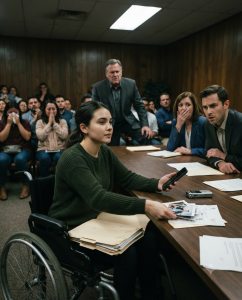
She moved to the table in front of the council with steady hands and set her folder down.
“I won’t take long,” she said.
The councilman started to speak, but one of the councilwomen lifted a hand, telling him to let her continue.
Mara opened the folder.
The first photo she laid out showed a smoke alarm hanging open with no battery inside. The second showed the blocked rear exit. The third showed scorch marks near the hallway heater from a storm two weeks earlier.
The council members leaned forward.
Then came the emails. Printed, dated, highlighted.
Subject: URGENT—heater sparking again when raining.
Subject: exit blocked, wheelchair access impossible.
Subject: smoke alarm on second floor not functioning.
She placed maintenance requests beside them, then the certified mail receipts, then copies of formal complaint letters. The evidence spread across the table like a second version of the building itself—one built from warnings instead of walls.
Pike finally turned to look.
Mara heard someone behind her whisper, “Oh my God.”
She picked up one page. “This was sent five months ago,” she said. “This one four months ago. This one after the second storm. This one after I was told the issue was cosmetic.”
Pike rose halfway from his seat. “Council, I have no way of authenticating—”
Mara pressed a button on her phone.
His own voice cut through the room.
“If you keep complaining, I’ll make sure nobody believes you when something finally happens.”
The sentence hit like a physical force.
The chamber went dead still.
No coughs. No shuffling papers. Even the reporters seemed frozen for a heartbeat before instinct took over and heads dropped, fingers flew, cameras lifted.
Pike stood up so hard his chair scraped the floor. The grief-stricken landlord mask fell away all at once, revealing naked anger.
“That is out of context,” he snapped.
“Then give us the context,” one reporter shot back.
He ignored her.
A councilwoman reached for the phone. “May I hear that again?”
Mara didn’t repeat the clip. She didn’t need to. Everyone had heard it the first time.
Instead, she turned and looked at the families from her building.
Mrs. Alvarez was crying silently. Jamal had both hands over his mouth. Mr. Denton looked less shocked than vindicated, like a man who had spent days doubting his own memory and was suddenly told he had not imagined any of it.
Mara faced the council again.
“I didn’t come here for sympathy,” she said. “I came here with receipts.”
The line sliced through the room.
The councilman who had tried to cut her off no longer looked inconvenienced. He looked alarmed. Staff began collecting the documents for copying. The mayor asked whether town counsel was present. Reporters crowded the side aisle. Pike started saying he would have no further comment without legal representation.
That might have been enough.
But once fear breaks, other people start speaking.
A father from the third floor stood up and said he had texted management twice about the smoke door jamming shut. Jamal said he had video of the dead hallway alarm from a month earlier because he had joked about it with his brother. Mrs. Alvarez said she had complained about the blocked exit after nearly tripping over debris while carrying groceries. Another tenant remembered a maintenance worker saying he had been told to leave the heater alone until next quarter.
The room transformed in minutes.
This was no longer a meeting about a tragedy.
It was a hearing without warning.
A councilwoman sorting through Mara’s documents suddenly stopped on one stamped letter and looked up sharply.
“This was copied to the town housing office,” she said.
Mara nodded. “Two of them were.”
A hush moved through the chamber again, different this time.
Because if the town had received warnings too, then Pike might not be the only one with questions to answer.
The housing clerk called to the front said she would need to review records. The mayor’s expression tightened. One of the reporters immediately began asking whether prior complaints had triggered any inspection review. No one answered clearly enough.
Pike tried to slip out during the confusion.
He made it only as far as the side hallway before two cameras followed and a reporter asked whether his public statement about receiving no serious complaints was still accurate in light of the documents and voicemail. He said “no comment” three times, each one sounding less controlled than the last.
By then, the story was already spreading.
Local reporters posted the voicemail quote within minutes. Photos of Mara’s documents began circulating online. Residents who had dismissed the fire as a terrible accident were suddenly asking how many warnings had been ignored and by whom. Former tenants from older Pike properties started messaging reporters with stories of their own—faulty wiring, delayed repairs, intimidation, pressure to stay quiet.
By morning, investigators had requested the full file from the town. The council announced an emergency review of rental code enforcement. Pike’s attorney released a statement calling the accusations misleading, but it collapsed under the weight of the evidence now moving from inbox to inbox across the county.
Mara woke in a borrowed guest room to seventeen missed calls.
For one disorienting second, she thought there had been another fire.
Then she remembered the meeting.
Her phone buzzed again. It was a reporter asking for comment. Another message came from a legal aid organization offering representation for tenants. Then a text from Jamal: You did it.
Mara stared at that one for a long moment.
Did it.
She wasn’t sure the phrase fit. The building was still gone. Families were still displaced. Children still needed clothes and school supplies. The losses were real and would remain real no matter how many headlines appeared.
But something had changed.
The truth was no longer trapped inside private fear, buried under polite procedures and a man’s confidence that no one would take her seriously. It was out now, loud and documented and impossible to stuff back into a file.
Later that afternoon, the town announced Pike’s rental licenses were under formal review pending investigation. State inspectors arrived at two of his other properties. Tenants gathered outside one building and compared notes with the stunned energy of people discovering their separate bad experiences were part of the same pattern. An assistant from the housing office quietly told a reporter that internal records showed prior complaints had indeed been received.
By evening, Pike’s photo was everywhere.
Not the one from before the fire, where he looked respectable and composed. The one from the town hall hallway, jaw tense, eyes furious, caught mid-turn as if he finally realized he was not walking away clean.
Mara didn’t give many interviews. When she did, she kept her answers simple.
“I warned them.”
“I kept records.”
“People deserve to be heard before disaster, not after.”
That was what struck people most. She was not dramatic. Not theatrical. Not eager for attention. She was precise. Grounded. Unimpressed by the machinery that had tried to grind her down. The very quietness others had mistaken for weakness now made her impossible to dismiss. She sounded like someone who had been forced to become her own archive because everyone else failed to do their job.
A week later, families from the building gathered at a church hall where donations had been sorted into neat piles of clothes, blankets, toiletries, and school supplies. There was food in foil trays, children running between folding tables, volunteers trying too hard to sound cheerful. Loss hung in the room, but so did something steadier.
Recognition.
People stopped Mara over and over. To thank her. To apologize for not listening sooner. To hand her one more screenshot or one more memory that might help the case. Mr. Denton took both her hands in his and said, “You saved what truth we had left.”
She almost cried then.
Not at the praise, but at the exhaustion underneath it. The months of writing messages into silence. The humiliation of being treated like a nuisance. The knowledge that being right had cost everyone so much.
That night, alone at last, Mara sat by the window of the room she was borrowing and listened to summer insects outside. Her folder rested on the table nearby, thicker now than it had been before the meeting.
Evidence had finally done what her voice alone could not.
But the victory was complicated, and she knew it.
Pike was being investigated, and he deserved every consequence coming to him. The town’s failures were harder to name and harder to fix. Some officials had ignored warnings through laziness. Some through bureaucracy. Some because people like Mara are easier to overlook until they become impossible to contain. Accountability was coming, but not evenly, not neatly, and not fast enough to erase what had happened.
Still, one fact remained.
When the room had tried to push her to the back, she had rolled forward.
When they said there was no time, she had made them listen.
When a man in a dark suit told the world he had done everything right, she answered him with the sound of his own voice.
And in the end, that was the detail nobody could stop thinking about.
Not the polished speech.
Not the official condolences.
Not even the fire itself.
But the moment a woman everyone underestimated opened a folder, pressed play, and forced an entire town to confront the price of ignoring her.
Some people later said Pike’s downfall began with the fire.
They were wrong.
It began the first time Mara warned him.
The fire was only the moment everyone else finally understood she had been telling the truth all along.
And that left one question hanging in the minds of everyone who followed the story afterward:
If they had listened when she was still just a tenant asking for repairs, how many lives would have looked different?