At her grandfather’s wake, Amy’s relatives handed her the cracked birdbath from his garden.
Not the fishing boat he had spent years restoring. Not the savings bonds everyone in the family treated like whispered legend. Not the white clapboard house where half the family photographs on the hallway wall had been taken. Just the birdbath. Heavy, weathered, cracked through the basin, with a carved stone bird on the rim missing one wing.
They told her it was the only thing he had specifically mentioned for her.
The words were delivered gently, almost politely, but the smirks around them spoiled the performance. Her cousins stood in dark funeral clothes, holding paper plates and coffee cups, trying to look solemn while satisfaction kept leaking into their faces.
Matthew, the oldest, had inherited the house. Denise had gotten the boat. Her younger cousin Ryan had walked away with the savings bonds and a few pieces of antique furniture he was already talking about appraising. They all spoke in careful voices, but Amy knew the family language well enough to hear what wasn’t being said.
Poor Amy.
Sweet Amy.
The one who showed up every summer but somehow ended up with the broken garden ornament.
Amy stood near the hedge in the side yard, staring at the birdbath where someone had set it down on the grass. It looked older than she remembered. The stone was dark with moss in the cracks, and one side of the basin sagged just slightly, as if it had been leaning for years. A thin fracture ran from the bowl down into the pedestal. Not dramatic. Just enough to make it worthless to anyone who wanted something pretty.
Behind it stood the house.
The house.
A hundred summer memories lived in that place. Morning sunlight through kitchen curtains. Muddy sneakers left by the porch steps. Her grandfather humming tunelessly while shelling peas. Jars of nails and screws in the workshop, all labeled in his blocky handwriting. The screen door that never latched properly unless you lifted it first and pushed with your hip.
Amy had learned half the practical things she knew on that property. How to prune tomato vines. How to replace torn screening. How to tell when peaches were ready by smell instead of color. How to make lemonade so tart it made her eyes water, because her grandfather liked it that way and always said sweet drinks were for people avoiding the truth.
If anyone had a claim that belonged to memory instead of money, it was her.
But funerals turned people into accountants.
“I think he wanted you to have something from the garden,” Aunt Rita said, touching Amy’s arm with the same hand that had just been counting serving trays on the patio table. “He knew how much time you spent out there.”
Amy looked at her. “The birdbath?”
Rita gave an apologetic shrug. “It’s what he mentioned.”
Matthew appeared beside them, hands in his pockets, posture easy in the way of someone already imagining himself as owner. “Grandpa was sentimental. You know how he was.”
Amy almost said, No, actually, you didn’t.
Matthew hadn’t spent his summers there. Matthew hadn’t learned the rhythm of the place. He hadn’t known that their grandfather checked seedlings before sunrise after a hard rain or that he talked to the orchard when he thought no one could hear him. He hadn’t known the old man kept a jar of lemon drops in the workshop and pretended they weren’t for Amy.
But grief had hollowed Amy out. She didn’t have the strength to defend a place in a conversation already decided.
So she nodded once and said, “Then I’ll take it.”
That earned her another tiny smile from Denise, who lowered her eyes as if embarrassed on Amy’s behalf.
The afternoon dragged. Condolences came and went. Cars crunched over the gravel drive. The minister left. Neighbors lingered. By dusk, the casseroles were stacked in the kitchen, the sympathy bouquets were shedding petals, and the inheritance had already begun rearranging people’s voices.
Amy loaded the birdbath into the back of her car herself.
It took everything she had not to cry when she passed the garden gate on the way out.
Her grandfather had once stood there in late July, one hand braced on the post, and told her, “Birds always know where water hides.”
She had been twelve, barefoot, holding a hose, more interested in spraying dust than in rural philosophy. She had laughed and asked what that even meant.
He just smiled and said, “One day you’ll see.”
That sentence came back to her that night as she wrestled the birdbath through the narrow gate of her rental house across town.
Her backyard was barely a backyard at all, just a rectangle of tired grass bordered by a chain-link fence and one stubborn rosebush left by the previous tenant. It looked absurdly small for something that had sat on acres of open land. But she needed to put it somewhere, and she couldn’t bear to leave it in the car.
Rain started just as she positioned it near the fence.
At first it was a whisper. Then a steady fall.
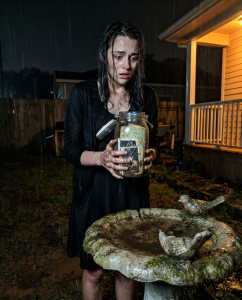
Amy stood under the weak yellow porch light and watched rainwater collect in the cracked basin. Maybe she was hoping the sight would comfort her, make the thing feel connected to him in some simple way. Instead it looked sad and out of place.
She was about to go inside when she noticed movement in the water.
Tiny bubbles rose from the crack near the base.
She stepped closer.
More bubbles surfaced. Not many. Just enough to stop her cold.
Amy crouched, rain soaking the knees of her jeans, and ran her fingers over the fracture. The stone around the pedestal was colder than the bowl. She knocked on the side with her knuckles and frowned. The sound was wrong. Hollow.
Her grandfather had repaired almost everything he owned at least once, but he never made a repair without reason. Amy fetched a flashlight from the kitchen, then a screwdriver and a hammer. By then the rain had strengthened, sliding down the back of her shirt and dripping from her chin.
She knelt in the mud and aimed the beam under the pedestal. There it was: an old seam, disguised with mortar that didn’t quite match the original stone. The kind of difference only someone patient—or someone taught by him—would bother noticing.
Her pulse started to race.
She chipped at the seam carefully, then less carefully when a piece came loose. Rain softened the old filler. Bit by bit, the bottom opening widened. Mud streaked her hands. Her hammer slipped twice. Her breath turned shallow.
Then she reached inside and touched glass.
For a second she froze.
When she pulled her arm back out, she was holding a large canning jar wrapped in wax paper gone yellow with age. Water ran over the lid. Something dark moved inside beneath the cloudy glass.
Amy sat down hard in the wet grass.
Her fingers trembled so badly she struggled to unscrew the cap. When it finally gave, the smell of old paper and dry dust rose out of the jar. Inside were photographs tied with faded ribbon, a folded survey map, and a letter with her name written on the front in the unmistakable hand she had seen on seed packets, hardware drawers, and birthday cards since childhood.
Amy.
No one had written her name like that in months. Maybe years.
She opened the letter first.
“Amy, they will take the house because it has walls. I left you the land because it has roots.”
Rain hammered the fence. Somewhere down the block a dog barked. But Amy heard none of it after that first line.
She kept reading.
Her grandfather wrote the way he spoke: plainly, with no wasted words. He said he knew the others would fight over what looked valuable. They would want the house because houses could be sold, bragged about, renovated, borrowed against. They would want anything with a dollar sign hanging visibly from it. But the land was the soul of the property, and he would not trust that to people who saw only surface.
He wrote that Amy had loved the place before she was old enough to know what ownership meant. She cared whether the peach trees fruited, whether the soil dried too quickly in July, whether the old climbing rose made it through winter. She understood the difference between possessing something and tending it.
Years earlier, he had quietly divided the property.
Amy read that line three times.
Then she tore open the folded survey map with frantic fingers and spread it across her lap under the porch light. Heavy black lines outlined parcel boundaries. The house sat on one deeded section. But the orchard, vegetable garden, side field, and the gravel access road that connected the house to the county lane belonged to another parcel.
A parcel transferred into Amy’s name.
The date on the paperwork was years old.
He had done it long ago. Deliberately. Quietly. Legally.
Amy felt dizzy.
She went through the photographs next. One showed her grandfather much younger, standing beside a fresh-planted peach tree with dirt on his jeans and joy on his face. Another showed Amy at maybe eight years old, arms wrapped around a ridiculous cucumber as if it were a trophy. Another showed the long gravel drive from the road entrance, wildflowers on both sides, the house small and distant beyond a curve of trees.
On the back of that photo, her grandfather had written four words:
The way in matters.
Amy stared at them until the meaning settled into her bones.
By morning, she had barely slept. She called the county records office at opening and asked for confirmation, trying to keep her voice steady. The clerk put her on hold long enough for panic to rise in her throat. When he came back, his answer was calm, almost bored.
“Yes, ma’am. The parcel transfer is on file.”
Amy called a lawyer next. Then she called the records office again, because facts this large demanded repetition.
Everything checked out.
The orchard was hers.
The garden was hers.
The side acreage was hers.
And most importantly, the only practical road access to the house crossed her property.
Her phone rang at 10:17 a.m.
Matthew.
Amy looked at the screen for a moment, then answered.
“There seems to be some confusion,” he said, trying for casual and failing. “About the deed.”
Amy leaned against her kitchen counter and looked at the papers spread across it. “Is there?”
“The realtor came by to do a preliminary walk-through. He says the driveway isn’t included with the house parcel.”
“It isn’t.”
Silence.
Then, “Amy, that doesn’t make any sense.”
“It made sense to Grandpa.”
Matthew exhaled sharply. “Come on. You know what I mean.”
Amy didn’t answer. She was suddenly remembering the way he had stood at the wake with the keys in his hand, already owner in his mind.
His next words came softer. “We need to sort this out.”
We.
It was a small word, but it carried an entire history of family politics. We, when he wanted cooperation. We, when something had gone wrong for him. Not we when she loaded the birdbath alone.
Amy picked up the second folded paper she had barely noticed in the jar the night before. It wasn’t a letter. It was a set of terms attached to the parcel arrangements. Witnessed. Signed. Dated.
There was an easement for access—but only under conditions her grandfather had specified if the house went to anyone except Amy.
No tree removal.
No destruction of the garden.
No transfer of access rights separate from the house.
And one line, underlined twice:
Any crossing of the land requires the written consent of Amy Bennett.
Amy felt the air in the kitchen change.
“Matthew,” she said, “did you already plan to sell it?”
He hesitated a fraction too long.
That was all the answer she needed.
“I didn’t say that.”
“No. You just had a realtor there the morning after the wake.”
“Amy, be reasonable. It’s a big property. None of us can maintain it.”
A voice murmured near his phone. Another person was with him.
Then she heard one word clearly, hushed but unmistakable: developer.
Amy went still.
All at once, her grandfather’s letter sharpened into warning.
They weren’t mourning the place. They were measuring it.
Matthew lowered his voice. “There’s interest in the property. That’s all. We’re just discussing options.”
Options.
Cut down the orchard. Rip out the garden beds. Flatten the old workshop. Pave where peach roots had been deepening for decades. Turn the gravel drive lined with Queen Anne’s lace into a wide entrance for trucks and contractors and strangers with measuring tapes.
Amy could hardly speak around the pressure in her chest. “You were going to sell the house and let them tear up the land.”
“No one said tear up.”
“You didn’t have to.”
He tried a new tone then—gentle, persuasive, practiced. “Amy, listen to me. This could help everybody. Grandpa’s gone. We have to be practical.”
Practical.
That word hit her almost as hard as grief.
Because her grandfather had been practical. He patched doors instead of replacing them. Saved coffee cans full of screws sorted by size. Rotated crops because soil got tired. He believed in work, not waste. But he never once used practical to mean heartless.
Amy looked out the window at the birdbath. Rainwater still gleamed in its bowl. A sparrow landed on the rim and dipped its head to drink, fearless and quick.
Birds always know where water hides.
She almost smiled.
“I’ll think about it,” she said.
Matthew seemed relieved too quickly. “Good. Because we should all sit down and—”
“I said I’d think about it.”
Then she hung up.
By afternoon, three relatives had called her. Aunt Rita was “concerned about misunderstandings.” Denise wanted to know whether the parcel line was “really worth making a family issue over.” Ryan tried charm first, then annoyance, then a clumsy suggestion that maybe Grandpa had been manipulated in old age.
Amy answered less and listened more.
They had all assumed the same thing: that she would be too emotional to challenge them, too polite to resist, too hurt to fight.
They had mistaken quiet for weakness.
That evening Amy drove out to the property and parked at the county lane where the gravel road began. She didn’t go in. She just stood at the entrance and looked down the drive, at the way it curved through trees before revealing the house. Golden light caught in the orchard beyond. The place looked exactly the same as it had when she was ten, as if time had paused out of respect.
Then she imagined it with orange survey flags. With heavy equipment. With strangers discussing square footage and resale values.
The grief she had been carrying shifted shape.
It became resolve.
She called the lawyer the next morning and asked what enforcement looked like. Fencing. Signage. Access agreements. Preservation restrictions. Her grandfather, it turned out, had done more than divide land. He had created barriers that would make development slow, expensive, and legally painful without her consent.
He had known.
He had seen his family clearly enough to predict them.
The next family meeting happened two days later around her aunt’s dining table. Matthew arrived confident, carrying folders. Denise came with a brittle smile. Ryan looked irritated before anyone spoke. Amy brought copies of the survey, deed transfer, easement conditions, and her grandfather’s letter.
When Matthew started talking about fairness, Amy slid the documents across the table.
When Denise talked about family unity, Amy asked whether unity included trying to sell the orchard before the funeral flowers had wilted.
When Ryan accused her of holding the house hostage, Amy calmly replied, “No. Grandpa arranged it so the land protecting the house belongs to the person who would actually protect it.”
That shut him up.
Finally, Aunt Rita read the letter in silence, tears gathering in her eyes. When she reached the line about walls and roots, she looked at Amy differently—as if seeing, perhaps for the first time, not the granddaughter who quietly accepted scraps, but the one their father had trusted most.
Matthew’s composure cracked last.
“What do you want?” he asked.
The question hung there, heavy and ugly.
Not What did he want?
Not What’s right?
What do you want?
Amy thought of the garden rows after rain. Of her grandfather’s hands pressing seeds into her palm. Of the photograph with The way in matters on the back. Of the cracked birdbath that had looked like an insult until it became a key.
“I want the orchard protected,” she said. “I want the garden untouched. I want no sale to any developer. And I want the access agreement to reflect exactly what Grandpa intended.”
Matthew stared at her. “That’s impossible.”
“No,” Amy said. “It’s just inconvenient.”
For a long time, nobody spoke.
In the end, practicality finally arrived in the room wearing its true face. The house without secure access was harder to sell, harder to insure, harder to market. The legal restrictions were real. The only path forward was negotiation with the one person they had dismissed.
So they negotiated.
The final arrangement took weeks. Amy did not get the house back outright, though part of her had once wanted that more than anything. Instead, she got what mattered more to the man who had made the choice. The orchard and garden were placed under strong preservation terms. The access road remained under her control. A limited-use agreement was drafted that protected the land. Future development plans died on paper before they could reach the field.
Months later, Matthew sold the house to a retired couple who wanted quiet, not profit. People who loved old places. People who asked about the peach trees before asking about the square footage.
Amy kept the land.
She spent that first spring restoring the garden beds, replacing broken stakes, pruning the orchard, and planting tomatoes in the same rows her grandfather had favored for years. On warm evenings, she sat by the cracked birdbath she had moved out beneath the lilacs and watched robins splash in the shallow water.
Sometimes grief still came hard and sudden. In the smell of cut grass. In the sound of a screen door. In a glass of lemonade that was just a little too sour.
But alongside the grief was something steadier.
Recognition.
Her grandfather had seen her clearly when others had not. He had understood that real inheritance was not always the thing with the highest price or the biggest footprint. Sometimes it was responsibility. Trust. Access. Soil. Roots. The living part beneath the visible one.
Family members still argued, quietly now, about whether he had been fair. Some thought Amy had been favored. Others thought the rest had been taught a lesson. Maybe both were true.
But on certain mornings, when the light came through the orchard just right and birds gathered around the old cracked basin to drink, Amy thought the biggest red flag had never been the will.
It was how quickly some people revealed what they loved most once grief put a price tag on everything.
And how one old man, who said very little and noticed everything, made sure the person who understood the land would be the only one holding the way in.