
They told her she wasn’t really family.
She let them believe it.
For eleven years, Sylvia Crane stayed away from the Millbrook Peach Festival. Stayed away from the folding tables draped in red-checked plastic, from the mason jars of sweet tea, from the sound of Dolores Crane’s voice carrying across a Georgia lawn like it owned everything it touched.
Because it did.
Dolores owned the orchard. She owned the festival. She owned the story of who belonged and who didn’t.
And once upon a time, on a sticky Fourth of July afternoon, she’d handed Sylvia a paper plate — not a real dish, a paper plate — and turned to the crowd of aunts and cousins and neighbors and said, loud enough for God and everyone to hear, “She’s not really family, but she’s welcome to eat.”
Sylvia had smiled.
She’d eaten her peach cobbler.
And she’d driven home and cried the whole two hours to Atlanta.
That was then.
—
She pulled up to Millbrook Orchards on a Tuesday morning, three days before the festival, in a car Dolores would not recognize and clothes Dolores would not expect.
No sundress. No casserole dish in the backseat. No apology in her posture.
Just Sylvia. Fifty-three years old. Shoulders back.
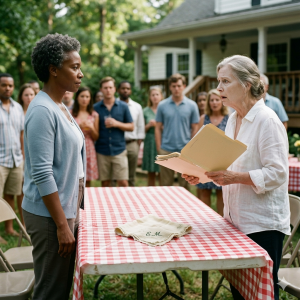
And in the pocket of her pale blue cardigan, folded into a soft square the way it had been for months now, a worn cotton handkerchief. Cream-colored. Old. Hand-embroidered in the corner with three initials in dark green thread — E.A.C. — that didn’t match a single living Crane she’d ever met.
She’d found it tucked inside a folder of documents she never expected to receive.
She hadn’t told anyone about it yet.
Every time she thought about showing it to someone, she’d feel it in her pocket, run her thumb across the raised stitching, and tuck it back down.
Not yet.
—
The festival set-up crew didn’t know her.
That was fine. She introduced herself simply — “Sylvia, I have a meeting with your events coordinator” — and they pointed her toward the old barn office like she was just another vendor.
She was not just another vendor.
The meeting lasted forty minutes. The property manager, a young man named Terrell who’d only been with the orchard two seasons, kept glancing at the paperwork in front of him like he was waiting for something to make sense.
“So you’re saying you’ve held this position in the trust since—”
“Since the restructuring in 2019,” Sylvia said. “Quietly.”
“And Mrs. Crane senior doesn’t—”
“Know?” Sylvia folded her hands on the table. “She will. I’d like to tell her myself. At the festival.”
Terrell blinked.
“Ma’am,” he said slowly, “are you sure that’s the way you want to—”
She touched her cardigan pocket.
“I’m sure,” she said.
—
Word travels fast in a small Georgia town.
By Thursday morning, Sylvia could feel the looks. The whispers at the peach stand. The way Dolores’s daughter-in-law, Rena, went stiff when she spotted Sylvia near the entrance arbor and then pulled out her phone and started typing fast.
Sylvia bought a lemonade. She watched the orchard rows stretch gold and green in the July heat. She thought about the first time she’d ever stood here, twenty-six years old and so desperate to belong she’d brought a homemade pound cake and memorized everyone’s names before she arrived.
She touched the handkerchief.
E.A.C.
She still didn’t know what those initials meant, not for certain. But she had a feeling that when Dolores Crane saw them, she would.
—
Dolores arrived at noon on the Fourth, same as always.
White linen blouse. Hair set. Waving like a politician.
She didn’t see Sylvia until she was already at the main table, surrounded by family, reaching for a glass of tea.
Their eyes met.
Dolores went very still.
Sylvia walked over slowly. She didn’t rush it. She’d waited eleven years.
“Hello, Dolores.”
The older woman’s chin lifted. “Sylvia.” Her voice was a locked door. “I wasn’t told you were coming.”
“I imagine not.”
Terrell appeared at Sylvia’s elbow, quietly, with a folder.
The crowd around the table had gone church-quiet.
Dolores looked at the folder. Then at Sylvia. Something moved behind her eyes — not quite fear, not yet. Just the first shadow of a thing she didn’t understand.
She took the folder.
She opened it.
She reached up and slid her reading glasses from her hair down to her nose, the way she always did, the gesture so familiar Sylvia had seen it a thousand times at a thousand Sunday dinners she was never quite invited to.
The orchard hummed around them. Somewhere a child laughed. Somewhere a jar of sweet tea sweated in the heat.
Dolores read.
And read.
And the color drained from her face — slow, then all at once — like cream clouds pulling back from the sun.
Because the name on the founding trust wasn’t a stranger’s.
And it wasn’t Sylvia’s.
And when Dolores finally looked up, her hands were trembling, and her eyes had gone somewhere far away, and the handkerchief in Sylvia’s pocket felt like it was burning right through the cotton.
—
The name on the trust was Elma Adelle Crane.
Dolores said it out loud without meaning to, barely a whisper, just the name dropping from her lips the way something falls when your hands stop working.
“Mama.”
Sylvia reached into her pocket.
She set the handkerchief on the table between them, smoothed flat, the embroidered initials facing up. E.A.C. Dark green thread, a little faded, still neat. The kind of needlework a woman does slowly, in good light, when she has time and intention and something she wants to last.
Dolores stared at it. She didn’t touch it.
“Where did you get that,” she said. Not a question. The kind of sentence that already knows the answer is going to change everything.
“From a lawyer in Macon,” Sylvia said. “A man named Gerald Fitch. He reached out to me two years ago. He’d been holding a sealed estate file since 1987, with instructions to contact me — specifically me — when certain conditions were met.” She paused. “Your mother left it for me, Dolores. She’d been looking for me for a long time before she died.”
The crowd around them hadn’t moved. Rena had her hand pressed flat against her sternum like she was trying to hold her heart in place. Dolores’s son Marcus was standing very still with a cup of lemonade he’d forgotten to drink.
Dolores finally reached out and touched the edge of the handkerchief with two fingers.
“She made this,” she said. “I remember her making this. I was maybe eight years old. She sat in the front room and she wouldn’t tell me who it was for.” Her voice had lost its architecture. It was just sound now. “I asked her and she said, ‘Someone who’s going to need to know she belongs somewhere.'”
Sylvia had to breathe through that one.
She’d read Gerald Fitch’s letter so many times she’d memorized it, but hearing it land in the real world, in the July heat, in Dolores’s voice — that was different.
“Elma Crane was my grandmother,” Sylvia said. “My mother was her daughter. A daughter she had before she married your father. Before the orchard, before Millbrook, before all of this.” She gestured at the rows of peach trees, the bunting, the folding tables. “My mother was given up when she was three days old. She never knew. I never knew. Not until Gerald Fitch called me.”
The silence had weight now.
A little girl in a yellow dress wandered close to the table, chasing a paper napkin the wind had caught, and one of the adults quietly stepped over and steered her elsewhere.
Dolores took her glasses off. Pressed her thumb and finger against the bridge of her nose. When she looked up again her eyes were wet, and it was the first time in Sylvia’s life — the first time, across twenty-seven years of knowing this woman — that she had ever seen her look small.
“She looked for your mother?” Dolores asked.
“For thirty years,” Sylvia said. “She found out the name of the family who adopted her, but by then my mother had passed. Cancer. 1983. Your mother — our grandmother — spent the last four years of her life trying to find if there were any children. She found a record that said there might be. She left everything she could with Gerald Fitch and told him to keep looking.” Sylvia’s voice held. She’d practiced this. She’d rehearsed it in her car on the highway and in her bathroom mirror and in the parking lot of Gerald Fitch’s office. She’d thought she knew how it would go. “He found me in 2022. I had taken my ex-husband’s name for twenty years and then gone back to my birth name. That’s why it took so long.”
“Crane,” Marcus said quietly from behind his mother. “Your birth name is Crane.”
“It is,” Sylvia said. “It always was.”
—
What happened next didn’t look like a movie.
There was no sweeping music. Dolores didn’t throw her arms open. Sylvia hadn’t come here for that and wouldn’t have trusted it if it happened.
What happened was Dolores sat down in one of the folding chairs, heavily, like a woman who has been standing for a very long time. She picked up the handkerchief and held it in both hands and looked at it for a long while.
Rena went somewhere and came back with a glass of water and set it by Dolores’s elbow without saying anything.
Marcus pulled two chairs together and sat in one and looked at Sylvia and said, “Do you want to sit down?”
She did.
So she sat.
For a while nobody said much. The festival went on around them at a respectful distance, the way life does — children running, music from a speaker somewhere, the smell of peach cobbler already starting from the big tent kitchen where the church ladies ran their operation every year like a military exercise.
Then Dolores said, “I was awful to you.”
Sylvia didn’t argue that.
“I was awful to you,” Dolores said again, like she needed to say it twice to make it real, “and I told myself it was because Bobby married you too fast and we didn’t know you and you were an outsider. But the truth was I just didn’t want to share.” She smoothed the handkerchief on her knee. “This orchard. This family. This story of who we are. I didn’t want anybody new in it.” She paused. “That’s a shameful thing to say out loud.”
“It is,” Sylvia said. “I appreciate you saying it anyway.”
Dolores looked up at her.
“Bobby loved you,” she said. “He used to call me after you’d go home from a visit and say, Mama, I don’t know why you’re so hard on her. And I’d say she’ll be fine, she’s tough. Like that was a compliment.” She shook her head. “I knew you were tough because I’d made you tough. I knew it and I kept going.”
“You did,” Sylvia said.
“And now you’ve come back here with papers that say you own a seat in the trust my father built—”
“That your mother’s inheritance helped build,” Sylvia said, gently but precisely. “Elma’s family money was the original purchase. It’s in the 1951 deed. Gerald Fitch’s letter explains all of it. I don’t want the orchard, Dolores. I’m not here to take anything.” She looked at the rows of trees. “I just wanted to stand here and not be on a paper plate.”
It was a terrible and perfect thing to say and she hadn’t planned it.
Dolores flinched like she’d been struck.
Then she laughed — a short, broken sound, halfway to crying — and put her face in her hand for a moment.
Marcus reached over and put his hand on his mother’s back.
Sylvia watched Dolores Crane, eighty-one years old, keeper of the family story, woman who had handed her a paper plate in front of God and all her people — watched her sit with what she’d done and not try to explain it away.
That was more than Sylvia had expected.
That was, if she was honest, more than she’d come here hoping for.
—
Later — after the formal part, after Terrell had collected his folder, after a few of the cousins had drifted close and introduced themselves with the careful politeness of people trying to recalibrate everything they thought they knew — Dolores asked if Sylvia would walk with her.
Just the two of them. Down the first row of peach trees, away from the noise.
The trees were heavy and drowsy in the heat. The fruit was just starting to blush. Another week and they’d be perfect.
Elma Crane had planted the first twelve of these trees herself, according to the deed records. Sylvia had read that three times in Gerald Fitch’s file and thought about it ever since.
“She would have liked you,” Dolores said, after a while.
“You think so?”
“You reminded me of her,” Dolores said slowly, like the thought was arriving for the first time and she was watching it come. “When you used to come around. The way you carried yourself. The way you didn’t ask for things but you noticed everything.” She was quiet a moment. “I think that’s part of why I was unkind. You reminded me of somebody and I didn’t know who, and it unsettled me.”
Sylvia turned that over.
“Did you ever wonder,” she said, “why she embroidered that handkerchief but never told anyone who it was for?”
Dolores was quiet.
“I’ve wondered about a lot of things she didn’t tell us,” she said finally. “She was a private woman. She carried things.” A pause. “I think she was ashamed. About the baby — about your mother. Not because of your mother, but because of how young she was and how little say she had in any of it and how she never got to explain herself to anyone.” She touched a branch as they passed it. “In those days you just swallowed things whole. You didn’t talk about them. You just — carried them until they became part of your weight and you forgot they were ever separate.”
Sylvia thought about her own mother, who had died at forty-one not knowing who she really came from. Who had been kind and funny and made good biscuits and never once, in Sylvia’s memory, talked about missing something she didn’t know was missing.
But sometimes she’d go quiet in a particular way. A looking-out-the-window way. And young Sylvia would ask what she was thinking and she’d say, oh, nothing, baby. Just listening.
Sylvia had carried that memory for forty years without knowing what to do with it.
She thought maybe she knew now.
She stopped walking. Dolores stopped beside her.
“I’m not looking for a mother,” Sylvia said. “I’m not looking for sisters or cousins or a seat at a holiday table. I’m grown. I have my own life.” She looked out over the orchard. “But I would like to know where I come from. I would like to stand here and not be an outsider. And I would like—” Her voice faltered for just a moment, one moment, and she let it. “I would like someone who remembers Elma to tell me about her. What she was like. What she cared about. What she planted and why.”
Dolores was still for a long beat.
Then she reached over and took Sylvia’s hand.
Not a hug. Not a performance. Just a hand, cool and papery and tentative, the hand of an old woman who had been wrong for a very long time and knew it and was trying to find the first small step back toward something better.
“She sang when she worked,” Dolores said. “Old hymns, mostly, but she’d get a pop song in her head sometimes and she couldn’t get rid of it and she’d just sing it out loud regardless of where she was. She was embarrassing that way.” There was a watery fondness in her voice. “She grew tomatoes alongside the peaches even though my father said it looked cluttered. She said tomatoes were honest. She trusted things that were honest.” A pause. “She made that cobbler you ate. Back in the beginning. It was her recipe. We’ve used it every year since she passed.”
Sylvia stood very still.
“The cobbler,” she said.
“Her recipe. Wrote it on a notecard and pinned it to the kitchen wall and it’s still there. Thirty-some years.” Dolores glanced at her sideways.