
The look on Diane Whitfield’s face when she saw me walk through those doors?
I’ve been waiting twenty-two years for that look.
—
Let me back up.
My name is Marvella Pruitt. I grew up in a double-wide off Route 441 in Sevier County, Tennessee, with a mama who worked double shifts and a last name that didn’t open any doors in this part of the mountains. I married into the Whitfield family at twenty-six — young, hopeful, and completely unprepared for what that family actually was.
Diane wasn’t my husband’s wife. She was his sister.
And she was the one who ran things.
She had opinions about where I sat at Sunday dinner. Opinions about how I talked, what I wore, whether my potato salad was “appropriate for company.” She had opinions about my whole entire existence, and she wasn’t shy about sharing them.
When my marriage fell apart — and it fell apart for reasons that had nothing to do with me — Diane was the one who showed up at my door.
Not to check on me.
Not to offer help.
She handed me a Greyhound bus ticket to Nashville and told me, clear as a bell on a cold morning, to go back to nothing. Because that’s all you ever were.
I took the ticket.
But I didn’t go to Nashville.
—
I want you to notice something in every photo from today’s grand opening of The Ridgeline Inn — Pigeon Forge’s newest boutique hotel, the one that’s been written up in Southern Living and featured on three different travel blogs this week.
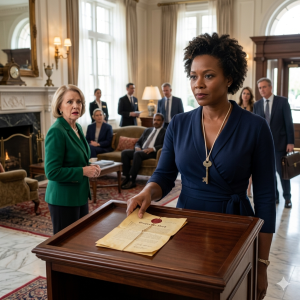
Look at the woman in the navy wrap dress standing near the back of the crowd.
Look at what’s around her neck.
It’s a small brass skeleton key on a plain cotton cord. Old-looking. Worn smooth in a few places, like it’s been held many times. Nothing fancy about it at all — just a little key hanging there against her collarbone like it’s always belonged there.
That key matters. Keep it in mind.
—
Diane Whitfield built The Ridgeline Inn from the ground up over the last four years. Everybody in Sevier County knows about it. Boutique rooms, a rooftop terrace, original stonework, a restaurant sourcing local ingredients. It was her dream project, her grand statement, her proof that the Whitfield name still meant something in these mountains.
The architect she hired — a man named Calloway out of Knoxville — gave an interview to the local paper last month. He talked about the original master key they’d had cast for the property, a custom brass skeleton key based on an antique design. One of a kind, he said. Irreplaceable.
He even had it engraved with the inn’s coordinates on the back.
Now.
I’m not going to tell you yet how I ended up with one just like it.
What I will tell you is that I’ve been carrying mine for eleven years. Long before Diane broke ground. Long before she hired Calloway. Long before any of this.
And when I walked into that grand opening today — dressed right, head up, invitation in hand — I felt that little key against my chest with every step across that beautiful lobby floor.
—
Diane was in her element.
Champagne flutes, white roses, local officials, a ribbon she’d had monogrammed. She was holding court near the fireplace like she’d been born to it, laughing that big practiced laugh she has, touching people’s arms, being gracious in the way that people are gracious when they want you to see them being gracious.
She didn’t notice me right away.
That was fine.
I found my seat near the small stage they’d set up for the mayor’s remarks. I set my bag down carefully. And I waited.
She noticed me about ten minutes in.
I watched the laugh stop.
I watched her say something quiet to the woman standing next to her, never taking her eyes off me.
I just smiled and lifted my glass.
—
The mayor was halfway through his remarks — a fine addition to our tourism corridor, a testament to entrepreneurial spirit — when I walked up to the podium.
I hadn’t been invited to speak.
But I had been invited to be there, and nobody stopped me, because I walked like someone who had every right in the world to be exactly where I was.
I set the document down on the podium.
Not a copy.
Not a lease.
The original deed.
The room got quiet in that particular way rooms do when something has shifted and nobody’s sure yet what it means.
Diane’s smile — that careful, practiced, twenty-two-years-in-the-making smile — finally cracked.
And the mayor leaned into his microphone, looking back and forth between us, and said —
“So you two already know each other?”
—
I said, “We do. Diane, why don’t you tell them?”
She didn’t say a word.
So I did.
—
Here is what most people in that room didn’t know about the land The Ridgeline Inn sits on.
They didn’t know it had belonged to a man named Curtis Roy Pruitt — my grandfather’s brother — who had no children and no wife and spent the last thirty years of his life in a two-room cabin on that exact ridge, raising goats and growing tomatoes and staying mostly to himself. They didn’t know that when Curtis Roy died in 2003, he left that land to me specifically, by name, in a handwritten will that his neighbor Margaret Shupe witnessed and a notary in Gatlinburg stamped.
They didn’t know any of that because they never had any reason to.
But Diane did.
Diane knew because my ex-husband Gary told her. He told her the week before he and I separated — told her about the land, told her it was in my name, told her I probably didn’t understand what I had.
And Diane — efficient, resourceful, clear-eyed Diane — decided to find out whether that was true.
She drove up to that ridge a month after she put me on that Greyhound bus. She walked the property. She stood where the rooftop terrace stands right now and looked out over those mountains and started making plans.
What she did next took me eleven years to fully understand and another six to properly address.
—
She found an attorney in Maryville who specialized in what I would come to learn was a particular kind of land fraud — the kind that preys on people who are grieving, or overwhelmed, or recently displaced, or simply don’t know that they need to read everything before they sign anything.
She sent me a certified letter in Nashville — I had gone to Nashville eventually, just not on her timeline — informing me that Curtis Roy’s estate had outstanding tax liens and that the property would be seized by the county unless I signed a quit-claim deed releasing my interest. She enclosed the quit-claim deed. She enclosed a pre-addressed envelope.
She signed the letter with the name of a county office that does not exist.
I was twenty-eight years old. I had forty dollars in a checking account and a job at a print shop on Charlotte Avenue. I did not know what a quit-claim deed was. I did not know to call the actual county assessor’s office and ask whether any of what she’d written was true.
I signed it.
I put it in the envelope.
I mailed it back.
—
The key.
I need to tell you about the key now.
Curtis Roy had a box. One of those old metal strongboxes with a clasp lid, the kind you find at estate sales, painted black and gone rusty at the corners. He kept it under his bed. When Margaret Shupe helped settle his affairs after he passed, she found the box and she found a key taped to the inside of the lid with a strip of electrical tape — a small brass skeleton key — and a note in Curtis Roy’s handwriting that said simply: for Marvella, when she needs it.
Margaret didn’t know what the key opened. She didn’t know who Marvella was, exactly, just that she’d heard Curtis Roy mention a niece of sorts, a young woman who’d married one of the Whitfield boys. She kept the box in her hall closet for two years before she tracked me down through a cousin of my mother’s.
She drove to Nashville and handed it to me herself. Told me Curtis Roy had always liked me. Said he used to say I had good bones, which apparently he meant as a high compliment.
I opened the box.
Inside was the deed to the land. The original deed, in Curtis Roy’s name, with a handwritten transfer notation at the bottom — signed, witnessed, dated — conveying the property to me upon his death.
And a second piece of paper. A letter Curtis Roy had written sometime in the last year of his life. It said that he knew the Whitfields had been circling that land for years, that Gary Whitfield had asked him twice to sell and twice he’d said no, and that he wanted me to have it because out of everyone he’d watched come through that family, I was the only one who ever sat with him on the porch without wanting something.
That key had been the key to the strongbox.
That was all.
But I kept it on a cord around my neck because it was mine and Curtis Roy had said when she needs it and I figured I’d know when that was.
—
Eleven years after Margaret Shupe handed me that box, I found an attorney of my own.
Her name is Renata Cross and she practices out of Chattanooga and she is, without exaggeration, the sharpest person I have ever met in my life. I found her through a legal aid clinic I’d been volunteering with after I got my paralegal certification — which I earned at night while working days at a property management company in Nashville, which is where I learned exactly what quit-claim deeds are and exactly what it means when someone uses one to take something from you.
Renata looked at what I had. The original deed. Curtis Roy’s letter. The fraudulent quit-claim. The fake county letterhead. Records she pulled showing the timeline of when Diane acquired the land, when she began quietly assembling adjacent parcels, when she incorporated the LLC that eventually built The Ridgeline Inn.
She looked at all of it and she said, “Marvella, this is going to take a while. But I think you know that.”
I said I did.
I said I’d been waiting this long. I could wait some more.
—
It took six more years.
There were depositions and continuances and a countersuit that Diane filed accusing me of harassment, which was dismissed. There were days I sat in Renata’s conference room feeling hollowed out and days I sat there feeling like iron. There were moments I thought about settling and moments Renata talked me back off that ledge and moments I talked myself back off it.
My mama, before she passed in 2019, asked me once if it was worth it. Not in a defeated way. In a genuine way, the way she asked things.
I told her yes.
She said she believed me.
—
Three months ago, a judge in Sevier County ruled that the quit-claim deed Diane had obtained was the product of fraudulent misrepresentation and was therefore void. The land reverted to my ownership. Every improvement on it — the stonework, the rooftop terrace, the restaurant kitchen with its local sourcing and its pretty little menu — became part of a damages calculation that I will not share in full but that settled the question of whether Marvella Pruitt had anything to go back to.
Diane’s attorneys filed an emergency appeal.
It was denied last Tuesday.
Her grand opening was scheduled for this Saturday.
My invitation came from the mayor’s office, which had been in contact with Renata about the transition of ownership. They thought it would be appropriate for me to be present for the remarks. They thought — and I agreed — that it was better to do this clearly, in public, without drama if possible.
Diane had not been told I would be there.
—
So.
Back to the room.
Back to the mayor and his microphone and his question — so you two already know each other — hanging in the air over all those champagne flutes and white roses.
I said, “We do. Diane, why don’t you tell them?”
And when she didn’t, I handed the deed to the mayor. I didn’t need to say much after that. Renata had prepared a brief statement that I read in about ninety seconds — the ruling, the settlement, the transition of ownership effective the first of next month, the fact that the inn would remain open and the staff would remain employed under new management.
That last part mattered to me. None of those employees had done a single thing wrong.
Diane stood very still for all of it.
I had imagined this moment many times over many years, and I want to be honest with you: it didn’t feel the way revenge is supposed to feel in movies. There was no swelling music. There was no moment of collapse on her part, no tearful admission, no satisfying public unraveling. She stood there and she went very pale and she looked at me with something I can only describe as the specific shock of someone who genuinely believed they had finished you.
She had believed that.
For twenty-two years she had believed that she had handed me a bus ticket and closed a chapter.
And that look — that moment of reckoning with how wrong she had been — was the thing I had been waiting for.
Not the deed. Not the damages.
Just for her to know that I was still here. That I had become something. That nothing she had done had finished me.
—
After the mayor wrapped up — God bless him, he kept his composure and said something gracious about transitions in ownership being a natural part of the business landscape, which I thought was admirably diplomatic — a few people came up to me. Local officials. A woman from the Southern Living piece who turned out to be lovely. Two of the waitstaff who had overheard enough to understand something of what had happened, who shook my hand with a kind of quiet solemnity that I will remember for a long time.
Diane left without speaking to me.
I didn’t need her to.
—
I’m staying in Room 7 tonight. It has a window that looks out over the ridge, over the same mountains Curtis Roy used to sit and watch from his porch. The stonework on the exterior is genuinely beautiful. Calloway did good work. I intend to keep him on.
The key is on the nightstand next to me as I write this.
It never opened anything except that strongbox. It was never magic. It was just a small brass key that an old man with good taste in people taped inside a lid and left for someone he trusted.
But I held it through every deposition. I held it in the hallway outside the courtroom on the day of the ruling. I held it this afternoon while I waited for Diane to notice me across that lobby.
And I held it tonight when I stood at that window and looked out at these mountains that are mine now — that were always mine, that no bus ticket and no forged signature and no amount of Whitfield certainty could ever have truly taken from me.
Curtis Roy knew what he was doing when he left me that land.
He knew what he was doing when he left me that key.
He just knew I’d need a while to understand it.
—
For those asking: yes, I will be sharing more about the inn’s reopening in the coming weeks. The restaurant is keeping its menu and its chef. Room bookings already made through the end of the year will be honored, no changes, no interruptions.
The Ridgeline Inn isn’t going anywhere.
Neither am I.