
She walked back into the Pelican Club wearing the same pearls they’d laughed at twenty-two years ago.
Not diamonds. Not the heavy gold her ex-husband’s family considered the minimum standard for a Mouton woman. Just a single strand of small, creamy pearls that caught the candlelight and did nothing particularly dramatic about it.
That was the point.
—
Claudette had driven the forty minutes from New Orleans to Baton Rouge alone, the way she’d done most important things in her life since the divorce. No date, no entourage, no armor except a navy wrap dress from a boutique in the Garden District and those pearls resting quiet against her collarbone.
She’d been invited by accident — or close enough to one. Gerald Jr. had emailed her a few weeks back, sheepish and rambling, saying his parents’ fiftieth anniversary party had a “family and close friends” list, and that she’d been on it longer than she’d been off it, if she understood what he meant.
She understood.
She also understood that Patricia Mouton had not signed off on that email.
—
The supper club looked exactly the same. Dark wood paneling, brass sconces, white tablecloths ironed to a crease you could cut yourself on. The kind of place that hadn’t changed a single curtain rod since 1987 and was proud of it.
Claudette stood in the doorway for just a moment.
Twenty-two years ago, she had stood in a different doorway of this same room while her rehearsal dinner conversation stopped and Patricia Mouton set down her fork, dabbed her mouth with a linen napkin, and said — in a voice that carried all the way to the bread station — that she hoped everyone would be patient with Claudette, because the girl was *trying*, but some people were simply too common to carry the Mouton name with any real dignity.
The table had gone quiet.
Claudette had smiled.
Then she had carried that silence home and built an entire life inside it.
—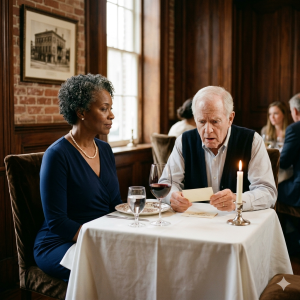
She found her seat near the end of the long family table. Several cousins she hadn’t seen in years looked up, surprised, then politely warm in the way that Southern people manage when they’re calculating fast.
A woman named Bette — married to one of the Mouton cousins — leaned over almost immediately.
“Those are sweet pearls, Claudette. Are they vintage?”
The word *vintage* doing a lot of careful work there.
“Something like that,” Claudette said.
Bette smiled and looked away.
But the woman across the table — a sharp-eyed friend of Patricia’s named Lorraine who’d come in from Shreveport — didn’t look away. She looked *closer*. Her gaze dropped to the clasp at the back of Claudette’s neck when Claudette turned to greet someone, and something happened in Lorraine’s expression.
She went very still.
She picked up her water glass, set it back down without drinking, and spent the next ten minutes stealing glances at Claudette’s neckline like she was trying to solve a math problem she hadn’t been asked.
—
Claudette let her look.
She had learned patience the hard way. When your ex-mother-in-law announces your unworthiness at your own rehearsal dinner and the man you’re about to marry laughs it off as “just Mama being Mama,” you either fall apart or you get very, very patient.
Claudette had chosen patient.
Patient through the divorce. Patient through the years of building her consulting firm from a spare bedroom in a Metairie rental. Patient through every room where someone underestimated the quiet woman with the sensible jewelry and the measured voice.
Patient enough to wait twenty-two years for a moment like this one.
—
The toast came near the end of dinner. Gerald Sr. stood at the head of the table — older now, a little slower, the big shoulders carrying some new weight behind the eyes — and he raised his glass to fifty years with Patricia, and the room filled up with warmth and clinking crystal.
Claudette raised her glass with everyone else.
Then, while the applause was still wrapping up and chairs were scraping back and people were reaching for dessert spoons, she reached into her small navy clutch and slid a business card, face down, across the white tablecloth toward Gerald Sr.’s place setting.
She didn’t say a word.
She didn’t have to.
Gerald picked it up. Glanced at it. Turned it over.
Then turned it over again.
The color left his face the way water leaves a glass when you tip it — all at once, and then gone.
Because the logo on that card was the same one printed on the foreclosure notice sitting unopened on his kitchen counter at home.
And Claudette Mouton — *too common*, they’d said — was watching him with the most patient eyes in the room.
—
The firm was called Pellucid Advisory Group. She had named it herself, alone at a kitchen table in 2009 with a bottle of Abita and a legal pad, after looking up a word she’d loved since high school. Pellucid. Translucently clear. Allowing light to pass through.
She had thought at the time it was just a pretty word for a small company she wasn’t sure would survive its first year.
Sixteen years later, Pellucid Advisory Group was one of the more quietly consequential commercial real estate workout firms operating between Houston and Atlanta. They didn’t advertise. They didn’t need to. When a family-owned commercial portfolio started hemorrhaging and the banks got tired of waiting, someone eventually said Claudette Glapion’s name in a conference room, and she got a call.
She had gotten a call about the Mouton properties eleven days ago.
She had not mentioned this to Gerald Jr. when she accepted the invitation.
—
Gerald Sr. set the card down on the tablecloth very carefully, the way you set down something you’re not sure is real.
He was a proud man. That was the thing about Gerald Sr. that Claudette had always understood better than his own son did. Gerald Jr. thought his father’s pride was about money, about the family name, about the old Mouton commercial holdings along Government Street and the storage facilities out near Gonzales that his grandfather had built when nobody thought that kind of unglamorous real estate would ever amount to anything.
But Claudette knew better. Gerald Sr.’s pride was about narrative. About the story he told himself at the end of every day: that he had protected what was given to him, that he had added to it rather than diminished it, that he would hand it forward in better condition than he’d received it.
That story had been getting harder to tell for about four years now.
The market shifts. The refinancing decisions made at the wrong time. Two anchor tenants lost in the same quarter. A lawsuit from a property management company that got settled quietly but not cheaply. These things accumulated. They had been accumulating the way water finds the low places in a foundation — slowly, invisibly, and then all at once.
Gerald Sr. had not told Patricia. He had not told his son. He had told no one.
But Claudette knew, because it was her job to know, and because she was very, very good at her job.
—
“Mr. Mouton,” she said, low enough that only he and the empty chair beside him could hear her clearly. “I wonder if we might find five minutes before the evening ends.”
He looked at her the way people look when they’re trying to find the angle on something and can’t locate it.
“Is this — ” he started.
“This is a conversation,” she said. “That’s all. Nothing has been decided. Nothing has to be decided tonight.”
He excused himself to the restroom and didn’t come back for several minutes. When he returned, his face had been rearranged into something more composed, but his eyes were doing the work of a man running calculations he didn’t like the outcome of.
He nodded once.
—
They found a quiet corner of the bar area while the rest of the party moved toward coffee and the anniversary cake Patricia had ordered from a bakery in Lafayette she’d been loyal to for thirty years.
Gerald Sr. sat across from Claudette with his hands folded on the table and the business card between them, and he looked at her with something she hadn’t expected.
Not anger. Not humiliation.
Exhaustion.
“How long have you known?” he asked.
“Long enough to have options prepared,” she said. “Which is the part I want to talk to you about.”
He looked down at the card, then back at her. “Why come here? Why tonight?”
It was a fair question. She had asked herself the same thing a number of times in the forty minutes on I-10, the city lights falling away behind her and the dark stretches of the Atchafalaya basin opening up on either side.
“Because I needed to know whether I could sit at this table,” she said. “Before I decided whether I wanted to help the people who own it.”
He understood her. Whatever his failures as a father-in-law had been — whatever he’d allowed Patricia to say and laughed off as just Mama being Mama — Gerald Sr. had always been a man who understood plain language when it was spoken to him directly.
“And can you?” he asked. “Sit at it?”
She thought about the pearls. She thought about the rehearsal dinner and the linen napkin and the voice that carried to the bread station. She thought about the spare bedroom in Metairie and the legal pad and the word she’d looked up when she was twenty-nine years old with nothing but the right instincts and enough patience to let them develop.
“Yes,” she said. “I can.”
—
What she offered him was not charity and she was clear about that. Pellucid didn’t do charity. What she offered was a structured workout arrangement: a negotiated pause on the foreclosure timeline, a reorganization of the commercial portfolio that would require selling the Gonzales facilities but could preserve the Government Street properties if he moved on it in the next sixty days, and a management transition plan that would let Gerald Jr. take operational control on a realistic footing rather than inheriting a crisis.
It was a good deal. It was the same deal she would have offered anyone in this situation.
She would not pretend there wasn’t something that felt like satisfaction in being the one to offer it. She was honest enough with herself for that. But satisfaction was not the same as cruelty, and the deal was the deal regardless of her feelings about it.
Gerald Sr. listened to all of it. He asked three questions, good ones, which told her he hadn’t lost his mind even if he’d lost his footing. Then he sat quietly for a moment.
“Patricia doesn’t know,” he said finally.
“That’s not my business,” Claudette said.
“She’ll have to know. If we move forward.”
“I imagine she will.”
He looked at the business card again. Then he looked up at Claudette with that exhausted face and said, very quietly, “She was wrong about you. What she said at the rehearsal dinner. I should have said so at the time.”
Claudette let the words land. She didn’t rush past them and she didn’t make them smaller than they were.
“Yes,” she said. “You should have.”
He nodded. He didn’t try to explain it or dress it up in context or tell her about the pressures he’d been under. He just accepted the truth of it the way a tired man accepts weather.
That was enough. It wasn’t everything, but it was enough.
—
She was back at her car by nine-thirty, the evening still warm and thick the way Louisiana evenings are in September, the kind of heat that doesn’t apologize for itself.
She sat for a moment before starting the engine.
Across the parking lot she could see the light from the Pelican Club’s windows, the shapes of people moving inside, the long anniversary party winding down toward its end. Somewhere in there Patricia Mouton was cutting cake from her favorite Lafayette bakery, not knowing yet what had been discussed in the corner of the bar, not knowing yet that the woman she’d dismissed at a rehearsal dinner twenty-two years ago was the person holding the lifeline to everything her husband had built.
Claudette didn’t feel triumphant, exactly.
She felt — settled. Like a level finding its bubble.
She started the car and let the air conditioning run for a minute, and she looked at herself briefly in the rearview mirror. The pearls caught a little light from the parking lot and glowed the way they always did, quiet and unhurried.
She’d bought them herself, years ago, at a small shop on Royal Street. The jeweler had told her they were cultured Akoya, very fine quality, not showy but excellent, the kind of pearls that held up over decades if you treated them right.
She had thought about that many times since.
Not showy. Excellent. The kind that held up.
—
Gerald Sr. called her office the following Tuesday. His assistant called, actually, and asked if Ms. Glapion had availability for a formal consultation later in the week. Professional, correct, the full formality of it.
Claudette said Thursday at two worked well.
She spent the intervening days on other files — there were always other files — and she did not think about the Mouton situation more than it warranted. It was a job. A significant one, but a job.
On Wednesday evening, Gerald Jr. called her personal cell.
“I heard you and my father talked at the party,” he said.
“We did.”
A pause. “He told me. What you’re offering. What the situation is.” Another pause, longer. “I didn’t know it was that bad. He hadn’t — I didn’t know.”
“I know you didn’t,” she said.
“Claudette.” His voice was careful. “I didn’t invite you to that dinner to set this up. I want you to know that. I just — I wanted you there. It felt wrong that you weren’t.”
She believed him. Gerald Jr. had always been sweet in the uncomplicated way of people who aren’t quite brave but aren’t unkind either. He had laughed when he should have spoken. He had let things happen that he should have stopped. But he had never been mean, and he had never forgotten her, and the email he’d sent had been genuine.
“I know,” she said. “I believe you.”
“Is there anything — ” he started. “Is there anything I should say to my mother? To help prepare her?”
Claudette thought about it.
“Tell her the woman coming in on Thursday is good at her job,” she said. “That’s true, and it’s enough.”
—
Thursday came.
She wore the pearls.
She drove to Baton Rouge again, alone, the way she did important things, and she walked into the conference room of Gerald Sr.’s attorney’s office and set her portfolio on the table and accepted a cup of coffee and waited.
Patricia Mouton came in last. She was older, her hair fully silver now, her posture still carrying decades of deliberate dignity. She sat across from Claudette and looked at her with those sharp eyes that had not gone anywhere since 1987, and for a moment the room held the weight of everything that had been said at a rehearsal dinner a long time ago.
Patricia looked at the pearls. Then she looked at Claudette’s face.
Claudette looked back at her, patient and clear and perfectly still.
It was Patricia who looked away first.
—
The meeting lasted two hours. By the end of it Gerald Sr. had agreed in principle to the workout arrangement and Patricia had asked twelve questions, every one of them intelligent, which Claudette answered directly and without softening them. Patricia Mouton had never been stupid. She had been cruel and she had been a snob and she had said unforgivable things in rooms full of people, but she had never been stupid, and in that conference room she was sharp enough to understand that the woman sitting across from her was the most competent person at the table.
At the end, when the attorneys were gathering papers and Gerald Jr. was saying something relieved to his father in the corner, Patricia stood and looked at Claudette for a long moment.
She did not apologize. Claudette had not expected her to. A woman like Patricia Mouton did not apologize in conference rooms, possibly not anywhere.
But she said, very precisely, “You’ve done well for yourself, Claudette.”
Which was not an apology and they both knew it.
But it was Patricia Mouton saying the name, just the name, without the qualifications she used to arrange around it like furniture.
Claudette gathered her portfolio and stood.
“Yes,” she said simply. “I have.”
—
She saved the Government Street properties. It took eight months and required the kind of detailed, relentless work that never makes for good storytelling because it’s mostly just competence applied consistently over time. The Gonzales facilities sold at a fair price. The debt was restructured. Gerald Jr. took operational control in the spring and did adequately, which was all anyone had reasonably hoped for.
She sent a final report to Gerald Sr. by courier on a Thursday morning and received a handwritten note back within the week. It said: *Thank you. We are grateful. The family is grateful.* It was signed by both of them, which was the only surprise in it, Patricia’s signature in blue ink just below his.
Claudette put the note in a file and the file in a drawer and went on to other work.
—
Somewhere in New Orleans, in a small