
She recognized the dresser before she even saw the drawer.
It was a Tuesday morning in October, and Renee Calloway was doing what she’d done every Tuesday for the past three years — sorting donations at the Salvation Army on Peoria Avenue in Tulsa, drinking bad coffee from a Styrofoam cup and being grateful for the ordinary.
Then a man in a charcoal blazer rolled a cart through the side door, and Renee’s coffee cup hit the floor.
She knew that dresser.
The white paint, gone yellowy at the edges. The brass pulls shaped like little teardrops. The water ring on the top left corner where her mother used to set a glass every single night.
Her mother, who had been gone since Renee was nine.
Her stepmother had sold that set — the whole bedroom set, the dresser, the nightstand, the headboard — the week Renee was sent away. She was twelve years old with a garbage bag full of clothes and a station wagon taking her to live with second cousins in Muskogee she’d barely met.
She hadn’t thought about that dresser in years.
Or she’d tried not to.
“Ma’am?” The man in the blazer was watching her. Mid-thirties. Clean shoes. Not the kind of person who usually drops things off on a Tuesday morning.
Renee steadied herself against the sorting table. “Where did you get this?”
He set down a clipboard. “Estate sale. Outside Broken Arrow.”
Her hands were already moving toward the dresser. She didn’t decide to touch it. Her hands just went there — the way hands do when they remember something the mind has spent decades trying to forget.
She pulled open the second drawer from the top.
And there it was.
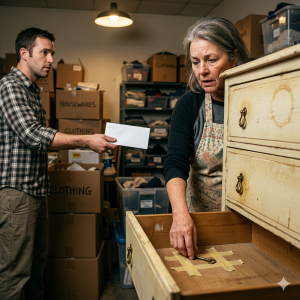
Still taped to the underside of the drawer. After all these years.
A small brass skeleton key.
She had put it there herself, the night before the station wagon came. She’d found that key in the backyard when she was ten, convinced herself it opened something magical — a garden gate, a treasure box, a door that led somewhere better. She’d kept it hidden for two years, and the night before she was sent away she’d taped it there, in the dark, with a piece of masking tape she’d pulled off a poster on her wall.
She hadn’t told anyone.
She had never told a single person about that key.
Her fingers were shaking.
“Are you all right?” the man asked.
“Who sent you here?” Renee’s voice came out quieter than she meant it to. “Who gave you this furniture?”
He hesitated. Just a half-second. But she caught it.
“It came from an estate,” he said again. “The family asked me to donate it personally. They were very specific — it had to come here, to this location.”
“What family?”
He looked down at his clipboard, though Renee had the feeling he already knew what it said.
“The donor name listed is a woman.” He turned the clipboard toward her. “Diane Calloway-Marsh.”
The room tilted.
Diane.
Her half-sister. Her father’s daughter from his second marriage, born the same year Renee was packed into that station wagon. They had never met. Not once in thirty-seven years. Renee had written two letters in her twenties that were never answered. She’d eventually stopped trying.
And now Diane’s name was on a donation slip, attached to Renee’s childhood dresser, with Renee’s secret still taped inside the drawer like a message in a bottle that had somehow found its way home.
“Is she here?” Renee asked. “Diane — is she the one who—”
“She passed,” the man said quietly. “Eight weeks ago.”
Renee pressed her hand flat against the top of the dresser. Against that old water ring.
“I’m sorry,” she said, though she wasn’t sure who she was saying it to.
The man picked up his clipboard and walked toward the door. Renee turned back to the drawer, to the little brass skeleton key that had waited thirty-seven years for her to find it again.
She was reaching for it when she heard him stop.
She looked up.
He had turned around in the doorway. And for the first time since he’d walked in, something in his face had changed. Whatever professional distance he’d been keeping — it was gone.
“My mother wanted me to find you first,” he said.
His mother.
Renee stared at him.
“She wanted me to find you before the lawyers do.”
He reached inside his blazer and drew out a plain white envelope.
He held it out across the room.
On the front, in careful, old-fashioned cursive, was Renee’s full name.
And Renee Calloway, who had not cried in a very long time, felt something crack open in her chest — because she knew that handwriting.
She hadn’t seen it in thirty-seven years.
But she knew it.
She knew it the way her hands had known that dresser.
She took one step toward him.
Then another.
Her legs felt like they belonged to someone else. The sorting table, the folding chairs stacked against the wall, the bins of donated winter coats — all of it went blurry at the edges. The only thing in focus was that envelope and the name on the front of it, written in the looping, careful cursive she had last seen on a birthday card she’d received when she was nine years old, three weeks before her mother died.
She had memorized that handwriting as a child the way other kids memorize prayers.
She stopped two feet in front of him. Up close he looked less like a stranger. The shape of the jaw. The way he was holding himself, braced for something.
“What’s your name?” she asked.
“Marcus,” he said. “Marcus Marsh.”
He said it simply, like he’d been rehearsing how to say it without ceremony, knowing it would hit her anyway.
Diane’s son. Her half-sister’s son. Which made him her nephew, in whatever complicated, technical, thirty-seven-years-of-silence way that word could still mean something.
Renee took the envelope.
The paper was heavy. Good stationery. The kind of envelope you buy when you mean what you’re writing.
She didn’t open it right away. She looked at Marcus, at this stranger who had her father’s jaw and his mother’s careful eyes, and she said the only thing she could think to say.
“How did she know I worked here?”
He exhaled slowly, like that was the question he’d been hoping she’d start with, because it had a real answer. “She’s known where you were for a long time. She hired someone to find you about twelve years ago.” He paused. “She didn’t tell me that until she was sick. She kept a lot of things until she was sick.”
Renee looked down at the envelope. “But she never reached out.”
“No.”
“Why?”
Marcus was quiet for a moment. He glanced at the dresser, at the open drawer, at the small brass key still hanging by its aging strip of masking tape. “She wrote it all down,” he said finally. “She said she wasn’t any good at explaining herself out loud. She said she never had been. But she wrote it down.”
Renee worked the flap open with her thumb. Inside were three folded pages, filled front and back in that same precise cursive. She unfolded them slowly, the way you handle something that might not survive rough treatment.
She read.
The sorting room was completely quiet. Somewhere in the back of the building a door swung shut. A truck rumbled past on Peoria. Renee stood next to her mother’s dresser and read her half-sister’s words, and the world outside those three pages ceased to exist entirely.
Diane had known about Renee her whole life. Not the way you know a fact — the way you know a wound. Their father had told her, when Diane was about seven years old, that she had a sister from his first marriage who’d gone to live with family in Muskogee. He’d said it like it was a closed chapter. A thing that had been handled. Diane wrote that she’d understood even as a child that she wasn’t supposed to ask more questions, and so she hadn’t, and the not-asking had calcified over the years into something that felt, by the time she was an adult, like it might be easier to leave alone.
When Renee’s letters had arrived — Diane would have been in her mid-twenties — she had read them both so many times the paper went soft at the folds. She’d written back twice. Both times she’d torn up what she’d written before she could send it. She didn’t explain why, not exactly. She just said she hadn’t known how to be someone’s sister when she’d been an only child her entire life, and by the time she understood that was a failure of courage and not of ability, she was afraid too much time had passed.
Then she got sick.
And when you get sick, Diane wrote, you stop being afraid of the things you were afraid of, and you start being afraid of different things. Harder things. Like the idea of leaving without having tried.
The dresser had been in Diane’s guest room for nine years. She’d bought it at an estate sale herself, not knowing whose it was. Only later — after her mother, Renee’s stepmother, had died and Diane was going through the old woman’s papers — did she find the original receipt of sale, the one from 1987, with the furniture description itemized in faded blue ink. White painted bedroom set, four pieces. She’d known then. She’d opened every drawer, run her hands along every surface, until she found the second drawer from the top.
And the key.
She’d left it where it was. She hadn’t touched it. She wrote that it felt like it wasn’t hers to touch.
She’d hired someone to find Renee the following spring.
Renee had to stop reading for a moment. She pressed the back of her wrist against her mouth and breathed through her nose until she was steady enough to continue.
The last page was shorter. The handwriting was slightly different — looser, a little less controlled. Diane had written it near the end, and her hand showed it.
She said she was sorry. Not in a single sweeping apology that tried to cover everything in one sentence, but specifically, carefully, in the way that only dying forces a person to be specific. She was sorry she’d torn up those letters. She was sorry she’d let fear do the talking for thirty-some years when it didn’t deserve the floor. She was sorry she would never get to sit across a table from Renee and hear her voice.
She said she’d spent a lot of her life wondering what Renee was like, and that she’d asked the man she hired enough questions to build up something like a picture. She listed small things she’d learned: that Renee was kind to people who were having a hard time, that she laughed easily, that she’d been a schoolteacher for a long time before she changed course. Diane said she was glad about all of it. She said it in the way a sister would.
Then she wrote: The dresser belongs to you. It always did. Everything in the estate that came from your mother’s home belongs to you. Marcus knows what this means legally and he will help you navigate it if you’ll let him. He’s a good person. I made sure of that, at least.
The last two lines were these:
The key was yours. I don’t know what it opens. I hope you do. I hope it opens something good.
Your sister, Diane.
Renee folded the letter back along its creases. She held it in both hands for a long moment, this thing that had taken thirty-seven years to travel six inches across a room.
Marcus hadn’t moved. He was watching her the way people watch someone walking out of a hospital — hoping, not sure what they’re hoping for.
“She was right,” Renee said. “You are a good person.” She’d only known him for ten minutes but she could tell, the way you can tell some things without being able to explain how. “Bringing this here yourself. You didn’t have to do that.”
“I know,” he said. “I wanted to.”
Renee looked back at the open drawer. At the key.
She reached in and peeled it away from the old tape carefully, the way you’d lift something fragile. The tape had dried to almost nothing over the decades, and the key came free easily, like it had been waiting to.
It was small and ordinary and completely plain. The kind of key that could open almost anything or nothing at all, depending on what you were looking for.
She turned it over in her palm.
She’d been ten years old when she found it in the backyard. She’d spent two years certain it was magic. She’d been wrong about that, obviously. It was just a key. But she’d been right about something — she’d been right that it opened a door to somewhere better. She just hadn’t known it would take this long. She hadn’t known the door would be on the other side of a grief she hadn’t finished grieving, or that she’d have to be forty-nine years old and standing in a Salvation Army on a Tuesday morning to finally step through it.
“The lawyers,” she said. “You mentioned lawyers.”
“It’s not complicated,” Marcus said. “She made sure it wasn’t complicated. She didn’t want you to have to fight for anything.” He reached into his blazer again and came out with a business card. “Take your time. There’s no deadline. She made sure of that too.”
Renee took the card and tucked it in the pocket of her vest, next to the folded letter.
Then she looked at Marcus — at her nephew, this careful, clean-shoed man who had driven to Tulsa on a Tuesday morning to hand-deliver his dead mother’s words — and she made a decision.
“There’s a diner two blocks north,” she said. “The coffee there is significantly better than what we have here.” She held up her empty Styrofoam cup as evidence. “I’d like to hear about her, if you’re willing. What she was like. The ordinary stuff. What she made for dinner. Whether she was funny.”
Something shifted in his face. The braced quality went out of it.
“She was funny,” he said. “She was really funny, actually. Nobody ever expected it.”
“That tracks,” Renee said. “Dad wasn’t funny at all, so she must have come by it from somewhere else.”
Marcus laughed. It surprised him, she could tell. It surprised her a little too, how naturally it came.
She went and told her supervisor she was stepping out, that something had come up, that she’d explain later. She pulled on her jacket. She picked up the little brass key and held it for a moment before dropping it into her jacket pocket alongside the letter and the business card, where it settled like it had always belonged there.
She and Marcus walked out together onto Peoria Avenue, into the flat October light, and headed north toward the diner.
She didn’t know what came next, exactly. She supposed there would be paperwork and attorneys and all the practical machinery that follows a death, and that would be hard in its own way. She supposed there would be harder conversations than this one, late-night phone calls, the slow and imperfect work of becoming family to a stranger. She supposed she would sit with Diane’s letter many more times before she felt finished with it, and that she might never feel entirely finished with it.
But for right now she was walking down a sidewalk in Tulsa with her dead half-sister’s son, and he was telling her that Diane had made very strong opinions about soup and would argue about it with anyone, and Renee was laughing again, for real this time, without expecting to.
In her pocket, the key was warm from her hand.
She’d been ten years old when she decided it opened something magical. She’d carried that idea for two years, then buried it, then lost it for thirty-seven more.
She’d been right all along. She just hadn’t been patient enough to know it.