“Are you married, sir?”
The question was so strange coming from a six-year-old that Aaron honestly thought he had misheard her.
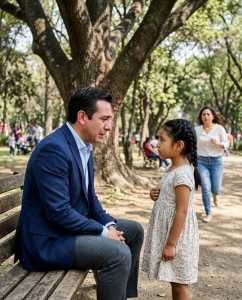
He had been sitting alone beneath one of the old ahuehuete trees in Chapultepec Park, his suit jacket folded over his lap, his tie loosened just enough to suggest the day had already gone wrong. Around him, the park was alive in a way that made his own life feel hollow. Children chased each other across the grass. Parents laughed with the weary happiness of people needed by someone. A baby cried, then settled as her father lifted her to his shoulder. A boy ran past with sticky hands and a face full of triumph over some small victory only a child could understand.
Aaron watched all of it with a feeling that had been growing sharper with each passing year.
He had money. More than enough. He had a respected consulting firm in Mexico City, prime office space in Santa Fe, investors who called him before making risky moves, and clients in Monterrey and Guadalajara who trusted him with numbers large enough to change their companies. He had a luxury apartment overlooking Reforma, a refrigerator that hummed in perfect order, and closets filled with expensive clothes that arrived clean and returned to their places without his having to think about them.
He also had silence.
Not the peaceful kind. Not the elegant quiet people brag about when they say they love living alone. His silence had weight. It waited for him at the door every night. It sat beside him while he ate meals no one admired. It followed him from room to room in that immaculate apartment where nothing was ever out of place because no one existed there except him.
That morning, the emptiness had felt unbearable.
So he had gone for a walk in the park, hoping motion might drown out thought.
Instead, it sharpened everything.
Watching families laugh over cheap snacks and children beg for one more turn at a game, he had felt something close to humiliation. He had spent years building a life most people envied, only to realize he had no one to share it with. No little drawings taped to his fridge. No tiny shoes abandoned in the hallway. No bedtime routines. No one calling him Dad.
And then this little girl with black braids and a serious face had stepped out of the grass and asked whether he was married.
“No,” he answered.
The relief on her face had unsettled him more than the question itself.
“That’s good,” she had said.
Then, in a low voice meant for secrets, she explained that her mother had said the night before she would never be with a married man. Breaking a family was a sin. A decent woman did not make another wife cry.
Aaron had still been trying to understand why a six-year-old would repeat such a thing to a stranger when a woman came running toward them, wild with panic.
“Iris!”
She reached the child in seconds and pulled her behind her with both arms, her body turning into a barrier. She was beautiful in the unguarded way exhausted women often are: dark hair half-falling loose, pale face, simple white blouse, jeans worn enough to tell a real story. Fear blazed across her expression when she looked at Aaron.
“What is going on here?”
He raised his hands at once, calm and careful. “Your daughter is fine. She came over on her own.”
“Iris, I’ve told you not to talk to strangers!”
The girl clung to her mother. “Mommy, I had to ask him something.”
The woman inhaled sharply, already sensing danger. “Ask him what?”
“I asked if he was married.”
The mother’s face changed instantly. Aaron saw embarrassment crash into dread. Her lips parted, but no words came out.
“And he said no,” Iris added with heartbreaking hope. “So I thought maybe he could—”
“Enough.” The woman covered her daughter’s mouth with a trembling hand. “Please don’t say another word.”
Too late.
Aaron had already begun to see what was happening, though he didn’t yet understand all of it.
He stood slowly from the bench. “I’m sorry. I didn’t mean to upset you.”
The woman wouldn’t meet his eyes. “You didn’t. My daughter just… she doesn’t know boundaries.”
But Iris looked up at her mother and said, “I do know. You were crying last night.”
The mother’s eyes shut for one brief second, as if she had been struck.
Aaron went still.
The child kept talking, in that merciless way children do when they think honesty is helpful.
“You said you’re tired of doing everything alone. You said maybe God forgot us. You said I need a dad, even if you don’t say it.”
The woman’s shoulders tightened.
“So when I saw him sitting here all sad,” Iris continued, pointing at Aaron, “I thought maybe he needed us too.”
Something in Aaron’s chest broke open.
He had spent years hiding from his loneliness by calling it ambition, discipline, focus. But this child had looked at him once and seen what people in his office never noticed.
Sad.
Her mother looked as though she might cry from shame. “Iris, stop.”
Aaron surprised himself by saying, “You don’t have to apologize for her.”
The woman finally looked at him then, and when she did, something strange passed through her expression. Not simple embarrassment. Not fear alone.
Recognition.
Her lips parted slightly. “Aaron.”
His heartbeat stumbled.
He had not told her his name. Iris knew it because he had introduced himself moments earlier, but this woman had said it with a different kind of certainty, as if she had known it long before the park, before the tree, before this impossible conversation.
“How do you know my name?” he asked.
Instead of answering, she clutched Iris’s hand tighter.
“We should go.”
He took a step forward, not threatening, only stunned. “Wait. Have we met?”
The little girl answered before her mother could stop her.
“Mommy has your picture.”
The woman turned pale. “Iris.”
“In a box,” the child said earnestly. “With letters and papers and a hospital bracelet.”
Aaron stared at the mother. “What is she talking about?”
“Please,” the woman whispered, and now her voice was different. Raw. “Not here.”
But the ground had shifted beneath him. He could feel it. The old rules of his life no longer applied.
“What hospital bracelet?”
For a long moment, the woman said nothing. People drifted around them carrying snacks, laughing, calling after children, unaware that for the three people standing beneath that tree, the world had narrowed into one unbearable moment.
Then the woman reached into her bag with shaking fingers.
She pulled out a photograph so worn it had clearly been unfolded dozens, maybe hundreds, of times. The edges were soft with age. She held it out to him without meeting his eyes.
Aaron took it.
The blood drained from his face.
The picture had been taken in a hospital room. He looked younger, leaner, stunned. Beside him stood a young woman with swollen eyes and one hand resting protectively over a pregnant belly.
It was this woman.
A much younger version of her, but unmistakably her.
Aaron looked from the photo to her face and back again. “Who are you?”
She swallowed. “Lauren.”
The name hit nothing at first. Just sound.
Then memory moved.
Not all at once. In fragments. A charity legal-aid project his company had funded years ago. Volunteering for publicity more than conviction. A waiting room. A terrified young woman arguing with a receptionist. A problem with insurance. A pregnancy complication. Aaron stepping in because he was in a good mood that day and the hospital administrator knew his name. Covering expenses without thinking much about it. Sitting with her while paperwork was processed because she looked like she might collapse.
And then another memory, sharper.
She had been alone.
No husband. No partner. Just a girl in her early twenties trying not to cry.
“I remember the hospital,” Aaron said slowly.
Lauren nodded once, tears gathering. “You stayed until the doctor came back.”
He could see flashes now. Her thanking him. Him telling her it was nothing. The doctor later explaining there had been a chance the baby might not survive if treatment had been delayed. Aaron had paid the bill and left before anyone could make a big scene of gratitude. He had been younger then, more restless, still trying on kindness like a suit he wasn’t sure fit him.
“I never saw you again,” he said.
“No,” Lauren replied. “You didn’t.”
“Then why do you have this picture?”
Her laugh came out broken. “Because it was the only proof that the worst day of my life didn’t end the way I thought it would.”
Iris looked from one face to the other, sensing the seriousness now and quiet for once.
Lauren crouched down and brushed her daughter’s braids back from her forehead. “Sweetheart, go sit on that bench for one minute. Don’t move.”
“I can still hear?” Iris asked.
“Yes.”
Satisfied, the little girl climbed onto the bench and hugged her own knees.
Aaron could barely breathe. “Talk to me.”
Lauren straightened, but her composure was gone now.
“The day you met me,” she said, “I was five months pregnant. I had just left the father. He was abusive, controlling, and when I told him I wouldn’t go back, he said the baby probably wasn’t even his. I had complications that morning. I thought I was losing her.”
Aaron listened in silence.
“You paid for treatment I couldn’t afford. You waited. You spoke to the doctor when I couldn’t think. You even made me laugh once, which felt impossible that day.”
He remembered making some awkward joke about hospital coffee being a crime against humanity. He remembered her laughing through tears.
“When I tried to thank you later, I was told you’d gone. The only thing I had left from that day was a copy of that photo the nurse took after the baby was stable and we were both breathing again.” She paused. “I kept it because that was the day a stranger proved not every man was cruel.”
Aaron stared at her. “And Iris?”
Lauren looked toward the bench. “She’s mine.”
The wording caught him. Mine. Not ours. Not his.
But his heart was already racing down another path. “Then why would she think—”
“Because children hear everything,” Lauren said. “And because I made a mistake last night.”
She wrapped her arms around herself and looked ashamed.
“I was tired. Rent is late. My second job cut hours. Iris asked why she doesn’t have a dad like other children. I told her sometimes life doesn’t give us the family we imagined. After she went to bed, I was talking to my cousin on the phone. I was crying. I said I was exhausted. I said she deserved better. I said maybe if God ever put a good man in our path, I wouldn’t run from it just because I was afraid.”
Aaron felt something painful twist through him.
Lauren continued, “I didn’t know she was awake. I didn’t know she was listening. I definitely didn’t know she’d turn my breakdown into a plan.”
For the first time since this began, Aaron almost smiled. The absurdity and heartbreak of it lived side by side.
“She came looking for a husband for you,” he said quietly.
Lauren covered her face for a moment. “I know.”
“And a father for herself.”
Lauren lowered her hands. “Yes.”
He looked at Iris, sitting obediently but watching them with the intense focus of a child who knows everything important is happening without her.
The strangest thing was not how desperate this all sounded.
It was how deeply it moved him.
He asked the question carefully. “Why did she come to me?”
Lauren hesitated.
Then she told the truth.
“Because she’s seen your picture. Because I told her once that the kind man in that hospital helped save her life before she was born. Because when she asks what a good man looks like, I may have pointed to that photo.”
Aaron’s eyes burned.
“She recognized me?”
Lauren gave a helpless nod. “I guess she did.”
He sat back down on the bench as the force of it hit him. Somewhere over the years, while he was building companies and collecting achievements, his face had been sitting inside a box in a small apartment, preserved as the image of kindness in a child’s mind.
He had thought his life left no imprint.
He had been wrong.
He looked up at Lauren. “Why didn’t you ever contact me?”
Her answer came without drama. “Pride. Shame. Survival. Pick one.”
Then, more softly, “And because you helped me once. I didn’t want you to think I was trying to turn that into something else.”
Aaron nodded slowly. He understood that more than she knew.
A breeze moved through the trees. Somewhere nearby, a vendor rang a bell.
“What happened after the hospital?” he asked.
Lauren sat at the far end of the bench, keeping enough space to show she expected nothing. “I had Iris early, but she survived. She’s strong. Too smart. Too curious. Her father disappeared completely after she was born. My parents helped for a while, then they both got sick. It’s been me and her ever since.”
“And the photo?”
“I kept it in a box with important things.” She laughed weakly. “Iris apparently considers herself important enough to search that box.”
Aaron looked at the child again. “She does.”
As if summoned by approval, Iris hopped off the bench and came trotting back. “Am I in trouble?”
Lauren opened her mouth to answer, but Aaron said, “No.”
Iris turned to him. “Really?”
“Really.”
She studied his face with unsettling seriousness. “Are you crying?”
He touched just beneath his eye and found that he was.
He laughed once, embarrassed. “Maybe a little.”
“Mommy cries when she’s scared,” Iris said. “Why are you crying?”
Because no one had needed him in years. Because a little girl had crossed a park to offer him belonging. Because the one decent thing he had done without expecting anything in return had somehow become sacred in the life of a child he did not know existed.
“Because,” he said carefully, “sometimes people ask very big questions.”
Iris nodded as though that made perfect sense.
Then she asked the most dangerous one yet.
“Do you want to know us?”
Lauren inhaled sharply. “Iris.”
But Aaron held up a hand. Not to silence Lauren. To buy himself one second.
He could have lied. He could have softened it, offered a polite exit, turned this into one of those beautiful, fleeting moments people tell at dinner parties and never act on again.
Instead, for once in his life, he answered from the emptiest and truest place in him.
“Yes,” he said.
Lauren stared at him.
“I don’t know what that means yet,” he continued. “I’m not saying something reckless. I’m not promising what I don’t understand. But yes. I want to know you.”
Iris broke into a smile so bright it changed the whole afternoon.
Lauren, however, looked terrified.
“Do you know how many people say kind things for one hour?” she asked. “Do you know how often hope becomes humiliation?”
Aaron met her eyes. “Maybe more often than it should.”
“I can’t let her get attached to a fantasy.”
“Then don’t,” he said. “Let her get attached to what is real. A coffee. A conversation. One honest step at a time.”
Lauren searched his face for pity, for performance, for the polished charm wealthy men use when they want credit for compassion. Whatever she saw there made her shoulders loosen by a fraction.
“One coffee,” she said.
“One coffee,” he agreed.
It happened the next day at a small café nowhere near his usual places. Lauren arrived guarded. Iris arrived prepared with questions. Aaron discovered within ten minutes that she disliked mushrooms, loved stories, and considered adults unreliable unless they kept promises exactly.
He kept showing up.
Not extravagantly. Not with gifts meant to impress. With consistency.
He brought coloring books once and was informed by Iris that she preferred mysteries. So he returned with age-appropriate detective stories. He learned Lauren took two buses to one of her jobs and pretended not to be exhausted. He learned Iris had a habit of talking herself to sleep. He learned that Lauren laughed rarely, but when she did, it changed her whole face.
Weeks turned into months.
Aaron did not rescue them. Lauren would never have allowed it. But he helped where help was welcome. He fixed a leaking faucet. He used his contacts to help Lauren get an interview for a steadier administrative position. He attended Iris’s school event and stood in the back, unsure whether he belonged there until Iris spotted him and waved so violently half the room turned to look.
That night, Lauren cried in the parking lot.
“I’m sorry,” she said, wiping her face. “I just… nobody ever comes.”
Aaron looked at her under the dull school lights and realized he was already in too deep to pretend otherwise.
“I’m here,” he said.
Their relationship did not become a fairy tale overnight. There were arguments. Lauren distrusted ease because life had never given it to her. Aaron struggled to understand needs that couldn’t be solved with efficiency and money. Iris adored him one day, tested him the next, and watched everything.
But real things grew.
Trust. Habit. Tenderness.
The first time Iris fell asleep against his shoulder during a movie, he did not move for nearly an hour.
The first time Lauren let him into the apartment when she was sick, with no energy to pretend she had everything under control, he knew that was a bigger act of love than any declaration.
And the first time Iris called him by accident—very quietly, very sleepily—“Dad,” he stood in the hallway afterward and cried where neither of them could see.
He did not mention it.
Neither did she.
Not until months later, when Lauren found him helping Iris with homework at the kitchen table and the child looked up, frustrated with a math problem, and said it again without hesitation.
“Dad, that’s not how my teacher showed us.”
This time, no one pretended not to hear it.
Aaron looked at Lauren.
Lauren looked back at him with tears standing in her eyes.
He turned to Iris and said, with a voice that almost failed him, “Okay. Show me your teacher’s way.”
A year later, they were married in a quiet ceremony with only a few close people present. Iris wore a dress she had chosen after rejecting seven others for not being “wedding enough.” During the reception, she informed everyone that she had basically organized the whole family before the adults caught up.
No one argued with her.
Aaron eventually adopted her legally. On the day the papers were finalized, Iris marched out of the courthouse announcing that now it was official and nobody could “send him back.”
Lauren laughed so hard she cried.
Aaron cried too, though by then no one found that surprising.
Sometimes he still thought about the bench in Chapultepec Park. About the fountain. About how convinced he had been that his life was finished in every way except financial. He had gone there feeling like a man with everything and nothing. He left as someone cracked open by a child’s impossible question.
Years later, the photograph from the hospital remained in Lauren’s keepsake box. But beside it sat newer pictures: Aaron teaching Iris to ride a bike, Aaron asleep with a storybook on his chest, Aaron and Lauren in the kitchen laughing over burned pancakes, Aaron at a school ceremony trying and failing not to look prouder than any father in the room.
The old photograph had once represented a stranger proving that goodness existed.
The newer ones told a stranger’s ending no one had seen coming.
Sometimes Lauren wondered whether it had been fate, coincidence, or just the reckless courage of a six-year-old who refused to let adults surrender to loneliness.
Aaron had his own opinion.
He thought the biggest miracle wasn’t that Iris found him.
It was that she recognized him before he recognized himself.
And if there was any lesson in what happened, it wasn’t about money, luck, or perfect timing. It was about the smallest act of kindness surviving longer than the person who gave it ever imagined. It was about a woman too proud to beg, a child too honest to hide, and a man who discovered far too late that a meaningful life is not measured by what you can afford.
It’s measured by who reaches for you when your hands are empty.
Some people would say Lauren should never have trusted again. Others would say Aaron should have been cautious before stepping into a life already full of pain. But that was the question their story left behind for anyone who heard it:
What was the real risk?
Opening the door to love after disappointment?
Or spending the rest of your life in a beautiful, silent room, wondering what might have happened if you had answered one brave little girl with anything less than the truth?