When the young woman walked into Patsy’s Route 9 Diner at 9:40 on a Tuesday night, Marlene Dupree almost didn’t notice her.
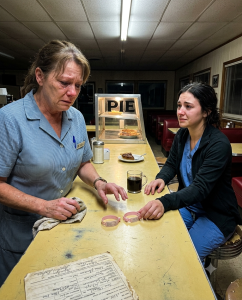
The dinner rush had ended an hour earlier. The booths were empty except for a retired farmer lingering over his second slice of coconut cream pie. Dale, the cook, was already scrubbing down the grill in back and complaining to himself about his knees. Outside, Route 9 glowed under a row of tired streetlights, and the summer air beyond the glass looked thick enough to drink.
Marlene was wiping down the counter with the same circular motion she’d used thousands of times before. That kind of routine could save a person. If she kept moving, she didn’t have to think. If she didn’t have to think, she didn’t have to remember.
That had been her system for years.
At fifty-eight, Marlene knew every inch of the diner. She knew the third stool from the register wobbled if a heavy man sat on it too fast. She knew booth five looked clean even when the syrup bottle underneath was sticky. She knew how to tell when a trucker wanted conversation and when he wanted silence. She knew how long the old ceiling fan would spin before it gave its familiar squeal on the third turn.
She also knew grief could sneak up on you in ordinary places. In reflections. In songs playing low on somebody else’s radio. In the sight of a little girl with dark curls in the grocery store. In the date July 14 on a receipt you didn’t ask to notice.
So she kept moving.
The young woman took the stool near the pie case. Mid-twenties, Marlene guessed. Dark hair pulled back neatly. Tired but alert eyes. A posture that looked trained, not casual. Nurse, Marlene thought before the girl said a word.
“What can I get you, hon?” Marlene asked.
“Decaf,” the young woman said. “And a slice of pecan pie.”
Marlene poured the coffee and set down the plate. “Long day?”
“Twelve-hour shift.”
“Hospital?”
The girl gave a small nod. “Saint Francis. Tulsa.”
That fit. There was a stillness to medical workers after a long day. They looked worn down and tightly held together at the same time, as if they’d spent all their energy taking care of other people and had none left to waste on themselves.
Still, something about the way the girl looked at her made Marlene uneasy.
Not rude. Not hostile. Intent.
“You from around here?” Marlene asked.
The girl wrapped both hands around the coffee mug. “I drove out specifically.”
Marlene tried a smile. “We’ve got good pie, but I don’t know if it’s drive-from-Tulsa good.”
The young woman looked straight at her. “I’m not here for the pie.”
A strange quiet settled over the diner.
Dale called out that he was leaving. Marlene answered automatically. A minute later the back door shut, and suddenly the place felt too open and too empty at once.
The farmer in the booth paid and shuffled out, giving Marlene his usual two-dollar tip and a complaint about gas prices. Then there was no one left but the two of them.
Marlene picked up the coffee pot again just to have something to do. “You know my name?”
“I do.”
That made Marlene still.
Most of Claremore knew her face. People knew the diner waitress with the kind smile and the no-nonsense coffee pours. But the girl hadn’t spoken like a regular. She’d spoken like someone who had come for a reason.
“What’s this about?” Marlene asked.
The girl reached into her jacket pocket and set something on the counter.
It was so small Marlene almost missed it at first. A pale pink plastic band with a snap clasp. The kind hospitals put around a newborn’s ankle or wrist.
Marlene’s breath caught.
The room, the lights, the diner, the smell of coffee and pie crust — all of it seemed to step backward while the bracelet sat there in perfect focus.
Without thinking, Marlene reached into her apron pocket.
For six months she had carried a newborn bracelet there every shift. She had found it while cleaning out her dead mother’s house, wrapped carefully in cotton inside a shoebox hidden on a closet shelf. She had stared at the tiny band for an hour that day, the date on it burning into her eyes: July 14, 1983.
The day she had been told her baby died.
Now her hand shook as she laid her own bracelet beside the stranger’s.
The two looked like twins separated by time.
Marlene’s mouth went dry. “Who are you?”
The girl didn’t answer immediately. She was composed, but not casual. Whatever had brought her here mattered deeply.
“My name is Claire Bennet,” she said. “I was adopted through a private arrangement in Claremore in 1983.”
Marlene gripped the counter.
Claire continued, her voice measured. “My parents were told my birth mother voluntarily relinquished me. Closed file. Private placement. Clean record.” She paused. “But I’m a nurse. I know how medical forms work. I know what signatures belong on which documents. And when my adoptive mother finally gave me my file, there was one paper in it that shouldn’t have existed.”
She pulled a photocopy from a folder and slid it across the counter.
Marlene looked down.
Death certificate.
Infant female.
Date: July 14, 1983.
The words blurred. Her eyes moved lower, found the signature line, and then all the air seemed to leave the room.
Dorothy Hale.
Her mother.
Not a doctor. Not a coroner. Not hospital administration.
Her mother.
Marlene’s knees weakened so suddenly she had to brace herself against the counter. “No,” she whispered, though she wasn’t denying it. She was denying the possibility that her life could split open this late and still find a deeper wound inside.
Claire spoke gently now. “I think you knew my mother. And I think you are her.”
Marlene stared at the girl’s face.
Until that moment, shock had kept her from looking too closely. Now details began arranging themselves in cruel, impossible harmony. The shape of the jaw. The set of the mouth. The eyes — not Marlene’s own, exactly, but her grandmother’s eyes, the Hale family eyes, impossible to mistake once seen.
“I didn’t know,” Marlene said. It came out ragged, desperate. “I need you to believe me. I didn’t know.”
Claire’s chin trembled once before she steadied it. “Then tell me what happened.”
And so Marlene did.
Not all at once. Not neatly. The story came in fragments, as traumatic memories often do. Summer heat. Seventeen years old. A secret pregnancy. Her mother saying no one could find out, that a scandal would ruin everything. The strange doctor. The private room. Her begging to hold the baby. Then the words: She didn’t make it.
“I never saw her,” Marlene whispered. “They sedated me. When I woke up, my mother said there was nothing to see.” Tears ran down her face unchecked. “I thought I buried you in my mind. That’s all I had. I buried you in my mind.”
Claire sat perfectly still, but her eyes filled.
“My adoptive parents loved me,” Claire said after a moment. “I need that said out loud. They were decent people. My father was kind. My mother… she was scared to tell me when I was young, but she wasn’t cruel. When he died last year, she gave me the file. She said if I wanted the truth, I deserved every page.”
She opened the folder again.
There was the death certificate. There was her adoption intake paperwork. And there was something worse: an old carbon copy note from a private clinic on outdated letterhead, with a typed line at the bottom that made Marlene feel sick.
Mother sedated. Maternal guardian approved transfer.
Approved transfer.
Transfer to whom? Under what authority? For what money? Marlene looked at the paper and thought of every time Dottie Hale had stood in church pretending to be the moral center of Claremore.
“My mother told me God had taken my baby,” she said hoarsely. “All those years.”
Claire’s anger surfaced then, controlled but unmistakable. “Somebody signed papers saying I died, and somebody else arranged for me to be adopted. Either your mother did that alone, or she had help.”
“She had help,” Marlene said instantly.
She knew Dottie too well. Dottie was determined, manipulative, and cold when cornered — but she was not sophisticated. She could not have forged a medical trail and arranged a private placement by herself. There had been a clinic. A doctor. Nurses. Someone willing to turn a frightened teenager’s labor into a transaction.
Claire pulled out one final document. “There was a witness name attached to one of the transfer notes.”
Marlene read it and felt a chill move through her.
Evelyn Mercer.
“Miss Evelyn?” she whispered.
Claire nodded. “Retired head nurse from the old private clinic outside town.”
Marlene remembered her. Crisp white shoes. A voice too cheerful. A woman everyone described as efficient. She had assisted with births, women’s procedures, and the town’s quietly unspoken problems.
“She’s alive?” Marlene asked.
“Assisted living now. Moved in last month. I checked.”
Claire leaned forward. “I also checked county storage records. Files from that clinic are missing. Entire boxes. Someone cleaned things up at some point, but not perfectly.”
Marlene felt something new pushing through the shock and grief.
Rage.
Not the wild helpless kind she’d felt at seventeen. This was colder. Sharper. A fury with a direction. They had taken her child and made her mourn a living girl for forty-one years. They had told Claire a version of her own beginning built on paperwork no one expected her to examine closely. They had trusted time to bury all of it.
Instead, time had raised a nurse with steady hands and a trained eye for forged records.
“I was going to see Evelyn Mercer tomorrow,” Claire said quietly. “Alone.”
“No,” Marlene said.
Claire blinked. “No?”
“You are not going alone.”
For the first time that night, something softer passed over Claire’s face. Not trust exactly. Not yet. But recognition. The beginning of it.
Marlene looked at her daughter. The word formed inside her with such force it made her dizzy. Daughter. Not memory. Not grave. Not tragedy. Daughter.
“I don’t know what you need from me,” Marlene said. “I don’t know what I have a right to ask from you. But if that woman helped do this, then I’ll sit across from her myself.”
Claire swallowed hard. “Okay.”
They sat there for a while after that, two strangers bound by blood and theft and forty-one lost years. They spoke in starts. Claire told Marlene about her adoptive father teaching her to ride a bike. About becoming a nurse because she liked knowing how to be useful in hard moments. About how her adoptive mother had cried when handing over the file and said, “I loved you enough to keep you, but not enough to keep the truth from you forever.”
Marlene told Claire about leaving town, about the quiet marriage that failed, about coming back only after Dottie died. She did not say aloud what both of them were thinking: that Dottie’s death had protected her from ever being forced to answer for it.
The next morning they drove together to the assisted living home on the north side of town.
Marlene barely slept the night before. She dug through everything she still had from her mother’s house and found old church directories, canceled checks, and a yellowing address book. On one page, next to E.M., was a number crossed out twice.
At ten in the morning they walked into the facility side by side.
Evelyn Mercer was ninety-one and smaller than Marlene remembered, but age had not erased her sharpness. Her eyes moved from Marlene to Claire and then to the documents in Claire’s hand. In that instant, before anyone said a word, Marlene knew. Guilt has a reflex. Recognition hit Evelyn’s face too fast to hide.
“Marlene Dupree,” Evelyn said faintly. “I’ll be.”
“You remember me,” Marlene said.
Evelyn looked at Claire. “And this must be…”
She didn’t finish.
Claire set the bracelets on the small table by Evelyn’s chair.
For a long moment no one spoke.
Then Marlene placed the death certificate on top of them.
Evelyn’s hand rose to her throat.
“Tell me,” Marlene said. Her voice shook, but it did not break. “Tell me exactly what you did.”
Evelyn closed her eyes.
What came out over the next twenty minutes was ugly, detailed, and somehow worse than Marlene had imagined.
Dottie Hale had approached the clinic before Marlene gave birth. She said her daughter was fragile, ashamed, too young, and would never recover from the scandal. She said there was a couple ready to adopt, churchgoing and stable, desperate for a baby. The doctor running the clinic had done “private placements” before, quietly, off the record enough to keep local families out of gossip. Dottie insisted it was mercy. Evelyn told herself the same thing.
When Marlene delivered, the baby was healthy.
“She cried right away,” Evelyn said, tears slipping down the sides of her face. “Strong lungs. Healthy weight.”
Marlene felt her fingernails cut into her palm.
“You let me think she was dead.”
Evelyn’s voice cracked. “Your mother said if you saw her, you’d never let go. She said you’d ruin your whole future. The doctor agreed to document a stillbirth. I signed as witness to the transfer. Your mother signed where a physician should never have signed. It was wrong. It was all wrong.”
Claire’s face had gone white. “Did my adoptive parents know?”
Evelyn looked directly at her. “No. Not the whole truth. They were told the birth mother relinquished after delivery. I believe they believed it.”
Believe. The word hung there, imperfect and painful.
The doctor was long dead. The clinic had closed decades earlier. But Evelyn still had something she had never destroyed: an old ledger page and a copy of the original placement note, kept because guilt had made a coward of her. “In case somebody ever asked,” she said.
Somebody finally had.
By the time Marlene and Claire left the facility, they had copies of everything and the name of an attorney in Tulsa who handled adoption fraud cases. The legal outcome would be uncertain. Too much time had passed. Some of the responsible people were dead. Records were incomplete. There might never be a courtroom or a headline or a punishment that matched the crime.
But truth had finally stepped into daylight.
Over the next months, truth made room for stranger, harder things.
Claire met Marlene again for lunch, then again the next week. They did not try to force forty-one years into a few conversations. They moved carefully. Claire brought photographs from childhood — Christmas mornings, school plays, a bike with streamers on the handlebars. Marlene looked at every one as if handling relics returned from a stolen life.
Sometimes joy and grief arrived together so intensely they made Marlene feel split in two. She was grateful Claire had been loved. She was heartsick those memories belonged to someone else’s arms, someone else’s kitchen, someone else’s bedtime stories.
Claire felt her own version of that division. She loved the parents who raised her. She also loved, with frightening speed and depth, the woman who had spent decades mourning her because she’d been lied to. Neither truth canceled the other. That was one of the hardest parts.
Months later, when the attorney explained that criminal consequences were unlikely, Marlene expected the news to flatten her. Instead, she surprised herself.
“I spent forty-one years believing a lie,” she said. “I don’t need a judge to tell me what happened. I know now.”
Claire reached across the office and squeezed her hand.
They were still learning each other. Marlene discovered Claire hated mushrooms, hummed while driving, and cried at animal rescue commercials. Claire learned Marlene kept too many canned peaches in her pantry and still folded dish towels the way Dottie taught her, though she hated admitting it.
One Sunday, Claire stood beside Marlene at the cemetery and looked down at Dottie Hale’s grave.
Neither of them said much.
Finally Claire asked, “Do you hate her?”
Marlene stared at the name carved in stone.
“I did,” she said. “Then I thought I had used it all up. Now I think hate is too simple for what she deserves.”
Claire nodded slowly.
Marlene rested a hand on her daughter’s back as they turned away from the grave together.
For years she had wondered what the biggest cruelty was: losing a child, or surviving the loss. But now she knew there had been something worse — having love manipulated into silence by people who believed they had the right to decide whose life would be broken and whose reputation would be saved.
And still, against all of that, something had survived.
A bracelet hidden in a shoebox.
A nurse who knew forged paperwork when she saw it.
A mother who never stopped carrying the date in her body.
Sometimes Marlene lay awake thinking about all the birthdays she missed, all the scraped knees she never kissed, all the nights Claire was sick or scared and reached for someone else. That pain would never vanish. There was no honest ending where it could.
But there was this: Claire was alive. Claire knew. Claire came back.
Some nights, after her shift at the diner, Marlene would sit across from her daughter in a booth near the window, two cups of coffee between them, and let herself study the face she had once been told she would never see.
It had taken forty-one stolen years, a dead woman’s hidden box, and one question asked across a counter to bring the truth into the room.
By then, the damage was permanent.
So was the love.
And maybe that was the part no one in 1983 understood. Not Dottie, not the doctor, not the nurse who signed the paper and looked away. They thought they were managing a scandal, moving pieces, cleaning up a mess.
They were wrong.
They were carving an absence into two lives and calling it mercy.
What they never imagined was that one day the child they renamed, rerouted, and buried on paper would grow into a woman capable of reading every crack in the story. They never imagined the mother they silenced would live long enough to hear the truth. They never imagined the lie would survive just long enough to expose itself.
And if there was any justice left in a story like that, maybe it wasn’t found in legal punishment or public shame.
Maybe it was found in this harder thing:
A woman who lost forty-one years still opening her arms.
A daughter with every reason to stay away choosing not to.
Two people standing in the wreckage of someone else’s choices and deciding the rest of the story would belong to them.
Whether forgiveness was deserved was another question entirely.
Whether Dottie Hale ever loved her daughter in whatever broken way she understood love hardly mattered now.
The real question — the one that lingered long after the paperwork was boxed and the tears had dried — was simpler, and crueler:
How many lives can one lie divide before the truth finally decides it has waited long enough?