Darlene Kopp did not come to Gary’s wedding to cause a scene.
She came because Melissa asked her to.
And she came with a handkerchief tucked in her purse that she had no intention of explaining to anyone.
—
Let me back up.
Gary Kopp — her ex-husband of eleven years, the man who once told her she’d “never amount to much without him” — had done well for himself.
Real well.
He’d married into Napa Valley money, built a vineyard out in Sonoma County, and was now standing at the altar in a linen suit that probably cost more than Darlene’s first car.
The venue was something out of a magazine.
String lights over the vineyard rows. White roses everywhere. A string quartet playing something Darlene didn’t recognize but figured was expensive.
She sat in the fourth row on the bride’s side, wearing her good navy dress — the one she’d bought on clearance at Chico’s two years ago and kept for exactly this kind of occasion.
She looked fine.
She knew she looked fine.
But what she didn’t do — what she made a quiet, deliberate choice NOT to do — was touch the handkerchief again.
She’d already checked it twice on the drive up from Modesto.
Still there. Still folded in that particular way, the embroidered corner facing up.
*E.B.*
Two initials. Old linen, yellowed just slightly at the edges. The embroidery done in pale blue thread so faded it was nearly gray.
Not her initials.
Not Gary’s.
Not the bride’s — Melissa’s last name was Hargrove, and her first name started with M.
Darlene set her clutch on her knee and folded her hands over it like a woman with nothing on her mind.
—
She’d met Melissa six months ago, completely by chance.
A water aerobics class at the Elk Grove YMCA.
Melissa had recognized Gary’s last name when Darlene introduced herself, and instead of making it awkward, she’d said, *”Oh, thank God. Someone who’ll tell me the truth about him.”*
They’d laughed.
They’d gotten coffee after class.
They’d become, against all reasonable odds, friends.
And when Melissa had called her in March, voice strange and tight, and said, *”Darlene, I need to ask you something and I need you to be honest with me”* —
Darlene had been honest.
She’d been very honest.
She’d also mentioned a name.
A name she’d spent twenty-three years wondering about herself.
—
The ceremony was lovely.
Gary cried, which surprised her.
Melissa was radiant in a champagne gown, which did not surprise her at all.
Darlene clapped at the right moments and smiled at the flower girl and did not look at Gary directly even once.
But she watched the father of the bride.
She’d been watching him since she sat down.
He was a tall man, late seventies, silver-haired and straight-backed. He’d walked Melissa down the aisle with the careful dignity of someone who understood ceremony. He’d kissed his daughter’s cheek. He’d taken his seat in the front row.
He had not looked at Darlene.
Not yet.
—
The reception moved to the terrace as the sun dropped low and gold over the vineyard rows.
Darlene ate her salmon.
She made small talk with the woman next to her, a second cousin from Fresno who wanted to discuss the centerpieces.
She touched her clutch once, just to be sure.
*Still there.*
The initials pressed faintly against the lining.
*E.B.*
—
The best man tapped his glass.
Toasts were beginning.
Melissa’s maid of honor went first — funny, warm, made everyone tear up at the end.
Gary’s brother said something that got a big laugh from the groom’s side.
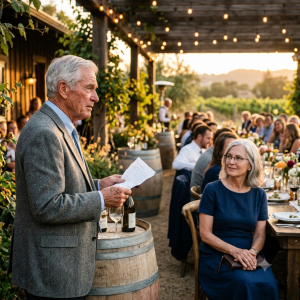
And then the father of the bride stood up.
The table went quiet in that particular way tables go quiet when the room understands that something real is about to be said.
He was holding a folded piece of paper.
Darlene set down her fork.
She reached into her clutch.
She did not take the handkerchief out.
She just held it.
The worn linen. The faded blue thread.
*E.B.*
He unfolded his speech slowly.
He looked out at the room — at his daughter, at the guests, at the vineyard lit up behind them all in the last of the evening light.
And then his eyes moved — just for a moment — to the fourth table.
To a woman in a navy dress from Chico’s.
To a woman who was already smiling at him.
Like she’d been waiting.
Like she’d been patient about it.
Like twenty-three years was a long time to hold onto a piece of old linen, but she’d always known the right moment would come.
The room went dead silent.
He looked at her.
He looked down at his speech.
And his hands —
His hands were shaking.
—
He stood there for a long moment.
Long enough that people started to shift in their seats. Long enough that Melissa, from the head table, glanced over at her father with a look of quiet knowing — because Melissa had known this was a possibility. Melissa had been the one to say, *you should come, Darlene. I think it matters that you come.*
Then Edward Beaumont folded his speech back up.
He put it in his breast pocket.
And he spoke without it.
“I had something prepared,” he said. His voice was steady, the kind of steady that costs something. “Melissa knows I’ve been working on it for weeks. Probably too long.” He smiled at his daughter, and the smile was genuine and full and a little undone at the edges. “But I find I can’t give that speech tonight.”
There was a soft murmur at the tables nearest the front.
“I want to tell you something true instead.”
He paused.
“Forty-one years ago, I made a mistake. I won’t dress it up. I was twenty-nine years old and I thought I understood the difference between what was comfortable and what was right, and I did not understand that difference at all. I chose comfortable. I chose what was expected of me, what made sense on paper, what didn’t require me to upend everything I thought my life was supposed to look like.”
The vineyard had gone the deep amber of last light. A breeze moved through the string lights and they swayed just slightly, back and forth.
“There was a woman,” he said. “Her name was Beverly.”
Darlene felt the linen between her fingers.
*E.B.*
Not Edward Beaumont.
Eleanor Beverly.
But Beverly was what everyone called her.
*Beverly.*
“We were together for two years,” Edward said. “She was from Modesto. She taught second grade. She had this laugh that she tried to keep quiet in restaurants, like she was embarrassed by how big it was, but she could never quite manage it.” He paused. “I never wanted her to manage it.”
At the head table, Melissa had reached over and taken Gary’s hand, not looking at him, just holding on.
“I ended it badly. I gave her no real explanation. I told myself the reasons I had were good reasons, and maybe some of them were, and it doesn’t matter now. What I knew then and refused to sit with is that she deserved better than what I gave her. She deserved the whole thing. The real thing. And I was too afraid of my own life to offer it.”
He cleared his throat once.
“She sent back a handkerchief I’d given her. Just put it in an envelope with no note. It had my mother’s initials on it — Eleanor Beaumont. E.B. My mother had given it to me when I was young and told me to give it someday to a woman worth keeping.”
Darlene’s hand tightened around the clutch.
“I didn’t know for a long time what happened to Beverly. Then years passed the way years do. I married. I had Melissa. Her mother and I had good years and hard years and then she was gone, and I was older, and I had made a life that I was grateful for and that I did not regret.”
He looked down at the table for a moment, at nothing in particular.
“But I thought about Beverly. More than was probably dignified.”
A few soft laughs in the room. The kind that understood.
“I want to tell you all this tonight because Melissa is starting her life with a man I respect. And what I know — what I am old enough now to say plainly — is that the most important thing you can do is not be afraid of the real thing. Not choose comfortable over true. Not hand someone back a handkerchief by mail and tell yourself you’ve handled it cleanly.”
He looked up.
He looked directly at Darlene.
“I found out recently, through a set of circumstances that are frankly none of your business—”
More laughter. Real laughter this time.
“—that Beverly passed away. Fourteen years ago. Cancer. She had a daughter. She had a good life out in Modesto and she had friends who loved her and a laugh she never once managed to keep quiet in restaurants.”
Darlene felt the warmth move up through her chest before she could stop it. The salmon on the table blurred just slightly.
“Her daughter reached out to me. We’ve spoken twice now on the phone, and I hope we’ll speak again.” He wasn’t looking at Darlene now. He was looking at Melissa, just Melissa. “That daughter is the one who had the handkerchief. Beverly kept it all those years. Which tells me what I always suspected, which is that Beverly was braver about the whole thing than I was.”
Darlene pressed the heel of her hand against her eye once, quickly, before anything could fall.
She was not going to cry at Gary’s wedding.
She was absolutely not going to cry at Gary’s wedding.
—
She cried a little at Gary’s wedding.
Just in the way you cry when something that has been unresolved your entire adult life quietly, finally, resolves — not with fanfare, not with everything made right, because some things can’t be made right, because her mother was still gone and fourteen years didn’t get shorter — but with the specific relief of being seen.
Of someone saying: she was worth it, and I knew it, and I was wrong not to act on what I knew.
That’s a thing you can give a person’s daughter, if nothing else.
—
After the toasts, after the dancing began and the lights over the vineyard buzzed warm and gold and the DJ played something with a lot of bass that seemed wrong for a winery and absolutely right for ten o’clock, Darlene found Edward Beaumont standing near the edge of the terrace with a glass of white wine, looking out over the rows.
She stood beside him.
He didn’t seem surprised.
They were quiet for a moment the way people can be quiet when they have already, in some sense, been introduced by someone who is no longer there.
“She really kept it?” he finally said. Not looking at her. Looking at the vineyard.
“In her cedar chest,” Darlene said. “Top left side, underneath her good sweaters. I found it when I was cleaning out her things.”
He nodded slowly.
“I almost threw it away,” Darlene admitted. “I didn’t know what it was. I thought it was just an old handkerchief.”
“What made you keep it?”
Darlene considered this honestly. “The initials, I think. They weren’t hers. I kept thinking someone was missing it.”
He turned to look at her then. He had blue eyes, still sharp, the kind that had probably once been very difficult to say no to. She could see Melissa in him — around the jawline, in the way he held his head when he was listening.
“She would have liked you,” he said. Not trying to flatter her. Just saying something he apparently believed was true.
Darlene looked back out at the vineyard.
“I know,” she said. “She liked most people. It was a whole thing.”
He laughed at that — a real one, the startled kind — and Darlene felt something loosen in her chest that she hadn’t even known she’d been holding.
They stood there a while longer. The music drifted out across the property. Somewhere behind them, Melissa and Gary were dancing badly and happily, the way people dance when they know everyone watching them is rooting for them.
After a bit, Darlene reached into her clutch.
She held out the handkerchief.
He looked at it for a long moment. Then he looked at her.
“She kept it for you,” Darlene said. “I think she always meant for you to have it back.”
He took it from her carefully, the way you take something you understand the weight of. He held it in both hands and looked at the faded blue thread and the yellowed edges and the initials that had belonged to his mother, who had told him to give it to a woman worth keeping.
He didn’t say anything.
He didn’t need to.
—
Darlene Kopp drove back down to Modesto at midnight with the windows cracked and a country station playing low.
She did not have the handkerchief anymore.
She had, instead, Edward Beaumont’s phone number — because his granddaughter was apparently also in Modesto, or close to it, and he’d said something about coming down in the fall, and Melissa had looked over at that exact moment and raised her champagne glass without being asked.
She had a to-go box of wedding cake on the passenger seat. Lemon with buttercream. The second cousin from Fresno had pressed it on her and she hadn’t had the heart to say no.
She had the particular lightness of a person who has carried something a long time and set it down in the right place.
The central valley opened up dark and wide around her. The lights of Stockton moved past on the left. The radio played a song she half-knew.
Her mother had kept that handkerchief for twenty-three years.
Not out of bitterness. Darlene knew that now in a way she hadn’t known it before tonight. Beverly Kopp — Beverly Carroll before that, second-grade teacher, owner of the loudest laugh in any restaurant in San Joaquin County — had not kept it because she was sad about it or stuck on it or unable to let it go.
She’d kept it because it was a nice piece of linen and it had belonged to someone and the right moment to return it simply hadn’t arrived yet.
She’d always believed the right moment would arrive.
She’d been patient about it.
Darlene smiled at the dark highway and thought: *Mom. You absolute sneak.*
She was fifty-four years old. She had a condo in Modesto and a job she didn’t hate and a Tuesday water aerobics class that had, against all reasonable probability, given her both a new friend and a small piece of her mother’s unfinished business to carry to its end.
Gary had not spoken to her at the reception.
Gary had, in fact, spent most of the night looking at her in a way that suggested he was trying to figure out how any of this had happened.
Darlene found she didn’t mind that at all.
She turned up the radio just a little.
She drove home through the valley dark.
And she thought about her mother laughing — really laughing, the way she always did, the way she could never quite keep quiet — and she thought: there it is. That’s the whole thing. That’s what it was for.
Some things take time.
The right moment always comes.