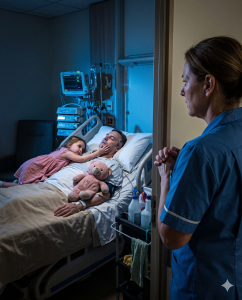
All the doctors had given up, and the billionaire had been declared dead.
By the time the clock in the fourth-floor hallway clicked to 11:47 p.m., Room 418 at Saint Agnes Private Hospital had become a place where hope was spoken about only in the past tense. Machines still hummed. A ventilator still moved air. Lines still ran into Roman Hale’s arms. But the room itself had changed. It had settled into that terrible stillness hospitals know too well — the one that arrives before families do, before grief catches up, before the paperwork turns a person into a case.
Roman Hale had built half the skyline people associated with power. His real estate empire stretched across Manhattan and beyond. He was the man newspapers called cold, rivals called dangerous, and investors called brilliant. He was the kind of wealthy that made strangers lower their voices when saying his name.
But in Room 418 he was just a failing body.
The doctors had fought for eleven days. A cardiac event had led to complications. Complications had led to swelling. Swelling had led to a neurological collapse no one could reverse. By the end, three specialists stood near his bed looking defeated in different ways.
Dr. Levin, the cardiologist flown in from Boston, had the stiff professionalism of a man who had delivered too much bad news to count. Dr. Shah, the neurologist, was older, silver-haired, and so respected that families often treated his words like verdicts. Dr. Ortega, the intensivist who had hardly slept since Roman was admitted, was the one left to say it aloud.
“There is no meaningful neurological recovery,” she said quietly. “We are no longer seeing useful activity.”
Roman’s daughter Sarah stood on the opposite side of the bed, holding his hand so tightly her knuckles had gone white. She was twenty-six, dark-haired like her mother had been, with the same steadiness Roman himself had sharpened into her over the years.
She did not cry.
That was not because she didn’t want to. It was because she had learned what grief looked like to opportunists. It looked like weakness. And her father had spent her entire life teaching her never to bleed in front of wolves.
There were wolves everywhere.
By midnight, the first wave had arrived.
Lawyers entered the floor with low voices and urgent eyes. Two board members called from London. Roman’s cousin Evelyn, who had not visited him once in the hospital, appeared in glossy black sunglasses and an expensive coat despite the summer heat. Then came Calvin Mercer, Roman’s brother-in-law and longtime executive vice president of Hale Urban Holdings.
Calvin knew how to look solemn without appearing wounded. He had mastered the expression years ago — a calculated blend of gravity, patience, and concern. Tall, elegant, silver at the temples, he moved through the hallway as if he already belonged to the future forming around Roman’s body.
He approached Sarah gently, which somehow made him worse.
“I’m sorry,” he said.
She stared at him.
He lowered his voice. “There are things that have to be addressed tonight. Temporary control. Voting authority. Restricted accounts. If we delay—”
“My father is still warm,” Sarah said.
Calvin paused.
“And you’re already counting his buildings.”
His expression barely shifted. “Your grief is understandable, Sarah. But the company can’t wait on emotion.”
The words hung between them like a slap.
Night nurse Mernetta Jackson heard it from six feet away and stepped in before Sarah could answer. Mernetta had worked enough years to know the difference between a grieving relative and a circling vulture. She was broad-shouldered, calm under pressure, and carried authority without ever needing to raise her voice.
“This floor is not a boardroom,” she said. “Everyone out.”
There was some resistance, mostly from Calvin, but she won. Hospitals give nurses a certain kind of battlefield power. She dimmed the room, adjusted Roman’s blanket, checked the lines one more time, and guided Sarah toward the door.
“You need two hours,” Mernetta told her. “Not to surrender. To return standing.”
Sarah looked back at her father. The angles of his face seemed too sharp now, as if life itself had already begun withdrawing from him.
“I don’t want him alone.”
“He won’t be alone,” Mernetta said.
That turned out to be truer than either of them knew.
In the hallway, Sarah passed Ada Wren.
Ada was pushing a cleaning cart stacked with disinfectant, paper rolls, gloves, and folded cloths. She wore scrubs under a faded housekeeping jacket, and there was a weariness in the way she stood that came not from one hard day but from a long hard life.
She had worked the fourth floor at Saint Agnes for nine years.
She knew which family members needed coffee before they knew it themselves. She knew how to straighten a waiting-room blanket without waking a sleeping child. She knew how to mop around someone’s grief without disturbing it. She knew the strange intimacy of being nearly invisible in places where people experienced the worst moments of their lives.
Ada was thirty-four and raising her daughter alone. She took classes toward a nursing credential whenever she could afford tuition, using used textbooks with cracked bindings and highlighted pages from other people’s lives. Her dream was not glamorous. It was simple and huge at the same time: stable hours, enough money to stop choosing between rent and childcare, and a future where her daughter could go to sleep without hearing her mother cry behind a bathroom door.
That night, Lily was with her.
The child had a pink dress with a frayed hem and a stuffed teddy bear she carried everywhere. The bear’s left ear had collapsed from years of being loved too hard. The fourth-floor supervisor knew Ada occasionally had to bring Lily on overnight shifts when childcare arrangements fell apart. The supervisor also knew Ada never abused the privilege.
So Lily slept in the family lounge on a folding cot while Ada worked.
Until she didn’t.
At 2:16 a.m., Ada went to check on her and found the cot empty.
For half a second, her mind refused to process what she was seeing. Blanket pushed back. Pillow crooked. Bear gone.
Then fear hit.
She searched the family restroom. Nothing. The coffee alcove. Nothing. Vending room. Waiting area. Still nothing. Her breath turned thin and sharp as she reached the corner near Room 418.
The door was slightly open.
Its latch had been malfunctioning all week. Maintenance had been asked twice. No one had come.
Ada pushed the door inward.
And stopped moving.
Lily was on Roman Hale’s hospital bed.
The child was curled carefully beside the body everyone on the floor believed was gone. One tiny hand rested against Roman’s cheek. Her teddy bear lay against the center of his chest, tucked there with solemn care. Her face was serious in the way only small children can be when they are trying to fix something bigger than themselves.
She was whispering.
Ada stayed in the doorway, too shocked to react.
“Don’t go,” Lily said softly. “Your daughter is sad.”
Ada should have pulled her away immediately. Protocol screamed through her mind. She could lose everything. A hospital room with a deceased high-profile patient was not a place for a child, much less the daughter of a housekeeper on an unofficial overnight shift.
But then the monitor changed.
Only slightly.
A flicker. A tremor. The thinnest disturbance in the useless line.
Ada stared at it.
Lily kept speaking in that patient little voice children use with hurt animals and sleeping parents and broken toys they still believe can be fixed.
“She needs you,” she whispered. “You have to stay.”
Ada approached slowly, every nerve in her body firing. She sat in the chair beside the bed, one hand hovering near the rail, the other resting lightly against Lily’s back. She didn’t know whether she was in the middle of a disaster or a miracle. She only knew that something in the room had changed.
The air felt charged.
Time stretched.
At some point Lily laid her head down against Roman’s side, still clutching one edge of the teddy bear. Ada did not move her. She was afraid that any interruption might break whatever fragile thread was suspended there in the dark.
At 4:23 a.m., Roman Hale moved his head.
Ada hit the emergency button so hard she split the skin of her finger.
Mernetta ran in first. A resident followed. Then another nurse, then Dr. Ortega, hair still damp from a rushed wash in the call room sink. They all stopped at the sight of the little girl asleep against the man who had been declared dead.
Mernetta looked from the child to the monitor to Ada.
“Ada,” she whispered. “What happened?”
Ada shook her head, tears already burning behind her eyes. “I don’t know.”
Roman’s lips moved.
Sarah was called back immediately.
She arrived in under twenty minutes, breathless, pale, with her coat half-buttoned and her hair unfastened from the hurried drive. She crossed the room in three strides and grabbed the bed rail as if it were the only solid thing left in the world.
“Dad?”
His eyelids fluttered, then opened just enough to find her. His breathing was weak, but present. His mouth worked with effort. It was like watching a man drag himself uphill through mud just to speak one sentence.
“Don’t…” he rasped.
Sarah leaned closer, tears finally spilling without permission. “I’m here. I’m here.”
Roman swallowed painfully. His eyes drifted toward the door.
Calvin stood there.
Someone had called him when word spread that Roman Hale had shown signs of life. He had arrived before sunrise in a fresh suit and a carefully arranged expression of concern.
The second Roman saw him, concern vanished from the room.
“Don’t let…” Roman whispered, his voice tearing. “Calvin…”
The silence that followed was not confused. It was electric.
Sarah turned slowly toward her uncle.
Calvin lifted both hands a few inches, almost offended. “He’s disoriented.”
But Roman was still looking at him. And even half-dead, there was recognition in that stare. More than recognition. Warning.
Dr. Ortega stepped in, trying to keep the room under control. “He needs rest. No one push him.”
Roman fought for another breath anyway.
“Safe,” he muttered. “Files… not accident.”
Sarah felt the bottom fall out of the world.
Not accident.
Her father’s collapse had been described as a catastrophic medical event. Sudden. Unpredictable. Tragic. Now the man himself was saying otherwise.
Calvin’s face remained composed for one second too long.
Then Lily woke.
She lifted her head, rubbed one eye, looked across the room at the polished man in the doorway, and pointed.
“He’s the bad one,” she said sleepily.
No one spoke.
Calvin gave a smile so thin it looked painful. “That is absurd.”
“No,” Sarah said, never taking her eyes off him. “What’s absurd is how fast you started grabbing for my father’s company.”
Security was called. Calvin objected with wounded dignity. But Roman, gathering the last of a failing body’s strength, forced out one more sentence.
“Desk… blue folder… Marina account…”
It was enough.
Sarah knew her father’s habits. Knew his private study. Knew there was only one desk he trusted for sensitive material. By eight-thirty that morning, while Roman was stabilized and moved under tighter medical supervision, she was inside his penthouse office with two company attorneys who had never been close to Calvin.
The blue folder was in the locked lower drawer.
Inside it was a nightmare.
Emails. Offshore transfer records. Shell entities. Internal memos. A private investigation Roman had apparently begun before his collapse. Attached to the front was a note in her father’s handwriting.
If anything happens to me, check Calvin’s redevelopment accounts and the Marina purchase.
Sarah sat down hard in Roman’s leather chair.
The Marina purchase was a waterfront acquisition Calvin had managed personally six months earlier. On paper it looked profitable. In reality it had been a maze of inflated contracts, ghost vendors, and siphoned funds. Buried deeper was something worse — evidence that Calvin had pressured a pharmaceutical consultant tied to one of Roman’s wellness clinics, trying to push a supplement regimen through Roman’s private physician network despite incomplete safety disclosures.
There was no single page that proved attempted murder.
There didn’t need to be.
What the file proved was motive, access, fraud, and the fact that Roman had discovered it. There were notes about a confrontation scheduled the morning of his collapse. There were references to blood pressure irregularities after a private dinner at Calvin’s home. Enough to begin a criminal inquiry. More than enough to destroy Calvin’s place inside the company.
By noon, board members were in emergency session. By two, federal investigators had been contacted. By four, Calvin’s office had been sealed, his devices seized, and his public statement cancelled before it could be printed.
He tried denying everything.
Then he tried reframing it as misunderstood strategy.
Then he tried to paint Sarah as emotionally unstable from grief.
That ended when Roman, against every expectation, regained enough strength to give a recorded statement from his hospital bed.
He didn’t speak long. He didn’t need to.
He confirmed he had been investigating Calvin. Confirmed that he believed company funds were being diverted. Confirmed that he had confronted him shortly before his collapse. Confirmed that the blue folder contained records he had hidden because he no longer trusted anyone inside the executive circle except Sarah.
Calvin was escorted from Hale Urban Holdings two days later.
The newspapers called it a shocking internal betrayal. Financial channels speculated around the clock. Rivals pretended sympathy while quietly celebrating the chaos. The city that had once feared Roman Hale now consumed his crisis like theater.
But the most extraordinary part of the story never fit neatly into a headline.
Not the fraud.
Not the boardroom collapse.
Not the billionaire returning from the edge of death.
It was the little girl.
Hospital administration launched an immediate review once it became clear a housekeeper’s child had somehow entered Room 418 during the night. Ada expected suspension at best, termination at worst. She prepared herself for humiliation. She brought every document she had, every childcare denial notice, every schedule, every shift log proving she had never once treated the hospital carelessly.
Instead, something no one expected happened.
Sarah Hale asked to speak at the review.
Ada stood there in a borrowed blouse, hands shaking, while executives discussed policy and liability in expensive language. Then Sarah entered, set a folder on the table, and spoke with the quiet force of someone who had not slept but had found clarity anyway.
“If you punish this woman,” Sarah said, “you will punish the only person on that floor who gave my father compassion after everyone else had moved on to paperwork.”
The room shifted.
Sarah continued. She explained that Ada had not exploited access, had not sought attention, had not sold a story, had not once tried to use what happened for gain. She described finding her father alive with a sleeping child beside him and hearing the first warning that likely saved Roman’s company — perhaps more than his company.
Then Roman himself sent a message from recovery.
It was brief. Typical Roman. The hospital board read it in silence.
Ada Wren showed more humanity in one night than many highly paid people in my life have shown in years. Keep her. Promote her. And fix your damn door locks.
That changed everything.
The disciplinary action disappeared.
The hospital funded the maintenance failures review within the week. Marguerite, the supervisor who had quietly looked the other way for years, cried in the stairwell when she heard Ada would not be fired.
But Roman didn’t stop there.
Once he was stable enough to leave intensive care, he asked for Ada and Lily.
Ada walked into his private recovery suite trembling. Lily hid behind her leg at first, clutching the tired pink teddy bear. Roman looked much smaller in a hospital bed than he ever had in photographs, but his eyes were clear now — sharp, observant, alive.
“I’m told,” he said, voice still rough, “that you gave me strict instructions.”
Lily nodded solemnly. “I told you not to go because your daughter was sad.”
For the first time, Ada saw something in Roman Hale she never expected to see.
His face broke.
Not dramatically. Not with sobbing. Just a crack in all that iron. His eyes filled. One hand covered his mouth for a second as if emotion itself offended his habits.
Then he held out the other hand to Lily.
“Thank you,” he said.
She crossed the room and placed the teddy bear in his lap as if formal gifts were expected.
Roman laughed, weak but real.
The weeks that followed remade lives.
Sarah assumed temporary leadership while her father recovered. She did it fiercely, and she did it well. People who had underestimated her because she was Roman’s daughter rather than Roman himself learned quickly that they had made a serious mistake.
Calvin was indicted on multiple financial crimes before the season changed. Other charges remained under investigation. Society friends vanished from his side almost overnight. Evelyn issued a statement about family pain that no one believed.
Roman, forced into stillness for the first time in decades, began seeing what power had hidden from him. He asked questions he had never asked before — about staffing shortages, about overnight workers, about why someone with Ada’s intelligence had spent nine years cleaning floors while teaching herself medicine from secondhand books.
When he learned she had been working toward nursing credentials one class at a time, he funded the rest of her education.
Not as charity, he insisted.
As investment.
Ada cried in the parking garage when the scholarship papers were placed in her hands. Then she laughed through the tears because she had spent so many years imagining rescue would look grand and cinematic, and instead it looked like tuition coverage, reliable childcare, and a schedule that let her sleep.
Lily got a proper bedroom that year. Pink walls. A lamp shaped like a moon. Shelves for books. A new teddy bear she ignored because she still preferred the old one with the ruined ear.
Roman visited once, at Sarah’s insistence, carrying a dollhouse that cost more than Ada’s first car. Lily thanked him politely and then made him sit on the floor for a tea party he was clearly unequipped to survive.
Sarah watched him there — a feared billionaire sitting cross-legged on a rug, accepting imaginary tea from the child who had spoken to him when the whole world thought he was beyond hearing — and something softened between father and daughter too.
He had almost died before realizing how many people he had expected loyalty from without offering tenderness in return.
Recovery didn’t make Roman a saint. He was still demanding. Still sharp. Still intimidating enough to frighten weak executives. But he changed in places that mattered. He called Sarah more. Listened longer. Stopped treating love like an inefficiency. He created a family emergency fund for hospital workers after learning how many were one missed paycheck away from collapse. He donated to Saint Agnes with one nonnegotiable condition: no employee would have to hide a child in fear again because the system offered them no humane alternative.
Months later, when Ada passed her first nursing certification exam, Sarah took her and Lily to dinner.
They celebrated in a quiet restaurant overlooking the river. The city lights flickered on the water like broken gold. Lily fell asleep in Ada’s lap before dessert arrived.
Sarah watched them and said, almost to herself, “You know my father still says she bullied him back to life.”
Ada smiled. “Sounds like Lily.”
Sarah’s smile faded into something deeper. “I used to think power meant making everyone afraid to lose you. That was my father’s language. Maybe mine too. But that night… the only thing that reached him was gentleness.”
Ada looked down at her daughter’s sleeping face.
Room 418 had changed everything. Not because a miracle came with thunder or spectacle. Not because death was defeated in some clean, cinematic way. Roman’s recovery took medicine, timing, luck, and a body that had not entirely surrendered.
But there was still one truth none of them could explain away.
At the loneliest hour of the night, after experts had stepped back and opportunists had stepped forward, it was a poor maid’s little girl who climbed into the bed of a man everyone had abandoned to silence, pressed a worn teddy bear to his chest, and told him not to leave because his daughter was sad.
And somehow, whether by mystery or mercy or the last stubborn thread of a human heart hearing exactly the right voice, he listened.
That was the part no boardroom could measure.
And maybe that was the most unsettling thing of all.
A city full of powerful adults had gathered around Roman Hale at the edge of death, but the clearest soul in the room belonged to the child with the broken teddy bear. The empire was saved by evidence, lawyers, and one surviving statement. But the man himself?
That was harder to explain.
Some would call it coincidence. Others would call it medicine catching up a few hours late. A few would insist it was something holier.
Sarah never argued with any of them.
She only knew this: when the rich and polished people around her started behaving like vultures, the person who stayed human was the woman with the cleaning cart… and the smallest person in the hospital was the one who knew her father was still worth speaking to.