Every morning for six weeks, Loretta Mae Hutchins packed two lunches.
One for herself.
One for the boy she didn’t know.
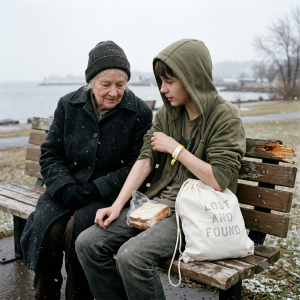
She’d spotted him the first Tuesday of September, sitting alone on the bench by the lake path in Leif Erikson Park — the one with the busted armrest she’d been meaning to report for three years. He was maybe sixteen, seventeen at most. Thin in the way that worried her. Not the skinny of a fast metabolism. The skinny of a missed meal.
He had a backpack propped against his knee.
That was the first thing that caught her eye.
Not a regular school bag. It was one of those white drawstring bags, the kind with a printed logo on the side. Faded, but she’d know that logo anywhere after thirty-two years working two blocks from St. Luke’s.
It was a hospital lost-and-found bag.
She told herself it was none of her business.
Then she went home and made an extra turkey sandwich.
—
Loretta had cooked for strangers her whole life. Forty-one years behind the counter at Shorty’s Diner on Superior Street. She knew hungry when she saw it — the way a person holds themselves differently when they’re not sure where the next meal is coming from. Careful. Quiet. Like they’re trying not to take up too much space in the world.
This boy took up no space at all.
She started leaving the lunches tucked just inside the top of that white bag when he’d get up to use the park restroom around noon. Turkey and Swiss on sourdough. A zip-lock of grapes. A little bag of those Pepperidge Farm Goldfish crackers, because something told her he might still like those.
She never signed her name. She didn’t want to embarrass him.
She just watched from her usual bench, forty feet away, knitting her granddaughter’s Christmas sweater, and felt something warm settle in her chest when he’d come back, open the bag, and go still for a moment.
Like he was trying to figure out if kindness was real.
—
Three weeks in, she noticed the wristband.
He’d reached into the bag, and his sleeve rode up — just for a second — and there it was.
A hospital wristband. Yellow. The plastic so worn it had gone the color of old paper.
He caught her looking. Tugged his sleeve down fast. Didn’t meet her eyes.
She pretended she hadn’t seen a thing.
But every day after that, she noticed. The way he’d absently pull at that sleeve. Thumb running over the wristband like it was a worry stone. Sometimes he’d stare at the lake for long stretches, not on his phone, not reading — just somewhere else entirely behind those quiet eyes.
Who wears a hospital wristband for weeks after discharge?
Someone who isn’t ready to take it off.
—
She started leaving notes with the lunches. Nothing heavy. Just small things.
*The lake’s pretty today.*
*Hope you like apple slices. I added peanut butter.*
*You’ve got good taste in benches. Best view in Duluth.*
He never responded. But one afternoon she found a single folded napkin tucked under her own bag.
*Thank you* was all it said. The handwriting was careful. Like someone who’d been taught that penmanship mattered.
She pressed that napkin flat and put it in her coat pocket and didn’t tell a soul.
—
It was a Thursday in mid-October when the first snow of the season started drifting down over the park, and she decided enough was enough.
She picked up her lunch, walked across the path, and sat down on the other end of his bench.
He didn’t run. That felt like something.
They sat in silence for a while. She watched the snow. He watched the lake. She pulled out his sandwich — she’d made it fresh that morning, knowing somehow — and set it on the bench between them.
“I’m Loretta,” she said.
“I know,” he said. “I looked you up. You used to work at Shorty’s.”
She laughed a little at that. “Forty-one years. You a regular?”
“My mom was.”
Something in the way he said *was* made her chest tighten.
She watched his hand move to his sleeve again. That familiar tug. The yellow wristband peeking out just a fraction before he covered it back up.
She thought about all the lunches. All the notes. All the quiet mornings on that bench, the two of them strangers sharing the same grief-heavy air without saying so.
And she asked him, soft as she could — the way she used to talk to the overnight truckers at Shorty’s who just needed someone to sit with them a while — she asked him whose name was on that wristband.
He looked up at her then.
Those tired, tired eyes.
And he said, *”It was supposed to be mine.”*
—
She didn’t ask him to explain. She just waited, the way you wait for something fragile to find its own way to you.
The snow kept coming down, light and early, not enough to stick yet. Just enough to make the world feel hushed.
His name was Caleb. He told her that first, like it was important to establish. Like he needed her to know he had one.
Caleb Durst. Seventeen years old. He’d been a junior at Denfeld High until the spring, when things had, in his words, gotten complicated.
The wristband wasn’t his, exactly. That was what he’d meant, and the truth of it was quieter and more devastating than anything she’d imagined.
It was his mother’s.
Her name was printed on that worn yellow plastic in the thin block letters she’d seen a thousand times from her years near St. Luke’s. DURST, MARIE A. Room 4-North. The date on it was April 3rd.
Marie Durst had gone into St. Luke’s on April 3rd with what she thought was a bad case of pneumonia. She had no insurance. She’d put off going for three weeks because of that, Caleb said. Three weeks.
By the time she got there, it wasn’t pneumonia anymore.
She died on April 19th. A Thursday. Caleb had been sitting with her, holding her hand, watching the lake out the fourth-floor window because she’d asked him to describe it to her. She’d always loved Lake Superior. Said it was the only ocean Minnesota ever got.
He’d described the lake to her until she didn’t need him to anymore.
The wristband was still on her wrist when they took her away. A nurse, a kind one, had come out to the family waiting area with it a little while later. Caleb was the only family there.
He’d put it in his pocket.
He hadn’t been able to put it anywhere else since.
—
Loretta sat with all of that for a moment. The snow. The lake. The boy next to her, who was holding himself the way she’d noticed from forty feet away back in September — careful, quiet, trying not to take up too much space.
“Where are you staying?” she asked. She kept her voice even. The way you ask something when you already suspect the answer is going to require you to do something about it.
He shrugged one shoulder. “I was with my uncle for a while. Over in Hermantown. That didn’t really work out.”
“How long?”
He looked at the lake again. “Since August, pretty much.”
She did the math fast. Since August. The white hospital bag. The way he ate like someone rationing. Six weeks of sandwiches that probably filled a gap she hadn’t fully understood until right now.
“The bag,” she said.
He nodded. “Lost and found at St. Luke’s. I go there sometimes. The chaplain lets me sit in the chapel when it’s cold.”
Loretta Mae Hutchins had lived seventy-three years on this earth. She had buried a husband and a sister and a best friend of forty years. She had served coffee to men coming off twelve-hour iron ore shifts and to women who hadn’t slept in two days and to children who came in with their parents and then came in without them. She was not a woman who cried easily or often.
She cried a little then. Just a little. She turned her face toward the lake so he wouldn’t feel responsible for it.
Then she picked up the second half of his sandwich and held it out to him.
“You’re going to eat that,” she said. “And then you’re going to come home with me and have a hot meal and a shower, and we’re going to figure out the rest after that. In that order.”
He looked at the sandwich. Then at her.
“You don’t have to do that,” he said.
“I know I don’t,” she said. “Eat.”
—
He came home with her.
She fed him chicken and dumplings — she’d made a full pot that morning, which she later decided she hadn’t done by accident. He ate two bowls. She pretended not to notice how fast, because she knew he was trying to be polite about it and she didn’t want to take that from him.
She called her daughter Renee that night after Caleb had fallen asleep on the couch under the afghan she kept folded over the armrest. Renee worked in social services over in Carlton County and knew people. She’d know what to do, or know who did.
The conversation took forty-five minutes. Loretta sat at the kitchen table in the dark and listened and said yes and wrote things down on the back of an envelope.
When she hung up, she sat there a little longer.
She thought about Marie Durst, who used to come into Shorty’s. She hadn’t placed it at first — Durst wasn’t an uncommon name and the diner had seen thousands of faces across forty-one years. But at some point in those six weeks, memory had come loose the way it sometimes does. A woman who came in on Sunday mornings. Dark hair. Sat at the counter. Always ordered the same thing — two eggs over easy, rye toast, a small orange juice she’d nurse all the way to the bottom. Always left a good tip, the kind of tip that told you she’d been on the other side of a counter herself once.
She’d sometimes brought a boy with her. Quiet. Good manners.
Loretta hadn’t connected it until right now, sitting in the dark with the envelope.
She looked over at the couch.
There he was.
—
The next few months were not simple. Loretta hadn’t expected them to be.
Renee came up from Carlton County on the weekend and sat at the kitchen table with Caleb and a mug of coffee and asked him questions so gently he answered most of them without seeming to realize he was doing it. There were forms to fill out. Phone calls to make. A caseworker named Diana who drove up from Duluth’s family services office and was no-nonsense in exactly the right way, the way that made Caleb feel handled with competence rather than pity.
The uncle in Hermantown was contacted. The situation there was what Loretta had suspected — not malicious exactly, just a man who hadn’t been prepared and had eventually made that clear in ways that weren’t kind.
There was a conversation about Caleb’s options. He was seventeen, which complicated certain things and simplified others. He was also, it turned out, an exceptionally good student — Diana pulled his records and the transcript that came back surprised even Caleb himself, as though he’d forgotten that version of his life existed.
Loretta didn’t insert herself where she didn’t belong. She fed people when they were at her table. She made sure there was always something warm on the stove. She did not pretend this was simple or that she fully understood what she’d walked into that Thursday in the snow.
But she showed up. That was the thing she knew how to do.
—
Caleb went back to Denfeld in January.
By then there was a proper arrangement in place — a foster placement, a good one, with a couple named the Okafor-Bergmanns over on the east side who had done this before and understood the shape of what a kid like Caleb needed, which was mostly steadiness and not being asked to be grateful out loud.
His first day back at school, Loretta packed him a lunch.
Turkey and Swiss on sourdough. Zip-lock of grapes. The Goldfish crackers.
She tucked a note in with it.
*You’ve got this. Best view from Denfeld’s the lake anyway. — L*
He texted her that afternoon. He had her number by then.
*Decent view. Cafeteria is worse than the park bench.*
She laughed out loud in her kitchen, alone, and felt that warm thing settle in her chest again.
—
In March, she got a letter in the mail. Handwritten. That careful penmanship.
He’d been thinking, he wrote, about what he wanted to do after graduation. He’d talked to his school counselor, who’d mentioned a program. There was a certified nursing assistant track at Lake Superior College that high school juniors could start over the summer. It wasn’t doctoring, he wrote. But it was something.
He said he’d been in a hospital room for a lot of hours in his life and he’d noticed which people made those hours easier and which ones made them harder and he thought maybe he could be useful in that way.
He said he still had the wristband. He wasn’t ready to talk about what he was going to do with it. But he’d been thinking about that too.
He signed it *Caleb*, and then underneath, in smaller letters, *Your bench regular.*
Loretta read it twice at the kitchen table. Then she got out a piece of her good stationery — the cream-colored stuff she saved for important things — and she wrote him back.
She told him his mother used to come into Shorty’s on Sunday mornings. She told him about the two eggs over easy and the rye toast. She told him his mother always left a good tip, and that said something about a person.
She said she thought the CNA program sounded exactly right.
She said the wristband could wait as long as it needed to.
She said some things you hold onto not because you’re stuck, but because you’re not finished yet. And that was okay. That was allowed.
She sealed the envelope and put a stamp on it and set it by the door so she wouldn’t forget it in the morning.
Then she went to the kitchen and started on tomorrow’s lunches.
Two of them.
Old habits, she figured. The good kind.