Every Saturday for six weeks, she noticed the boy.
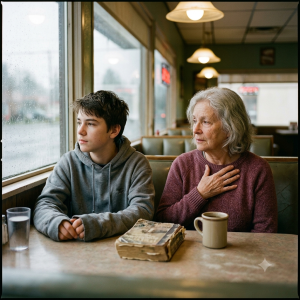
Same booth. Same corner. Same worn paperback pressed flat against the laminate table like it might float away if he let go.
Margaret Elaine Howell had been a school librarian for thirty-one years. She knew the way a child holds a book they love. She knew the way a child holds a book they need.
This was the second kind.
She started going to Pearl’s Diner on purpose after that first Saturday. Told herself it was the biscuits. It was not the biscuits.
The boy was maybe fifteen, sixteen. Quiet the way some kids are quiet — not shy, just somewhere else entirely. He always arrived before she did and was always gone before the lunch crowd. He wore the same gray hoodie every week, sleeves pulled down over his hands even when the heat kicked on and the windows fogged up from the cold.
But it was the book that kept pulling at her.
Where the Red Fern Grows. Paperback. The spine was cracked in three places, the cover soft and faded the way a book gets when it has been read by more than one pair of hands. She could see it from two tables over. She is a librarian. She always notices the book.
The third Saturday, she got close enough to see the inside cover.
There was a name written there. In a woman’s looping cursive. Not his name — she would learn that later. A different name entirely. Written in blue ink that had gone a little purple with age.
She thought about it all week.
The fourth Saturday she watched him more carefully. He ordered coffee. Just coffee. Wrapped both hands around the mug like it was the warmest thing in the room.
He wasn’t eating.
Not a biscuit. Not a side of toast. Not even one of Pearl’s two-dollar sweet rolls that sit right there on the counter under the glass dome where you cannot miss them.
Just coffee. And the book. And that name on the inside cover that wasn’t his.
By week six, Margaret Elaine Howell had eaten enough biscuits she didn’t want to see another one until Easter. She had also made a decision.
She picked up her coffee, walked across the diner, and sat down across from him without asking.
He looked up, startled. She had kind eyes and she knew it, so she led with them.
“I’m Margaret,” she said. “I’ve been a librarian my whole life and I haven’t been able to mind my own business about that book for six Saturdays now. I’m sorry for intruding. You don’t have to talk to me.”
He stared at her for a long moment.
Then he slid the book an inch across the table. Not toward her. Just — moved it. Like he was deciding something.
“It’s a good book,” he said. His voice was quieter than she expected.
“It’s a heartbreaking book,” she said. “I’ve watched grown men cry at the end.”
Something shifted in his face. Not quite a smile. Something more fragile than that.
She looked down at the cover, then back at him.
“The name on the inside,” she said gently. “Is that yours?”
He shook his head.
“Somebody who gave it to you?”
He didn’t answer right away. He picked the book up. Held it the way she recognized — not like a child holds something they love. Like a child holds something that is all they have left.
Outside, the rain had started. She could hear it ticking against the diner windows, soft and steady, and Pearl had turned the lights up a little the way she always did when it rained, and the whole place felt smaller and warmer and closer than it usually did on a Saturday morning in Savannah.
He looked down at the name in the inside cover.
She waited.
He closed the book slowly.
Looked out the rain-streaked window.
And said the thing that made Margaret Elaine Howell, thirty-one-year school librarian, press her hand flat over her heart without even meaning to.
“She was my mom,” he said quietly. “She died in this booth. Three years ago today.”
Margaret did not say she was sorry. She had been a librarian long enough, and a person long enough, to know that sorry was what people said when they didn’t know what else to do with their hands. She just stayed where she was. Kept her eyes on his face. Let the rain fill the silence for both of them.
After a moment he said, “She used to bring me here on Saturdays. Before she got sick. We’d split the biscuits and she’d read out loud. She did voices.” He said that last part a little helplessly, like it still surprised him. “Billy’s dad she did real low. The grandpa she did kind of wavery. She said it wasn’t cheating if it made the story better.”
“It’s not cheating,” Margaret said.
He nodded like he already knew that, like he just needed to hear it confirmed by someone outside his own head.
His name was Caleb. He told her that a few minutes later when Pearl came by to refill Margaret’s coffee and gave the boy a look that was not unkind — more like the look of someone who had been watching a situation develop and was relieved it was finally developing. Pearl brought him a sweet roll without being asked. Set it down in front of him with the quiet authority of a woman who has fed people through hard things for forty years and does not make a production of it.
He ate it. Margaret noticed that too.
His mother’s name, the name in the inside cover written in ink gone a little purple with age, was Diane. Diane Parrish. She had been thirty-eight years old. A cardiac event, Caleb said, using the clinical words with the careful steadiness of someone who has had to explain it many times to many adults who needed him to be calm so they didn’t have to be. She had been sitting right here, in this booth, reading to him, and then she wasn’t.
“The paramedics came,” he said. “And everything that happens after that — it happens fast. And then slow. And then you’re just standing in the parking lot of a diner and someone is handing you her purse and her book and her coat because she’s not going to need them anymore and you’re fourteen years old.”
Margaret pressed her hand flat on the table this time instead of her heart. She didn’t say anything. He didn’t need her to.
He lived with his aunt now on the east side of town. Good woman, he said. Trying hard. Two kids of her own and a job and a half and not a lot of room, but she was trying. He said it the way teenagers say things about the adults who are doing their best — with a generosity that costs them something.
He came back to Pearl’s every year on the Saturday closest to the date. Sometimes on the actual date if it fell on a Saturday like this one did this year. He wasn’t sure why, exactly. It was the only place, he said, looking down at the table, where he could still sort of hear her voice. In his head. Doing the voices.
“You’ve been coming alone?” Margaret asked.
He shrugged, which she understood to mean yes.
She looked at him sitting there in that gray hoodie with his hands wrapped around a mug of diner coffee, sixteen years old, alone in the booth where his mother died, reading the book she’d left him, and she thought about thirty-one years of watching children carry things that were too heavy for them and pretend otherwise.
“Do you want me to read some of it to you?” she asked.
He looked up. She was not sure he had expected that.
“I won’t do voices,” she said. “I want you to know that up front. I am not a voices person. But I’m a pretty good reader.”
He stared at her for a long moment. There was something happening behind his eyes — some careful internal negotiation between the part of him that was sixteen and didn’t want to need anything and the part of him that was still fourteen and standing in a parking lot holding his mother’s things.
He slid the book across the table. All the way this time.
She opened it to the first page. She could see the name in the inside cover — Diane, in that looping cursive gone purple with age — and she said it quietly to herself before she began, the way you do when you want to honor something small.
Then she read.
She read for forty-five minutes. The rain came down and Pearl refilled their coffees and two tables over a couple argued quietly about directions and the whole diner went about its Saturday business around them, indifferent and warm. Margaret read about Billy and his dogs and the hills of Cherokee country and the way love works when you are young and it is fierce and it does not know yet that it is going to have to survive losing something.
When she stopped to rest her voice he said, without looking up from the table, “She always stopped there too. At that same chapter.”
“It’s a natural stopping place,” Margaret said.
“Yeah,” he said.
She gave him back the book. He held it the way she had watched him hold it for six Saturdays, and now she knew what she was looking at, and it was not grief exactly — or not only grief — but something more durable than that. More complicated. The way love becomes an object when it has nowhere else to go.
She left him with her phone number written on a Pearl’s Diner napkin, the kind with the little coffee cups printed on the border. Told him she was at the Chatham County public library on Tuesdays and Thursdays if he ever wanted to talk books, or not talk at all, or just needed somewhere quiet to be.
He folded the napkin and put it in the front cover of the book, right next to his mother’s name.
That was eleven months ago.
Caleb started coming to the library on Thursdays. Sometimes he read. Sometimes he sat at one of the big tables and did homework and drank the terrible library coffee without complaining, which Margaret respected. She introduced him to a few other books — not to replace the one he had, but to keep it company.
Slowly, over those Thursday afternoons, she learned more. That he wanted to study environmental science. That he was good at it, better than he’d been told to expect. That his mother had been a reader her whole life, the kind of person who wrote her name in her books the way some people make sure they always have ID — just in case.
In March, Margaret helped him apply for a small scholarship through the county literacy foundation. In April, he got it. Not a life-changing amount of money, but enough to matter. Enough to mean someone outside his own family had looked at him and seen what was there.
He texted her when he found out. Just three words.
I got it.
She was in the middle of shelving returned books in the 500s when her phone buzzed, and she stood there in the stacks with one hand on a field guide to Georgia birds and read those three words and had to take a moment to collect herself before she could go back to shelving.
This past Saturday — six weeks ago when I first saw all this, sitting two tables over from them at Pearl’s, minding my own business over a plate of biscuits I did not need — I watched an older woman in reading glasses sit down across from a teenage boy and open a book between them and just start reading.
I didn’t know what I was seeing. I thought maybe she was his grandmother. I thought maybe they were rehearsing something. I watched Pearl smile at them from behind the counter with the specific warm satisfaction of someone who has been watching this story unfold since its beginning.
I asked Pearl about it when I went to pay my bill.
She told me the short version, which isn’t really the short version at all.
Then last week I posted something small about it on my Facebook page — just a few lines, didn’t use names, just said I’d seen something that got me — and my notifications have not been the same since.
So I asked around. Found Caleb through a friend of a friend who knows his aunt. He is seventeen now. He said I could share the story as long as I got one thing right.
“Make sure you say she reads slow,” he said. “She reads slow and she doesn’t do voices. But she shows up every Thursday.”
And then he said, “That’s actually better.”
I promised him I’d get that part right.
I hope I did.
If you have a kid who is carrying something heavy and pretending not to, find them a Margaret. They are out there. They go to the library on Tuesdays and Thursdays. They sit in diners eating biscuits they don’t really want, watching for the thing they recognize in a stranger’s hands.
They know the way a child holds a book they need.
They show up anyway. That’s the whole thing. They just keep showing up.