Every Saturday morning for six months, he showed up right as Dolores was unlocking her garage door.
She never asked his name. He never offered it.
He was maybe fifteen, sixteen — lanky in the way teenage boys are when they’ve grown three inches before their confidence caught up. Always wearing the same clean white t-shirt. Always carrying a plastic garment bag over one arm like it weighed more than it should.
Inside was always the same thing: a formal dress. Silk, or something trying to be. Beaded sometimes. Always beautiful. Always broken.
A split seam here. A torn hem there. And almost every single time — at least one loose button. Small, white, satin. The kind that belonged on something special.
Dolores had been mending clothes out of her garage on Paseo del Norte for eleven years. No charge, ever. Just her machine, her coffee, and whatever the neighbors brought her.
But this boy was not from the neighborhood.
She never asked about that, either.
She’d take the dress, write him a little ticket, tell him Saturday next week. He’d nod — barely — and then do the thing that first made her look twice.
He’d check the dress one more time before he handed it over.
Running his fingers slow along the bodice, the sleeves, the collar. Looking for buttons.
If one was loose, he’d work it free right there in her driveway. Gently. Like he was handling something sacred.
He kept them in a folded piece of notebook paper.
She noticed it the second week — peeking out from his back pocket, soft and worn at the creases like it had been folded and unfolded a hundred times. When he’d find a loose button, he’d take that paper out so carefully, open it flat on his palm, and tuck the button inside with the others.
She counted once, when he set it on her workbench to free up his hands.
Seven buttons. Eight. Then nine.
He never let her touch it.
She didn’t ask why.
Some things you just know to leave alone.
The dresses were always formal. Always a woman’s size. Always needed the kind of repair that said they’d been worn hard and often — not stored in a closet, but lived in.
Dolores started to build a picture in her mind. A mother who worked events, maybe. Weddings, quinceañeras. Someone who needed to look put-together on a budget that didn’t allow for put-together. Someone whose son loved her enough to haul her dresses across town on a Saturday morning rather than let the seams give out.
He always picked them up looking relieved.
Like she’d handed him something more than fabric.
By month three, she started having the dress pressed and on a hanger when she saw him coming up the driveway. By month four, she started leaving a bottle of cold water on the workbench.
He started saying “thank you” instead of just nodding.
Small things. But with this boy, small things felt large.
Then last Saturday, he came without a dress.
He came with just the notebook paper.
Held in both hands, this time. Flat. Careful. Like an offering.
Dolores set down her coffee.
His face was different. Not the careful, closed face she’d learned over six months. Something had cracked open in it.
He stood in her driveway for a long moment, not saying a word.
Then he said, “She passed. Three weeks ago.”
Dolores pressed her hand to her chest.
“I’m so sorry, baby.”
He nodded. Looked down at the paper.
“She knew about you,” he said. “She said you were the reason she could keep going to work.”
Dolores couldn’t speak.
“I’ve been trying to figure out what to do with these.” He looked at the folded paper. “She saved every button that ever fell off, because she said she was going to sew them back on someday when things got better.”
He exhaled.
“Things didn’t get better. But she kept saving them anyway.”
Dolores reached out.
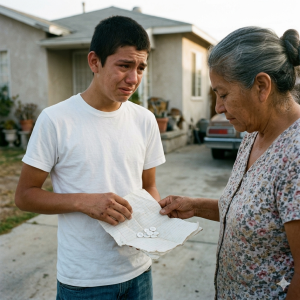
She reached for the notebook paper — the one he’d clutched through six months of Saturdays — and this time, he didn’t pull it away.
He opened it himself.
And what was inside was not just buttons.
There were fourteen of them, yes. Small, white, satin, exactly as she’d expected. But they were arranged in the paper with a kind of deliberate care — not loose and rattling around, but nestled into two neat rows, held in place by small strips of tape. Careful tape. The kind of careful that takes time.
And underneath each button, written in pencil in a woman’s handwriting, was a date.
Just dates. No other words.
Dolores looked up at him.
“She wrote down every time one fell off,” he said. His voice was steady in the way voices get when someone has cried until they’re temporarily out of crying. “Every time she lost a button at work, she’d find it if she could, bring it home, tape it in, write the date.”
He pointed to the first one. April of two years ago.
“That was her first big event. A wedding at the Hyatt. She was so nervous she said she forgot to eat all day.” He almost smiled. “Said she didn’t even notice the button was gone until she got home.”
Dolores was holding the paper like it was made of something that could dissolve.
“She worked catering,” he said. “Banquets, mostly. She’d been doing it since I was in fifth grade. The dresses were her uniform, basically. She bought them at Goodwill and she had four of them and she rotated them.”
He paused.
“She was proud of how she looked at work. That was a big thing for her. She said when you work a room full of people in nice clothes, you have to carry yourself a certain way or they look right through you.”
Dolores thought about the dresses. The way they’d been worn in, shaped by a body that moved in them constantly. She’d mended those dresses the way you mend something that matters, because she’d understood without being told that they mattered.
“She found you on her own,” the boy said. “She asked around. Someone told her there was a woman on Paseo del Norte who fixed things. She rode the bus the first time because she wasn’t sure it was real.”
The first time. Dolores thought back, tried to place a woman, couldn’t. Six months ago that first Saturday had been a morning like any other — coffee, the garage door grinding up, the familiar light.
“She didn’t come herself after that,” he said. “She worked Saturday mornings. So she sent me.”
He’d been doing it alone all those months. Getting himself across town on a Saturday, carrying those dresses, waiting, coming back the next week. A fifteen-year-old boy, honoring his mother’s system because it was her system and it worked.
“I want you to keep them,” he said, nodding at the paper. “The buttons.”
Dolores shook her head immediately. “Baby, these belong with you—”
“I know.” He said it gently, firmly, like he’d thought this through for three weeks and arrived somewhere solid. “I want them back eventually. But I want you to do something with them first.”
He reached into the pocket of his jeans and brought out a photograph. A woman in a deep green dress, standing in what looked like a hotel ballroom, holding a tray of champagne glasses. She was looking off to the side, not at the camera, and she was laughing at something. Really laughing. Head tilted back a little.
Beautiful dress. Dolores had mended it. She recognized the neckline.
“She talked about you like you were friends,” he said. “She said she never met you but she felt like she knew you. She said — ” he stopped, cleared his throat — “she said someday she was going to come by on a Saturday when she wasn’t working and bring you coffee and just talk.”
The thing Dolores had been holding back since he said “she passed” finally came loose.
She didn’t try to stop it. She just stood in her driveway and cried quietly, and the boy stood there and let her, because he’d been doing this for three weeks already and he understood that people needed a moment.
Then she opened her arms and he walked into them without hesitation.
He was tall — she’d noticed that before — and she is not a tall woman, so his chin came down to the top of her head and he just stayed there, this lanky boy with his mother’s photograph in his hand, in a stranger’s driveway on a Saturday morning.
After a while she pulled back and looked at him.
“What’s your name?” she asked.
“Marcus,” he said.
“Marcus.” She nodded. “Your mother raised someone good.”
He looked down.
“I’m going to tell you what I’m going to do with these buttons,” she said. “And you tell me if it’s okay.”
She took the paper back to her workbench and looked at it carefully in the light. Fourteen buttons, fourteen dates. A record of two years of work. Of getting up and getting dressed and going and not letting the small deteriorations stop you.
She told him she was going to sew them back onto the green dress. Every single one, even the ones that hadn’t come from it. She was going to put them all on — along the collar, where they’d look like they belonged — and she was going to press the dress, and she was going to put it in a proper garment bag.
And when she gave it back to him, it would be whole.
More whole than it had ever been.
Marcus was quiet for a moment.
“She would like that,” he said.
He came back the following Saturday. And the one after that. Not with dresses — with nothing, at first, and then eventually with homework he’d spread out on the workbench while Dolores sewed other things, the two of them not talking much, not needing to.
Some Saturdays he brought her coffee. The cheap kind from the gas station on the corner, in a styrofoam cup. She drank every drop.
The green dress is finished now. It’s hanging on the back of her garage door in a clear garment bag, every button in place, the seams straight and clean, the hem perfect.
Marcus says he’s not ready to take it yet.
She says it’ll be there when he is.
It’ll be there.