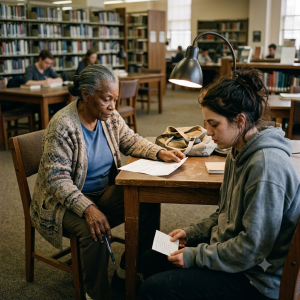
Every Thursday at 1 p.m., Dorothea set her notary stamp on the same wobbly table in the back corner of the Washington County Free Library and waited.
She’d been doing this for three years. Retired from the county clerk’s office, still needed somewhere to be useful. The library let her have the table, the good lamp, and a paper sign that read *FREE NOTARY SERVICE — No Appointment Needed.*
Most weeks it was landlords and renters. Power of attorney forms. The occasional affidavit.
But six months ago, a young woman started coming in.
—
She never gave her last name. Just “Mia.” Maybe twenty-five, twenty-six years old. Always the same gray hoodie, always five minutes early, always sitting with her hands folded tight in her lap like she was trying to hold herself together.
And always — *always* — that index card.
Small. White. Folded into a neat square. Mia would take it out of her front pocket the moment she sat down and just… work it with her fingers. Smooth it flat against her knee. Fold it back up. Smooth it flat again. Over and over, quiet as breathing.
She never once opened it to read it.
Dorothea noticed the first time and told herself it was nerves. Notarizing can feel official and scary if you’re not used to it.
But the second Thursday, the card came out again.
And the third.
And the fourth.
—
Dorothea is not a nosy woman. Fifty-one years in a small Maryland city will teach you which questions to ask and which ones to leave alone.
But she started watching Mia the way you watch a bird that keeps flying into the same window. Not to pry. Just because something in you recognizes that it *means* something.
The documents were always legal, always straightforward. Lease agreements. An employment verification. A medical release form once, for someone else — Mia had clarified that quietly, without being asked.
Dorothea stamped and signed. Made small talk about the weather. Offered Mia a butterscotch candy from the dish she kept on the table.
The second time she offered, Mia took one.
That felt like progress.
—
By month four, they had a routine. Mia would arrive, sit, take out the index card. Dorothea would pretend not to notice. They’d work through whatever document needed witnessing, and then Mia would carefully tuck the card back in her pocket and leave with a small, tired smile that never quite reached her eyes.
Once, when Mia dropped it and bent to pick it up, Dorothea caught a glimpse of the outside of the fold.
Nothing. Just plain white. Whatever was written on it was folded *in.*
She told herself it wasn’t her business.
She told herself that for two more months.
—
Last Thursday was cold for early May. The library was quiet. A grandfather was reading to a toddler two tables over, and the sound of it — that soft, patient voice — filled the whole room like something holy.
Mia came in at 1:02. Gray hoodie. Card already in her hand.
But something was different.
Her eyes were red. Not crying-right-now red. The other kind. The kind that means you cried last night and the night before and maybe the night before that, and now you’re just empty and doing what has to be done.
She sat down. Laid a single document on the table, face down.
Dorothea waited.
Mia didn’t smooth the card this time. She just held it. Pressed flat between both palms like a prayer.
“I need this one notarized,” she said. “And I need you to know — ” Her voice caught. She reset. “I need you to know that I’ve been working up to this for a long time.”
Dorothea nodded the way she’d learned to nod. Steady. Open. *I’m not going anywhere.*
Mia slid the document across the table. Still face down.
“You can turn it over,” she said. “I think you should be sitting down when you do.”
Dorothea almost smiled at that. She was already sitting.
She turned the paper over.
She read the name printed at the top.
And the pen she’d been holding for fifty-one years of professional steadiness rolled right out of her hand and fell to the floor.
Because the name on that document —
The full legal name, printed in clean black type at the top of a paper Mia had clearly been carrying the weight of for months —
Was Dorothea’s daughter.
A daughter she had not spoken to in nine years.
A daughter she had not known anyone else even knew how to find.
Dorothea looked up. Mia’s hands had finally gone still. The index card rested open in her lap for the first time.
And Dorothea could see now, after all these months, what was written on it.
Just four words.
*She needs to know.*
—
The grandfather’s voice kept going at the next table. Something about a bear and a forest. The toddler laughed, and neither Dorothea nor Mia moved.
Dorothea looked at the card. Then at Mia. Then back at the document.
It was a medical proxy form. The kind that designates who can make decisions for a patient who cannot make them for herself.
Her daughter’s name — Renee, Renee Louise Watkins, a name Dorothea had not said aloud in so long it lived in her chest now like a splinter — was printed in the top field. The field for the patient.
The field for the designated proxy was blank.
Dorothea understood forms. She had spent a lifetime with them. She understood exactly what she was looking at and exactly what it meant.
“How long,” she said. Her voice was professional. It was the only register she trusted at that moment.
“They found it eight months ago.” Mia’s voice had gone quiet and careful, the way people speak in libraries and hospitals. “Ovarian. Stage three when they caught it. She’s been doing treatment at Frederick Health. It’s — ” She stopped. Started again. “She’s strong. She’s really strong. But she needs someone. She needs someone who can speak for her if she can’t speak for herself, and she won’t — ” Mia pressed her lips together. “She won’t ask you. She said she used up her right to ask you. Those were her exact words. She said she used up her right.”
Dorothea heard a sound she didn’t at first recognize as coming from herself.
“She doesn’t get to decide that,” she said.
It came out harder than she intended. Harder and more certain. And something in Mia’s face shifted, like a curtain moving.
“That’s what I told her,” Mia said. “That’s what I’ve been trying to get her to believe for eight months.”
—
They sat with it for a minute. The grandfather finished the book and the toddler said *again* the way toddlers do, like a small, pure commandment.
Dorothea picked up her pen from the floor. Set it on the table.
“You’re her friend,” she said.
“Her roommate. Four years.” Mia looked down at the index card in her lap. “She didn’t know I was coming here. She doesn’t know I found you. I’ve been — I had to work up to it. You have to understand. She made me promise not to contact you, and breaking that promise, I just needed to — I had to be sure I could actually sit down and say the words out loud before I tried.” She smoothed the card against her knee one last time, the old habit, and then she folded it and held it still. “So I practiced. Every week I came in here with some document or other that actually needed notarizing — I had a whole lease situation, and then there was my grandmother’s thing — and I just practiced sitting near you. Practiced believing I was doing the right thing.”
Dorothea thought about all those Thursdays. The lease agreement. The employment verification. The medical release for someone else.
“The release form,” she said. “Whose was that?”
Mia’s eyes went to the table. “Renee’s. She needed it for a second-opinion consult in Baltimore. I was the one listed on her records at the time, but I’m not — I’m not family. And eventually there are things I can’t — ” Her voice broke, finally, after holding so long. “I can’t do this by myself anymore. I can’t be the only one who knows where she is.”
—
Here is what Dorothea did not do: she did not explain the nine years. She did not offer a summary of the argument that had ended things, the things said that both of them probably meant and neither of them should have kept, the long specific silence that had calcified around her family the way limestone builds up, slowly, until you can’t remember what the water used to look like running clear.
There would be time for all of that. Or there wouldn’t, and then none of it would matter anyway.
What she did was this: she opened the drawer in the wobbly table — the drawer she’d been using for three years to hold extra ink pads and a spare pair of reading glasses and the bag of butterscotch candies — and she took out the small notepad she kept for client information.
She wrote her personal cell number on a sheet and slid it across to Mia.
Then she slid the proxy form back across too.
“I want to fill this out,” she said. “But I need her to ask me. She needs to do that part.”
Mia nodded. She understood the distinction.
“Tell her —” Dorothea started. Stopped. There was so much packed into the space where the sentence should have been. Tell her I never stopped. Tell her there isn’t a version of this where she doesn’t have a mother. Tell her the last nine years were a waste of nine years. “Tell her I’m here every Thursday at one o’clock,” she finally said. “Tell her I’ll be here whether she calls or not. Tell her I’ve got nowhere else to be.”
Mia tucked the proxy form into her bag. She picked up the index card, and she didn’t fold it this time. She just looked at the four words for a moment — *She needs to know* — and then she set it on the table between them.
“You can have that,” she said. “I don’t need to practice anymore.”
—
Dorothea sat alone at the table for a long time after Mia left.
The grandfather and the toddler packed up around two. The librarian at the reference desk — a young man named Gerald who always waved at Dorothea when she arrived — brought her a cup of water she hadn’t asked for, set it quietly next to her lamp, and went away without a word.
She picked up the index card. Read it again.
*She needs to know.*
She thought about what Renee had looked like the last time she’d seen her. Thirty-one then. Standing in the driveway of the house where Dorothea still lived, in the November dark, saying things that couldn’t be unsaid, and Dorothea saying them right back like she had something to prove. She had not known, standing in that driveway, that she was making a choice she’d carry every day for the rest of her life.
You never know which moments are the last ones until they’re over.
—
Renee called on a Sunday.
Four days after Mia had come to the library and left the card on the table. Four days during which Dorothea had kept her phone on the kitchen counter where she could see it, and tried to go about her regular life, which is to say she tried and failed and tried again.
The number was Maryland but not local. Dorothea answered before the second ring.
The silence on the other end lasted about three seconds. She’d recognize that silence in any room in the world. She’d listened to it for thirty-four years before it went away.
“Mama.”
One word. Hoarse and small and so much older than it should have been, and Dorothea thought: I have to remember this is what nine years sounds like when it finally ends. I have to remember this costs her something enormous. Don’t make it harder.
“Hi, baby,” she said.
She kept her voice the way she kept it at the notary table. Steady. Open. Not going anywhere.
Renee cried. Not immediately, but within about twenty seconds, and then she couldn’t stop for a while, and Dorothea held the phone and let her, and said nothing except what you say, which isn’t words exactly, just the sound of being present.
When Renee could talk, she talked. When she needed to stop and breathe, Dorothea waited.
She learned things. She learned that the treatment was hard but that the last scan had shown something the oncologist called “cautiously encouraging.” She learned that Renee had a good doctor and a bad apartment and a best friend who had apparently been sitting in a Maryland library for six months working up the nerve to do something Renee herself had been too afraid to do.
“She wasn’t supposed to,” Renee said. But she didn’t say it with anger. She said it the way you say something when you’re relieved someone broke a rule you never should have made.
“She loves you,” Dorothea said.
“I know.” A breath. “I was afraid you’d — I thought maybe you wouldn’t want —”
“Renee.” Dorothea stopped her there. “There is not a condition under which I don’t want to hear from you. There was never a condition. I should have said that nine years ago and every year since, and I didn’t, and I’m sorry. I’m sorry I let it go this long.”
Another long silence. But different from the first one.
“Me too,” Renee said. “Me too.”
—
The following Thursday at 1 p.m., Dorothea set her notary stamp on the wobbly table in the back corner of the Washington County Free Library and waited.
A landlord came with a lease renewal. A woman came with a durable power of attorney that her sister needed signed before her surgery. A man who looked about nineteen came in clutching a student loan deferment form, looking terrified of all paperwork in general, and Dorothea walked him through it slowly and offered him a butterscotch candy and told him it wasn’t as complicated as it looked.
At 2:15, when she was beginning to pack up, the door opened.
Mia came in first, still in the gray hoodie, and held the door.
And then, moving a little carefully, a little slower than she probably had moved before eight months of treatment, Renee came in behind her.
She looked like herself. Older, thinner, with a knit cap pulled over her head, and the same eyes she’d had since she was born — Dorothea’s mother’s eyes, dark brown and slightly watchful — but herself. Entirely, unmistakably herself.
She stopped a few feet from the table.
Dorothea stood up.
There is no elegant way to describe what happened next, and there doesn’t need to be. It was a library. People kept their voices down. But nobody kept their distance, and nobody was careful, and the wobbly table rocked when Dorothea’s hip caught it, and the butterscotch dish nearly tipped over, and none of that mattered even slightly.
—
After a while, they sat down — all three of them, Mia dragging over a chair from a neighboring table.
Dorothea opened the drawer and put the proxy form on the table. She’d filled in her own information in advance. Had it ready. All it needed was Renee’s signature and Dorothea’s notary seal to make it official.
Renee looked at it for a moment.
“You were ready,” she said.
“I’ve been ready for nine years,” Dorothea said. “I just didn’t know for what.”
Renee picked up the pen. Dorothea noticed her hand was steady.
She signed her name — Renee Louise Watkins, full and clear — and pushed the form back across the table.
Dorothea uncapped her stamp.
In fifty-one years of notarizing documents, she had stamped many thousands of things. Transfer deeds and affidavits and living wills and permissions and releases and authorizations. She had put her seal on things that mattered and things that were purely bureaucratic and things somewhere in between.
She pressed the stamp down on that form and felt it the whole way through her hand, up her arm, into her chest.
Official. Witnessed. Binding.
She looked up. Renee was watching her. Mia had quietly found the butterscotch dish and was holding it out between them like an offering.
Renee took one.
Dorothea took one.
And in the back corner of the Washington County Free Library, on a cold Thursday in May, at a wobbly table under a good lamp, something that had been broken for nine years was witnessed back into wholeness.
No appointment needed.