Every Thursday for six weeks, Marlene had been feeding a man who never asked to be fed.
She’d noticed him the first time he came in — early October, when the aspens outside were going gold and the breakfast rush hadn’t yet thinned. He took the same stool at the far end of the counter. Ordered coffee, black. Said thank you in a voice so quiet she almost missed it.
And then he just… sat.
Three hours. Every single Thursday. Coffee going cold. Eyes fixed on that notebook in his hands.
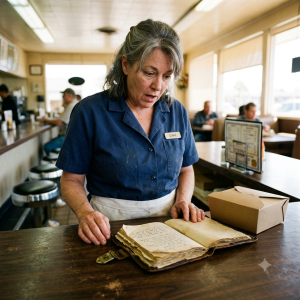
It was old — the kind of leather that gets soft as skin after years of use. Dark brown, with a brass clasp he never bothered to close. He’d set it flat on the counter, open it to somewhere near the middle, and stare at the same page like it owed him something.
Never wrote a word. Never turned the page.
Marlene had been cooking at the Copper Spoon for eleven years. She’d seen plenty of lonely. She knew the difference between a man who wanted to be left alone and a man who had simply forgotten he deserved company.
This one, she decided, was the second kind.
So the second Thursday, she packed an extra box. Nothing fancy — eggs scrambled soft, two strips of bacon, wheat toast with real butter, a little cup of fruit on the side because she’d read somewhere that older men don’t eat enough fruit.
She didn’t give it to him that day.
Or the next.
She wasn’t sure why. Maybe she didn’t want to embarrass him. Maybe she just needed to be sure.
But she watched him every week.
He always arrived at 9:15, five minutes after the worst of the rush. He hung his jacket — a navy canvas coat with a frayed collar — on the hook by the register. He ordered his coffee, thanked her quietly, and opened that notebook.
The same page. Every time.
By the fifth Thursday, Marlene had started to wonder what was on it. A letter, maybe. A name. Something someone had written to him a long time ago that he couldn’t stop reading, the way you can’t stop pressing a bruise.
The regulars had noticed him too. Patty, who took the booth by the window every Thursday morning with her crossword, had said he looked like someone’s grandfather who’d gotten turned around. Dale, the plumber who ate the same Denver omelet since 1987, said he’d tried to say hello once and the man had smiled like it cost him something.
He wasn’t unfriendly. He was just somewhere else.
On the sixth Thursday, Marlene made up her mind.
She packed the box the same way she always had — eggs, bacon, toast, fruit. She added a slice of the peach pie that had come out especially well that morning. She wrote no charge — you’re one of the good ones on a napkin and tucked it inside.
She waited until the rush died down. Until the Copper Spoon got quiet in that particular way it does around 10:30, when the morning feels like it’s exhaled.
Then she picked up the box and walked to the end of the counter.
He didn’t look up right away. His eyes were on that notebook. That same worn page.
“Sir.” She set the box down gently. “I want you to have this.”
He looked up.
And Marlene’s breath caught somewhere between her chest and her throat.
She knew that face.
She couldn’t say from where — not yet, not in that first electric second — but she knew it the way you know a song from the first three notes. The shape of his jaw. The particular gray of his eyes. The way a small scar cut through his left eyebrow.
He looked at the box. Then at her. And something moved across his expression that she couldn’t name.
“You didn’t have to do this,” he said.
“I know,” she said. “I wanted to.”
He nodded slowly. Looked back down at the notebook.
And without thinking — without knowing why, the way you sometimes do the exact right thing before your brain can talk you out of it — Marlene reached across the counter.
“May I?” she asked.
He didn’t stop her.
She turned the notebook around.
And her own handwriting looked back at her.
Not typed. Not printed.
Her handwriting — the big loopy G’s, the way she crossed her sevens, the little star she’d always drawn at the end of a sentence when she was proud of what she’d written.
Words she recognized.
Words she had written.
But she could not for the life of her remember writing them to him.
She stood there, one hand still resting on the edge of the notebook, and read.
It was a letter. Three paragraphs, written in blue ink on a page that had been folded and unfolded so many times the creases had gone white. The date at the top said September 14th. No year. The salutation said Dear Mr. Aldrich.
And then:
I don’t know if you remember me. I was the girl in the back booth at the Sunrise Grill in Durango, the summer of 1987. I was seventeen and I had just had the worst week of my life and I was trying very hard not to cry into my hot chocolate. You were sitting across the aisle, and at some point you just slid a piece of paper across to my table without a word. It said: Rough patches always end. I’ve checked. You didn’t wait for me to say anything. You just paid your bill and left.
I kept that piece of paper for years. Through high school, through a bad marriage, through learning how to start over. I lost it eventually — the way you lose things that matter, a little at a time — but I never forgot what it said.
I’m thirty-eight now and I cook at a diner and most days that is exactly enough. I just wanted you to know that a small thing you did a long time ago mattered more than you could have guessed. You don’t owe me anything for this letter. I just needed it to exist somewhere outside my own head.
— Marlene G., Copper Spoon Diner, Calverton, CO
She read it twice. Then a third time.
The kitchen felt very far away. She could hear the low murmur of the refrigerator unit, the clink of Patty stirring her coffee, the distant sound of a truck passing on the highway outside.
She looked up at him.
“I wrote this,” she said. It wasn’t a question. Her voice came out smaller than she intended.
“You did,” he said.
“I don’t — ” She stopped. Pressed her fingers to her lips for a moment. “I wrote letters. For a while. To people I’d never properly thanked.” She shook her head. “I never sent most of them. I didn’t think I had the nerve.”
“This one you sent,” he said. “It came to my old P.O. box in Durango. My daughter was clearing it out after I moved. She forwarded it to me.” He paused. “I almost didn’t open it.”
“I almost didn’t write it.”
He smiled then — a real smile, the first one she’d seen from him, and it changed his whole face. The scar through his eyebrow caught the light.
“I didn’t remember you,” he said, and his voice was careful, like he was being honest even though honest was harder. “I’m sorry. I wish I could tell you I did. But I was going through something that summer too. I don’t know what made me write that down. I just — I saw you, and something told me to.”
Marlene thought about that. About how little it took, sometimes. A scrap of paper. Four words. A stranger who didn’t wait for a thank you.
“Do you remember what you were going through?” she asked.
“I’d just buried my wife,” he said. “We were married thirty-one years. I drove up to Durango because I didn’t know what else to do with myself. Just drove.” He looked down at the notebook. “Evelyn used to say that motion helped. When things were bad. Just move through the world and let it move back.”
Marlene didn’t say anything. She’d learned, over eleven years of short-order cooking, that some silences were not meant to be filled.
“When your letter came,” he said, “I didn’t know what to do with it either. I’d never thought about that morning again. And then here it was, this thing I’d done — almost without thinking — that had apparently meant something.” He touched the edge of the page. “It seemed important to understand it.”
“So you came here.”
“I almost didn’t,” he said again. “I’m from Glenwood Springs, originally. I have a daughter there. But I kept thinking about this letter.” He shook his head slowly. “I’m not sure what I was looking for, honestly. Maybe I thought if I came and sat here long enough, I’d figure out why I wrote it. Or why it mattered so much to you. Or just — ” He stopped. “I don’t know. Maybe I just didn’t want it to be a coincidence.”
“What do you mean?”
He looked at her steadily, with those particular gray eyes. “Evelyn used to come to a diner,” he said. “When she was young. Some little place in Wyoming. And she used to say the woman behind the counter always knew when she needed feeding without her having to ask. She said it was the kindest thing — to be seen like that.” He paused. “I read your letter and I thought, well. She found her way to the right diner.”
Marlene felt something loosen in her chest that she hadn’t known was tight.
“I’m sorry about your wife,” she said.
“Thank you.” He opened the box she’d brought him and looked at the eggs, the bacon, the toast. He found the napkin she’d tucked inside — no charge — you’re one of the good ones — and he read it, and his jaw tightened in that way men’s jaws do when they are not going to cry, they have simply decided.
“It occurs to me,” he said, “that I’ve been sitting here for six Thursdays and I never introduced myself.”
“I know,” she said. “I didn’t want to push.”
“Roy,” he said. “Roy Aldrich.”
“Marlene Greer.” She reached across and they shook hands over the counter, which felt both formal and exactly right. “You want me to heat that up?”
“If you don’t mind.”
She took the box back to the kitchen. Her hands were steady, which surprised her. She felt like she should be trembling — like the moment demanded it — but instead she just felt clear. The way you feel after a long cry, or after a fever finally breaks.
She heated the eggs gently. Cut the toast again so it would stay crisp. Brought everything back on a real plate instead of the box, because the box had served its purpose.
Roy Aldrich ate slowly, the way people eat when they’re actually tasting things. He asked her, between bites, how long she’d been in Calverton. She told him eleven years, coming up on twelve. She told him about her ex-husband, not with bitterness but with the kind of factual clarity that comes after enough time has passed. She told him she’d thought about leaving a hundred times and never quite managed it and had gradually stopped wanting to.
He told her about his daughter in Glenwood Springs. About his grandkids, a boy and a girl, seven and nine. About how he’d taken up woodworking since retiring because his hands needed something to do and furniture, at least, stayed where you put it.
Patty, from the booth by the window, pretended to work her crossword.
Dale came back from the parking lot and ordered a second coffee he hadn’t wanted, just to have a reason to stay.
At some point Roy ate the peach pie, and he closed his eyes for one moment while he did it, the way people close their eyes when something is better than expected.
“That’s exceptional,” he said.
“It’s the peaches,” Marlene said. “I get them from a farm stand off Route 9. They’re almost done for the season. I’ve been making pies all week trying to use them up.”
“You should charge more for it.”
“Don’t tell the regulars.”
He laughed. It was a good laugh — the low, unhurried kind that lives in the chest.
Around noon, the lunch rush started to build. Marlene had things to do. Roy understood without being told. He put on his navy canvas jacket with the frayed collar, and he tucked the notebook — carefully, with both hands — under his arm.
He left a twenty on the counter for a cup of coffee. She pushed it back. He pushed it forward. She let it stay.
At the door he paused.
“Same time next week?” he said.
Marlene considered that — the weight of it, the lightness of it.
“I’ll have the eggs ready,” she said.
He nodded once, stepped out into the November noon, and walked to his truck. She watched him through the window. The aspens had gone bare while she wasn’t looking, and the light had that thin, flat quality it gets in late fall, but the sky over the mountains was the particular blue that makes people move to Colorado and then spend the rest of their lives trying to describe it to people who haven’t seen it.
Roy Aldrich drove away.
Marlene stood at the counter for a moment, her hand resting on the spot where the notebook had been.
Then Patty called over from the booth. “You going to tell us what that was about, or are you going to make us guess?”
“I’m going to make you guess,” Marlene said.
“Dale owes me four dollars,” Patty said. “He bet it was a long-lost brother.”
“I said cousin,” Dale said, not looking up from his coffee.
Marlene laughed, and the kitchen called her back, and the Copper Spoon filled up the way it always did at noon — with noise and orders and the smell of good food and the specific, ordinary, irreplaceable warmth of a place where people keep showing up.
The notebook was gone from the counter. But the twenty was still there.
She put it in the tip jar.
It seemed like the right thing, and Marlene had learned, over the course of a long and not uncomplicated life, to trust herself when something seemed like the right thing.
Next Thursday came on schedule, as Thursdays do.
At 9:15, the door opened.
She already had the eggs on.