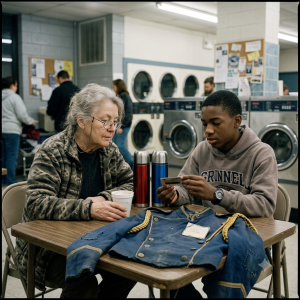
Every Tuesday night, Marlene showed up at the Riverside Laundromat in Grinnell with her tote bag, her reading glasses, and a thermos of decaf.
She wasn’t there to do her own wash.
She was there for the free wash night — a little program the owner, Dale Hutchins, had quietly started for families who couldn’t quite make ends meet. Marlene folded. That was her job. She’d fold whatever came out of those dryers, neat and careful, the way she’d once taught third-graders to make their letters.
The first night she found the uniform, she almost missed it.
It was tucked inside a pillowcase — a marching band jacket, deep blue and gold, the kind with the brass buttons and the stiff collar. Faded at the elbows. A small tear along the left seam, mended with black thread that didn’t quite match.
And the name tag above the breast pocket.
She leaned in close under the fluorescent lights. The name tag had been removed and re-sewn. You could see it plain as day — three sets of stitching holes where thread had gone in and come back out again. The current name, C. Novak, was sewn on in red thread. But underneath it, ghost outlines of older letters pressed through the fabric. Different thread each time. First white, then blue, now red.
Marlene folded that uniform like it was made of something precious.
She waited to hand it back.
But no one came.
Dale shrugged when she asked. “Kid drops stuff off before we open sometimes. Doesn’t always stick around.”
So she put the uniform on the lost-and-found shelf and didn’t think much more of it.
Until the next Tuesday, when it came through the wash again.
Same pillowcase. Same jacket. Same careful mending — except now the tear at the elbow had been stitched up again, neatly, with whatever thread had been on hand. Orange, this time.
Marlene folded it. Waited. No one.
The third week, she started watching for him.
She spotted the boy around eight o’clock, hanging back near the door like he wasn’t sure he was allowed inside. Maybe fifteen, sixteen. Thin. A good face — serious eyes, the kind that had already seen a few things they shouldn’t have. He was wearing a Grinnell High hoodie with the drawstring pulled tight.
He saw Marlene holding his uniform and went very still.
“You forgot this,” she said simply.
He crossed the room and took it from her without a word. Started to leave.
“I’m Marlene,” she said. “I used to teach over at Lincoln Elementary.”
He paused. “I know. My grandma talks about you.”
And that was the beginning of it.
His name was Calvin. He started coming inside instead of hovering at the door. Started talking — a little, then more. He was in the band, yes. Trumpet. He wasn’t very good yet, he said, but he practiced every day in the shed behind their house so he wouldn’t wake his grandma on the nights she worked late.
Marlene started bringing two thermoses.
Hot chocolate for Calvin. Decaf for herself.
And every week, she folded that uniform. Every week, she noticed the name tag — C. Novak in red thread, with those ghost stitches underneath. Three sets of holes. Three different threads.
She wanted to ask.
She didn’t ask.
Some things, she’d learned in thirty-one years of teaching, were doors a child had to open from the inside.
She just kept showing up. She kept folding. She kept the hot chocolate warm.
Then one Tuesday in late November — cold enough that ice was forming on the laundromat windows — Calvin came in and sat down across from her without being asked.
He didn’t have his uniform with him.
He just sat there for a moment, hands wrapped around his cup.
Marlene kept folding. She didn’t push. She’d learned that silence, offered kindly, was sometimes the most generous thing you could give a person.
“Mrs. Marlene,” he said finally.
“Mm-hm.”
“Can I ask you something?”
“Of course you can.”
He looked at the uniform sitting folded on the shelf between them.
“Do you ever wonder,” he said slowly, “about the name tag?”
Marlene set down the shirt she was folding. She looked at him — really looked — and said, “I’ve wondered every single week.”
Calvin was quiet for a long moment.
Then, carefully, he reached over and turned the name tag so she could see the back of it. The ghost stitches. Three sets of holes. White thread first, then blue, then red.
“The first name,” he said. “The white thread one.”
He stopped.
He looked at the floor.
And then he told her about the brother he’d never once mentioned.
His name had been Darius.
Older by four years. First-chair trumpet in the Grinnell High marching band, three seasons running. The jacket had been his — broken in, smelling like valve oil and the inside of a band bus, the elbows worn shiny from leaning on the rail at football games.
Darius had been seventeen when he died. A car accident on Route 6, November two years prior, the week before Thanksgiving. He’d been a passenger. He hadn’t done anything wrong. He was just in the wrong seat on the wrong night, and then he was gone, and Calvin’s grandmother had folded the jacket up and put it in a box in the closet because she couldn’t look at it and couldn’t throw it away.
Calvin spoke quietly, without drama, the way people do when they’ve rehearsed a thing in their heads so many times that the telling of it has worn smooth.
“She didn’t know I’d found it,” he said. “I’d been sneaking it out since last spring.”
He’d discovered the box while looking for an extension cord. Pulled back the flap and there it was — the blue and gold, the brass buttons, the name tag.
D. Novak, sewn in white thread.
He’d held it for a long time.
He’d wanted to be in band his whole life, he told Marlene. Since he was eight years old and Darius used to let him hold the trumpet and pretend. But after the accident their grandmother hadn’t been able to set foot in the gymnasium, couldn’t hear the fight song without her hands going to her mouth. Calvin had decided on his own, without being told, that joining band would be too hard on her. So he hadn’t.
Then freshman year, something shifted. He couldn’t name it exactly. But he’d signed up. Borrowed a school trumpet. And when he’d found the jacket in the box, he’d thought maybe — maybe — it was okay to wear it. To carry something of Darius into those stands, those Friday nights under the lights.
But the name tag was wrong.
He couldn’t wear Darius’s name into something Darius never got to finish.
So he’d taken out the white thread and put in a new name tag. C. Novak. His own name, in blue thread.
That was the second set of holes.
“What happened to the blue thread?” Marlene asked.
Calvin almost smiled. “I did it wrong. The letters were crooked. Real bad. I was embarrassed to wear it like that at a game where people might see.”
So he’d pulled it out and done it again, carefully, in red. The thread his grandmother kept in her sewing basket on top of the refrigerator.
Three names. Three sets of holes. One jacket making its way down the years, holding everyone it had ever held.
Marlene sat very still.
Outside, a car crept past on the iced-over street, its headlights sweeping across the ceiling of the laundromat. One of the dryers thumped along in the background — someone’s jeans knocking against the drum, rhythmic and steady as a heartbeat.
“Does your grandmother know?” Marlene asked. “That you wear it?”
He shook his head. “I thought it would hurt her.”
“Have you thought about asking her?”
He looked up at her. His serious eyes, the ones that had seen things they shouldn’t have had to see, were doing something complicated just then.
“I don’t want to make her sad,” he said.
Marlene picked up the uniform from the shelf. She turned it in her hands — the brass buttons, the careful mending, the seams that had been opened and re-closed and opened and re-closed.
“Calvin,” she said, “in my experience, the things we try to protect people from knowing are usually the things that would help them the most.”
She handed the jacket back to him.
“I think your grandmother might like to know her boy is in the band.”
He took it. He sat with it in his lap for a long time. Then he nodded, once, like he’d made a decision he’d been circling for months.
That was the last Tuesday night he came without his grandmother.
The following week, he walked in holding the door open behind him. A woman came through — small, deliberate in her movements, wearing a good coat and the careful expression of someone who wasn’t sure what she’d walked into.
Her name was Gloria. She’d taught herself to sew out of necessity, she told Marlene, after Calvin’s grandfather passed. She did alterations for the dry cleaner on Fifth Street. She was the one who’d mended the elbow seam. Every time it opened up, she fixed it — once with black thread, once with orange, whatever was closest.
She hadn’t known Calvin was wearing the jacket to games.
She hadn’t known he’d joined the band at all.
They sat together that night, the three of them, with two thermoses and a cup of vending machine coffee for Gloria. The laundromat hummed and churned around them. Dale waved from behind the counter and didn’t intrude.
Gloria held the jacket across her knees and ran her thumb over the name tag. C. Novak. Red thread.
She didn’t cry, exactly. Her eyes went bright and stayed there.
“He would have liked that you’re playing,” she said to Calvin. “He would have thought that was just right.”
Calvin nodded. He was looking at his hands.
“I’m not very good yet,” he said.
“No,” Gloria agreed, and the way she said it was the warmest thing Marlene had heard in a long time. “Not yet.”
The winter passed. Then spring. Calvin kept coming to the laundromat on Tuesdays, sometimes with his grandmother, sometimes alone. He kept playing. He was right that he wasn’t very good yet — but he was getting there, steadily, the way things grow when they’re attended to with patience.
In May, Marlene got a voicemail from an unfamiliar number.
A woman’s voice: “Mrs. Marlene, this is Gloria Novak. Calvin’s grandmother. I just wanted to let you know — the spring concert is on the fourteenth. Thursday evening. Seven o’clock. Grinnell High gymnasium.” A pause. “We’d be glad if you came.”
Marlene went.
She sat three rows back from the front, on the aisle, next to Gloria, who smelled like good hand lotion and was wearing her best earrings. The gymnasium was warm with bodies and noise and that particular electricity a school concert has just before it begins.
The band filed in.
Calvin was third from the end of the trumpet row. He was wearing the jacket — deep blue and gold, brass buttons, C. Novak in red thread above his heart.
He found his grandmother in the crowd. She raised one hand. He gave a small nod, the kind that carries a lot of weight in a small gesture.
They played four songs. Calvin wasn’t the best one up there, not by a long way. But his posture was good, and he didn’t look at the floor, and when the music lifted and the cymbals came in and the whole gymnasium swelled with it — he was part of it. Fully, completely part of it.
Gloria reached over without looking and took Marlene’s hand.
She held it through all four songs.
Afterward, in the parking lot, Calvin found them in the cold spring air. He was still wearing the jacket, the brass buttons catching the light from the gymnasium doors.
His grandmother pulled him into a hug without warning. He went still for just a moment — the way teenagers do when a hug catches them off guard — and then his arms came up and he held on.
Marlene stood nearby and looked at the sky over Grinnell, Iowa, which was doing that particular thing it does in May, all wide and dark blue and full of stars that seem improbably close.
She thought about thirty-one years of teaching, and about all the things she’d gotten to be a small part of. The letters. The reading. The way a child’s face looks the first time something clicks.
She thought about a jacket that had held two brothers and all the love and loss that went with them.
She thought about how the most important things in a community are so often invisible — a Tuesday night program that doesn’t make the paper, a woman who shows up to fold other people’s laundry, a thermos of hot chocolate kept warm on the off chance a boy decides tonight’s the night he’ll finally come inside.
Calvin walked her to her car. It was something he’d started doing in February, without being asked.
“Next year I might make first chair,” he said. He was trying not to sound like he cared too much about it.
“You might,” Marlene said.
“Mr. Ayers — the band director — he says I’ve got good instincts. Just need the technique to catch up.”
“That sounds right to me.”
He opened her car door. She got in. He stood there for a moment with his hand on the door, the jacket open over his hoodie, and she thought he looked — not older exactly, but more settled. Like something that had been waiting to land had finally found its place.
“Mrs. Marlene,” he said.
“Mm-hm.”
“Thank you. For not asking.”
She looked at him. He was looking at the ground, but he meant it.
“Thank you for telling me,” she said.
He closed her door gently, the way you close a door when you don’t want to wake someone sleeping. She pulled out of the lot and drove home through the quiet streets of Grinnell, past the darkened storefronts and the houses with their porch lights on, and she felt — not happy exactly, because there was too much grief mixed into all of it for happy to be quite the right word.
She felt like a person who had shown up.
Which, she had found over the course of a long life, was most of what mattered.
On the folding shelf at the Riverside Laundromat, if you came on a Tuesday night, you might still see the uniform laid out neat and square, ready to be picked up. C. Novak. Red thread. The ghost of two older names pressed into the fabric beneath it like a kind of scripture.
Dale had started leaving a small thermos of hot chocolate on the counter next to the lost and found.
Just in case.