For 31 years, I delivered letters to the woman who was supposed to forget I existed.
I didn’t know that, of course.
Not until today.
—
My name is Darlene Purcell, and I spent three decades walking the same mail routes through Flagstaff, Arizona. Rain, snow, the kind of July heat that turns the asphalt soft under your shoes. I knew every house on my route the way a person knows their own kitchen — by feel, by muscle memory, by the sound the screen door makes before anyone even opens it.
I retired last spring. Thirty-one years. They gave me a sheet cake from Fry’s and a card signed by people I’ll probably never see again.
And I thought that was the end of it.
It wasn’t.
—
Two weeks ago, my sister Linda called from Phoenix and said, “Darlene, I think it’s time you knew something about Daddy.”
Daddy. Raymond Purcell. Died in 1987, when I was nineteen years old and already wearing the small tattoo on the inside of my left wrist — a roadrunner, hand-painted style, because I’d always loved the way those birds ran like they had somewhere important to be and weren’t going to apologize for it.
The tattoo was my own little rebellion. Nineteen years old and freshly grieving.
Linda said, “Daddy had a daughter before us. Before Mama. The family paid to have her placed — that’s the word they used, placed — with another family up north. She was four years old. Her name was Carol.”
I sat down on my kitchen floor.
Just sat right down.
“How long have you known this?” I asked.
Linda was quiet for a long time.
“Since we were kids,” she said. “Mama made me promise.”
—
I don’t know how long I sat there after we hung up. Long enough for the light to change in my living room. Long enough to go through half a box of Kleenex and make a pot of coffee I forgot to drink.
I had a half-sister named Carol. Somewhere.
And then something started pulling at me. Something small and insistent, the way a name sits on the tip of your tongue.
I went to my spare bedroom, where I keep thirty-one years of things a mail carrier accumulates — old route maps, rubber band balls, the kind of useless sentimental clutter you can’t bring yourself to throw away.
And I pulled out a bundle of letters I had saved.
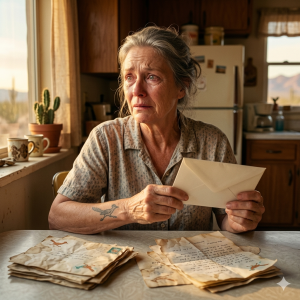
I don’t know why I ever saved them. Carriers aren’t supposed to. But years ago, a stack of envelopes got rained on before I could deliver them to one house on Timber Ridge Lane, and I’d set them aside to dry, and somehow they’d never left my possession.
Every envelope in the bundle was addressed to the same name.
Carol Whitmore. 4412 Timber Ridge Lane.
A house I had walked to. A door I had touched. For years.
I turned the first envelope over in my hands, and that’s when I saw it.
In the upper left corner — not printed, not official — a small hand-stamped image. A roadrunner. Painted in the same rust-and-turquoise colors as the one I’d been wearing on my wrist since I was nineteen years old.
My hands started to shake.
I told myself it was a coincidence. Roadrunners are everywhere in Arizona. It’s practically the state mascot. I told myself that while I flipped through envelope after envelope after envelope.
Every single one had it.
The same roadrunner. In the same corner. In the same two colors.
Thirty-one years of letters, all going to Carol Whitmore on Timber Ridge Lane.
And then I noticed the last envelope in the pile.
It was different from the others. Newer. Crisper. Like it had never been rained on, never been rubber-banded, never sat in a pile for years in a spare bedroom in a house belonging to a woman who didn’t yet know what she was holding.
And the name on the front was not Carol Whitmore.
It was mine.
Darlene Purcell.
My address. My name. In handwriting I had never seen before.
With a roadrunner stamp in the corner.
My heart was hammering so hard I could feel it in my fingertips when I turned that envelope over.
And on the back flap, in careful, deliberate letters —
Four words.
“I always knew you.”
—
I’m still sitting here at my kitchen table. The envelope is in my hand. I haven’t opened it yet. I don’t know if I’m afraid or if I just want to hold this moment a little longer — this moment right before everything changes.
Thirty-one years. The same route. The same door. The same two colors on a roadrunner I thought was mine alone.
She knew.
Somehow, she always knew.
—
I opened it.
I’m not sure exactly when I decided to stop waiting. I think my fingers just went ahead and did it without asking my permission. The flap came up clean, like it had been sealed without much pressure, like whoever closed it understood it would need to be opened someday and didn’t want to make that any harder than it had to be.
Inside was a single sheet of paper, folded in thirds. The same careful handwriting. No date at the top. Just words.
Dear Darlene,
If you’re reading this, then something finally fell into place the way I always believed it would. I have been patient. I learned patience the hard way, which I imagine you might understand.
My name is Carol. I was born Carol Ann Purcell in 1951. I was four years old when your grandmother — our grandmother — drove me to a farmhouse outside of Prescott and left me there with a family named Whitmore, who were kind people and raised me as their own. I don’t say that to make you feel sorry for me. I say it because I want you to know I wasn’t unhappy. I found out the truth when I was thirty-two years old, when Edna Whitmore was dying and felt she owed me the whole story.
I found out about you not long after that.
I was never supposed to find you. The arrangement was that I would stay gone. But I was Raymond’s daughter, and I have been told I am stubborn in the same particular way he was, which is to say quietly and completely.
I hired a woman in Albuquerque who was good at finding things. She found your name and your route and your address. And then I did something that must seem very strange to you now.
I moved to Flagstaff.
I chose a house on a mail route that I had been told was yours.
I want to be honest with you about that. I knew it might never go anywhere. I knew you might carry my mail for the rest of your working life and we would never speak and I would grow old watching a stranger walk up my front path and never know what was walking away. I was prepared for that. What I was not prepared to do was be in the same city as my only sister and not at least be close enough to see her once in a while.
I watched you for years, Darlene.
Not in a frightening way, I hope. In the way you watch something you love from a careful distance because you’re afraid of what reaching out might cost.
I saw the tattoo the first spring you delivered to my house. You were reaching across the porch railing to put something in the box and your sleeve came up and there it was. A roadrunner. Rust and turquoise.
I had to go inside and sit down.
Because I had that same image on a stamp I had been using for fifteen years by then. A stamp I had commissioned from an artist in Sedona, because I had a photograph — taken before I was placed — of our father holding me on his shoulders, and in the background of that photograph, painted on the wall of the house we lived in, was a roadrunner in rust and turquoise that our grandmother had put there. Our grandmother painted. I only know that from one letter I was given, written by Raymond himself, long before you were born.
He loved those birds because he said they looked like they were running toward something, not away.
I don’t know how you came to put that bird on your wrist. I have imagined many explanations. Maybe you felt something connected to your father and didn’t know quite what it was. Maybe it was nothing more than a nineteen-year-old girl’s impulse. Either way, I took it as a sign, and I am old enough now to not be embarrassed about that.
I am also old enough to know I can’t keep doing this.
I retired from teaching last year. My husband Gene passed in 2019. My kids are grown and scattered and good. I have more time now than I know what to do with, and I have been spending too much of it in the past.
I heard through a neighbor — Joyce Alderman, who I believe you know — that you had retired from the postal service. And I thought: if not now, then it simply isn’t going to happen.
So I did something I should have done twenty years ago.
I left this envelope with Joyce and asked her to get it to you. I want to meet you, Darlene. I am not asking you to call me your sister right away, or ever, if that word feels like too much. I am asking if you might want to have coffee. I live at the same address I always have. The number is at the bottom of this page.
I always knew you were there.
I hope you’ll let me tell you everything else in person.
With love that has been waiting a long time to be useful,
Carol
—
I read it twice. Then a third time. Then I got up from the kitchen table and walked to my bathroom and stood in front of the mirror for a while, not doing anything in particular, just needing to look at something solid.
Then I picked up my phone.
She answered on the second ring.
“Darlene?” Her voice was nothing like mine — lower, a little raspy, the voice of a woman who had spent decades in front of classrooms. But she said my name like she had been practicing it.
“Carol,” I said. And then I didn’t say anything else for a moment because my throat had closed up on me.
“Take your time,” she said. “I’ve been waiting thirty-one years. I can wait another minute.”
That made me laugh. It came out a little wet and a little startled, the kind of laugh that lives right next to crying.
We talked for two hours and forty minutes. I know because my phone told me afterward and I couldn’t quite believe it. She told me about Prescott and the Whitmores and the teacher’s college in Tucson. She told me about Gene, who had been a high school football coach and made excellent enchiladas and died of a heart attack on a Tuesday morning in February, which she said was somehow the most Tuesday thing imaginable, and that she had been angry about it for a long time but was getting better. She told me about her three kids — a son in Denver, a daughter in Portland, another daughter who stayed local and gave her two grandchildren she described as feral in the best possible way.
I told her about my route. About thirty-one years of other people’s mail passing through my hands. About how I knew which houses had dogs and which had screen doors that needed fixing and which ones left water out on hot days because they were thinking about the people who walked up their paths.
“I left water out for you,” she said quietly.
I remembered that. House at the end of Timber Ridge, clay pot on the top step with a tin cup hanging off the rim. I had thought of it as one of those small, anonymous kindnesses that certain houses have.
“I didn’t know it was for me specifically,” I said.
“It was always for you specifically.”
—
We met in person four days later.
She had suggested a coffee shop on Milton Road, neutral ground, easy parking, good light. I got there ten minutes early and sat facing the door because I didn’t trust myself to handle being surprised.
I knew her the second she walked in.
She was taller than I expected. Silver-haired. She walked like someone who had been standing in front of rooms full of people for forty years — unhurried, like she was giving everyone time to catch up. She was wearing a blue cardigan and she had our father’s nose. I know that from photographs. I have three photographs of Raymond Purcell and in all of them his nose is exactly like hers.
She saw me and stopped walking.
We looked at each other across a coffee shop in Flagstaff, Arizona, on a Thursday afternoon in late April, and I don’t know what my face was doing but hers had gone very still in the way faces go when something long-held finally comes to rest.
She crossed the room and sat down across from me and put both her hands on the table, palms up, an offering.
I put my hands in hers.
She looked down at my wrist. At the roadrunner.
“May I?” she asked.
I turned my wrist over so she could see it clearly. She traced it with one finger, very lightly, the way you touch something you’ve been thinking about for a long time.
“I have the photograph at home,” she said. “The one with the painting on the wall. I’d like to show you.”
“I’d like to see it,” I said.
We ordered coffee. We stayed for three hours. The woman behind the counter refilled my cup four times without being asked, which I like to think means she could tell something important was happening at that table and wanted to be a small part of keeping it going.
—
That was six weeks ago.
I’ve been to Carol’s house on Timber Ridge Lane twice now. I stood on that porch where I must have stood a thousand times and it felt completely different, the way a place feels different when you finally know whose door it is.
The first time, she showed me the photograph. It’s small and black-and-white and a little blurred — someone’s personal camera, not much quality to it — but you can see Raymond Purcell plain as day with a little girl on his shoulders, grinning up at her, and behind them on the wall of a house that doesn’t exist anymore, that bird.
Same posture as mine. Same colors you could tell even through the gray scale, because Carol had the original stamp to compare it to, the rust and turquoise clear as anything.
I held that photograph for a long time.
The second visit, she introduced me to her daughter Renee, the one who stayed local. Renee has Carol’s cheekbones and apparently inherited the stubbornness, because she walked in the door, looked at me, and said, “You have Grandpa’s forehead, I can’t believe nobody found each other sooner,” and then hugged me like we had always known each other, which I suppose in some way we had.
I called Linda after that visit. It was a harder conversation. Linda cried and said she was sorry, which I believe she meant, and which I also think is not quite enough but might be the beginning of enough, which is probably all any of us can ask for.
—
I keep thinking about the route.
Thirty-one years. Every street on that grid. Every name on every box. You get to thinking, after a while, that you know a place completely. But a mail carrier only knows the surface of a street — the numbers, the boxes, the habits. Not the lives stacked up behind the doors.
Carol was stacked up behind a door I touched every working day for most of my adult life.
She was thirty feet away from me, most days. Sometimes less.
And I think about what she said in her letter — that she was prepared for it to never go anywhere. That she was willing to grow old watching me walk away.
I don’t know if I find that heartbreaking or the most devoted thing I’ve ever heard. Probably both. Probably they’re the same thing.
What I do know is that she didn’t let it be nothing. She moved to a street on my route. She left water out on hot days. She stamped every envelope she ever received with that bird, in those colors, on the chance that I might one day handle one of them and feel something pull at the edge of my knowing.
She ran toward something rather than away. Just like our father said those birds did.
I think about that a lot.
—
There’s not a tidy ending to put on this. Life doesn’t really work that way, and I’ve been walking routes long enough to know that the mail never actually stops — it just keeps coming, one day after another, and what you do with it is up to you.
But I will say this.
I have a sister.
Her name is Carol. She taught fourth grade for thirty-eight years and she makes a green chile stew that I have now eaten twice and will eat for the rest of my life if she’ll keep making it. She has a stamp collection and an unfinished quilt and a big orange cat named Biscuit who did not like me at first but has recently started sitting next to me on the couch, which Carol says means I’ve been accepted and should feel honored.
I feel honored.
We’re going to Prescott next month. She wants to show me where the farmhouse used to be, out past the old highway. She says there’s nothing left of it, just a field now, but she’s been back a few times over the years and there’s something about standing in that field that she can’t fully explain but thinks I might understand.
I think I will.