Harold Sykes had spent forty-one years reading the Columbia River the way other men read the morning paper.
Every current. Every sandbar shift. Every mood the water wore depending on the season.
So when a stranger started showing up at Pier 11 every single morning, Harold noticed.
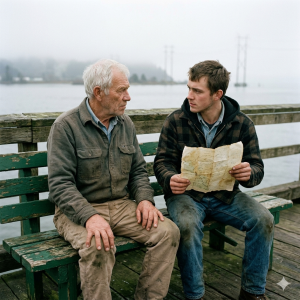
The young man — couldn’t have been more than twenty-five — always took the same bench. The weathered green one near the old cannery wall, the one that faced the water like it had something to apologize for.
He never had coffee. Never had his phone out.
He just sat there with a folded piece of paper in his hands.
Every morning. Same bench. Same paper.
Harold watched him from a respectful distance for the first few days, the way you watch a heron — careful not to spook it. The young man would unfold the paper partway, study one corner of it with a focused intensity that didn’t match his age, then fold it right back up before anyone could see.
Like it was something private.
Like it was something precious.
The paper was water-stained. Yellowed at the edges. Folded so many times the creases had gone soft, like old linen. Whatever was on it had been looked at so many times the paper practically knew the route home by heart.
Harold recognized that kind of document. He’d made a few himself.
Nautical charts, hand-drawn, were a dying art. In the old days, before GPS, before satellite imaging, a captain who knew a waterway drew what he saw. Depth markings. Current warnings. The little notations that saved lives and didn’t show up in any official publication.
The Columbia Bar — that stretch of water where the river meets the Pacific — had eaten ships whole. Still did, some years. You didn’t cross it without respecting it.
And you didn’t carry a hand-drawn chart of it for eleven years without having a reason.
By the end of the first week, Harold had started bringing two coffees.
He’d set one on the far end of the bench without a word and walk to the railing to watch the tugboats work. The young man never said thank you out loud. But the cup was always empty when Harold glanced back.
That was enough.
By week two, they’d exchanged names. The young man said his was Caleb. He said it quietly, like he wasn’t sure it still fit him.
He asked Harold what he did before he retired.
“Ferry captain,” Harold said. “Forty-one years on this river.”
Something shifted in Caleb’s face. Just for a second. Then he looked back at the water.
That was Tuesday.
By Thursday, Harold had stopped pretending he wasn’t curious about the paper.
He’d watched Caleb unfold it and refold it a hundred times by now. Always that same careful motion — two-thirds open, never more. Whatever was in the center of that chart, Caleb kept it tucked inside itself like a secret it wasn’t ready to share.
Harold had seen sailors carry things like that. A letter. A photograph. A final set of coordinates.
Objects that carried the weight of someone who wasn’t there anymore.
Friday morning was gray and cold the way Astoria mornings know how to be — fog rolling in low off the river, the air smelling like salt and diesel and something older underneath. Harold brought the coffees. Caleb was already there.
The chart was in his hands.
Harold sat down. Wrapped both hands around his cup. Let the silence do what silence does between two people who’ve been sitting together long enough to stop filling it.
Then he asked.
He didn’t plan to. It just came out, the way honest things do when you’ve stopped overthinking them.
“Is that a chart of the Columbia Bar?”
Caleb went very still.
Harold watched the young man’s jaw tighten. Watched his thumbs press against the folded paper the way you press against something to make sure it’s still real.
The fog moved across the water. A pelican crossed low overhead.
Then Caleb looked up.
And Harold — a man who had navigated through November storms, who had held his course through swells that made grown men weep, who had spent four decades being the calmest person in any emergency —
Harold felt his breath leave him.
Because the look in that young man’s eyes wasn’t the look of a stranger.
It was the look of someone who had been carrying something across a very long distance and had just, after eleven years, arrived.
Caleb’s voice was quiet. Steady. Like a river that had finally found its level.
“You drew this,” he said. “I’ve been looking for you for eleven years.”
Harold set his coffee down on the bench between them.
He did it slowly. Carefully. The way you set things down when your hands have started to shake and you don’t want anyone to know.
“Let me see it,” he said.
Caleb unfolded the paper for the first time all the way.
Harold looked at it for a long moment without speaking.
He knew it immediately.
The handwriting in the depth notations — that cramped, leftward slant he’d developed on a rolling deck because neat penmanship was a luxury you gave up by your third year on the water. The way the shoaling near the South Channel was marked not with standard notation but with a small cross-hatching he’d invented himself after he’d watched a pilot boat founder there in 1987. The initials in the lower right corner: H.A.S.
Harold Allen Sykes.
He’d drawn that chart in the winter of 1993. He was certain of it the way you’re certain of a scar. He’d drawn several copies in those days, back when he was still running the Bar crossing regularly and the Corps of Engineers kept issuing official charts that didn’t account for the seasonal drift of the south spit. Charts that were technically accurate and practically dangerous.
He’d given them to pilots he trusted. To a few captains who’d asked.
He didn’t remember giving one to anyone who would have passed it to a boy who wasn’t born yet when he drew it.
“Where did you get this?” Harold asked.
Caleb wrapped both hands around his coffee cup. He looked at the water for a moment, like he was choosing where to start.
“My father had it,” he said. “He kept it in the inside pocket of his jacket. The one he wore every time he went out.”
Harold waited.
“His name was Dennis Mauer. He ran a thirty-eight foot troller out of Hammond. Dungeness crab, mostly. Some salmon in season.” Caleb paused. “You might not remember him.”
But Harold did.
Dennis Mauer. The name arrived with a weight Harold hadn’t felt in years. A compact, serious man with a red beard going gray before its time. Always wore the same blue Grundéns jacket. Always carried a thermos of terrible coffee and didn’t apologize for it.
They’d spoken dozens of times at this very pier. Dennis had been one of those fishermen who took the Bar seriously in a way not everyone did — asked questions, compared notes, never assumed he knew more than the river. Harold had liked him for it.
“I remember your father,” Harold said.
Caleb nodded. Like he’d been hoping for that and bracing against it at the same time.
“He died crossing the Bar,” Caleb said. “November 2013. The Marian Lee. You can look it up.”
Harold knew. He didn’t need to look it up.
The Marian Lee. A November squall that came in faster than the forecast suggested. Two men aboard. Dennis Mauer and his deckhand, a kid from Warrenton named Phil Greer. The Coast Guard had found the boat and found Phil, who had held onto a cooler for four hours in forty-degree water and survived with hypothermia and a story he still didn’t tell easily.
Dennis they’d found three days later.
Harold had read about it in the Daily Budget and felt a heaviness he carried for weeks without fully understanding why. He’d known a hundred men who worked that water. He’d attended seven funerals over the years. But Dennis Mauer had stayed with him.
“I’m sorry,” Harold said. “I am very sorry about your father.”
Caleb pressed his lips together and nodded once. His eyes stayed on the river.
“I was fourteen when it happened,” he said. “They gave me his things from the boat. The jacket was in the cabin, so it survived. And the chart was inside it.” He smoothed his thumb across the paper the way Harold had seen him do it a hundred times now from a distance, and up close it was clearly something he’d done so many times it had become involuntary, the way you touch a scar or a ring. “I didn’t know what it was at first. I just knew he’d kept it close.”
He folded it again. The practiced fold. The one that protected whatever mattered most.
“When I got older and started to understand what I was looking at, I realized it wasn’t a printed chart. Someone had drawn it. And there were initials.” He glanced at Harold. “H.A.S.”
Harold picked up his coffee. Held it without drinking.
“I looked for a long time,” Caleb said. “The initials didn’t turn up anything obvious. There wasn’t exactly a registry for hand-drawn nautical charts. I asked around at the docks in Hammond, in Warrenton. People remembered your name, but no one seemed to know where you’d gone after you retired. Someone told me Astoria, so I started coming to the piers.” He almost smiled. Not quite. “It took a few months to work my way down to Pier 11.”
Harold sat with that for a moment.
Eleven years. A fourteen-year-old boy who became a young man who got up every single morning and came to the waterfront with his father’s most-carried thing.
“What did you want to ask me?” Harold said. “When you found me.”
Caleb looked at him directly then.
“I wanted to know if the chart was right,” he said.
Harold didn’t understand. He said so.
“The official inquiry,” Caleb said, and his voice was still steady but there was something underneath it now, something that had been kept at the same temperature as that folded paper, preserved and pressurized. “The Coast Guard report said he misjudged the Bar conditions. That there had been a small craft advisory and he went out anyway.” He paused. “My father was not a man who ignored advisories. Not ever.”
Harold said nothing.
“I’ve read everything I could find about that crossing. About what the conditions were. About the official charts they would have been using.” Caleb touched the folded paper again. “And I’ve looked at your chart. The way you marked the channel. The depth variations in the approach. The notation here in the south margin — do you remember what that says?”
Harold didn’t need to look. He remembered.
He’d written: Seasonal drift of S. spit underestimated in official surveys — treat published depths as optimistic by 2-3ft in late autumn. Do not trust November.
“He went out in November,” Caleb said.
“I know.”
“The official chart showed a clear approach in the window he chose. Your chart shows why that window wasn’t what it looked like.”
Harold set down his cup. He looked at the water. The fog was burning off now, slowly, the way it did by ten o’clock on a morning like this, the light beginning to find its way through.
“I’m not saying the chart would have saved him,” Caleb said quietly. “I’m not saying that. I know better than to say that.” He exhaled. “I just — I needed to know if what he was carrying was real. If he had looked at it enough times that he knew what was on it.”
“He knew what was on it,” Harold said.
“How can you be sure?”
Harold looked at the chart.
“Because of where the wear is,” he said. “See those creases. The ones that have gone soft.” He pointed without touching. “A paper folds where you open it. The wear concentrates at the corners you handle most. Your father opened this map to this corner—” he indicated the south margin, the November notation “—more than any other. More than the center. More than the depth figures.” He paused. “He read that warning. He read it many times.”
Caleb stared at the paper.
Harold let him stare at it.
“The Bar is not a forgiving place,” Harold said eventually. “I’ve been crossing it and watching it be crossed for four decades. Men I respected and men who knew what they were doing have been taken by it. Sometimes it isn’t about what you knew or what you carried. Sometimes November just wins.” He looked at the young man. “But your father was careful. He was one of the careful ones. I want you to know that I believed that when I knew him and I believe it now.”
The river moved. A container ship was making its slow way toward the sea in the distance, a gray shape in the lightening fog.
Caleb was quiet for a long moment.
Then he said, “I’ve been so angry for a long time. At the report. At the idea that it was carelessness. At the version of him that report implied.”
“That version wasn’t him,” Harold said.
“No,” Caleb said. “It wasn’t.”
They sat together in the way they’d been sitting for two weeks now, the two of them and the water and the old cannery wall, except that everything was different and also somehow exactly the same.
After a while, Caleb refolded the chart with the same hands his father had used. The same careful motion. The same crease lines, worn soft as old linen.
He held it for a moment.
Then he looked at Harold.
“Would you be willing to write something down?” he said. “What you just told me. About the chart. About what the wear pattern means. About what you knew of him.” He stopped. “I have a younger sister. She was eight when it happened. She’s never had anything but the report.”
Harold thought about his own daughter, who was fifty-three and lived in Bend and called him every Sunday. He thought about what it would have meant to her to grow up with a different version of him than the one that was true.
“I’ll write it down,” he said.
He said it the way you say the things that matter. Without hesitation. Without making it bigger than it was.
Caleb nodded. He didn’t say thank you, not yet, but the way he exhaled said everything that thank you would have said and more.
They finished their coffee.
The fog had lifted off the river almost entirely now. You could see the far bank, the dark line of the Washington shore, the water between silver and brown the way it got when the light hit it right and you could almost believe it was peaceful.
Harold picked up both empty cups and stood.
“Same time Monday?” he said.
Caleb looked up at him.
“Same time Monday,” he said.
Harold wrote the letter the following week. Four pages, longhand, on the good stationery his wife had left behind when she passed. He described Dennis Mauer as he remembered him. He described the chart and what the wear on it meant and what it told you about the man who had carried it. He wrote about the Bar and about November and about the truth that careful men could still be taken, that the river did not always keep score the way the living needed it to.
He signed it H.A. Sykes, and under that he wrote: Ferry Captain, Columbia River, 1974–2015.
Caleb came back on Monday. And the Monday after that.
The chart stayed in his jacket pocket. But the way he held himself on the bench had changed, the way a man changes when he has put something down that he has been carrying a very long way.
Not lighter, exactly.
Settled.
Harold knew the feeling.
He’d learned it from the river.