Gerald Marsh stood under the ballroom lights with a crystal trophy in his hand, and for one suspended second he looked exactly like the kind of man communities trust without question.
He wore a dark tailored suit, a polished smile, and the calm confidence of someone who had spent decades learning how to sound reliable. Around him, the Rotary Club’s annual banquet glowed with soft chandeliers, folded napkins, and the low clink of silverware against china. People had just finished the salad course. There were murmurs of approval, scattered applause, warm introductions. It was the kind of room where reputations were polished in public and rarely challenged.
In the third row sat Wanda Pruett in a navy dress, her hands folded in her lap.
Most people in that room saw a widow.
They did not yet understand they were looking at the most prepared person there.
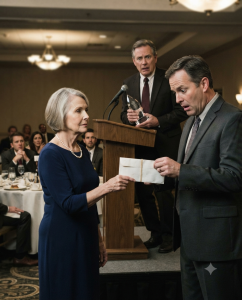
When the emcee, Paul Whitfield, called Gerald’s name for Regional Small Business of the Year, Gerald rose with an easy smile and strode toward the stage as if the evening had already gone exactly according to plan.
Wanda stood too.
Quietly, almost gently, she walked to the side of the stage and handed Paul a plain white envelope held shut with a rubber band. The paper was slightly bowed from having spent eighteen months in her purse.
Her name was written across the front in her late husband’s hand.
Paul slid out the first page, and his expression changed so abruptly that Gerald noticed before anyone else did.
The room fell still.
By the time Paul reached the microphone, Gerald had gone so pale it looked as if the blood had drained out of him. He gripped the trophy too tightly. His smile collapsed. And before a single word had been read, every instinct in the room had shifted.
Something was wrong.
To understand how a banquet turned into a public unmasking, you have to understand Harold and Wanda Pruett.
They had built Blueridge Air Charter from almost nothing.
Forty-one years earlier, they were just a couple with more nerve than money, sitting at the Dairy Queen on Route 9 with a paper napkin between them. Harold sketched out a rough idea with a ballpoint pen while Wanda laughed that his airplane looked more like a dragonfly. He had one used Cessna 172 in mind, a small office, and a belief that there were business travelers, medical clients, and cargo contracts in the region that needed dependable air charter service. Wanda understood books, schedules, and people. Harold understood engines, routes, weather, and the kind of careful service that turns first-time customers into lifelong clients.
They started with what they had.
It wasn’t much.
The first office was barely more than a box with a desk in it. The hangar smelled like fuel, grease, old coffee, and damp concrete. Some weeks they weren’t sure they’d make payroll. Wanda answered calls with one hand while balancing invoices in the other. Harold flew early, met clients midday, and stayed late checking aircraft logs. When cash got tight, they went without before the business did.
Over time, Blueridge grew.
A second aircraft came. Then more contracts. Then pilots who stayed because Harold was fair and careful and refused to cut corners. Local hospitals trusted him. Law firms trusted him. Manufacturing clients trusted him. More importantly, mechanics and staff trusted him, and in aviation that mattered more than any brochure ever could.
Harold was the kind of man who remembered birthdays, changed light bulbs without being asked, and still called Wanda from the hangar if he was going to be even fifteen minutes late for supper.
Gerald Marsh entered their lives during the growth years.
At first he was simply their accountant. Then he became something more familiar. That is how it often happens in small towns. The line between professional and personal softens. Gerald did the taxes, then the payroll advice, then broader business filings. He knew where records were kept. He had Harold’s home office key. He had eaten at their kitchen table enough times that Wanda set out the good butter dish for him automatically.
He was careful, mild, comforting.
He had the manner of a man who understood the power of being seen as safe.
So when Harold died suddenly on a Tuesday morning in March, Wanda did exactly what Harold had conditioned her to do in a crisis. She called Gerald.
Harold had collapsed at home before breakfast. One ordinary morning and then no ordinary life after it. Wanda remembered the ambulance, the neighbors, the calls she couldn’t finish, the robe Harold had still been wearing, the coffee that kept dripping in the kitchen because neither of them had turned the machine off.
The funeral passed in a blur of flowers, hymns, casseroles, and people saying “He was a good man” in voices full of helpless sincerity.
Gerald stood near the family.
He held Wanda’s hands and told her, “Don’t worry about a thing. I’ll handle everything.”
At the time, those words felt merciful.
Wanda did not know where all the accounts were. She did not know what deadlines were looming. She did not know what the company owed, what it owned, which contracts were current, or which corporate papers needed attention. Harold had been brilliant with operations and loyal to a fault, but like many founders of his generation, he had kept too much in his own head.
In those first weeks, Gerald stepped in smoothly.
He fielded calls. He gathered documents. He told Wanda some restructuring might be necessary “for her protection.” He explained that aviation businesses often needed fast administrative action after the death of an owner. He used technical language, softened by sympathy, and Wanda—half-drowned in grief—accepted his guidance.
He brought papers.
She signed some.
Others he told her not to worry about.
By the time her mind began to clear enough to ask sharper questions, the shape of the business had already changed.
The first warning came by accident.
Three months after Harold’s death, Wanda was cleaning out the drawer of her bedside table. Under a pair of reading glasses she found a plain white envelope she didn’t recognize. It was secured with a rubber band, and on the front was her name in Harold’s handwriting.
She sat down immediately.
Her chest tightened so hard she thought for a second she might be sick.
There are objects the grieving learn to fear: a voicemail, a jacket, a receipt, a note. Not because they are dramatic, but because they carry the ordinary voice of the person who is gone. Wanda turned the envelope over in her hands and knew she could not bear whatever was inside—not that night.
So she put it away.
Not far away. Never far away.
She tucked it beside her Bible, then later started carrying it in her purse. Church. Grocery store. Doctor visits. Her sister Lorene’s house in Greenville. The envelope went everywhere with her, unopened, as if she needed Harold physically near before she could risk hearing him one more time.
Meanwhile, little things began to bother her.
Letters arrived with names she didn’t recognize. Statements looked different. Gerald kept referring to new structures and revised filings. Clients who had once called the Pruetts directly now seemed to be dealing elsewhere. When Wanda asked what “restructured” meant, Gerald answered in a way that sounded reassuring while somehow saying almost nothing.
She was suspicious, but suspicion without language is a lonely thing.
That changed the day Cody Harrison came to her kitchen table.
Cody was her neighbor’s son, young and newly admitted to the bar, eager in the way that only fresh lawyers and young ministers tend to be. Wanda asked him to look over “a few papers” because something felt wrong and she needed someone who wasn’t already woven into Gerald’s orbit.
Cody arrived with a laptop, a legal pad, and a face that grew grimmer by the minute.
After an hour of searching records, he went very quiet.
“Mrs. Pruett,” he said carefully, “Blueridge Air Charter no longer exists.”
She stared at him.
“It was dissolved,” he continued. “The aircraft, contracts, lease interests, and operating assets were transferred into an entity called Marsh Aviation Consultants LLC.”
She felt the room tilt.
“Marsh,” she repeated.
He nodded. “Gerald filed it six weeks after your husband died.”
Six weeks.
Wanda sat very still. She could hear the refrigerator humming. Outside, somebody’s dog barked twice and stopped. Cody slid the printouts toward her, but she barely looked. Her eyes went to her purse hanging on the chair beside her.
She rose. Opened it. Touched the envelope.
Just touched it.
Then she returned to the table and said, “Tell me what I need to do.”
From that moment forward, Wanda changed.
Not in the dramatic, cinematic way people imagine revenge stories unfold. She did not become loud. She did not become reckless. She became precise.
She started keeping records of every conversation. She built binders. She created timelines. She drove to Charlotte four times to speak with the FAA regional office. She found out which forms had been filed, when, and under whose authority. She learned the meanings of terms she had never expected to hear in relation to her own life: fraudulent conveyance, fiduciary duty, commingling of assets, unauthorized transfer.
People underestimated her constantly, and every time they did, she learned something useful.
An investigator named Diane Hollis took her seriously almost immediately. Wanda came prepared with labeled copies, dates, handwritten notes, and cross-referenced filings. Diane eventually told her, “Mrs. Pruett, you are exactly the kind of witness we rarely get.”
That sentence sustained her more than Diane knew.
Still, Wanda did not open Harold’s letter.
She told herself she was waiting for the right moment, though she could not have fully explained what that meant. Deep down she felt that once the envelope was opened, something final would begin. She wanted that moment to matter. She wanted Harold’s words to land where they could not be dismissed, hidden, or quietly managed.
The opportunity arrived the following October when she heard Gerald was receiving a public award.
Regional Small Business of the Year.
For a company built from the bones of hers.
Wanda did not react immediately. She sat with the news. Then she called Paul Whitfield, the banquet’s emcee and one of Harold’s oldest friends. She told him enough to get his full attention: Gerald had taken control of Blueridge through suspect transfers, an investigation was active, and Harold had left a sealed letter.
Paul was stunned.
When he called back two hours later, his voice had changed. “Tell me what you need me to do.”
Wanda’s answer was simple. At the exact moment Gerald stepped on stage to receive his award, she wanted Paul to open and read Harold’s letter aloud.
Paul hesitated only once.
“Are you sure?”
“Yes,” she said. “It’s time.”
So he agreed.
Now, standing in that ballroom, Paul looked down at the first page and felt the weight of Harold’s words before he had even finished the opening paragraph.
Then he spoke into the microphone.
“Ladies and gentlemen… before Mr. Marsh gives his remarks, there is something written by Harold Pruett himself that this room needs to hear.”
A murmur moved through the audience. Gerald stepped back.
Paul began reading.
The letter was dated several months before Harold’s death.
It was written in Harold’s unmistakable voice: direct, practical, unadorned. He explained that Gerald had recently pressured him to move certain company assets into a new structure “for efficiency and liability protection.” Harold wrote that he had refused. He stated plainly that if anything happened to him unexpectedly, Wanda was not to trust any emergency transfer, dissolution, or restructuring initiated by Gerald without independent legal review.
The room went utterly silent.
Paul kept reading.
Harold referenced specific account numbers. He named a meeting in his home office in which Gerald had pushed documents Harold considered improper. He wrote that Gerald had been given access to records for tax preparation and compliance only—not ownership, transfer authority, or discretionary control after Harold’s death. Harold also stated that copies of supporting records, including a disputed draft signature page and correspondence, had been stored separately because he “did not like the direction the conversations were taking.”
By the second page, Gerald’s hand had gone slack.
The crystal trophy slipped from his fingers and struck the stage with a sharp crack.
Someone gasped.
A woman near the front covered her mouth and began to cry. One of Harold’s former mechanics lowered his head. Wanda’s sister Lorene, seated toward the side, pressed a napkin to her eyes. Three people were crying before Paul reached the bottom of the page.
Gerald moved suddenly toward him.
Not with dignity. Not even with anger properly contained.
With panic.
Paul stepped back instinctively, clutching the pages. Two men from the side of the ballroom moved at once, one of them a retired sheriff’s deputy who had known Harold for years and recognized desperation when he saw it.
“Don’t,” Paul said, not loudly, but with enough force to stop Gerald for half a beat.
Then he read the final paragraph.
Harold had written where the duplicate records were hidden.
An old metal lockbox in a storage cabinet behind manuals in the home office closet. The spare key was taped under the bottom shelf of the desk. Inside, he wrote, were unsigned originals, correspondence, annotated drafts, and notes from meetings with Gerald. Harold added one devastating line: “If any document appears with my signature authorizing transfer to any Marsh-controlled entity, compare it to the marked draft in the box and ask why the execution page was ever separated.”
That was the line that broke Gerald.
His knees buckled.
He caught himself on the edge of the podium but not before the whole room saw it—the physical collapse of a man who realized there was no elegant way out.
Wanda did not smile.
She only watched.
In the days that followed, everything Harold promised in that letter began to unravel Gerald’s story. The lockbox existed exactly where Harold said it would. So did the key. Inside were draft transfer papers, notes in Harold’s handwriting, and a correspondence trail showing escalating pressure from Gerald to push assets into structures Harold had rejected. Most damaging of all was a separated signature page and markup set that made the later filings impossible to explain away as innocent misunderstanding.
Investigators moved quickly after that. Diane Hollis coordinated with state authorities and financial investigators. More records were subpoenaed. Banking activity revealed company income routed through Marsh-controlled accounts. Operating expenses had been mingled. Lease authority had been represented under claims Wanda had never knowingly approved. What Gerald had hoped would pass as protective restructuring looked more and more like a calculated exploitation of a grieving widow during the narrow window when she was least able to fight back.
Gerald tried, at first, to frame everything as administrative confusion.
Then as verbal authorization.
Then as a misunderstood temporary arrangement.
But paper is patient, and Harold had left the kind of paper that survives charm.
Civil claims followed. Regulatory actions followed. The award was, of course, withdrawn before the banquet flowers were cold. Clients distanced themselves. Community allies evaporated. Those who had once praised Gerald’s steadiness began saying they had always thought something about him was “a little too smooth,” though Wanda privately felt late insight was one of the cheapest things people offer after a betrayal becomes public.
The legal process took time, but not forever.
Blueridge Air Charter’s core assets were ultimately returned through court action and negotiated enforcement. Some damage could not be undone. Contracts had been disrupted. Staff had scattered. Trust had been fractured. But the business Harold built was not erased, and Wanda was not left voiceless.
When the final orders were entered, Wanda drove alone to the cemetery before telling anyone else. She brought no flowers. Harold had always said cut flowers were pretty but impractical. Instead she sat in her car for a while with the engine off and the window cracked, listening to summer insects in the grass.
Then she took the letter—now creased, copied, and preserved in more ways than one—and read it again from start to finish.
This time she did not cry until the end.
What made her weep was not the warning itself.
It was the first line Harold had written above all the business detail, a line Paul had not read into the microphone because his voice had already nearly broken:
Wanda, if you are reading this, trust your own mind before you trust any man who tells you not to use it.
In the months that followed, people in town told the story in different versions. Some focused on the banquet. Some on Gerald collapsing. Some on the hidden lockbox. Some on the scandal of a trusted accountant trying to inherit what he had never built. But the people who knew Wanda best told it differently.
They said a grieving woman was expected to disappear into confusion, and instead she learned the language of the people who thought they could outmaneuver her.
They said Harold’s letter mattered.
But so did the eighteen months before it was opened.
Because the truth was, Wanda had already begun saving herself before anyone read a single word out loud.
Blueridge did not go back to exactly what it had been. Nothing ever does after that kind of fracture. But some former staff returned. The company name came back onto the hangar. Harold’s photograph went back onto the office wall. Wanda did not run day-to-day operations alone, but she helped choose the people who would. This time, every signature was reviewed. Every structure was independently checked. Every closed door stayed a little less closed.
As for Gerald, the fall people witnessed at the banquet turned out to be only the visible part of it.
The deeper collapse came later, in depositions, filings, repayments, and the slow stripping away of the respectable image he had worn for decades. He had counted on grief. He had counted on trust. He had counted on a widow being too tired, too polite, too old, and too heartbroken to fight.
He was wrong on every count.
Even now, people still debate the story when it comes up.
Some say Harold should have acted sooner if he suspected Gerald. Some say Wanda should never have trusted him after Harold died. Some say public exposure was too cruel.
Maybe.
But others ask a different question.
When someone uses your sorrow as cover, what does mercy even look like?
And if Harold had not left that letter, would anyone have believed Wanda soon enough to matter?
That is the part that stays with people long after the legal details fade—the uneasy realization that the biggest red flag was not Gerald’s confidence, but how naturally everyone, for a while, mistook it for care.