He almost didn’t stop.
Earl Thibodaux had been driving that same stretch of Highway 24 for fifty-one years, and he knew better than most that the Louisiana heat could make a person do foolish things — like pull over for strangers after dark.
But those hazard lights were blinking like a tired heartbeat, and something in his chest wouldn’t let him pass.
He eased the old Silverado onto the gravel shoulder.
The young man standing beside the broken-down minivan couldn’t have been more than thirty. Dark circles under his eyes. Shirt untucked. The particular kind of exhausted that doesn’t come from one bad night — it comes from a hundred of them stacked up like cord wood.
“She just quit on me,” the man said. “Three kids in there. Been sitting two hours.”
Earl looked through the minivan window. Sure enough — three little ones folded into their car seats like sleeping angels, mouths open, not a worry in the world.
“Name’s Earl,” he said, extending his hand. “Let’s get y’all into town.”
The young man’s name was Marcus. He transferred each child with the practiced gentleness of a father who’d done it a thousand times — lifting them one by one into the back seat of Earl’s truck without waking a single one.
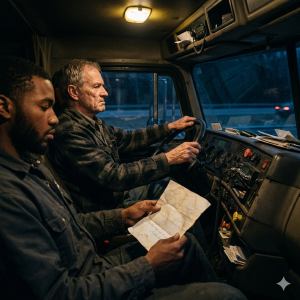
And the whole time, Marcus never once put down the paper in his left hand.
Earl noticed it right away.
Tri-folded. Water-stained along the bottom edge, like it had been caught in a flood or pulled from a wet pocket. The paper had that soft, worn look of something handled so many times it had gone limp at the creases — the way old love letters get, or documents that matter so much you can’t stop touching them to make sure they’re still real.
Even when Marcus buckled the last child in, he kept that paper pressed against his palm.
Earl didn’t ask. Not his business.
They pulled onto the highway, and for a few miles it was quiet except for the hum of the engine and the sound of three little ones breathing in the back.
Then Marcus started to talk.
He was from Houma originally, he said. Raised by his grandmother after the storm took everything else. He’d spent fifteen years trying to find something — a record, a document, any piece of paper that could help him prove what his grandmother always told him was true before she passed.
Earl kept his eyes on the road.
“She said there was an officer,” Marcus said. “Back in the eighties. Fish and Wildlife. He helped her when she had nothing. Helped her get something in writing that she could pass down.”
The truck cab felt smaller suddenly.
Earl cleared his throat. “What kind of document?”
Marcus looked down at the folded paper in his hand. Smoothed the top edge with his thumb the way you’d touch something sacred.
“A land use certification,” he said quietly. “For a small tract off the bayou. She always said the man who signed it was the only person who ever looked at her like she was worth something.”
Earl’s hands were steady on the wheel.
He was proud of that.
Because inside his chest, something had gone very still — the way the marsh goes quiet right before the weather changes.
He knew about land use certifications. Lord, he’d signed dozens of them over his career. It was one of the things he’d been proudest of — finding ways, within the rules, to help families along the bayou hold onto what little they had.
But that was forty years ago.
And he hadn’t thought about most of those families since.
The truck hit a little bump in the road, and the paper slipped from Marcus’s fingers toward the open vent of the dashboard.
Earl reached over instinctively — just to steady it before it blew.
His fingers caught the bottom edge of the fold.
And that’s when the paper opened just enough.
Just enough for the dome light to catch it.
Just enough for Earl Thibodaux, seventy-four years old, retired, driving a young man he’d never met down a Louisiana highway at nine-thirty at night — to see the signature at the bottom.
Looping. Unhurried. The kind of cursive they don’t teach anymore.
His own signature.
In the same hand he hadn’t used since 1987, when he was thirty-four years old and still believed one piece of paper could change a family’s life.
He hadn’t been wrong.
He just hadn’t known how far that paper had traveled to find its way back to him.
Earl stared at the road ahead.
His throat tightened.
In the back seat, one of the children murmured something soft in their sleep — and Marcus reached back without even looking, just to rest a hand on a little knee, the way good fathers do.
Earl gripped the wheel.
He had about four miles left before they reached town.
Four miles to decide whether to say anything at all.
He opened his mouth.
And then he closed it again.
Because what do you even say? How do you begin? Son, that document you’ve been carrying like it’s your heartbeat — I signed that. I remember your grandmother. I remember the particular slant of the afternoon light the day I drove out to that property and walked the edge of it with her, and I remember thinking she had more dignity in the way she stood on that ground than most people carry in a lifetime.
He couldn’t say any of that. Not yet. It would come out wrong in the dark, at speed, with three children sleeping four feet away.
So instead he said, “Your grandmother. What was her name?”
Marcus turned toward the window, and Earl could see the reflection of his face in the glass — a kind of careful stillness that meant the name still cost something to say out loud.
“Celestine,” Marcus said. “Celestine Arceneaux.”
Earl felt the name land in his chest like a stone into still water.
Celestine Arceneaux.
He hadn’t heard that name in nearly four decades, and yet it came back to him complete — the way certain memories do, not fuzzy at the edges but sharp and whole, preserved by the simple fact that they mattered when they happened.
She’d called the Fish and Wildlife office on a Tuesday. He remembered because Tuesdays were his paperwork days and he’d almost let it go to the answering machine. She’d been trying to get documentation for a small parcel her family had worked for three generations — crabbing, mostly, some crawfish — land that didn’t have clear title going back as far as anyone could trace because clear title was a luxury that hadn’t always been available to families like hers.
It had taken Earl the better part of four months to find a proper legal mechanism. He’d called in two favors and driven to Baton Rouge twice on his own time. The certification wasn’t a deed — it couldn’t give her what should have been hers outright — but it was something official with a seal on it, something that said this family has a recognized claim, something no one could just sweep away with a handshake and a lie.
When he’d brought it out to her in person, she’d looked at it for a long time without speaking.
Then she’d said, “You didn’t have to do all this.”
And he’d said, “Yes ma’am, I did.”
She’d made him a plate of food before he left. He’d eaten it on her porch looking out at the water.
He’d thought about her occasionally over the years, the way you think about people you helped and then lost track of — hoping it amounted to something, never quite knowing.
Now here was her grandson in his truck.
And now Earl understood why he hadn’t been able to pass those blinking hazard lights.
Some things in this life are not coincidences. Earl Thibodaux was seventy-four years old and he’d stopped believing in coincidences sometime around his sixty-fifth birthday. What he believed in instead was something his own grandmother had called the returning — the idea that goodness, when you put it into the world, didn’t disappear. It traveled. It took the long way home. Sometimes it took forty years and a broken-down minivan on Highway 24 after dark, but it always came back.
He let two more miles pass.
Then he said, “I need to tell you something, and I want you to let me finish before you say anything.”
Marcus turned from the window.
“I’m listening,” he said.
Earl kept his eyes on the road. His voice, when it came, was steady.
“I knew your grandmother. I was the Fish and Wildlife officer who drew up that certification. I drove out to that property in the fall of 1987. She made me a plate of food. We sat on her porch and watched the water.”
The cab went so quiet Earl could hear his own pulse.
“That paper you’ve been holding onto,” he said. “I signed it. I remember signing it. I remember her.”
For a long moment Marcus didn’t move. Then Earl heard it — a sound so small you could have missed it, something between a breath and a word, grief and relief arriving at the same moment the way they sometimes do.
“She said you were a good man,” Marcus finally said.
His voice had gone rough at the edges.
Earl nodded once at the windshield. Didn’t trust himself with more than that.
“She tried to find you,” Marcus said. “After Katrina. When she lost the copies she’d made. She went to the office and they told her the records from that period had been damaged in the flooding. She thought the whole thing was gone.” He paused. “This is the original. She never let it out of her house. When she died, it was in a zip-lock bag in her Bible.”
Earl thought about Celestine Arceneaux keeping that document in a plastic bag in her Bible for forty years.
He thought about what it means to hold onto the one piece of paper that proves somebody saw you. Somebody thought you were worth the trouble.
He thought about how that paper had survived a hurricane, and a flood, and a woman’s death, and fifteen years of a grandson searching, and a broken-down minivan on a dark highway — and had somehow ended up, on this particular night, in the hands of the man who wrote it.
“The land,” Earl said. “Is it still in the family?”
“That’s why I’ve been driving,” Marcus said. He exhaled slowly, like he’d been holding it a long time. “There’s a developer. They’ve been putting pressure — saying there’s no documentation, nothing enforceable. My grandmother’s sister has been living on that property for thirty years. She’s seventy-one years old. They want her gone.”
Earl was quiet for a moment.
“You got a lawyer?”
“I’ve talked to three. Nobody wants to take it on contingency and I can’t—” He stopped. Started again. “I can’t pay upfront. Not right now.”
The lights of Thibodaux were beginning to appear in the distance, the particular orange glow of a small Louisiana town at night, familiar and warm.
Earl thought about a woman he hadn’t seen since 1987 who’d fed him on her porch and looked at a piece of paper like it was holy.
He thought about her grandsons three children asleep in his back seat.
He thought about all the things a person can do with the years they’re given.
“I went to school with a man named Gerald Fontenot,” Earl said. “He’s been a land rights attorney in this state for thirty-five years. We have breakfast the first Saturday of every month at the same diner on St. Mary Street.” He paused. “He owes me more favors than either of us can count. And I want you to know that document is enforceable. I know because I spent four months making sure it would be.”
Marcus had gone very still.
“I can’t ask you to—”
“You didn’t ask,” Earl said. “I’m telling you.”
They crossed into the city limits. Earl pulled into the parking lot of a 24-hour diner — warm light, coffee smell, the kind of place that would let a man sit with three sleeping kids without a word said.
He put the truck in park.
Both men sat there for a moment in the quiet.
Then Marcus said, “Why did you stop tonight? On the highway.”
Earl thought about the hazard lights blinking like a tired heartbeat. He thought about his grandmother’s word — the returning.
“Same reason your grandmother held onto that paper for forty years,” he said finally. “Some things you just know are worth something, even when you can’t explain exactly why.”
Marcus nodded slowly.
In the back seat, the oldest child — a girl of maybe seven — stirred, blinked at the diner lights, and looked around at the unfamiliar truck with the calm, untroubled certainty of a child who trusts that her father has handled things.
She looked at Earl with wide dark eyes.
“Hi,” she said.
“Hi yourself,” Earl said.
She seemed to find that satisfactory. She closed her eyes again.
Earl and Marcus sat there another moment, and then Earl pulled out his phone and found Gerald Fontenot’s number, and read it out slowly so Marcus could type it in.
“Call him Monday morning,” Earl said. “Tell him Earl Thibodaux sent you. Tell him it’s a land rights matter and it’s time-sensitive and you have original documentation.” He looked over. “He’ll pick up.”
Marcus looked at the number on his phone for a long moment.
Then he folded his hands over it the way you’d hold something you’d been searching a long time to find.
“I’ve been driving for two days,” he said quietly. “I kept thinking I was out of options. I kept thinking maybe Grandma was wrong, maybe the paper didn’t matter anymore, maybe it was too late.”
He looked up.
“She used to say God don’t lose paperwork.”
Earl laughed — a real laugh, short and surprised, the kind that comes from somewhere honest.
“She wasn’t wrong about much, was she?”
“No sir,” Marcus said. “She was not.”
They went inside. Earl bought coffee and orange juice and four pieces of pie, and they sat in a corner booth while the kids woke up slowly and blinked at the lights and wanted to know where they were and could they have the pie. Marcus cut it up into small pieces and nobody worried about the hour or the mess.
Earl watched those three children eat pie at midnight in a diner in Thibodaux, Louisiana, and felt something in his chest ease open like a window that’s been painted shut for years.
He stayed until Marcus’s cousin arrived to pick them up — a woman in a purple LSU sweatshirt who hugged Marcus so hard she nearly lifted him off the ground and looked at Earl with the kind of eyes that said she understood, without being told, that something important had happened here tonight.
Earl drove home on Highway 24, same road, same dark, same marsh smell coming through the cracked window.
He thought about Celestine Arceneaux in 1987, standing at the edge of her property in the afternoon light with the kind of dignity that doesn’t ask for anything but quietly expects to be seen.
He thought about a piece of paper in a zip-lock bag in a Bible, surviving everything the world threw at it for forty years.
He thought about a little girl who’d looked at a stranger in the dark with perfect calm, trusting that her father had handled things.
He was almost home when it came to him — the thing he’d felt in his chest when he’d first seen those hazard lights, the thing that hadn’t let him pass.
It wasn’t obligation.
It wasn’t habit.
It was recognition.
Somewhere deeper than thought, something in him had already known.
Earl Thibodaux pulled into his driveway and sat in the truck for a minute with the engine off, listening to the night sounds of the bayou — frogs and crickets and the particular breathing dark of a Louisiana summer.
Then he went inside, found a yellow legal pad, and wrote down everything he remembered about that parcel of land off the bayou, the legal mechanism he’d used, the specific language of the certification, the names of the two men in Baton Rouge who’d helped him make it airtight.
Every detail he could still reach.
He wrote for an hour.
When he was done he put it in an envelope and wrote Marcus’s number on the outside, and left it by his keys so he wouldn’t forget to call in the morning.
Then he went to bed.
He slept the way he hadn’t slept in years — deep and untroubled, like a man who has just remembered something important about who he is.
Outside, the bayou moved in the dark the way it always has and always will, indifferent to the small human dramas playing out along its edge.
But some of those dramas are not so small.
Some of them are a woman standing on her land in 1987, looking at a young officer who drove out on his own time because he believed a piece of paper could change a family’s life.
Some of them are her grandson, thirty-seven years later, falling asleep in the passenger seat of a stranger’s truck with that same paper finally safe in his pocket, heading toward something that might actually work out.
Some of them are three children who will grow up on land that belonged to their great-grandmother, on ground that knew her footsteps, with a piece of paper in the family Bible that says in clear official language: this family was here, this family was seen, this family is worth something.
Earl Thibodaux had been driving that same stretch of Highway 24 for fifty-one years.
He knew better than most that the Louisiana heat could make a person do fool