The day Abigail Mercer was sold, the town of Red Hollow treated it like an inconvenience at first and entertainment soon after.
By noon, the square was full.
Boots crunched over old snow. Breath rose white in the air. Shopkeepers leaned in their doorways pretending they were too busy to stare, while staring anyway. Women gathered in pairs and trios under shawls, whispering behind gloved fingers. A line of boys stood near the trough, laughing too loudly because cruelty always came easier in a crowd. Above them all, the auction platform stood in front of the meeting hall like a splinter of bad law driven straight into the center of town.
Abigail had walked through that square a thousand times in her life. She had carried baskets through it as a child. Raced through it in spring mud. Followed her mother through it to church on Sundays and to the apothecary on market days. She knew every warped board, every sign, every face.
That was what made it unbearable.
This was not happening among strangers. It was happening in front of the people who knew her name.
Mayor Tully read the debt notice in a solemn voice, as if gravity could wash the filth from what he was doing. He spoke of unpaid obligations, inherited liability, legal transfer, settlement. He used so many clean words Abigail almost laughed. Her father’s gambling had hollowed out the Mercer farm years before he drank himself into an early grave. Her mother had spent the last years of her life patching holes that men like Tully had quietly widened. By the time her mother was buried, there was barely a roof left to save.
And still the debt never seemed to shrink.
Abigail stood on the platform with her wrists bound and understood, at last, that it had never been meant to.
Her eyes searched the crowd for someone who might object. Mrs. Elkin from church. Mr. Haines, who had once promised her mother he’d help after the harvest. Clara Dunn, who used to braid Abigail’s hair by the creek. Nobody moved. Some looked ashamed. Some looked curious. Some looked relieved it wasn’t them.
That relief was the ugliest face of all.
When the auctioneer called for bids, Abigail felt something inside her split clean down the middle. One half was terror. The other was humiliation so sharp it was almost physical. Men looked at her openly now. Not as a neighbor. Not as a grieving daughter. As value.
A broad-shouldered ranch hand bid first, grinning as though he expected applause. Another man shouted a higher number. Someone in the back made a joke about whether she could cook. Laughter rippled through the square.
Abigail fixed her eyes on the mountains beyond town because looking at the people was worse.
That was when she saw him.
Silas Boone stood near the hitching post at the far edge of the crowd, coat dark with snow, hat brim shadowing his face. He rarely came into town except for supplies. When he did, conversations changed shape around him. Men lowered their voices. Women took a step aside. Children stared until their mothers pulled them close. Every story about him carried teeth. He lived alone beyond the northern ridge in a place no one visited without need. Some called him dangerous because they feared him. Others called him dangerous because they needed a story larger than themselves.
Abigail had never spoken more than three words to him in her life.
But she noticed what others didn’t.
He wasn’t smiling.
He wasn’t enjoying this.
He was watching the platform with a stillness that felt nothing like entertainment.
The bids climbed. Abigail’s stomach churned. The auctioneer began to sound pleased. Then Silas raised his hand.
Just once.
That was enough.
No one bid after him.
A hush spread over the square so suddenly the wind seemed loud by comparison. The hammer came down. The auctioneer declared the sale complete. Ropes were cut from Abigail’s wrists and she was shoved toward the man the town feared most.
Silas removed his coat and wrapped it around her shoulders before anyone could touch her again.
He didn’t say a word to the crowd.
He didn’t thank them, didn’t glare at them, didn’t linger.
He simply guided Abigail to his wagon and drove out of Red Hollow while whispers chased them all the way to the last building.
The climb toward the mountain cabin was long and bitterly cold. Snow flew across the road in pale sheets. Pine limbs bent under the weight of ice. Abigail kept waiting for him to say something that would confirm every rumor. A threat. A bargain. A smug reminder of what she now owed him.
Silas said almost nothing.
Twice he asked if she was warm enough beneath the coat. Once he asked if the ropes had cut deep. She refused to answer. The silence between them thickened until it felt alive.
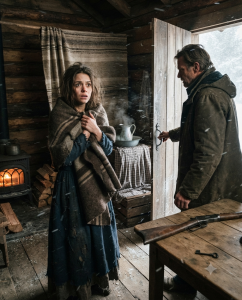
His cabin stood high among the trees where the land turned harsher and the wind stronger. It was built of blackened timber, broad-shouldered and solid against the storm. Inside, heat rolled from a cast-iron stove. The place smelled of pine smoke, iron, soap, leather, and something simmering low in a pot by the fire. Everything was plain, clean, and arranged with practical care. No chaos. No bottles. No filth.
Abigail hated how much that unsettled her. Monsters were easier to survive when they looked the part.
She stood just inside the door, wet with melting snow, and watched him bank the fire. Then he turned and said, “Take off everything.”
Terror hit her so fast she stopped breathing.
Her hands flew to the edge of her torn skirt. Every ugly lesson the world had taught her about men, power, and helplessness rushed in at once. She had just been sold. Bought. Transported. The horror of what came next felt so obvious she could already taste it.
Silas took one step closer and stopped.
His gaze fell to her wrists.
The skin there was raw and swollen, marked deep where the ropes had been twisted too tight. His face changed. The temperature of the room seemed to drop, though the fire was hot enough to sting her frozen cheeks.
He crossed the cabin without another word, took down a heavy wool blanket, and hung it across a line to divide the room. Behind that makeshift curtain he placed a basin of steaming water, a fresh bar of soap, a flannel nightdress, wool stockings, and a thick towel.
He kept his back turned.
“Your clothes are frozen through,” he said quietly. “If you sleep in them, you’ll be hurting by morning.”
Abigail could not make sense of him.
Then she saw the rifle leaning beside the table.
And the key.
Silas set the key next to the rifle where she couldn’t miss it. The small click of metal on wood carried through the room.
“If you don’t trust me,” he said, already moving toward the door, “lock it after I leave. Keep the rifle.”
He opened the door. The storm crashed inward.
Abigail stared at him.
He looked back only once. “I didn’t buy you to own you.”
Then he stepped outside and closed the door behind him.
For several stunned seconds she couldn’t move.
Then instinct took over. She locked the door. She washed behind the blanket with shaking hands. The hot water turned gray with road grit and thawing fear. When she finally looked at her wrists in the steam, she flinched. The rope burns were worse than she’d thought.
Wrapped in the blanket, she sat by the table with the rifle across her lap and listened to the storm throw itself against the cabin.
Sometime after midnight, voices cut through the wind.
Male voices.
Near the porch.
Abigail stiffened, lifting the rifle. At first she could only make out fragments.
“Paid too much—”
“She’s worth more than that—”
“Town’s been patient long enough—”
Then one line came clear enough to stop her heart.
“Once the weather breaks, we take what’s ours.”
Abigail moved toward the door in silence, the rifle trembling in her hands.
Before she reached it, another voice answered from just outside.
Silas.
Low. Calm. Deadly.
“Take one more step toward that door, and Red Hollow buries three men come spring.”
The porch fell silent.
A few muttered curses followed, then crunching footsteps retreating through snow.
Abigail didn’t sleep after that.
At dawn she cracked the door open and found Silas seated on the porch rail, dusted white with snow, rifle across his knees. He had spent the night outside in the storm while she sat warm within, armed against him.
He stood when he saw her, but he did not come inside.
“They know who you really are now,” he said.
Abigail stared at him through the gap in the door. “What does that mean?”
Silas reached into his coat and slowly withdrew a folded scrap of paper. “Found this under my wagon after the auction.”
She unfolded it.
Your mother kept the ledger. The girl doesn’t know where.
The words made no sense at first. Then they made too much.
Her mother, Eleanor Mercer, had been careful in ways Abigail had never understood while she was alive. She distrusted generosity from town officials. She burned certain letters without reading them twice. She taught Abigail never to discuss family business near open windows. And in her final fevered days, she repeated one warning so often Abigail had thought sickness was speaking for her.
If kind men arrive quickly, don’t believe the kindness.
Abigail looked up from the note. “What ledger?”
Silas held her gaze. “Twenty years ago, your mother learned what Red Hollow’s leaders were doing. Land seizures. false debts. payments made in names that didn’t exist. They used bad seasons and grief to strip people clean, then split the profit through the council and the church fund so it all looked lawful.”
Abigail went cold despite the fire behind her.
“No.”
“It’s why families kept leaving with nothing. Why widows signed papers they couldn’t read. Why your father was never allowed to pay ahead, no matter how much grain he sold.”
She wanted to deny it. Wanted to call him a liar and shut the door. But memory had already started rearranging itself into something uglier. Mayor Tully offering help that never helped. The reverend insisting records were in order. Her mother snapping once—only once—when Abigail asked why they couldn’t just ask the council for mercy.
Mercy from thieves, Eleanor had said, then covered the sentence too late.
“Why didn’t my mother tell me?” Abigail whispered.
“Because if they knew you knew, you’d be dead already.”
The truth hit hard enough to make her grip the latch.
Silas continued, “She made a copy. A full ledger of names, dates, amounts, land transfers. She hid it. Only two people knew where she meant to hide it.”
Abigail looked up.
“Her,” Silas said, “and me.”
That should have terrified her more than anything else. Instead, a smaller detail tore through her first.
“You knew my mother?”
His face tightened with old regret. “Before your father drank himself blind, Eleanor and I were friends. Close ones.”
Not lovers, Abigail thought immediately, though the possibility flashed through her. Something steadier. Something built before damage. It explained the note. It explained his presence in the square. It explained why he’d looked sick, not satisfied, while she stood on that platform.
“Why didn’t she come to you?” Abigail asked.
“I offered. More than once.” His voice roughened. “She said coming near me would only make them move sooner. She thought she still had time.”
Outside, wind moved through the pines with a long mournful sound.
Abigail opened the door wider and let him in.
That was the first choice she made for herself in two days.
Over black coffee and a breakfast she could barely taste, Silas told her what Red Hollow had become while she was busy surviving it. Men in office working with traders from three counties over. Land taken under debt law, then sold cheap through relatives and shell names. A network dressed up as order. Eleanor Mercer had discovered enough to ruin them if the records were exposed. When she realized she was being watched, she copied everything by hand and hid the proof.
Then she died before she could retrieve it.
“They thought the papers died with her,” Silas said. “When they couldn’t find them, they started tightening the debt around your house. Waiting. Watching to see if she had told you where to look.”
“And the auction?”
Silas’s mouth hardened. “A trap. Public enough to frighten you. Humiliating enough to break you. They expected whoever bought you to pressure the answer out. When I bid, I ruined their plan.”
Abigail stared into her cup. The square, the crowd, the legal language, the smirks—none of it had been random cruelty. It had been strategy.
A knock came at the door before noon.
Three men stood outside when Silas opened it: Mayor Tully, Reverend Pike, and Harlan Keene, who served as clerk and kept most of the town records. Their smiles were measured, their coats expensive, their eyes sharp with calculation.
“We came to ensure Miss Mercer is settling in acceptably,” the mayor said.
Abigail stayed seated at the table but looked each of them in the face, one by one. For the first time she saw it clearly: not concern, not discomfort. Hunger.
Reverend Pike folded his hands. “These circumstances were regrettable, child. But lawful. Still, now that emotions have cooled, perhaps there is a more merciful arrangement to discuss.”
Silas said nothing.
That silence unsettled them more than anger would have.
Keene’s gaze drifted around the cabin. “Any family papers among your belongings, Abigail? Personal effects? Items of your mother’s? We would be happy to safeguard them.”
Safeguard. Another clean word.
Abigail thought of the note. Thought of her mother’s warning. Thought of the men outside in the storm last night.
“I have nothing of value for you,” she said.
Mayor Tully smiled thinly. “I wonder whether you know the value of what you have.”
The room changed.
Nobody moved, but all politeness dropped away like a stage curtain.
Silas stepped forward half an inch. That was enough to make the reverend swallow.
Tully recovered first. “The town can still show grace,” he said. “There are debts that vanish when cooperation appears.”
Abigail rose from the table slowly. “You sold me in front of children.”
No one answered.
She went on, voice steadier than she felt. “You called it lawful. So don’t come to me wearing mercy now.”
For a second, hatred flashed plain and unguarded across Keene’s face. Reverend Pike glanced at him sharply, worried the mask had slipped.
Tully adjusted his gloves. “You’re upset. Understandably. We’ll return when you’ve had time to think.”
As they turned to leave, Abigail said, “Did my mother beg too?”
The mayor paused but did not look back.
When the door shut, Silas exhaled once. “They’ll move faster now.”
“Then we move first.”
He studied her with something close to respect. “You remember anything? Anything strange your mother said?”
Abigail closed her eyes.
For several minutes there was nothing but fragments. Her mother hiding letters in flour sacks. Her mother once forcing Abigail to help scrub soot from the hearth stones after a storm. Her mother saying, angry and distracted, that some things survived best where honest people looked least.
Then it came.
Not a sentence. A picture.
Her mother kneeling at the old farmhouse hearth with a loose brick beside her and black ash on both hands.
Abigail opened her eyes. “The hearth.”
They rode down at dusk to what remained of the Mercer property. The house stood abandoned and half-gutted, windows broken, roof sagging, the yard buried in drifted snow. It looked less like a home than a memory the weather had been chewing on.
Inside, the air smelled of damp wood and old smoke. Abigail moved through the rooms like someone walking through a wound. Here was the kitchen where her mother used to hum while kneading bread. Here the chair where her father once slept off his debts. Here the narrow hall where Abigail had measured herself against the wall each birthday.
At the hearth, she knelt.
Her fingers shook as she dug into the packed ash and pressed at the bricks. The third from the left shifted.
Behind it, wrapped in oilcloth blackened with soot, was a ledger.
For a moment she could only stare.
Silas took it carefully, but he did not open it first. He handed it to her.
Inside were pages of names, dates, amounts, properties, signatures copied from town records and private books. Mercer. Dunn. Elkin. Haines. Families Abigail knew. Payments charged twice. Acres seized over fabricated fees. Transfers routed through Keene’s relatives, then sold to Tully’s investors. Even the church fund appeared, used to wash stolen money into respectability.
At the back was the worst page of all.
A list of those who objected.
Some had left town soon after. Some had died in accidents. One had hanged himself after losing his farm.
Abigail felt sick. “My mother saw all of this.”
Silas nodded.
“And no one stopped them.”
“Your mother tried.”
Lantern light flickered over the pages. The enormity of it settled like iron inside Abigail. The auction hadn’t been the town’s shameful exception. It had been the cleanest expression of who they’d become.
The floorboard behind them creaked.
Silas turned first.
Harlan Keene stood in the doorway with two men from town, one holding a lantern, the other a shotgun.
“So,” Keene said softly, “the ghost did know.”
Abigail clutched the ledger to her chest. Silas moved in front of her.
Keene’s eyes fixed on the oilcloth bundle. “Hand it over. This still ends quietly.”
Silas’s voice was flat. “No.”
The man with the shotgun lifted it slightly. Not aimed yet, but enough.
Abigail’s pulse hammered so loudly she could hear little else. Then she remembered something from the cabin—the rifle, the key, the way Silas had always offered choice before force. He was not going to decide this moment for her.
So she stepped around him.
Silas glanced back, startled.
Abigail held up the ledger where Keene could see it and said, “You sold me because you were afraid of paper.”
Keene’s expression broke. All that official smoothness vanished, revealing the greedy, frightened thing beneath it. “Your mother should have burned it.”
“My mother should have exposed you.”
He smiled then, but there was no warmth in it. “And who will believe a dead woman’s notes and a girl sold for debt?”
Abigail answered by tearing out the final page—the list of objectors and deaths—and holding it above the lantern flame.
Keene lunged instinctively, shouting, “No!”
That single movement gave Silas the opening he needed. He drove Keene into the wall, the shotgun went off into the ceiling, and the room exploded into smoke, splinters, and screaming. One of the other men fled at once. The lantern dropped and rolled, fire licking across old straw near the hearth.
Abigail didn’t freeze.
She thrust the burning page into her apron pocket before it could catch fully, grabbed the lantern, and kicked snow from the doorway onto the spreading flames. By the time Keene staggered up, coughing, Silas had the shotgun pointed at his chest.
“Done,” Silas said.
Keene looked from the barrel to Abigail. For the first time since she’d known him, he looked afraid.
Not of Silas.
Of her.
The next morning Red Hollow woke to church bells ringing out of schedule.
People crowded into the square again, drawn by alarm and curiosity, the two forces that had always guided the town best. This time Abigail stood on the meeting hall steps by choice, not by rope. Silas stood beside her. Reverend Pike arrived pale as milk. Mayor Tully looked furious enough to choke.
Abigail held the ledger in both hands.
Then, loud enough for every doorway and every second-story window to hear, she began to read.
Names.
Amounts.
Properties stolen.
Widows stripped.
Records altered.
Donations laundered through the church.
Accidents that were not accidents.
At first the town listened in shocked silence. Then voices started. Mrs. Elkin weeping. Mr. Dunn shouting that his brother had lost land under one of those dates. Clara Dunn staring at Reverend Pike like she had never seen his face before. Men demanding to see the pages. Women calling out names of their dead.
The square became something Abigail had never seen in Red Hollow before.
Not fear.
Recognition.
Mayor Tully tried to call it forgery. Harlan Keene tried to push through the crowd and seize the book. Silas stopped him with a hand to the chest that sent him backward onto the frozen mud. Reverend Pike began to pray until someone yelled at him to stop using God’s name like a hiding place.
By noon, the county marshal had been sent for from Grayridge with twenty signed witness statements and half the town ready to testify. Men who had stayed silent for years suddenly found courage once silence stopped being safe. It wasn’t noble, but it was enough.
Tully, Keene, and Reverend Pike were taken before sunset.
The story spread quickly beyond Red Hollow. An unlawful auction was scandal enough. A corruption ring masked by debt law was worse. By week’s end, county officials had sealed the town records office. By month’s end, several land transfers had been reversed and claims were opened for families who had been cheated.
Justice did not arrive pure. It never did. It came mixed with opportunists, late honesty, selfish witnesses, and people eager to stand on the right side only after the ground shifted. But it came.
That mattered.
Abigail returned to the Mercer property in spring. With county compensation and help from neighbors who finally understood what they had allowed, the house was repaired instead of razed. Some offers she accepted. Others she refused. She had learned enough to know guilt and goodness were not the same thing.
As for Silas Boone, the town did not know what to make of him after that.
Some called him a hero.
Some called him dangerous still.
Both were probably true in different ways.
He never asked Abigail for gratitude. Never reminded her what he had paid. Never used the rescue as a debt of his own. He helped mend the roof, chopped wood without speaking much, and left before supper often enough to keep gossip from inventing too much too fast.
One evening, as the sun burned copper over the ridge, Abigail asked the question that had sat with her since the day of the auction.
“Why did you do it?” she said. “Why spend that money? Why take the risk?”
Silas looked out toward the valley before answering.
“Because your mother once saved my life,” he said. “And because when I saw them put you on that platform, I knew if I did nothing, I’d be helping them kill the last decent thing she left behind.”
Abigail stood quietly beside him.
After a while she asked, “And if I had locked the door and told you never to come back?”
His mouth shifted, almost a smile, though there was sadness in it. “Then I’d have slept in the snow until you were safe anyway.”
Years later, people still argued over what the biggest scandal in Red Hollow had been. The ledger. The land theft. The church corruption. The public auction.
Abigail thought they were all wrong.
The biggest scandal was simpler.
An entire town had watched a young woman be sold and found a way to call it lawful.
One man everyone feared had been the only one willing to stand up and make it stop.
That truth stayed with her longer than anger did.
So did another harder question:
How many monsters had Red Hollow invented over the years just to avoid facing the ones it trusted?