“Please, take this shy virgin bride.”
The words were so ugly, so casually spoken, that for a second Gideon Holt thought he had heard wrong.
The mountain town of Cooper’s Crossing had never been a place of mercy. It was a place where men arrived with dreams and left with debts, broken fingers, and a permanent suspicion in their eyes. The streets were not really streets at all, only trenches of mud churned by boots, wagon wheels, and desperation. The buildings leaned like tired old drunks, and every doorway seemed to hold either a gambler, a prospector, or a widow trying not to be noticed.
Gideon hated all of it.
He only came down from the mountain twice a year, and only because a man couldn’t trap beaver, hunt elk, and live through winter without salt, ammunition, coffee, and a few things he could not make himself. He sold pelts, bought supplies, spoke as little as possible, and left before anyone decided to ask questions about his scar, his solitude, or his temper.
On that October afternoon, he was inside Cooper’s Mercantile laying a bundle of fresh pelts on the counter. The store smelled of lamp oil, flour, leather, and damp wool. Outside, the sky hung low and gray. Snow would come soon in the higher elevations. He wanted to be back on the trail before dark.
Then the argument at the front of the store sharpened enough to cut through his indifference.
“I owe you fifty dollars, Boyd,” an older man said, voice shaking. “Not the girl. She don’t belong in it.”
Gideon recognized the speaker without looking. Uncle Jeb. A failed miner with a weak back, a strong thirst, and the sour face of a man who had borrowed too often and worked too little.
Boyd answered in the easy tone cruel men used when they already believed they had won. “You don’t have fifty. Your lot’s gone. Your tools are gone. Your word was worthless months ago. But I’m a generous man, Jeb.” He let the pause stretch. “Give me the girl and I’ll wipe the debt clean. I’ll even put twenty dollars in your hand.”
There was a low laugh from somewhere near the doorway. Someone else muttered that it was a fair trade.
That was when Gideon turned.
The girl stood beside a flour barrel. She looked no more than twenty, maybe younger. Her dress was washed thin and worn at the sleeves. Her hair had been pinned back carefully, as if someone had once taught her that dignity mattered even when life gave her little else. She was too pale, too slight, too still.
But she was not crying.
That was what pulled Gideon fully into the moment. Most people in that position would have begged, pleaded, shouted. The girl did none of that. She stood like someone who had already learned that panic merely fed the wolves.
Boyd seized her by the arm and pulled her forward.
“She’s young, clean, and quiet,” he said to the room. “What more does a man need?”
Uncle Jeb could not raise his eyes. “She was my brother’s child,” he muttered. “I took her in when they died.”
“And now you’re paying what you owe,” Boyd said. “That’s all.”
Gideon saw the girl’s fingers curl once against her skirt. Just once. The only sign she was still flesh and not stone.
He moved before he had time to decide whether he wanted to.
One moment he was at the counter. The next he was standing between Boyd and the girl.
“Let her go.”
Everything in the room stilled.
Gideon was used to that reaction. At six foot four, broad shouldered, wrapped in a winter coat lined with bear fur, he looked more carved than born. The old scar on his jaw made him seem meaner than he was, and his silence usually did the rest. Men in town called him mountain savage, hermit, brute. He didn’t care. Their opinions stayed below the tree line.
Boyd did not release the girl. “This isn’t your concern.”
“It is now.”
Boyd smiled. It was a reckless smile, but not a foolish one. His eyes flicked to the revolver at Gideon’s side, then back to Gideon’s face. “You planning to buy every girl men owe money on?”
Gideon reached into his coat, took out a leather pouch heavy with gold dust, and dropped it onto the barrel so hard flour jumped.
“There’s eighty dollars in there,” he said. “The debt is covered.”
Boyd stared at the pouch.
Gideon added, “And if your hand is still on her when I count to three, I’ll remove it for you.”
Boyd let go.
He did it with an ugly laugh, but he did it.
“Take her, then,” he said. “You’ll learn same as the rest. Weak things become burdens.”
He left with two other men behind him. The room breathed again, though no one looked proud of what they had witnessed.
The old man stepped forward, wringing his hands. “Thank you, sir. Thank you. But if she stays here, Boyd’ll come back. Maybe not today, but soon. And I’m no use against men like that.”
Gideon had no patience left for any of it. “I paid for her freedom. That should be the end of it.”
Uncle Jeb looked miserable. “In a decent place, yes. But this is Cooper’s Crossing.”
Then, lowering his voice, he said the thing that made Gideon want to break the man’s nose.
“If you marry her proper, Boyd won’t dare challenge it. A magistrate’ll make it legal. She has no family name that can protect her. No dowry. No land. Nothing.”
Nothing.
He said it as if listing tools on a shelf. Gideon looked at the girl. She was watching him with steady eyes, and in that steady gaze there was terror, yes, but no begging. No manipulative softness. She was evaluating him. Measuring one danger against another.
“What’s your name?” he asked.
“Clara Bell,” she said.
Her voice was quiet, but clear.
“You willing to go with me?”
A long silence passed. Then she said, “Are you asking, or telling?”
Several men nearby shifted awkwardly. Gideon almost smiled despite himself.
“Asking.”
Her throat moved once as she swallowed. “Then yes.”
Ten minutes later, Gideon found himself in the saloon, signing a marriage ledger on a sticky bar while the magistrate squinted through spectacles and smelled strongly of whiskey. Clara signed beneath him with careful penmanship that looked entirely out of place in that room. Gideon noticed that. A girl taught to write like that had not come from nothing. Somewhere in her past there had been books, lessons, hands gentler than Jeb’s or Boyd’s.
Outside, the wind had sharpened. Gideon loaded flour, coffee, salt, cartridges, and lantern oil onto his mule.
“In spring,” he told her, “I’ll take you to Cheyenne. I’ll buy you a ticket east or west, wherever you choose. I’ll give you money enough to rent a room and start over.”
She stood quietly beside the mule. “And until then?”
“Until then, you stay at my cabin. You eat, keep warm, and stay out of my way.”
“Yes, sir.”
“Don’t call me sir.”
A faint pause. “What should I call you?”
“Gideon.”
The climb out of Cooper’s Crossing began as muddy switchbacks and turned cruel within an hour. Rocks slick with freezing runoff. Roots hidden under leaf rot. Slopes too narrow for a misstep. Gideon was built for it. Clara was not.
Her shoes were fine town shoes, meant for church pews and dry floorboards, not mountain trails. But she said nothing. When she stumbled, she got up. When the wind strengthened, she bowed into it and kept moving. He slowed twice, pretending to check the mule’s load. Both times she closed the distance without complaint.
Near sunset, they stopped under a jut of rock that broke the wind just enough for a fire. Gideon gathered wood while she sank to the ground.
“Take off your shoes,” he said.
She hesitated.
“That wasn’t a suggestion.”
When she did, he saw blood at the heel and toe, raw blisters burst open. He fetched salve and linen. She accepted them with a short nod, though he could tell from the tightness around her mouth that the pain was significant.
He heated beans, poured black coffee, and handed her a tin cup.
After a while he asked, “Why didn’t you fight Boyd?”
She stared into the fire. “Because men like him enjoy resistance. It proves they have power.”
“And me?”
Her answer came softer. “Because you didn’t stare at me the way he did.”
He waited.
“You looked at me like a problem you didn’t want.”
That should not have made him ashamed, but it did.
Later, after the fire had burned low and the stars sharpened above the ridge, he lay awake under his blanket and listened to the mountain settle around them. Somewhere during the night he heard her shifting restlessly. Once he thought he heard a muffled cry, but by the time he sat up she had gone silent again.
The next day the weather turned. Snow began before noon, first as scattered flakes, then as a steady sheet. The world narrowed to white breath, white branches, white ground. Clara slipped twice. Once she went down hard enough that Gideon heard the impact from twenty feet ahead. He turned back expecting tears. Instead he found her on one knee, blood on her palm, jaw locked.
“You can ride the mule,” he said.
“That would slow you down on the incline.”
“It wasn’t a debate.”
She looked up at him. “I can walk.”
Something in the way she said it made him let the matter drop.
When they finally reached the cabin at dusk, it stood half-hidden among pines, smoke rising from the chimney, rough-hewn and weathered but solid. Gideon had built it himself twelve years earlier after deciding the company of trees suited him better than the company of men.
Inside were the essentials: a stove, a table, shelves, a washstand, a ladder to the loft, and one bed.
Clara looked at that bed, and for the first time since the store, real fear crossed her face plainly enough to hurt him.
“You take it,” he said at once. “I sleep above.”
Some of the terror left her shoulders. “Thank you.”
That night the storm worsened. The cabin creaked under the force of the wind. Gideon lay in the loft, staring at the rafters. Sometime after midnight, Clara began whispering in her sleep.
“No… don’t… please…”
He went still.
“Uncle, no…”
The words were broken and faint, but they stripped something raw open in the dark.
In the morning, she was awake before him, trying to light the stove.
“You should have stayed in bed,” he told her.
She drew back as if she had done something wrong. “I thought I should be useful.”
Useful.
Like payment. Like property. Like a bargain somebody might regret.
He was about to answer when the mule outside let out a sharp, ugly bray.
Gideon crossed to the window.
Tracks.
Men’s tracks, multiple, fresh in the snow.
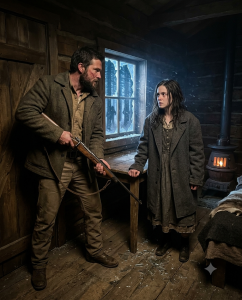
His body tightened all at once. He took the rifle from above the door.
Clara saw it and went pale. “What is it?”
“Stay away from the window.”
“Is it Boyd?”
He didn’t answer because movement flickered low among the pines. More than one shape. Men using the trees for cover.
Gideon banked the fire, dimmed the lamp, and checked the rifle chamber. “How many bullets can you load?”
She blinked. “Excuse me?”
“Can you load a rifle?”
“My father taught me before he died.”
That surprised him less than it should have. “Good. Stay low. Do exactly what I say.”
A fist struck the cabin door.
Once.
Then again, harder.
Boyd’s voice carried through the wood. “Open up, mountain man. We only came to speak.”
Gideon moved Clara behind the table and shifted a second rifle toward her. “If anyone comes through that door who isn’t me, you shoot.”
Her fingers trembled when they closed around the stock, but her eyes did not.
Another bang shook the hinges.
“You bought what wasn’t yours,” Boyd called. “That girl belongs in town.”
Gideon’s voice was flat. “You have until I count to five to leave my land.”
Laughter outside.
Then the window glass exploded.
One of Boyd’s men tried to climb through. Gideon fired once. The man dropped backward into the snow with a scream. Everything erupted at once—shouting, boots, gunfire, splintering wood. Clara ducked low, hands over her ears for half a second before forcing herself back into motion.
“Reload,” Gideon barked.
She moved instantly, more by instinct than calm. He fired again through the door as it shuddered under a shoulder slam. Another man cursed outside. Boyd yelled for them to circle the cabin.
“They’ll try the back,” Clara said.
Gideon looked at her sharply. She was pale as candle wax but thinking clearly.
He jerked his head toward the rear wall. “Watch it.”
Seconds later the latch on the back window lifted.
Clara swung the rifle up just as a face appeared in the opening. She squeezed the trigger. The shot went wild, hitting the frame, but the man vanished with a shout anyway.
Gideon gave a short nod. “Good.”
The attack lasted less than ten minutes, but in a small cabin, with every strike of wood and gunshot echoing off the walls, it felt like an hour. Then, suddenly, silence.
Not true silence. Just the kind that comes when men retreat far enough to stop dying.
Gideon waited, listening. Snow hissed against the roof.
At last he cracked the door just enough to look. Blood marked the drifts near the porch. One man lay motionless by the woodpile. Another trail showed somebody had been dragged or had stumbled downhill. Boyd was gone.
When Gideon barred the door again, Clara was standing exactly where he had left her, rifle still in hand, knuckles white.
“It’s over,” he said.
She set the rifle down carefully, as if her fingers had forgotten how to release it. Then all the strength went out of her at once. He caught her before she hit the floor.
She was shaking violently.
“You’re safe,” he said, and instantly knew how foolish the words sounded. Safe was not something her life had allowed often enough to be believed.
Still, she pressed her face against his coat and breathed like someone resurfacing from deep water.
He stood there, one arm around her shoulders, not knowing when simple protection had begun to feel personal.
The next three days passed under storm and watchfulness. Boyd did not return, but Gideon knew men like him rarely accepted humiliation quietly. Clara helped patch the broken window, cooked beans and biscuits, and cleaned the rifles without being asked. In the evenings, she read from an old Bible Gideon kept on a shelf not from faith but from his mother’s memory.
Her reading voice changed the room.
On the fourth day, while cutting kindling, Gideon asked, “Where did you learn to write like that?”
She stood still a moment. “My mother was a schoolteacher in Missouri.”
“What happened to them?”
“My parents died of fever six years ago. Uncle Jeb was my father’s brother. He said he’d take me west and keep me safe.”
The bitter smile she gave after that needed no explanation.
That night, more truths came.
Not in one flood, but in pieces. The way painful things often emerge.
Jeb had not sold her the first time. He had only threatened to. Then apologized. Then borrowed against her future in smaller, uglier ways—forcing her to serve drunken boarders, letting men stare too long, warning her to smile because they were paying customers. Boyd had been the worst of them all because he wanted ownership, not merely access.
When Clara finished speaking, Gideon’s hands were clenched so tightly his scar ached.
“You should’ve killed him in the store,” she said quietly.
He looked up.
She wasn’t being dramatic. She was simply telling the truth as she saw it.
Two days later, Boyd returned.
Not with gunfire this time.
With the sheriff.
Gideon disliked the sheriff on sight. A soft-bellied man with clever eyes and a badge that looked more rented than earned.
“Complaint’s been made,” the sheriff said at the door. “Boyd claims the marriage was coerced and the girl was taken against family interest.”
“Family interest?” Gideon repeated.
Boyd stood just behind the sheriff with a bruised cheek and righteous anger painted over his greed. “I’m only trying to see the girl restored to proper care.”
Clara appeared beside Gideon before he could answer.
“I’ll speak for myself,” she said.
The sheriff frowned. “Miss, are you being held here?”
“No.”
“Did this man force you to marry him?”
“No.”
“Do you wish to return with your uncle?”
“No.”
Boyd cut in. “She doesn’t understand what’s best for her.”
Clara turned then, and whatever had once made men mistake her silence for weakness was gone.
“What’s best for me?” she said. “You tried to buy me in a general store.”
Boyd flushed. “You ungrateful little—”
Gideon stepped forward. “Finish that sentence.”
The sheriff raised a hand quickly. “Enough.”
But Clara wasn’t finished.
“My uncle traded my safety for drink and debt. Boyd offered money for my body. The magistrate witnessed the marriage. If you drag me anywhere, Sheriff, you’ll be doing it after telling this whole county you think a signed wife belongs to whichever man bids highest.”
The sheriff’s expression shifted. Not toward morality. Toward caution. Public disgrace mattered to him more than justice ever would.
He cleared his throat. “Seems the lady has stated her preference.”
Boyd stared at Clara as if seeing her for the first time. Not as quiet merchandise. As a witness. A threat.
That was the real turning point.
After they left, Gideon secured the door and stood with his back to it for a long while.
“You didn’t have to call yourself my wife like that,” he said at last.
Clara folded her hands. “I know.”
“Then why did you?”
She held his gaze. “Because somewhere between the store and this cabin, it stopped feeling like a lie meant only to keep me alive.”
He had faced blizzards, bear charges, avalanches, and gunfire. Nothing had ever struck him as cleanly as those words.
Winter deepened around them. Days became rhythm: chopping wood, mending traps, cooking, reading, silence that no longer felt hostile. Gideon taught Clara how to snowshoe. Clara taught Gideon that coffee need not taste like boiled regret if one measured it properly. They laughed once over a ruined batch of biscuits, then both went quiet in surprise, as though laughter were a dangerous luxury.
In late February, Gideon rode into town for supplies and returned with news.
Uncle Jeb had died in a ditch behind the saloon.
Clara sat very still when he told her. At length she asked, “Was he alone?”
“Yes.”
She nodded once. “He was less cruel than weak. Sometimes that does worse damage.”
Gideon sat beside her on the bench but did not crowd her. After a while she leaned into him of her own accord.
By spring, the mountain had begun to thaw. The trail to Cheyenne would soon open.
Gideon waited three days before speaking of it. “I meant what I said,” he told her. “When the roads clear, I’ll take you down. I’ll pay your fare anywhere you choose.”
Clara was kneading bread. She kept working.
“And if I don’t want to go?”
The question tightened his chest. “Then I suppose you don’t.”
She wiped flour from her hands and turned to face him fully. “Gideon, when you paid Boyd, I thought you were a harder kind of cage. When you married me, I thought you were a storm I might survive. When we reached this cabin, I told myself all I had to do was endure until spring.”
He didn’t move.
“But spring is here,” she whispered, “and I am not enduring anymore.”
He crossed the room slowly, as though any sudden movement might break the moment beyond repair. “Clara…”
“I know what this marriage began as,” she said. “I know what the town would say. I know what’s written on paper and what isn’t. But I also know who stood between me and men who would’ve destroyed me. Who gave me space when he had power. Who never asked for what the law said he could take.”
Her voice faltered, then steadied.
“So if you send me away because you think that’s mercy, say it plainly. But don’t send me away because you still believe I’m furniture.”
Something shifted in his face then, some old restraint finally worn through.
“I was trying to make sure you had a choice,” he said.
She stepped closer. “I do. I’m making it.”
When he kissed her, it was careful at first, like touching something he had no right to break. Then she lifted a hand to his scarred jaw, and all the quiet between them became something warmer, stronger, no longer fear and not yet peace, but the beginning of both.
They remarried that summer in Cheyenne, properly this time, before a minister who did not smell like whiskey. Clara wore a blue dress she chose herself. Gideon bought a ring too plain for town women and too good for a mountain man, and she wore it like it had always been waiting for her hand.
Boyd left Cooper’s Crossing before autumn. Some said he headed north after a card game ended badly. Some said he ran because too many people in town had started repeating Clara’s version of events instead of his. The sheriff remained, as cowards often do.
Gideon and Clara returned to the cabin before the first frost. They added a second room before winter. Then a porch. Then, one year later, a cradle Gideon built with rough hands and sanded smooth three times because he could not bear the thought of anything sharp touching what was theirs.
People in town called the story a rescue. Others called it luck. A few called it scandal turned respectable.
Clara called it something else when the fire burned low and snow pressed soft against the window.
“A door,” she told Gideon once, resting her head against his shoulder. “It was a terrible door. But it opened.”
And maybe that was the hardest truth of all.
A woman had been traded like property in a muddy store. A man who wanted no part of anyone’s life had stepped in out of anger more than virtue. Neither of them had chosen the beginning.
But they chose everything after.
And depending on who hears that story, the question never quite dies: was Gideon saving Clara that day in Cooper’s Crossing… or was Clara the one who finally dragged a lonely mountain man back into a life worth living?