Estate sales are strange places for lonely people.
Some visitors come for bargains. They drift through old homes with coffee in paper cups, hunting for dressers, lamps, silverware, anything solid enough to carry into a new life. They talk about “good bones” and “a great find,” pretending objects can be separated from the people who once used them.
But lonely people come for different reasons.
They come because grief leaves traces. A coat still hanging by the back door. A cookbook split open at a favorite recipe. A sweater folded in a drawer that still smells faintly of perfume and laundry soap. Lonely people stand in those rooms and feel, for a moment, that objects know more than the living do. That a house left half-empty might still whisper the truth if someone quiet enough stepped inside.
Rachel told herself she was there for practical reasons.
Her daughter needed a dresser. The cheap particleboard one in their apartment leaned badly to one side, and one drawer came off the track every time Daisy pulled it open too fast. Rachel had been meaning to replace it for months, but meaning to do something and being able to afford it were two completely different things.
So when she saw the handwritten ESTATE SALE sign outside a pale brick house on a Saturday morning, she turned into the driveway.
That was the practical reason.
The less practical reason was harder to admit.
At thirty, Rachel was divorced, overworked, and tired in a way sleep no longer fixed. Her world had shrunk into bills, school pickup, apartment hunts, lunchboxes, and careful budgeting. She and Daisy had moved twice in eighteen months. Every new place felt temporary, like a stage set for a life that belonged to sturdier people.
A family home, even one shadowed by recent death, still had something her life lacked.
Weight.
History.
A sense that someone had stayed long enough to leave marks.
Daisy bounced beside her on the walkway, humming to herself. At five, she still saw every errand as a possible adventure. Rachel envied that more than she liked to admit.
Inside, the house smelled faintly of wood polish, old books, and flowers that had passed their prime. Tables were arranged with careful order: dishes wrapped in newspaper, lamps with price tags looped around the necks, stacks of folded blankets, framed pictures turned face-down out of respect or discomfort. Shoppers moved with lowered voices. No one said it directly, but everybody knew they were walking through the remains of someone’s life.
The man taking payments stood near the dining room archway.
Rachel noticed him before he noticed her.
Tall, lean, mid-forties. Dark sweater despite the warmth outside. He had a handsome face made harsher by exhaustion, the kind of exhaustion that rearranges a person from the inside out. No wedding ring. But his left hand flexed every so often, a private reflex, as if remembering the missing pressure of one.
He wasn’t chatting with customers. He wasn’t smiling or making small talk about antiques. He looked like a man forcing himself to stand upright while strangers priced his memories.
This had to be his house.
Or had been.
Rachel gave him a small, polite nod before steering Daisy upstairs.
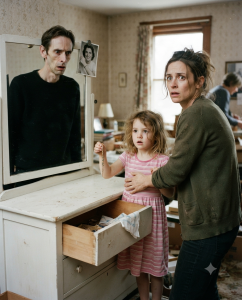
Near the landing, in a small bedroom with faded wallpaper and a window overlooking the side yard, sat a white dresser. It was scuffed in places, but solid wood, with rounded knobs and a mirror attached to the back. Child-sized. Sturdy. Exactly right.
Daisy ran to it immediately. “Mommy, this one!”
Rachel smiled. “Maybe. Let me see the drawers.”
A voice behind her said, “That belonged to my wife.”
Rachel turned, startled. It was the widower.
Up close, he looked even more strained. Not just sad. Guarded.
“I’m sorry,” Rachel said quickly. “We can look at something else.”
He shook his head. “No. It’s for sale.”
The words were simple enough, but his face said something else entirely. Selling and letting go were not the same thing. Maybe they never would be.
Before Rachel could respond, Daisy opened the top drawer.
Children reach into old places without fear. They don’t know the adults around them have learned to be afraid of what might still be there.
Daisy pushed aside the paper liner inside and gasped. “Pretty!”
Rachel turned.
In Daisy’s hand was a gold bracelet with tiny blue stones circling the clasp.
The reaction from the widower was immediate and terrible.
His face drained of color so fast Rachel felt it in her own chest. He took one step forward, then stopped as if he had just seen something crawl out of a grave.
“Where did you get that?” he asked.
Daisy shrank a little at his tone. “In the drawer.”
“No.”
The word came out rough and disbelieving.
Rachel instinctively moved between him and her daughter. “She didn’t mean anything by it.”
He wasn’t looking at Rachel. He wasn’t even looking at Daisy.
He was looking at the bracelet.
“I buried that with my wife,” he said.
For a beat, Rachel honestly thought she had misheard him.
The room went very still.
The widower pressed a hand to his mouth, then lowered it. “I fastened it on her wrist myself.”
Daisy’s eyes widened. “Then why is it here?”
No one had an answer.
Rachel took the bracelet gently from her daughter and examined it. It was real gold, old-fashioned, delicate. On the inside clasp was an engraved date:
April 14.
The sight of it unsettled her more than it should have. April 14 was her own private wreckage date — the day her husband had left. Not with a dramatic fight. Not even with enough guilt to sound convincing. He had simply decided the life they built no longer suited him and walked out before dinner, while Daisy napped in the next room.
Rachel had learned that day how quickly a home could stop being a home.
She told herself the date on the bracelet meant nothing. A coincidence. Just an ugly collision between stranger and memory.
Then Daisy looked toward the mirror attached to the dresser and whispered, “That’s the lady from my dream.”
Rachel followed her gaze.
A faded photograph had been tucked into the top corner of the mirror frame. A woman with loosely pinned brown hair smiled at the camera, caught mid-laugh. Her wrist was raised. The bracelet shone there clearly.
Rachel felt a prickling unease at the back of her neck.
“What dream?” she asked.
Daisy kept staring at the photo. “She was looking for something.”
The widower’s breathing sharpened. “What did she say?”
Rachel almost told him to stop. Daisy had an active imagination. Children dreamed about strangers all the time. They said eerie things because their minds stitched scraps together in ways adults no longer could.
But Daisy wasn’t playing.
“She said not to let him sell the blue box,” she whispered.
The widower went rigid.
Rachel turned toward him slowly. “What blue box?”
“There isn’t one,” he said too quickly.
Daisy frowned at the photograph. “She said he forgot where she put it.”
Rachel’s pulse thudded in her ears. “Daisy—”
“She said if strangers take it, he’ll never know.”
The widower took a step backward toward the hallway closet. His hand was shaking now, not with grief but with fear.
Rachel saw it clearly then.
Whatever this was, it had cracked through something deeper than mourning.
He opened the hall closet and stared into the dark, crowded back corner. Coats. Cleaning supplies. Board games. Old storage bins. Nothing blue.
“It was there before the funeral,” he muttered, mostly to himself.
Rachel’s mouth had gone dry. “What was?”
He swallowed. “A blue velvet box.”
Daisy shook her head. “Not that one.”
The widower turned sharply. “What?”
“You’re remembering the wrong box,” Daisy said.
For a second, the room felt airless.
Then the man rushed down the hall toward the master bedroom.
Rachel should have left. Any reasonable mother would have taken her child and walked out of that house without another glance. But reason had begun slipping the moment the bracelet appeared, and now curiosity pulled almost as hard as fear.
She tightened her grip on Daisy’s hand and followed.
The master bedroom was nearly stripped bare. The bed frame remained, but the mattress was gone. Sale tags hung from the lamps. The dresser drawers had been removed and leaned against one wall. The room looked interrupted, as if its owners had stood up in the middle of living there and never returned.
The widower dropped to one knee beside the bed frame and reached underneath. He shoved aside a flat storage bin, then an old shoe box, then a stack of magazines tied with twine.
“Please,” he muttered. “Please.”
His hand stopped.
Slowly, he dragged out a blue velvet box.
It was larger than Rachel expected. Not a jewelry box. More like a keepsake case. The clasp was already undone.
He stared at it a long time before opening it fully.
Inside were envelopes, a flash drive, several folded documents, and a thick stack of photographs bound with a faded ribbon.
The widower let out a broken sound.
Not grief.
Recognition.
Rachel stepped closer. One envelope lay on top, addressed in feminine handwriting. The widower snatched it up so quickly Rachel only caught part of the front:
IF ANYTHING HAPPENS TO ME—
He covered the rest with his hand.
His face had changed. He looked less like a grieving husband now and more like a man standing on rotten floorboards, realizing too late that the ground beneath him had been weak for a long time.
“What is it?” Rachel asked.
He didn’t answer.
Daisy tugged Rachel’s sleeve. “She said he has to read the pictures last.”
The widower looked at her with naked alarm.
Rachel’s skin turned cold.
Slowly, he opened the envelope.
A letter trembled in his hand. He read only the first few lines before his knees seemed to weaken. He sat hard on the floor.
Rachel shouldn’t have looked, but when the paper tipped, she caught enough.
If you are reading this, then I was right not to trust what I was told about the accident.
The widower’s lips parted.
“Accident?” Rachel repeated.
He looked up at her, and for the first time, the defensive shell around him cracked open completely.
“My wife, Nora, died in a car crash three months ago,” he said hoarsely. “That’s what the police said. That she lost control on wet pavement.”
Rachel glanced at the box. “And she didn’t believe that?”
His jaw tightened. “Apparently not.”
He kept reading. His breathing grew shallower with each line. At last he lowered the page and whispered, “Oh God.”
“What?” Rachel said.
He didn’t answer. Instead, he reached into the box and pulled out the photographs. Remembering Daisy’s warning, he hesitated, then set them aside and grabbed the flash drive instead.
“There’s a laptop downstairs,” he said.
Rachel knew then she had crossed too far into this to pretend otherwise. She should still leave. But some truths drag everyone in the room toward them.
They went downstairs to a small study off the living room. The widower’s hands shook so badly he nearly dropped the flash drive twice. He inserted it into an old laptop on the desk and opened the only folder.
Inside were scanned bank records, screenshots of messages, and copies of emails.
Rachel watched the man’s face as he clicked.
Then she understood why.
The files documented transfers from an account in Nora’s name into another account Rachel didn’t recognize. Large ones. Frequent ones. Hidden over nearly two years.
There were also emails between Nora and a private investigator.
The widower stared at the screen as though each line cut him open.
“She thought I was stealing from her,” he said.
“Were you?” Rachel asked quietly.
He flinched.
That was answer enough.
He sat back, staring at nothing.
“I borrowed from one of her accounts,” he said after a long moment. “At first. Just to cover debt. I meant to put it back.” His laugh was empty. “Then there was more debt. Then business problems. Then lies.” He dragged a hand over his face. “She found out last year. We fought. She said if anything ever happened to her, people should know where to look.”
Rachel looked at him carefully. “Did you tell the police any of this?”
“No.” His voice was dead flat. “I told them we’d been under stress. That was all.”
The implications sat between them, huge and ugly.
Rachel finally said the thing both of them were thinking. “If you hid that from the police, and your wife was investigating her own death before it happened…”
He closed his eyes.
“It makes me look guilty.”
“It makes you look worse than guilty,” Rachel said.
He didn’t argue.
With trembling hands, he picked up the photographs at last.
The first few were harmless enough — copies of documents, pictures of a dent in Nora’s car, an unfamiliar sedan parked near her office, a blurry man in a baseball cap. Then came a photo of the widower himself standing outside a restaurant, speaking intensely to another woman.
Rachel glanced at him.
He went pale. “That’s my sister-in-law.”
The next photo proved it. The woman was Nora’s younger sister, Elise.
But what mattered wasn’t who she was.
It was what she was handing him.
An envelope.
Another photo showed them arguing in a parking lot a week later. Another showed Elise getting into Nora’s car on the day before the crash.
Rachel felt something shift sharply in her mind. “Your wife didn’t think you were having an affair,” she said. “She thought the two of you were hiding something.”
The widower stared at the photos like he had never seen his own life before.
Then he grabbed his phone and dialed a number with frantic urgency.
“Elise,” he said when the call connected. “Come to the house. Right now.”
Whatever answer came through the speaker made his face harden.
“No,” he said. “Not later. Now.”
She arrived twenty minutes later while the last shoppers were loading furniture into their cars.
Elise was in her late thirties, elegant in a controlled way, with Nora’s eyes and none of her softness. The moment she saw the box on the study desk, she stopped.
Her expression gave her away before anyone spoke.
“What is that doing here?” she asked.
The widower stood. “Nora left it.”
Elise’s composure broke for half a second. “That’s impossible.”
“She hid it,” he said. “And she knew.”
Rachel stood by the doorway with Daisy tucked against her side. She hated that her daughter was hearing any of this, but Daisy had gone strangely quiet, as if even she knew the room had become dangerous in a way no child could fix.
Elise looked from the documents to the photographs and finally to Rachel. “Who are you?”
“Someone buying a dresser,” Rachel said.
Elise gave a short, humorless laugh. “Of course.”
The widower held up the letter. “Nora hired an investigator. She documented the money. She documented you.”
Elise’s jaw tightened. “Then you know enough already.”
“Know what?” he demanded.
Elise stared at him in disbelief. “You really don’t?”
He took a step toward her. “Tell me.”
Her eyes flashed. “Nora found out your debts were bigger than you admitted. She found out creditors had started calling around. She panicked. She thought if your finances collapsed publicly, it would destroy both of you.”
Rachel listened, heart pounding.
Elise went on. “She was moving money before you could. Not for herself. To protect it. To protect the house. The insurance. Everything.” She swallowed. “She asked me to help.”
The widower looked stunned. “She thought I’d take everything.”
“You already were.”
Silence.
Elise’s voice turned colder. “Then the week before she died, she told me she was going to confront you with all of it. She said she’d hidden copies in case anything happened.”
Rachel felt Daisy press closer into her side.
The widower whispered, “I didn’t kill her.”
Elise looked at him for a long time. “I know.”
That landed with more force than denial would have.
He blinked. “Then why did you let me think—”
“Because I didn’t know what to believe after the crash,” she snapped. “You lied to police. You hid the debts. You acted like a grieving husband when I knew she had been afraid.” Her eyes filled, but her voice stayed sharp. “And because the last person Nora called before she died wasn’t you. It was me.”
The room held its breath.
“What did she say?” he asked.
Elise’s face changed. Grief finally pushed through the anger.
“She said she was coming home to tell you everything. And if you cried, if you begged, if you promised to fix it, I wasn’t supposed to let her change her mind.”
The widower sank into the desk chair like his bones had dissolved.
Elise looked at the box. “I searched for that after the funeral. I never found it.”
Rachel’s eyes flicked to Daisy.
Daisy, still half-hidden against her mother, whispered, “She said the papers mattered more than the bracelet.”
No one in the room had the energy left to react to that.
The truth, once opened, was already haunting enough.
In the end, the police were called.
The box, the files, the photos, the letter — all of it went with them. Nora’s crash was reopened, though the eventual conclusion was both less dramatic and more painful than suspicion had made anyone imagine. Her brakes had not been cut. No one had followed her off the road. The investigator’s records and the reopened review confirmed what the first report only partly captured: she had been driving in heavy rain, emotionally distracted, speaking to her sister through the car’s audio system just moments before impact. She had hung up, reached for something in the passenger seat, hydroplaned, and hit the median barrier at speed.
No murder.
No grand conspiracy.
Only fear, secrecy, and a marriage already collapsing under the weight of deception.
But the rest of the truth was devastating enough.
Nora had known her husband was draining accounts and lying about the extent of his debt. She had been trying to shield what remained before confronting him. She had hidden proof because she no longer trusted the man she lived with. And after her death, the widower’s silence made everything darker than it needed to be.
Rachel never bought the dresser.
A week later, though, the widower called her. His voice sounded older, stripped down.
He said the police had finished collecting what they needed. He said he wanted Daisy to have the dresser if she still liked it. Free of charge.
Rachel almost refused. The whole thing felt too strange, too heavy. But Daisy lit up when she heard, and in the end Rachel accepted.
When the dresser was delivered, Rachel checked every drawer herself before bringing it into Daisy’s room.
No bracelet.
No hidden notes.
Just wood, polish, and the ordinary smell of old furniture.
Still, some nights she would glance at the mirror and remember the faded photograph of Nora laughing with her hand raised. Remember the blue stones. Remember the way grief had peeled back and exposed something uglier underneath.
Months later, Rachel heard through a neighbor of the house that the widower had sold the property and moved out of state. Elise had cut contact. The debts were public by then. So was the shame. Maybe that was the punishment. Not prison. Not accusation. Just having to live with the knowledge that the woman who loved you had died on her way home to stop believing your lies.
As for Daisy, she mentioned “the dream lady” only once more.
Rachel was tucking her in when Daisy said, sleepy and matter-of-fact, “She’s not looking for the box anymore.”
Rachel paused. “No?”
Daisy shook her head against the pillow. “She said he found what she wanted him to find.”
Then she rolled over and fell asleep.
Rachel stood there in the dark a long time after that.
Because maybe children only absorb more than adults realize.
Or maybe grief really does cling to objects, waiting for the right hands to open the right drawer.
Either way, Rachel never forgot the lesson that house left behind.
The dead do not always return for revenge.
Sometimes they return for the truth.
And sometimes the most unsettling part is not discovering that something impossible happened, but discovering how much damage ordinary betrayal can do before anyone dares to name it.