He called me by a name I haven’t used in forty years.
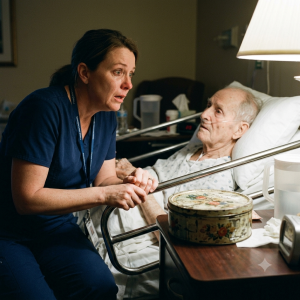
I’m a hospice nurse. I’ve held the hands of hundreds of people at the end of their lives. I know how to stay steady when everything around me is falling apart. I know how to keep my face calm and my voice low and my heart tucked safely behind the professional wall I’ve spent two decades building.
But when that old man whispered those four syllables into the stale air of room 7, my clipboard hit the floor.
Let me back up.
His name on the intake form was Robert Earl Calloway. Seventy-one years old. No listed next of kin. The referring doctor’s notes said he’d driven himself to the county hospital three weeks ago, barely conscious, already in the final stage of liver failure. No one came to visit. No one called.
He was mine for the week.
The first morning I changed his IV line, he grabbed my wrist with more strength than a dying man should have and said, “You need to find the blue tin.”
I thought he was confused. They often are, near the end. I smiled the way I’ve learned to smile — warm but neutral — and I said, “I’ll take care of it, okay? You rest now.”
“Under the floorboards,” he said. “At the farm.”
I wrote *mild confusion, possible memory episode* in the chart and moved on.
But he said it again that afternoon.
And the next morning.
And every single day after that, always the same words, always the same sequence: *the blue tin, the floorboards, the farm.* Sometimes he’d add details. A dented lid. A Danish butter cookie tin, the round kind with the blue flowers, the kind your grandmother kept her sewing things in. He said it was hidden beneath the kitchen floor of a farmhouse out past Billings, on the old Calloway land.
I looked it up on the third day — I don’t know why, something kept nagging at me.
The Calloway farmhouse burned to the ground in 1987.
I told him that, gently, the way you tell a confused elderly man that the thing he’s searching for is gone.
He looked at me with the clearest eyes I’d seen on him all week and said, “It didn’t burn. I made sure of that.”
I didn’t sleep well that night.
On the fifth day, I pulled his birth records from the file the social worker had assembled. Routine, just trying to track down any family who might want to be notified before the end.
And I sat there in the break room for a long time, staring at a name.
My mother’s name.
Listed as the mother of Robert Earl Calloway’s only child — a daughter, born 1974, in Cascade County, Montana.
A daughter whose father had signed away his parental rights in the spring of 1979, six months before her fifth birthday, and simply disappeared.
I know this because that little girl was me.
I sat with that for three days. Three days of walking into his room, doing my job, checking his vitals, adjusting his oxygen, watching his chest rise and fall. Three days of telling myself it was a coincidence. A common last name. A statistical quirk. Montana is small but it’s not that small.
Three days of him whispering about the blue tin.
I never told him my name. Not my real name, not the name I grew up with, not the name I legally changed when I was nineteen because I wanted to bury every trace of the father who hadn’t wanted me enough to stay.
He didn’t know who I was.
He couldn’t know.
Yesterday was his last day.
I could see it when I came in for the morning shift — the particular quality of stillness that settles over a person in those final hours. I’ve seen it enough times to know. I pulled a chair close to his bed and I took his hand the way I do, the way I do for all of them, because no one should leave this world without someone beside them.
His eyes opened one more time.
He turned his head toward me with what must have been enormous effort.
And he said my name.
Not my current name.
The one I buried.
My knuckles went white on the bed rail. My whole body went cold.
He was still talking. His voice was barely a thread, barely a breath, but his lips were moving and I leaned in close — so close I could feel the warmth coming off his face — trying to catch every word.
And what he said wasn’t just my childhood nickname.
He said exactly why I’d changed it.
He said something only one other person in the world has ever known. Something I never wrote down, never said aloud, something I told to exactly one person on one night twenty-two years ago and then never spoke of again.
I don’t know how a dying man in room 7 knew that.
His hand went still in mine.
And on the nightstand, I noticed for the first time — a dented blue tin, the round kind with the painted flowers, sitting right there in plain sight.
I never saw anyone bring it in.
I sat there for a long time after his breathing stopped. That’s not unusual for me. I believe in staying. I believe the leaving deserves to be witnessed all the way to the end, not just up until the moment it gets hard to look at. My coworkers know this about me. No one came to check on us for a while.
The tin just sat there.
Round. Blue. Painted with faded flowers that might have once been cornflowers, or forget-me-nots, or just some generic Scandinavian pattern pressed onto a million identical cookie tins in a factory somewhere. The lid was dented on one side, just like he’d described. The metal had the particular dullness of something that had been somewhere dark and airless for a very long time.
I kept not touching it.
I checked his pulse. I documented the time. I smoothed the blanket over him the way I always do, an instinct I’ve never been able to explain to myself, making someone comfortable after comfort no longer applies. I did every procedural thing I do. And then I sat back down and looked at that tin some more.
Here is what I knew about the secret he had whispered: it was something I had told my college roommate, Deanna, during the winter of my sophomore year, at about two in the morning, in the particular confessional dark of a dorm room when you are nineteen and you feel like the past is finally far enough behind you to say a thing out loud for the first time. I told her about my original name, the name on my birth certificate, and I told her why I’d changed it, which was not just about my absent father but about something that had happened the summer I was sixteen — something I had always been ashamed of, something that intersected with who my father was and who I was afraid I might become.
I had never told another person. Not a therapist, not a husband, not a best friend. Deanna had moved to Portland and we had lost touch the way people do, and I trusted the story was safe in that particular vault of things said in the dark between people who don’t quite know each other well enough anymore to ever bring it up.
Robert Earl Calloway could not have known any of that.
But he had said her name. That was what broke me, sitting there in that room, thinking back through his last words. He had said my old name and then he had said Deanna’s name, and then he had said the thing I told her. In that order. Like a code being read back to me. Like a message written specifically so I would know it was real.
I picked up the tin.
It was heavier than I expected.
The lid required some pressure — the dent had warped it slightly, and it had clearly been sealed for a long time. When it came open it made a sound like a small held breath finally released, and the smell that came out was paper and metal and something faintly sweet, like old cedar.
Inside, folded in a square of wax paper, was a letter.
Not a short one. Six pages, front and back, in handwriting that slanted hard to the left the way left-handed people sometimes write when they’re trying to make their penmanship look normal. I would come to learn that he had been left-handed his whole life and self-conscious about it.
I won’t put everything he wrote here. Some of it is mine and I intend to keep it. But I’ll tell you what he told me, the shape of it.
He had known who I was from the day I walked into his room.
Not because he recognized my face, though he wrote that he had studied it in those first days, looking for my mother in my jaw and his own mother in my eyes, and found both. He’d known because he had been looking for me for eleven years.
He had hired a private investigator in 2012, when a cancer scare had turned out to be benign but had shaken something loose in him, made him understand that time was not the endless supply he’d been spending like he had a surplus. The investigator had found my legal name change, my nursing license, and eventually my place of employment. Robert had driven past the facility twice. He had not gone in.
He wrote that he wasn’t sure he had the right to.
He wrote a lot about rights. About how he had signed his away voluntarily, in a lawyer’s office in Great Falls, because my mother had asked him to and because he had believed, with the particular self-serving logic of a twenty-nine-year-old man who did not want to be a father, that a clean break was a gift he was giving us rather than a wound he was making. He wrote that he had understood his mistake within about three years and had spent the following four decades constructing a very sophisticated internal architecture for not thinking about it.
The cancer scare had knocked that architecture down.
He had not contacted me directly, he explained, because the investigator had told him I had no public record of ever searching for him, no activity on any of the reunion registries, nothing. He took that to mean I did not want to be found. He wrote that he thought he had forfeited the right to override that choice. He wrote that he was probably a coward, and that dressing cowardice up as respect for someone else’s boundaries was one of his oldest tricks, and he wanted to stop doing it, but he didn’t know what the alternative was.
So he had driven himself to the county hospital when he got sick, because he had looked up where I worked, and he knew this was the facility they would likely transfer him to.
He had put himself in my care on purpose.
He wrote that he had not planned to say anything. That his plan, to the extent a dying man making this particular decision can be said to have a plan, was simply to see me. To be tended to by the person he had failed. To let his last conscious weeks be in the presence of the daughter he hadn’t allowed himself to know. He wrote that it sounds insane when laid out plainly like that and he agreed that it probably was.
But then, he wrote, something happened that he had not anticipated.
I was good at my job.
He described watching me work. The way I moved through a room, the particular quality of attention I brought, the fact that I always addressed patients by name when I came in, that I always made sure the light wasn’t in their eyes, that I laughed at the bad jokes, that I did not flinch. He wrote that he watched me and he thought: she became this. She became this person without any help from me at all, and look at what she built.
He wrote that he was proud of me.
And then he wrote that he was sorry, and this part took two full pages and I have read it four times now and I will probably read it forty more. He was not a lyrical man. He was not a man who had spent a lot of time developing the vocabulary for this kind of thing. The apology is plain and a little clumsy and completely specific, and that specificity is what makes it land. He did not apologize for being absent in the general way. He apologized for the concrete things. The fifth birthday. The school pictures no one sent him because he had made sure there was no address to send them to. The particular loneliness, which he could only imagine, of being a teenage girl with a question mark where a father should be.
He apologized for the summer I was sixteen.
He knew about it because he had been there.
Not present, not involved, not in any way I would have recognized. But the investigator, years later, had found the public record of what had happened that summer, and Robert had understood immediately what it had to do with him, what chain of cause and effect his disappearance had set in motion, what door he had left open by leaving. He wrote that he had gone for a walk alone after reading that file and he did not come back inside for a long time.
As for the thing I told Deanna in the dark: he hadn’t known the exact words until he was in that hospital bed, he wrote, and I need you to understand that I am a skeptic. I have watched enough people die to have made my peace with the fact that I don’t know what it means, if it means anything, what happens to consciousness in those last hours. I’ve seen things I can’t explain and I’ve learned to hold them loosely. Robert wrote that he had always been a skeptic too — a rancher’s practical agnosticism, he called it, the theology of someone who has watched enough animals be born and die to stop expecting the universe to be sentimental.
But he wrote that in those last days, lying in that bed, he had felt something he could only describe as information arriving. He wrote that he knew it sounded like the morphine talking. He wrote that he was including it anyway, because he had decided that his last act in this world was going to be honesty, even the embarrassing kind.
He wrote: I don’t know how I knew what I knew. I only know I needed you to believe that I knew you. That I saw you. That whatever it took to reach you, I would have paid it.
Below all of that, tucked in a separate fold of the wax paper, was a document.
A deed.
The Calloway land out past Billings. Forty-three acres, the farmhouse long gone but the land itself intact, transferred into my legal name — my current legal name, which he had known, which the investigator had found — and notarized two weeks ago, just after he was transferred to our facility.
And beneath the deed, a photograph.
Black and white, slightly water-damaged at one corner. A woman I recognized as my mother, young, maybe twenty-two, sitting on a porch step. And next to her, a man I had never seen before, but whose jaw I recognized from the mirror, squinting into the sun with an expression that was trying to be neutral and failing, a man who was clearly, even in a fifty-year-old photograph, trying not to look as happy as he was.
On the back, in that left-handed slant: *June 1973. She used to call this our good summer. I never stopped thinking she was right.*
I closed the tin.
I sat with him a little while longer. I did not feel the things I expected to feel. I didn’t feel the anger I had been carrying since I was old enough to understand what his absence meant, the anger I had assumed would be there if this day ever came. I didn’t feel the closure that people promise you, either. I felt something quieter than either of those. Something that didn’t have a clean name.
I thought about a man who drove himself to a hospital and arranged to die in his daughter’s care because he did not believe he had earned the right to knock on her door. I thought about whether I agreed with him on that point, and I found that I didn’t. I found that I wanted to be angry at him about it. The anger surprised me by feeling almost like tenderness once I examined it — because it meant I thought he should have knocked. It meant some part of me had kept the door.
I went home that morning after my shift and I sat at my kitchen table for a long time.
Then I called my mother.
She is seventy-four. She lives in Arizona now, has for twenty years. We talk every Sunday and we do not talk about him. That has been the arrangement since I was old enough to notice the arrangement existed.
When I said his name, she was quiet for so long that I thought the call had dropped.
Then she said, “Where did you hear that name?”
I told her. All of it. She listened without interrupting, which is not her usual style. When I finished, she made a sound I had never heard from her before — not crying exactly, more like the sound of something that had been held under pressure for a very long time finally finding a way to equalize.
“He found you,” she said.
“He found me,” I said.
Another silence. Then: “He was not a bad man. That’s what made it so hard. He was not a bad man. He was just — not ready. And by the time he was, he’d done the thing you can’t undo.”
She asked if she could see the photograph sometime. I said yes.
She asked if I was all right.
I told her I didn’t know yet. I told her I thought I might be getting there.
I have a week before I have to decide anything about the land. There is a lawyer who needs to be called, paperwork that needs to be processed, a deed that needs to be formally accepted or declined, though declining feels like a kind of theater at this point — like refusing an apology that already landed whether you meant it to or not.
I don’t know what I’ll do with forty-three acres in Montana. I have a life here.