He came in from the rain at 9:47 on a Tuesday night, and Marlene almost didn’t open the door.
She’d already flipped the sign. Already wiped down the counter, tucked the pie domes over the last two slices of peach, and told her feet they could rest soon. The Sunrise Diner in Flagstaff doesn’t stay open for sentiment — it stays open for the breakfast rush, and that’s it.
But something made her pause with her hand on the light switch.
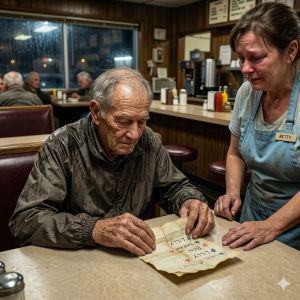
He was standing under the little overhang by the door, not knocking, not trying the handle. Just standing. His jacket was soaked through, the thin kind that doesn’t do much against an Arizona October rain. He was maybe eighty. Maybe older. And he was looking down at something in his hands — a small folded slip of paper — pressing it flat against his palm with his thumb, over and over, like a man trying to keep something from disappearing.
Marlene unlocked the door.
She didn’t make a fuss about it. That’s not her way. She just said, “Back booth’s warm,” and that was that.
His name was Eugene. He told her that much while she heated up what was left from the day — chicken and dumplings, half a pan of cornbread, green beans that had been sitting since noon but were still good. He sat in the corner booth, the one near the old jukebox that hasn’t worked since 2019, and he thanked her three times before she even set the plate down.
She noticed the paper right away.
Every few minutes, he’d take it out of his shirt pocket. Unfold it just partway — never all the way open — and smooth it against the table with that same slow thumb press. The paper was soft at the creases, the kind of soft that only comes from being folded and unfolded hundreds of times. Maybe thousands.
Once, when he tilted it toward the light to read something, Marlene caught a glimpse of the edge. Names. Written in a child’s handwriting, the big loopy letters kids use when they’re still proud of knowing cursive. And next to each name — she thought she saw it, wasn’t sure — something small. A little mark. A shape.
She refilled his coffee and didn’t ask.
Eugene ate slowly and talked about the rain, about how Flagstaff surprised people who thought Arizona was nothing but heat. He talked about a daughter in Phoenix and a son he hadn’t spoken to in years and a wife named Ruth who had loved peach pie specifically, not apricot, not apple — peach. Marlene cut him one of the last two slices without being asked.
The paper came out three more times while he ate.
Each time, he’d unfold it just to that same point — never further — and press it flat. Once his lips moved a little, like he was counting. Once he closed his eyes for just a moment after looking at it, the way you do when you’re holding something too heavy to carry standing up straight.
Marlene had been working in diners for thirty-one years. She knew when someone was carrying a weight that had nothing to do with their coat being wet.
She sat down across from him when he finished. She doesn’t usually do that either.
They talked for a while — about Ruth, about the way the canyon looks in October, about whether the Sunrise’s coffee was better before they switched suppliers (it was, and Marlene will die on that hill). And every so often, her eyes would go back to the paper, now sitting folded on the table beside his plate, one corner lifted slightly in the draft from the kitchen.
Names in a child’s handwriting.
That same careful thumb pressing it flat.
Finally, when the rain had slowed to just a whisper against the window and Eugene had gone quiet in the comfortable way of someone who hasn’t felt safe enough to be quiet in a long time, Marlene asked him.
Not pushily. Just gently, the way you ask someone about something that clearly matters.
“Eugene,” she said. “What’s on your list?”
He looked at her for a long moment.
Then he picked it up. And this time — slowly, carefully — he unfolded it all the way.
She could see the names now. All of them. Eight, maybe ten, written in that big loopy child’s script. And next to every single name, just like she thought she’d seen —
A small hand-drawn star.
His eyes filled before he could say a single word.
And in the moment before he spoke, Marlene understood something. She didn’t know the whole story yet. But she understood why he carried that paper the way he did. She understood why he pressed it flat like it might vanish. She understood why every name had a star beside it.
And she had to press her own hand flat against the table to steady herself.
Eugene set the paper down between them on the table, very carefully, like you’d set down something made of glass.
“My granddaughter made this for me,” he said. “Nora. She was seven.”
Marlene waited.
“Nora had a teacher in second grade — wonderful woman, Mrs. Calloway — who had the kids do this project before Thanksgiving. She asked each of them to make a list of everyone in their life who had been kind to them. She called them their kindness stars. You draw a star next to each person’s name, she told them, so they shine.”
He touched the edge of the paper with one finger.
“Nora worked on it for three days. Ruth told me she’d come home from school, go straight to the kitchen table, and just sit there thinking. Really thinking, the way little kids do when something matters to them. Erasing names and putting them back. Getting the stars just right.”
He smiled at that — the real kind, the kind that lives in old photographs.
“She gave it to me on Thanksgiving morning. Folded it up small and put it in my shirt pocket herself. Right here.” He tapped his chest. “She was so proud. She said, Grandpa, these are all the people who make me feel safe.”
Marlene didn’t say anything. There was nothing to say yet.
“There were nine names on the list. Her mother, her father, her little brother even — she put him on there and then drew a question mark next to the star, which made us all laugh. Her teacher. Her best friend from down the street. Her Sunday school teacher, Mrs. Pham.”
He paused.
“Ruth. She put Ruth on there.” His voice dropped on the name. “My wife.”
He smoothed the paper again with his thumb, that same motion Marlene had been watching all night, and she understood now that it wasn’t a nervous habit. It was something else entirely. It was the way you touch something you are trying to memorize.
“And me,” he said quietly. “She put me on there too.”
He looked up at Marlene.
“I hadn’t been an easy man to be around, some years. I won’t dress that up. I worked too much and I missed things I shouldn’t have missed and there were stretches of time where I wasn’t — I wasn’t what Ruth needed, and I certainly wasn’t what my kids needed. My son Danny, the one I told you about — there’s a lot of history there that I can’t fix now. I’ve tried. He’s not ready. Maybe he never will be.”
He folded his hands on the table.
“So when Nora handed me that paper and I saw my name on it — my name with that little star beside it — I stood in Ruth’s kitchen and I cried in front of everyone. Hadn’t cried in probably fifteen years before that. And I said to Nora, I said, Sweetheart, are you sure you want me on here? And she looked at me like I was the silliest person she had ever encountered in her seven years on earth, and she said, Grandpa. Obviously.”
Marlene laughed, soft and sudden, and pressed her fingers to her mouth.
“Obviously,” she repeated.
“Obviously.” He nodded. “That was four years ago.”
The rain had almost stopped now. There was just the sound of water running off the roof in a thin ribbon, and the hum of the refrigerator case by the register, and the quiet between two people in a warm booth at the end of a hard day.
“Nora passed away in February,” Eugene said. “Eleven years old. A thing with her heart that nobody knew was there.”
Marlene went very still.
“She didn’t suffer. That’s what they tell me, and I believe it because I have to believe it. She just — she went to sleep one night and she didn’t wake up, and that was that.” He exhaled slowly, the way a man does when he’s said a true and terrible thing out loud enough times that he’s learned how to survive the saying of it. “She had just turned eleven. She had a poster of horses on her wall and a half-finished friendship bracelet on her desk and eleven dollars and some change in a little ceramic pig on her windowsill.”
He looked at the paper.
“After the funeral, I started carrying this. Took it out of my bureau drawer where I’d kept it — I’d kept it safe, all those years, in a little cedar box Ruth had — and I put it back in my shirt pocket. Where she put it.”
Marlene’s eyes were wet. She wasn’t fighting it anymore.
“I take it out when I’m having a hard time,” he said simply. “I look at the names. All these people who Nora decided were worth a star. And I think about how she saw the world. How she sat at that kitchen table and really thought about who made her feel safe.” He shook his head slowly. “Seven years old and she understood something that most people never figure out.”
He refolded the paper. Not quickly — with that same deliberate care he’d used all night — and slid it back into his shirt pocket.
“I’m driving to Phoenix tomorrow to see my daughter Carol. Haven’t seen her since the service. We’ve talked on the phone, but.” He shrugged, the kind of shrug that carries a whole year inside it. “It seemed like time. She’s been carrying this too, in her own way. We all have.”
He looked out at the wet street.
“I pulled off 40 because I didn’t want to drive in the rain and I was hungry and I was just — tired. The kind of tired that doesn’t come from driving.”
“I know that kind,” Marlene said.
He looked at her then, really looked at her, and he nodded.
“I think your name would’ve gone on that list,” he said. “If Nora had met you tonight.”
Marlene has told this story maybe a dozen times since then. To her sister in Tucson. To her regulars, the ones who’ve been coming in for years and who know the difference between a story she tells because it’s funny and a story she tells because she needs to say it out loud. To her daughter, who called her on a Sunday afternoon and got an earful.
Every time she tells it, she gets to the same place and she has to stop for a second.
Because what she doesn’t always mention — what she’s still not sure she has the right words for — is what she did after Eugene paid his check and put on his still-damp jacket and said goodnight.
She went back to the booth. Cleared the plate, wiped the table. And then she stood there for a minute looking at the spot where the paper had been.
And she thought about all the people she would put on her own list. Her mother, gone twelve years. Her daughter. The friend who’d sat with her in a hospital waiting room without being asked. The first-grade teacher whose name she still remembered fifty years later — Mrs. Deardorff — who had told her once that she was a very good reader and had apparently meant it in some way that changed the course of things.
She hadn’t thought about Mrs. Deardorff in a long time.
She thought about Nora, who she had never met, sitting at a kitchen table with her tongue between her teeth drawing stars as carefully as she could next to the names of people she loved. Deciding her grandfather belonged on the list. Obviously.
She turned off the lights.
She drove home in the last of the rain.
She told her daughter she loved her when she got in the door, which made her daughter look up from the couch with an expression that was one part confusion and one part the kind of softness that adult children reserve for moments when they catch a glimpse of their parent’s actual heart.
“Love you too, Mom. You okay?”
“I’m good,” Marlene said. “Just had a night.”
Carol, the daughter in Phoenix — Eugene called her from the Sunrise parking lot before he got back on the highway. Marlene knows because he came back inside two minutes after leaving to ask if she had a phone charger he could borrow.
She heard him through the pass-through window while she was getting her coat.
“I’m on my way,” he said. “I know it’s late. I know. But I wanted to hear your voice.” A pause. “I know, honey. Me too.” Another pause, longer. “I have the list with me. I always have it with me.”
Marlene doesn’t know if Eugene and Carol are doing okay. She doesn’t know if he ever finds a way through to Danny. She doesn’t know what it looks like to carry what that family is carrying, or whether it gets lighter, or whether you just get stronger, or whether it’s some of both.
But she knows he got back in his car that night with a warm meal in him and a full phone battery and her second-to-last slice of peach pie in a to-go box on the passenger seat.
Ruth’s kind of pie.
And she knows that somewhere in his shirt pocket was a small piece of paper, soft at the folds, with nine names written in a child’s careful cursive.
Each one with a star.
Each one still shining.